Epimetheus Above the Rings
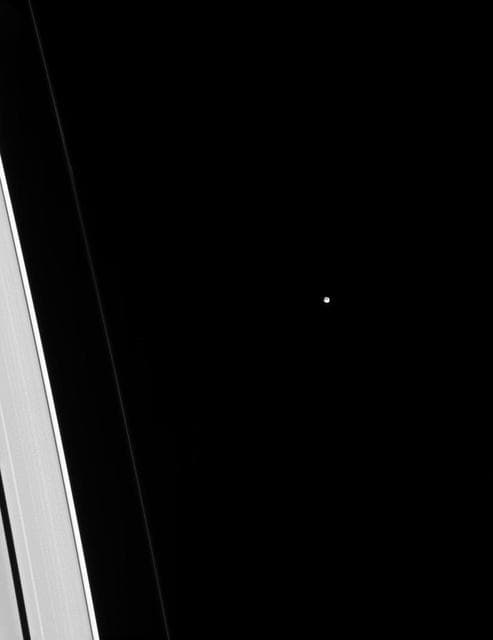
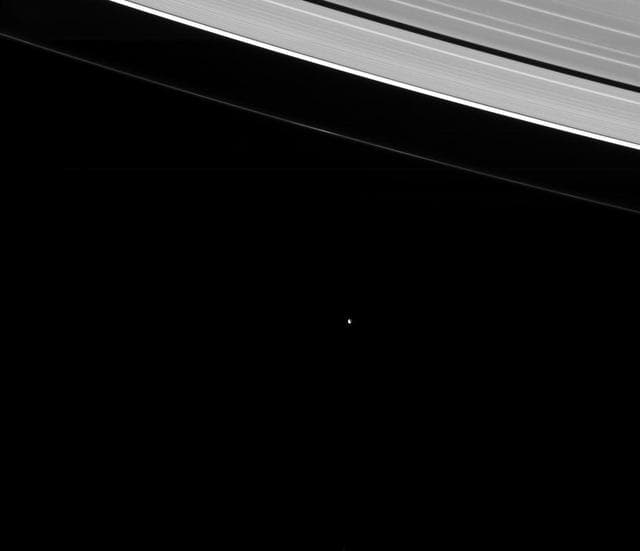
Although Epimetheus appears to be lurking above the rings here, it's actually just an illusion resulting from the viewing angle. In reality, Epimetheus and the rings both orbit in Saturn's equatorial plane. Inner moons and rings orbit very near the equatorial plane of each of the four giant planets in our solar system, but more distant moons can have orbits wildly out of the equatorial plane. It has been theorized that the highly inclined orbits of the outer, distant moons are remnants of the random directions from which they approached the planets they orbit. This view looks toward the unilluminated side of the rings from about -0.3 degrees below the ringplane. The image was taken in visible light with the Cassini spacecraft narrow-angle camera on July 26, 2015. The view was obtained at a distance of approximately 500,000 miles (800,000 kilometers) from Epimetheus and at a Sun-Epimetheus-spacecraft, or phase, angle of 62 degrees. Image scale is 3 miles (5 kilometers) per pixel. http://photojournal.jpl.nasa.gov/catalog/PIA18342
Usage Rights
Most NASA images are in the public domain and free to use. Credit NASA as the source. Check NASA's media usage guidelines for details. Images featuring identifiable individuals may require additional permissions.
Keywords
Details
NASA ID
PIA18342
Date Created
November 9, 2015
Center
JPL
Media Type
image
Downloads
Download this image in multiple resolutions. All NASA media are free for public use.