Deceptively Small
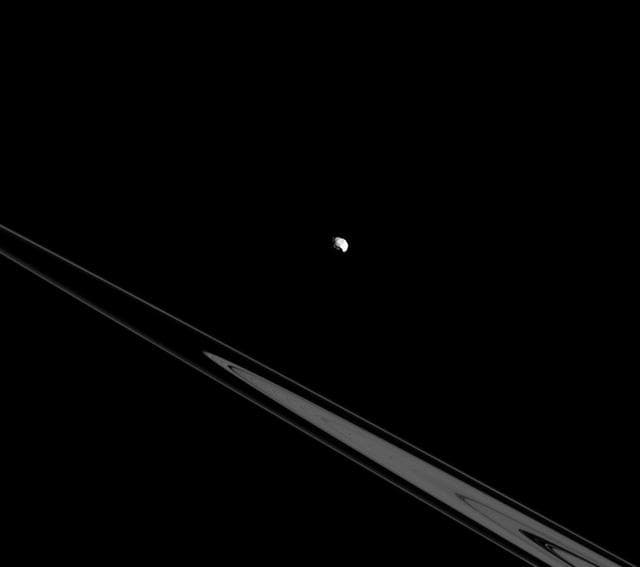
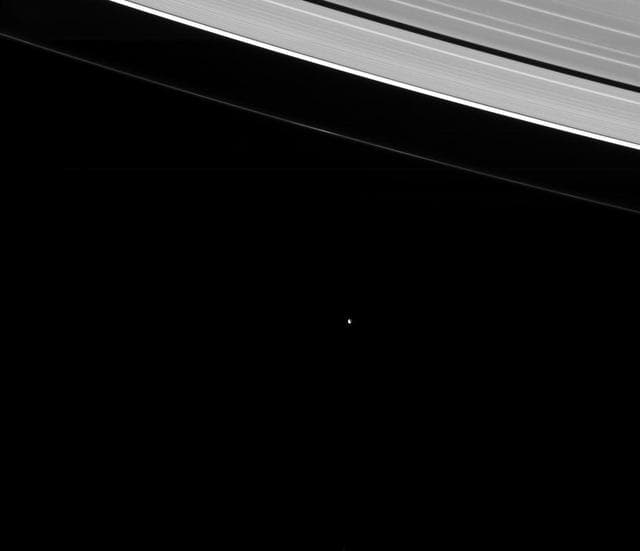
Tiny Epimetheus is dwarfed by adjacent slivers of the A and F rings. But is it really? Looks can be deceiving! There is approximately 10 to 20 times more mass in that tiny dot than in the piece of the A ring visible in this image! In total, Saturn's rings have about as much mass as a few times the mass of the moon Mimas. (This mass estimate comes from measuring the waves raised in the rings by moons like Epimetheus.) The rings look physically larger than any moon because the individual ring particles are very small, giving them a large surface area for a given mass. Epimetheus (70 miles or 113 kilometers across), on the other hand, has a small surface area per mass compared to the rings, making it look deceptively small. This view looks toward the sunlit side of the rings from about 19 degrees above the ringplane. The image was taken in visible light with the Cassini spacecraft narrow-angle camera on Dec. 5, 2014. The view was obtained at a distance of approximately 1.2 million miles (2 million kilometers) from Epimetheus and at a Sun-Epimetheus-spacecraft, or phase, angle of 40 degrees. Image scale is 7 miles (12 kilometers) per pixel. http://photojournal.jpl.nasa.gov/catalog/PIA18302
Usage Rights
Most NASA images are in the public domain and free to use. Credit NASA as the source. Check NASA's media usage guidelines for details. Images featuring identifiable individuals may require additional permissions.
Keywords
Details
NASA ID
PIA18302
Date Created
February 2, 2015
Center
JPL
Media Type
image
Downloads
Download this image in multiple resolutions. All NASA media are free for public use.