CosmosObservatory
Explore
Solar System
Live
Learn
Tools
About
Cosmos Observatory
ToolsAbout
Cosmos Observatory

Explore the universe through NASA data, real-time ISS tracking, Mars rover imagery, asteroid monitoring, and comprehensive space encyclopedia. Your gateway to the cosmos.

Explore

  • APOD
  • Mars Rovers
  • Earth Imagery
  • NASA Gallery
  • ISS Tracker

Data

  • Asteroids
  • Solar System
  • Exoplanets
  • Space Weather
  • Launches

Tools

  • Glossary
  • News
  • Calculators

Legal

  • About
  • Privacy Policy
  • Terms of Use
  • Space Tools
  • Contact

Stay updated with the cosmos

Get weekly digests of APOD highlights, upcoming launches, and space events.

© 2026 Cosmos Observatory. All rights reserved. Built with for space enthusiasts.

This website is not affiliated with, maintained, authorized, endorsed by, or in any way officially connected with NASA or any of its subsidiaries or affiliates. All NASA imagery is in the public domain unless otherwise noted. Data sourced from NASA Open APIs, Launch Library 2, and other open data services.

NASA Gallery

Explore NASA's vast collection of space images, videos, and audio from missions past and present.

  1. Home
  2. /
  3. NASA Gallery

NASA's Image and Video Library: A Visual Archive of Space Exploration

NASA's Image and Video Library is one of the most comprehensive public archives of space imagery in the world, containing over 140,000 images, videos, and audio recordings spanning more than six decades of space exploration. From the earliest Mercury and Gemini missions through the Apollo Moon landings, the Space Shuttle era, and today's cutting-edge observations from the James Webb Space Telescope, this collection documents humanity's journey into the cosmos.

The library includes imagery from diverse sources: telescopes like Hubble and Webb that capture deep-space nebulae, galaxies, and exoplanets; planetary missions like the Mars rovers ( browse Mars photos) and Cassini at Saturn; Earth observation satellites ( see EPIC imagery); astronaut photography from the ISS; and documentation of rocket launches, spacecraft assembly, and ground testing. Most NASA images are in the public domain and free to download at full resolution for educational, editorial, and personal use.

Use the search bar above to find specific subjects — try queries like "Apollo 11," "Hubble Deep Field," "Mars surface," or "astronaut EVA." You can also filter by media type (image, video, or audio). For a daily curated experience, visit the Astronomy Picture of the Day.

Showing results for "STS-1 Launch"

4,674 results found - Page 1 of 195

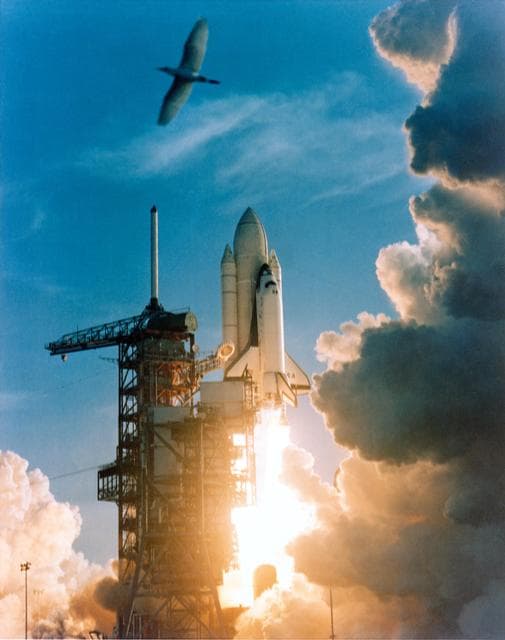
NASA image: STS-1 - LAUNCH - KSC
Image
Apr 15, 1981

STS-1 - LAUNCH - KSC

The Space Shuttle Columbia begins a new era of space transportation when it lifts off from NASA Kennedy Space Center...

JSC
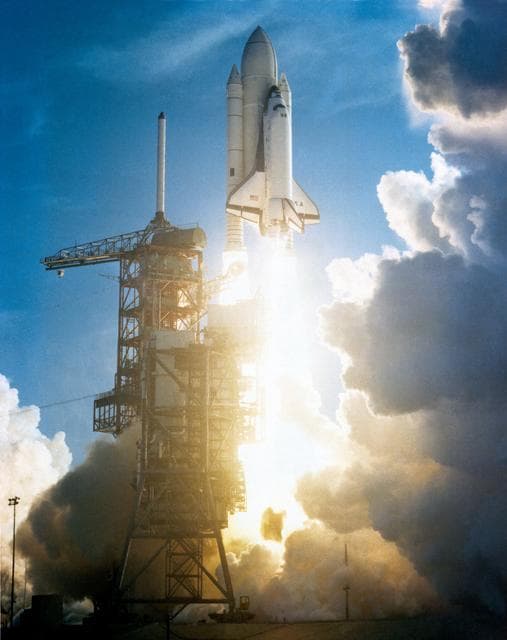
NASA image: STS-1 - LAUNCH - KSC
Image
Apr 15, 1981

STS-1 - LAUNCH - KSC

The Space Shuttle Columbia begins a new era of space transportation when it lifts off from NASA Kennedy Space Center...

JSC
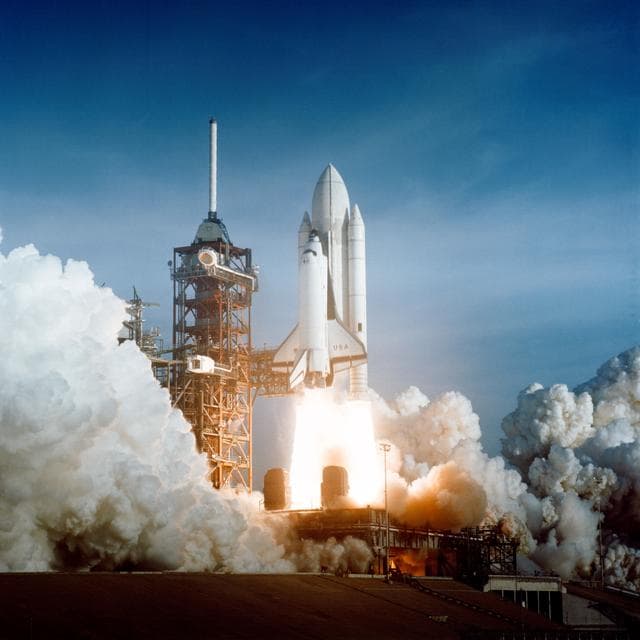
NASA image: LAUNCH - STS-1 - KSC
Image
Apr 12, 1981

LAUNCH - STS-1 - KSC

S81-30498 (12 April 1981) --- After six years of silence, the thunder of manned spaceflight is heard again, as the...

JSC
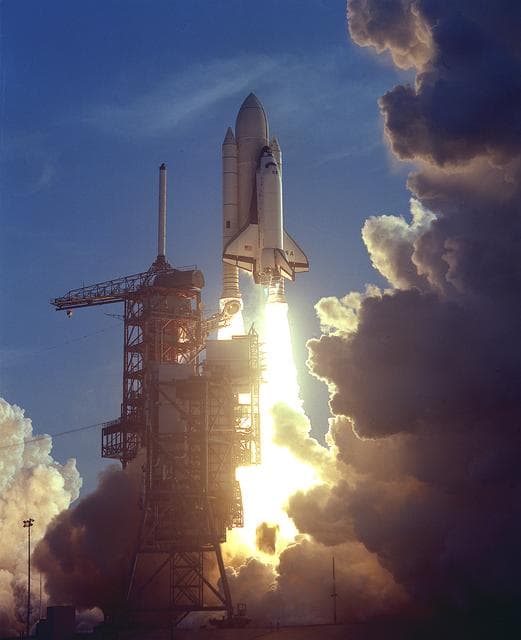
NASA image: Space Shuttle Projects
Image
Apr 12, 1981

Space Shuttle Projects

The new era in space flight began on April 12, 1981. That is when the first Space Shuttle mission (STS-1) was...

MSFC
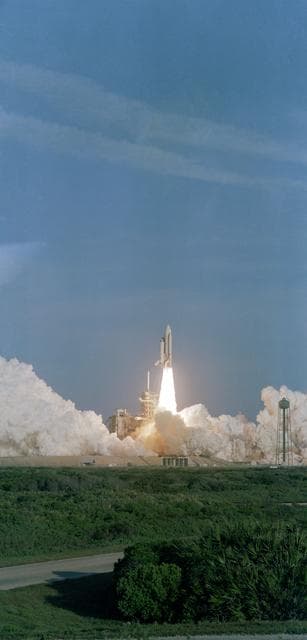
NASA image: Launch Views - Columbia - STS-1 Mission - KSC
Image
Apr 12, 1981

Launch Views - Columbia - STS-1 Mission - KSC

S81-30460 (12 April 1981) --- A remote camera at the Kennedy Space Center's Launch Pad 39A captured this scene as...

JSC
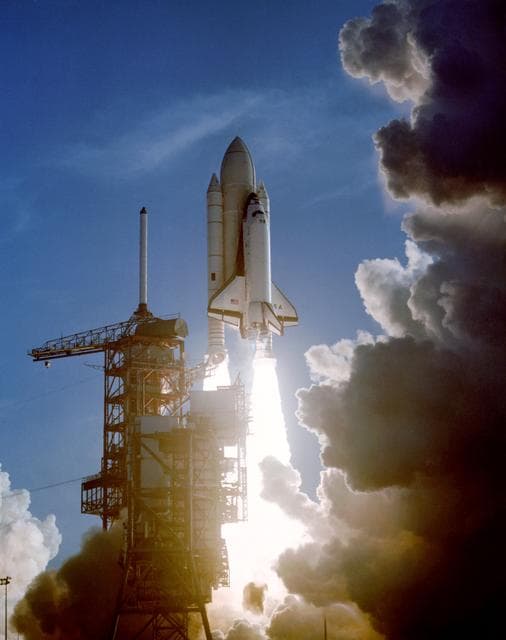
NASA image: Launch Views - Columbia - STS-1 Mission - KSC
Image
Apr 12, 1981

Launch Views - Columbia - STS-1 Mission - KSC

S81-30459 (12 April 1981) --- A remote camera at the Kennedy Space Center's Launch Pad 39A captured this scene as...

JSC
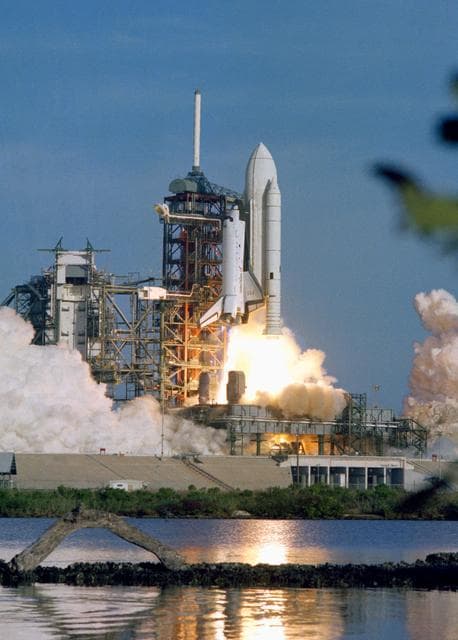
NASA image: Launch views of the Columbia for the STS-1 mission, April 12, 1981
Image
Apr 12, 1981

Launch views of the Columbia for the STS-1 mission, April 12, 1981

S81-30463 (12 April 1981) --- The space shuttle Columbia rises off Pad 39A a few seconds past 7 a.m. (EST) on April...

JSC
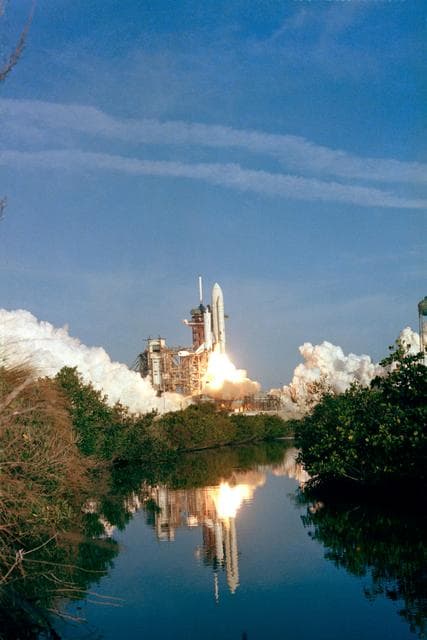
NASA image: Launch views of the Columbia for the STS-1 mission, April 12, 1981
Image
Apr 12, 1981

Launch views of the Columbia for the STS-1 mission, April 12, 1981

S81-30462 (12 April 1981) --- The space shuttle Columbia rises off Pad 39A a few seconds past 7 a.m. (EST) on April...

JSC
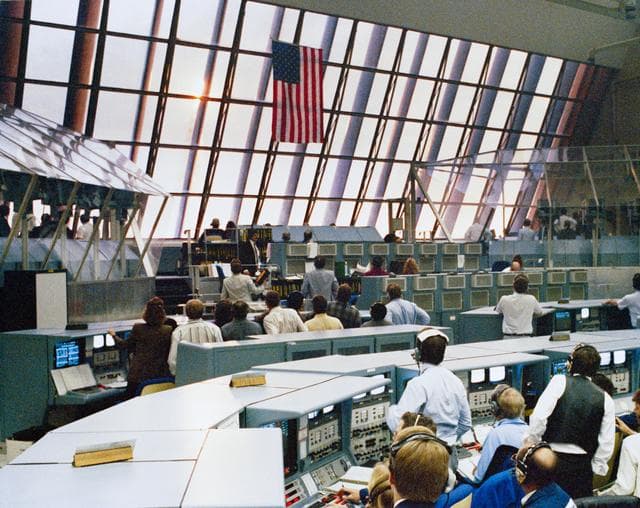
NASA image: KSC Launch Control Center (LCC) Firing Room 1 during STS-32 launch
Image
Jan 9, 1990

KSC Launch Control Center (LCC) Firing Room 1 during STS-32 launch

S90-29047 99Jan 1990) --- At the conclusion of another successful countdown, members of the KSC launch team in...

JSC
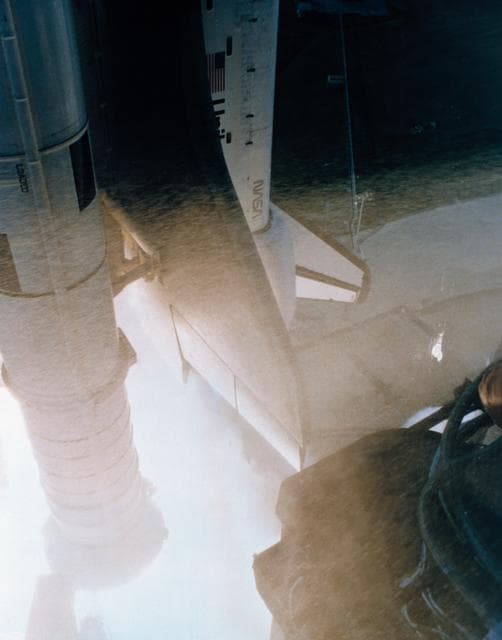
NASA image: LAUNCH - STS-1 - KSC
Image
Apr 12, 1981

LAUNCH - STS-1 - KSC

S81-30502 (12 April 1981) --- Space shuttle Columbia’s aft orbiter section dominates the field of view in this fifth...

JSC
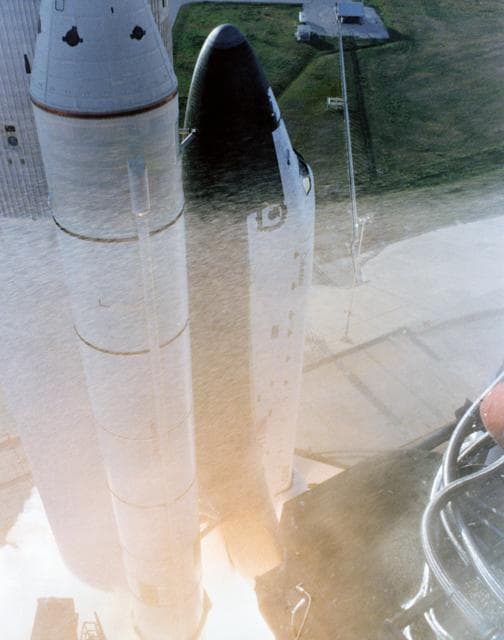
NASA image: LAUNCH - STS-1 - KSC
Image
Apr 12, 1981

LAUNCH - STS-1 - KSC

S81-30501 (12 April 1981) --- Nose pointed skyward, space shuttle Columbia begins its climb toward orbit moments...

JSC
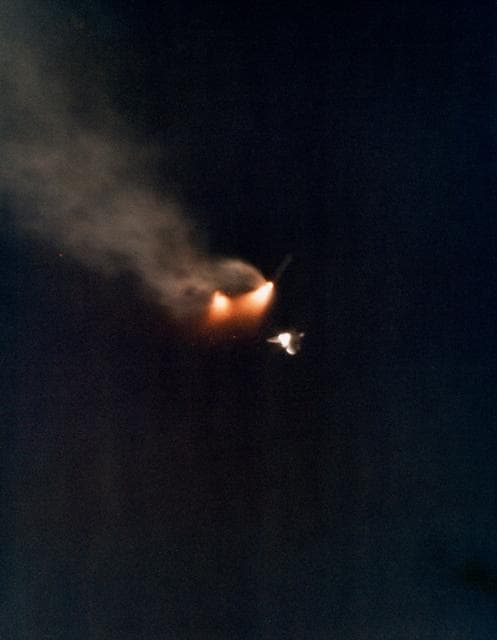
NASA image: LAUNCH (IGOR) - STS-1
Image
Apr 12, 1981

LAUNCH (IGOR) - STS-1

S81-33180 (12 April 1981) --- The two solid rocket boosters are jettisoned from the climbing space shuttle Columbia...

JSC
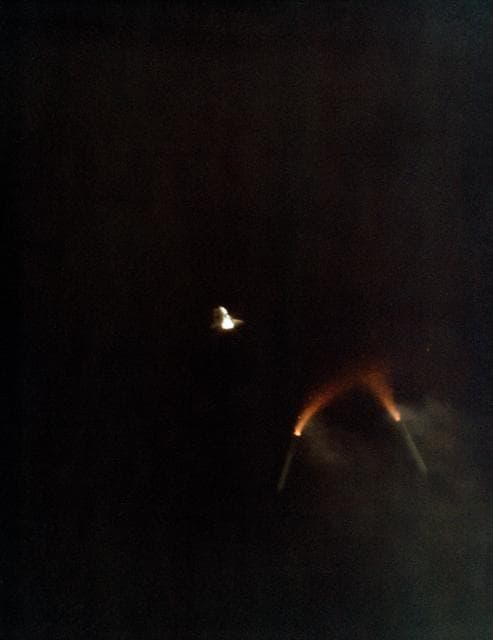
NASA image: LAUNCH (IGOR) - STS-1
Image
Apr 12, 1981

LAUNCH (IGOR) - STS-1

S81-33178 (12 April 1981) --- The two solid rocket boosters are jettisoned from the climbing space shuttle Columbia...

JSC
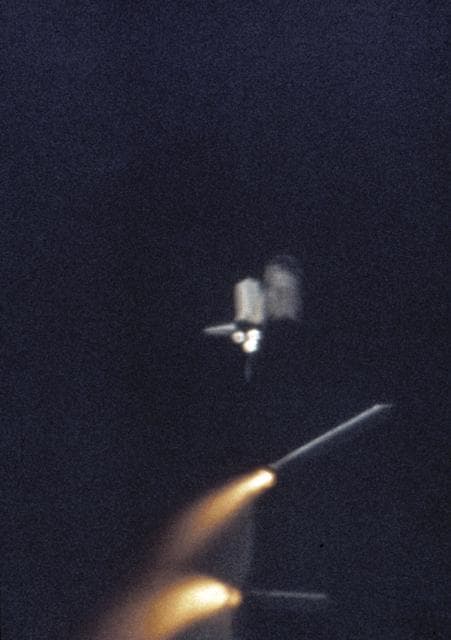
NASA image: LAUNCH (IGOR) - STS-1
Image
Apr 12, 1981

LAUNCH (IGOR) - STS-1

S81-33179 (12 April 1981) --- Though their STS-1 task has been performed, the two solid rocket boosters (SRB) still...

JSC
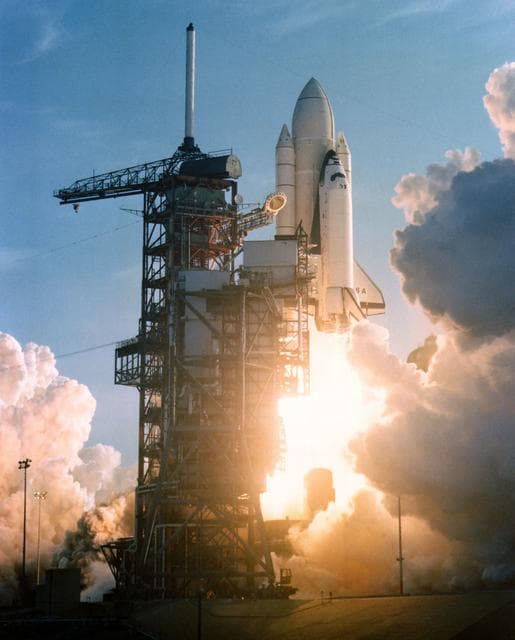
NASA image: LAUNCH - STS-1 - KSC
Image
Apr 12, 1981

LAUNCH - STS-1 - KSC

S81-30499 (12 April 1981) --- Space shuttle Columbia flies. Just seconds past the scheduled launch time of 7 a.m. on...

JSC
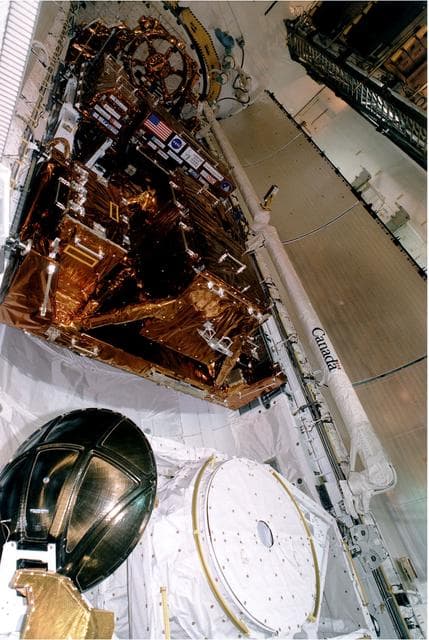
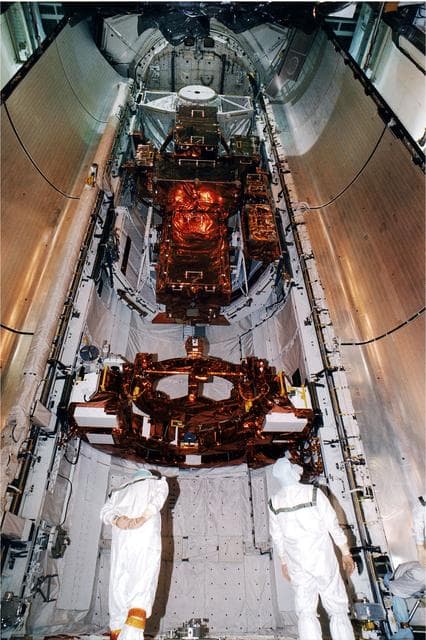
NASA image: KENNEDY SPACE CENTER, FLA. -  The Payload is seen inside of the Bay just before the doors are closed for flight at KSC's Launch Pad 39A.   Discovery, the orbiter for the STS-82 mission, is ready for the launch of the second Hubble Space Telescope service mission.  The payload consists of the Near Infrared Camera and Multi-Object Spectrometer (NICMOS) that will be installed, Fine Guidance Sensor #1 (FGS-1), and the Space Telescope Imaging Spectrograph (STIS) to be installed. The STS-82 will launch with a crew of seven at 3:54 a.m. EST, Feb. 11, 1997. The launch window is 65 minutes in duration. The Mission Commander for STS-82 is Ken Bowersox. The purpose of the mission is to upgrade the scientific capabilities, service or replace aging components on the Telescope, and provide a reboost to the optimum altitude.
Image
Feb 7, 1997

KENNEDY SPACE CENTER, FLA. - The Payload is seen inside of the Bay just before the doors are closed for flight at KSC's Launch Pad 39A. Discovery, the orbiter for the STS-82 mission, is ready for the launch of the second Hubble Space Telescope service mission. The payload consists of the Near Infrared Camera and Multi-Object Spectrometer (NICMOS) that will be installed, Fine Guidance Sensor #1 (FGS-1), and the Space Telescope Imaging Spectrograph (STIS) to be installed. The STS-82 will launch with a crew of seven at 3:54 a.m. EST, Feb. 11, 1997. The launch window is 65 minutes in duration. The Mission Commander for STS-82 is Ken Bowersox. The purpose of the mission is to upgrade the scientific capabilities, service or replace aging components on the Telescope, and provide a reboost to the optimum altitude.

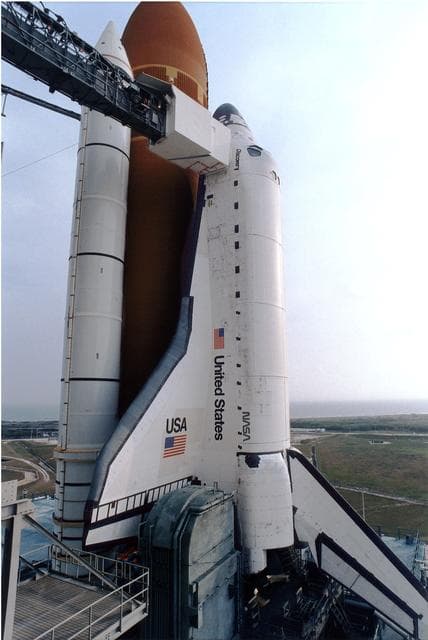
NASA image: KENNEDY SPACE CENTER, FLA. -   At the KSC Launch Pad 39A, two members of the payload closeout crew check equipment as the doors are just about ready to be closed.  The Payload inside the bay of Discovery, the orbiter for the STS-82 mission, is ready for the launch of the second Hubble Space Telescope service mission.  The payload consists of the Near Infrared Camera and Multi-Object Spectrometer (NICMOS) that will be installed, Fine Guidance Sensor #1 (FGS-1), and the Space Telescope Imaging Spectrograph (STIS) to be installed. The STS-82 will launch with a crew of seven at 3:54 a.m. EST, Feb. 11, 1997. The launch window is 65 minutes in duration. The Mission Commander for STS-82 is Ken Bowersox. The purpose of the mission is to upgrade the scientific capabilities, service or replace aging components on the Telescope and provide a reboost to the optimum altitude.
Image
Feb 7, 1997

KENNEDY SPACE CENTER, FLA. - At the KSC Launch Pad 39A, two members of the payload closeout crew check equipment as the doors are just about ready to be closed. The Payload inside the bay of Discovery, the orbiter for the STS-82 mission, is ready for the launch of the second Hubble Space Telescope service mission. The payload consists of the Near Infrared Camera and Multi-Object Spectrometer (NICMOS) that will be installed, Fine Guidance Sensor #1 (FGS-1), and the Space Telescope Imaging Spectrograph (STIS) to be installed. The STS-82 will launch with a crew of seven at 3:54 a.m. EST, Feb. 11, 1997. The launch window is 65 minutes in duration. The Mission Commander for STS-82 is Ken Bowersox. The purpose of the mission is to upgrade the scientific capabilities, service or replace aging components on the Telescope and provide a reboost to the optimum altitude.

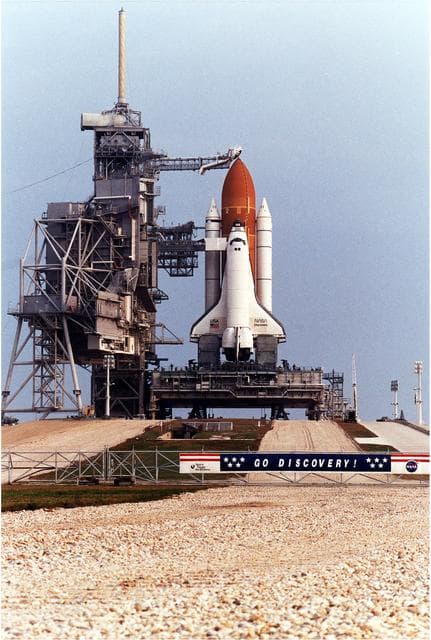
NASA image: KENNEDY SPACE CENTER, FLA. -  The Rotating Service Structure has been retracted at KSC's Launch Pad 39A.   Discovery, the orbiter for the STS-82 mission, is ready for the launch of the second Hubble Space Telescope service mission.  The payload consists of the Near Infrared Camera and Multi-Object Spectrometer (NICMOS) that will be installed, Fine Guidance Sensor #1 (FGS-1), and the Space Telescope Imaging Spectrograph (STIS) to be installed. The STS-82 will launch with a crew of seven at 3:54 a.m. EST, Feb. 11, 1997. The launch window is 65 minutes in duration. The Mission Commander for STS-82 is Ken Bowersox. The purpose of the mission is to upgrade the scientific capabilities, service or replace aging components on the Telescope, and provide a reboost to the optimum altitude.
Image
Feb 10, 1997

KENNEDY SPACE CENTER, FLA. - The Rotating Service Structure has been retracted at KSC's Launch Pad 39A. Discovery, the orbiter for the STS-82 mission, is ready for the launch of the second Hubble Space Telescope service mission. The payload consists of the Near Infrared Camera and Multi-Object Spectrometer (NICMOS) that will be installed, Fine Guidance Sensor #1 (FGS-1), and the Space Telescope Imaging Spectrograph (STIS) to be installed. The STS-82 will launch with a crew of seven at 3:54 a.m. EST, Feb. 11, 1997. The launch window is 65 minutes in duration. The Mission Commander for STS-82 is Ken Bowersox. The purpose of the mission is to upgrade the scientific capabilities, service or replace aging components on the Telescope, and provide a reboost to the optimum altitude.

NASA image: KENNEDY SPACE CENTER, FLA. -  The White Room is seen at the upper left where the astronauts enter the Space Shuttle for flight.  The Rotating Service Structure has been retracted at KSC's Launch Pad 39A.   Discovery, the orbiter for the STS-82 mission, is ready for the launch of the second Hubble Space Telescope service mission.  The payload consists of the Near Infrared Camera and Multi-Object Spectrometer (NICMOS) that will be installed, Fine Guidance Sensor #1 (FGS-1), and the Space Telescope Imaging Spectrograph (STIS) to be installed. The STS-82 will launch with a crew of seven at 3:54 a.m. EST, Feb. 11, 1997. The launch window is 65 minutes in duration. The Mission Commander for STS-82 is Ken Bowersox. The purpose of the mission is to upgrade the scientific capabilities, service or replace aging components on the Telescope, and provide a reboost to the optimum altitude.
Image
Feb 10, 1997

KENNEDY SPACE CENTER, FLA. - The White Room is seen at the upper left where the astronauts enter the Space Shuttle for flight. The Rotating Service Structure has been retracted at KSC's Launch Pad 39A. Discovery, the orbiter for the STS-82 mission, is ready for the launch of the second Hubble Space Telescope service mission. The payload consists of the Near Infrared Camera and Multi-Object Spectrometer (NICMOS) that will be installed, Fine Guidance Sensor #1 (FGS-1), and the Space Telescope Imaging Spectrograph (STIS) to be installed. The STS-82 will launch with a crew of seven at 3:54 a.m. EST, Feb. 11, 1997. The launch window is 65 minutes in duration. The Mission Commander for STS-82 is Ken Bowersox. The purpose of the mission is to upgrade the scientific capabilities, service or replace aging components on the Telescope, and provide a reboost to the optimum altitude.

NASA image: LAUNCH (SOLID ROCKET BOOSTER [SRB]) - STS-1
Image
Apr 12, 1981

LAUNCH (SOLID ROCKET BOOSTER [SRB]) - STS-1

S81-30509 (12 April 1981) --- Separation of space shuttle Columbia?s external tank, photographed by motion picture...

JSC
NASA image: LAUNCH (SOLID ROCKET BOOSTER [SRB]) - STS-1
Image
Apr 12, 1981

LAUNCH (SOLID ROCKET BOOSTER [SRB]) - STS-1

S81-30505 (12 April 1981) --- Separation of space shuttle Columbia?s external tank, photographed by motion picture...

JSC
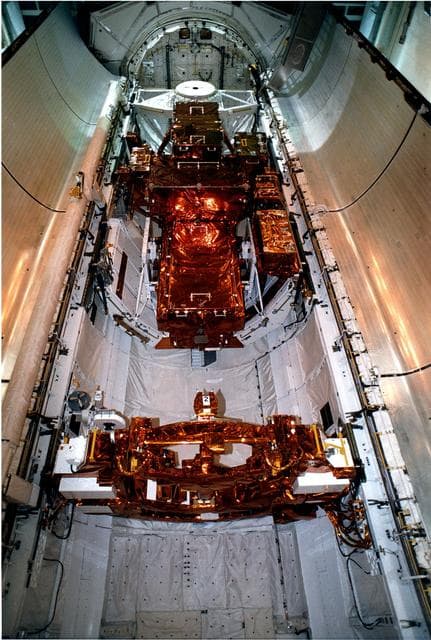
NASA image: KENNEDY SPACE CENTER, FLA. -   The Payload is seen inside of the Bay just before the doors are closed for flight at Pad 39A, Kennedy Space Center, Fla.  Discovery, the orbiter for STS-82 mission, is ready for the launch of the second Hubble Space Telescope service mission.  The payload consists of the Near Infrared Camera and Multi-Object Spectrometer (NICMOS) that will be installed, Fine Guidance Sensor #1 (FGS-1), and the Space Telescope Imaging Spectrograph (STIS) to be installed.  The STS-82 will launch with a crew of seven at 3:54 a.m. EST, Feb. 11, 1997.  The launch window is 65 minutes in duration.  The Mission Commander for STS-82 is Ken Bowersox.  The purpose of the mission is to upgrade the scientific capabilities, service or replace aging components on the Telescope, and provide a reboost to the optimum altitude.
Image
Feb 7, 1997

KENNEDY SPACE CENTER, FLA. - The Payload is seen inside of the Bay just before the doors are closed for flight at Pad 39A, Kennedy Space Center, Fla. Discovery, the orbiter for STS-82 mission, is ready for the launch of the second Hubble Space Telescope service mission. The payload consists of the Near Infrared Camera and Multi-Object Spectrometer (NICMOS) that will be installed, Fine Guidance Sensor #1 (FGS-1), and the Space Telescope Imaging Spectrograph (STIS) to be installed. The STS-82 will launch with a crew of seven at 3:54 a.m. EST, Feb. 11, 1997. The launch window is 65 minutes in duration. The Mission Commander for STS-82 is Ken Bowersox. The purpose of the mission is to upgrade the scientific capabilities, service or replace aging components on the Telescope, and provide a reboost to the optimum altitude.

NASA image: KSC-00PP-1169
Image
Aug 17, 2000

KSC-00PP-1169

KENNEDY SPACE CENTER, FLA. - The STS-106 flight crew participate in a question and answer session for the media at...

KSC
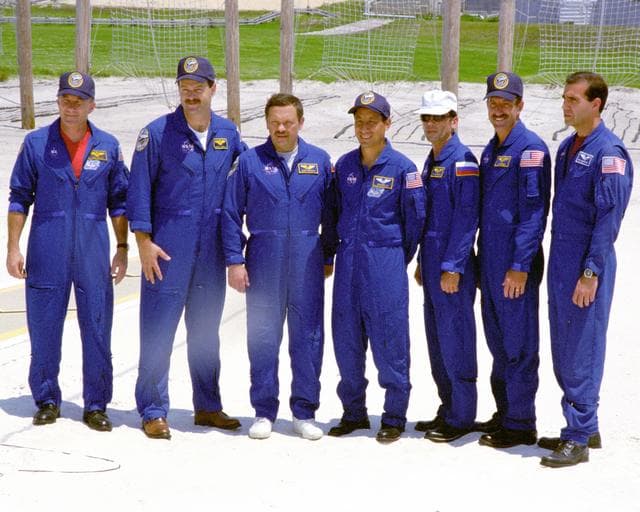
NASA image: KSC00PP-1169
Image
Aug 17, 2000

KSC00PP-1169

KENNEDY SPACE CENTER, FLA. - The STS-106 flight crew participate in a question and answer session for the media at...

KSC
PreviousPage 1 of 100Next

Frequently Asked Questions About NASA Images

Are NASA images free to use?+
Yes, most NASA images are in the public domain and are free to use for educational, informational, and personal purposes. NASA's media usage guidelines state that NASA material is not copyrighted unless otherwise noted. However, the NASA logo and certain insignia are protected. Some images may include identifiable individuals or third-party content that requires additional permissions. Always check the specific image's usage rights and credit NASA as the source.
How many images does NASA have?+
NASA's Image and Video Library contains over 140,000 publicly accessible images, videos, and audio files spanning the agency's entire history, from the Mercury program of the 1960s to the latest James Webb Space Telescope discoveries. The collection grows daily as new missions capture imagery and archival materials are digitized. Individual mission archives, such as Mars rover photos, contain hundreds of thousands of additional images.
Can I download NASA images?+
Yes, you can download NASA images in multiple resolutions directly from this gallery. Each image detail page provides download links for original (full resolution), large (1920px), medium (960px), small (480px), and thumbnail sizes. NASA encourages the public to use these images for education, media, and personal projects. High-resolution originals are ideal for printing and professional use.

Explore More NASA Content

Astronomy Picture of the Day

Daily curated space image

Mars Rover Photos

Curiosity & Perseverance images

Earth from Space

DSCOVR EPIC daily images

Launch Schedule

Upcoming rocket launches

Space News

Mission updates & discoveries

KENNEDY SPACE CENTER, FLA. - The Payload is seen inside of the Bay just before the doors are closed for flight at...

KSC

KENNEDY SPACE CENTER, FLA. - At the KSC Launch Pad 39A, two members of the payload closeout crew check equipment as...

KSC

KENNEDY SPACE CENTER, FLA. - The Rotating Service Structure has been retracted at KSC's Launch Pad 39A. Discovery,...

KSC

KENNEDY SPACE CENTER, FLA. - The White Room is seen at the upper left where the astronauts enter the Space Shuttle...

KSC

KENNEDY SPACE CENTER, FLA. - The Payload is seen inside of the Bay just before the doors are closed for flight at...

KSC