CosmosObservatory
Explore
Solar System
Live
Learn
Tools
About
Cosmos Observatory
ToolsAbout
Cosmos Observatory

Explore the universe through NASA data, real-time ISS tracking, Mars rover imagery, asteroid monitoring, and comprehensive space encyclopedia. Your gateway to the cosmos.

Explore

  • APOD
  • Mars Rovers
  • Earth Imagery
  • NASA Gallery
  • ISS Tracker

Data

  • Asteroids
  • Solar System
  • Exoplanets
  • Space Weather
  • Launches

Tools

  • Glossary
  • News
  • Calculators

Legal

  • About
  • Privacy Policy
  • Terms of Use
  • Space Tools
  • Contact

Stay updated with the cosmos

Get weekly digests of APOD highlights, upcoming launches, and space events.

© 2026 Cosmos Observatory. All rights reserved. Built with for space enthusiasts.

This website is not affiliated with, maintained, authorized, endorsed by, or in any way officially connected with NASA or any of its subsidiaries or affiliates. All NASA imagery is in the public domain unless otherwise noted. Data sourced from NASA Open APIs, Launch Library 2, and other open data services.

NASA Gallery

Explore NASA's vast collection of space images, videos, and audio from missions past and present.

  1. Home
  2. /
  3. NASA Gallery

NASA's Image and Video Library: A Visual Archive of Space Exploration

NASA's Image and Video Library is one of the most comprehensive public archives of space imagery in the world, containing over 140,000 images, videos, and audio recordings spanning more than six decades of space exploration. From the earliest Mercury and Gemini missions through the Apollo Moon landings, the Space Shuttle era, and today's cutting-edge observations from the James Webb Space Telescope, this collection documents humanity's journey into the cosmos.

The library includes imagery from diverse sources: telescopes like Hubble and Webb that capture deep-space nebulae, galaxies, and exoplanets; planetary missions like the Mars rovers ( browse Mars photos) and Cassini at Saturn; Earth observation satellites ( see EPIC imagery); astronaut photography from the ISS; and documentation of rocket launches, spacecraft assembly, and ground testing. Most NASA images are in the public domain and free to download at full resolution for educational, editorial, and personal use.

Use the search bar above to find specific subjects — try queries like "Apollo 11," "Hubble Deep Field," "Mars surface," or "astronaut EVA." You can also filter by media type (image, video, or audio). For a daily curated experience, visit the Astronomy Picture of the Day.

Showing results for "PROTECTION"

7,845 results found - Page 89 of 327

NASA image: Artemis III Liquid Oxygen Tank Moves to Vertical Assembly Building at Michoud
Video
Jul 9, 2025

Artemis III Liquid Oxygen Tank Moves to Vertical Assembly Building at Michoud

Teams move a liquid oxygen tank – designated for the core stage of NASA’s SLS (Space Launch System) rocket for its...

MAF
NASA image: Artemis III Liquid Hydrogen Tank moves into Final Assembly
Image
Apr 22, 2025

Artemis III Liquid Hydrogen Tank moves into Final Assembly

Teams at NASA’s Michoud Assembly Facility in New Orleans move a liquid hydrogen tank for the agency’s SLS (Space...

MAF
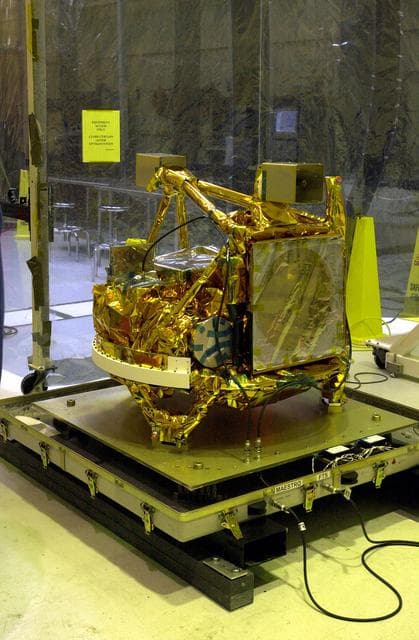
NASA image: KENNEDY SPACE CENTER, FLA. -   The SciSat-1 spacecraft is revealed after being uncrated at Vandenberg Air Force Base, Calif.  SciSat-1 weighs approximately 330 pounds and will be placed in a 400-mile-high polar orbit to investigate processes that control the distribution of ozone in the upper atmosphere.  The scientific mission of SciSat-1 is to measure and understand the chemical processes that control the distribution of ozone in the Earth’s atmosphere, particularly at high altitudes.  The data from the satellite will provide Canadian and international scientists with improved measurements relating to global ozone processes and help policymakers assess existing environmental policy and develop protective measures for improving the health of our atmosphere, preventing further ozone depletion.  The mission is designed to last two years.
Image
Jun 26, 2003

KENNEDY SPACE CENTER, FLA. - The SciSat-1 spacecraft is revealed after being uncrated at Vandenberg Air Force Base, Calif. SciSat-1 weighs approximately 330 pounds and will be placed in a 400-mile-high polar orbit to investigate processes that control the distribution of ozone in the upper atmosphere. The scientific mission of SciSat-1 is to measure and understand the chemical processes that control the distribution of ozone in the Earth’s atmosphere, particularly at high altitudes. The data from the satellite will provide Canadian and international scientists with improved measurements relating to global ozone processes and help policymakers assess existing environmental policy and develop protective measures for improving the health of our atmosphere, preventing further ozone depletion. The mission is designed to last two years.
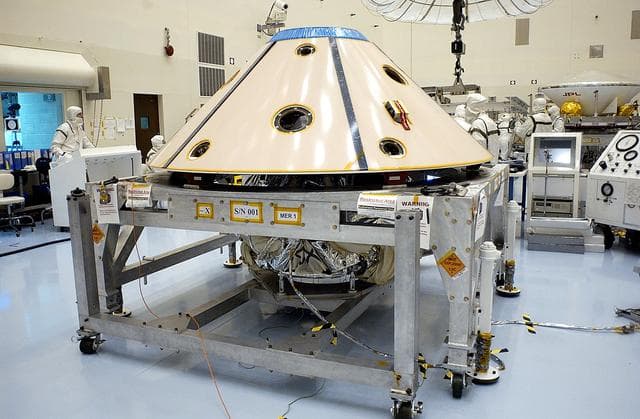
NASA image: KENNEDY SPACE CENTER, FLA. - The backshell is in place over the Mars Exploration Rover 1 (MER-1).  The backshell is a protective cover for the rover.  NASA's twin Mars Exploration Rovers are designed to study the history of water on Mars. These robotic geologists are equipped with a robotic arm, a drilling tool, three spectrometers, and four pairs of cameras that allow them to have a human-like, 3D view of the terrain. Each rover could travel as far as 100 meters in one day to act as Mars scientists' eyes and hands, exploring an environment where humans can't yet go.  MER-1 is scheduled to launch June 25 as MER-B aboard a Delta II rocket from Cape Canaveral Air Force Station.
Image
May 10, 2003

KENNEDY SPACE CENTER, FLA. - The backshell is in place over the Mars Exploration Rover 1 (MER-1). The backshell is a protective cover for the rover. NASA's twin Mars Exploration Rovers are designed to study the history of water on Mars. These robotic geologists are equipped with a robotic arm, a drilling tool, three spectrometers, and four pairs of cameras that allow them to have a human-like, 3D view of the terrain. Each rover could travel as far as 100 meters in one day to act as Mars scientists' eyes and hands, exploring an environment where humans can't yet go. MER-1 is scheduled to launch June 25 as MER-B aboard a Delta II rocket from Cape Canaveral Air Force Station.

KENNEDY SPACE CENTER, FLA. - The backshell is in place over the Mars Exploration Rover 1 (MER-1). The backshell is a...
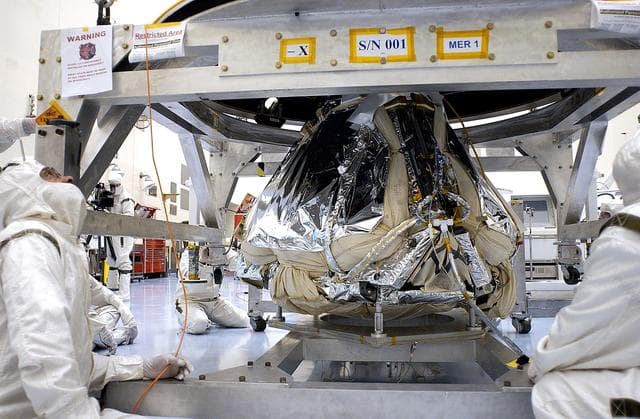
NASA image: KENNEDY SPACE CENTER, FLA. - Workers in the Payload Hazardous Servicing Facility lower the backshell over the Mars Exploration Rover 1 (MER-1).  The backshell is a protective cover for the rover.  NASA's twin Mars Exploration Rovers are designed to study the history of water on Mars. These robotic geologists are equipped with a robotic arm, a drilling tool, three spectrometers, and four pairs of cameras that allow them to have a human-like, 3D view of the terrain. Each rover could travel as far as 100 meters in one day to act as Mars scientists' eyes and hands, exploring an environment where humans can't yet go.  MER-1 is scheduled to launch June 25 as MER-B aboard a Delta II rocket from Cape Canaveral Air Force Station.
Image
May 10, 2003

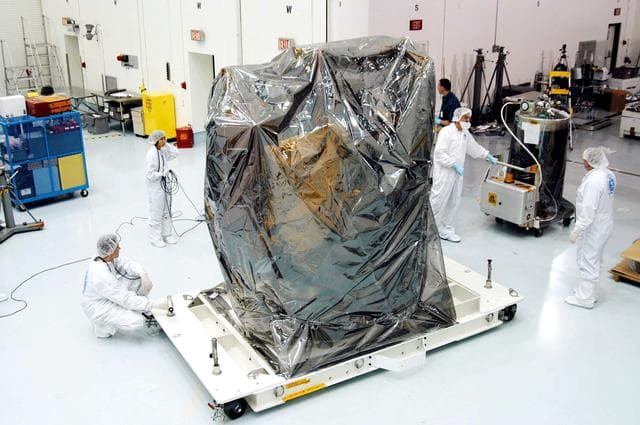
KENNEDY SPACE CENTER, FLA. - Workers in the Payload Hazardous Servicing Facility lower the backshell over the Mars Exploration Rover 1 (MER-1). The backshell is a protective cover for the rover. NASA's twin Mars Exploration Rovers are designed to study the history of water on Mars. These robotic geologists are equipped with a robotic arm, a drilling tool, three spectrometers, and four pairs of cameras that allow them to have a human-like, 3D view of the terrain. Each rover could travel as far as 100 meters in one day to act as Mars scientists' eyes and hands, exploring an environment where humans can't yet go. MER-1 is scheduled to launch June 25 as MER-B aboard a Delta II rocket from Cape Canaveral Air Force Station.

NASA image: KENNEDY SPACE CENTER, FLA. -  In the high bay clean room at the Astrotech Space Operations processing facilities near KSC, workers get ready to remove the protective cover from NASA’s MESSENGER spacecraft.  Employees of the Johns Hopkins University Applied Physics Laboratory, builders of the spacecraft, will perform an initial state-of-health check.  Then processing for launch can begin, including checkout of the power systems, communications systems and control systems.  The thermal blankets will also be attached for flight.  MESSENGER - short for MErcury Surface, Space ENvironment, GEochemistry and Ranging - will be launched May 11 on a six-year mission aboard a Boeing Delta II rocket.  Liftoff is targeted for 2:26 a.m. EDT on Tuesday, May 11.
Image
Mar 10, 2004

KENNEDY SPACE CENTER, FLA. - In the high bay clean room at the Astrotech Space Operations processing facilities near KSC, workers get ready to remove the protective cover from NASA’s MESSENGER spacecraft. Employees of the Johns Hopkins University Applied Physics Laboratory, builders of the spacecraft, will perform an initial state-of-health check. Then processing for launch can begin, including checkout of the power systems, communications systems and control systems. The thermal blankets will also be attached for flight. MESSENGER - short for MErcury Surface, Space ENvironment, GEochemistry and Ranging - will be launched May 11 on a six-year mission aboard a Boeing Delta II rocket. Liftoff is targeted for 2:26 a.m. EDT on Tuesday, May 11.
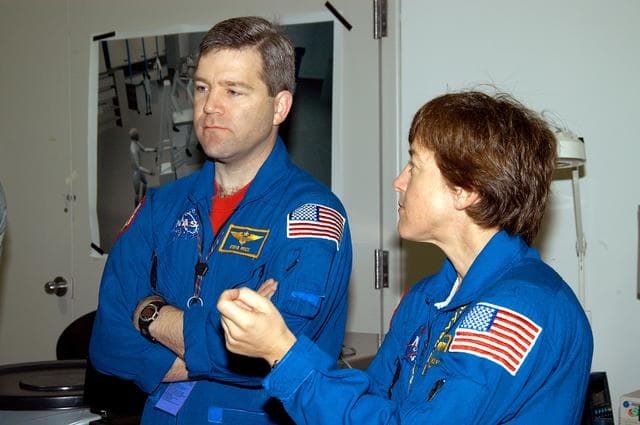
NASA image: KENNEDY SPACE CENTER, FLA. -  In the Space Station Processing Facility, astronaut Stephen Frick and STS-114 Mission Specialist Wendy Lawrence watch as crew members work with equipment that will be used on the mission.  Frick is a tile specialist, who joined the STS-114 crew during equipment familiarization at KSC. STS-114 is classified as Logistics Flight 1 to the International Space Station, delivering new supplies and replacing one of the orbital outpost’s Control Moment Gyroscopes (CMGs). STS-114 will also carry a Raffaello Multi-Purpose Logistics Module and the External Stowage Platform-2.  The crew is slated to conduct at least three spacewalks: They will demonstrate repair techniques of the Shuttle’s Thermal Protection System,  replace the failed CMG with one delivered by the Shuttle, and  install the External Stowage Platform.
Image
Jan 27, 2004

KENNEDY SPACE CENTER, FLA. - In the Space Station Processing Facility, astronaut Stephen Frick and STS-114 Mission Specialist Wendy Lawrence watch as crew members work with equipment that will be used on the mission. Frick is a tile specialist, who joined the STS-114 crew during equipment familiarization at KSC. STS-114 is classified as Logistics Flight 1 to the International Space Station, delivering new supplies and replacing one of the orbital outpost’s Control Moment Gyroscopes (CMGs). STS-114 will also carry a Raffaello Multi-Purpose Logistics Module and the External Stowage Platform-2. The crew is slated to conduct at least three spacewalks: They will demonstrate repair techniques of the Shuttle’s Thermal Protection System, replace the failed CMG with one delivered by the Shuttle, and install the External Stowage Platform.
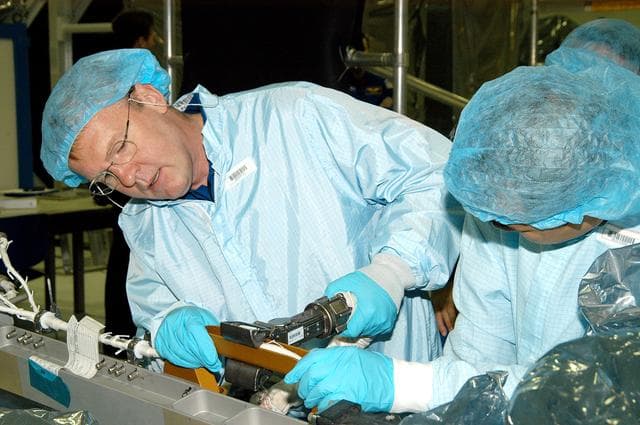
NASA image: KENNEDY SPACE CENTER, FLA. -  In the Space Station Processing Facility, STS-114 Mission Specialist Andrew Thomas (left) works with equipment while Mission Specialist Soichi Noguchi watches.  Noguchi is with the Japanese Aerospace Exploration Agency (JAXA).  They and other crew members are at KSC for equipment familiarization.  STS-114 is classified as Logistics Flight 1 to the International Space Station, delivering new supplies and replacing one of the orbital outpost’s Control Moment Gyroscopes (CMGs). STS-114 will also carry a Raffaello Multi-Purpose Logistics Module and the External Stowage Platform-2.  The crew is slated to conduct at least three spacewalks: They will demonstrate repair techniques of the Shuttle’s Thermal Protection System,  replace the failed CMG with one delivered by the Shuttle, and  install the External Stowage Platform.
Image
Jan 27, 2004

KENNEDY SPACE CENTER, FLA. - In the Space Station Processing Facility, STS-114 Mission Specialist Andrew Thomas (left) works with equipment while Mission Specialist Soichi Noguchi watches. Noguchi is with the Japanese Aerospace Exploration Agency (JAXA). They and other crew members are at KSC for equipment familiarization. STS-114 is classified as Logistics Flight 1 to the International Space Station, delivering new supplies and replacing one of the orbital outpost’s Control Moment Gyroscopes (CMGs). STS-114 will also carry a Raffaello Multi-Purpose Logistics Module and the External Stowage Platform-2. The crew is slated to conduct at least three spacewalks: They will demonstrate repair techniques of the Shuttle’s Thermal Protection System, replace the failed CMG with one delivered by the Shuttle, and install the External Stowage Platform.
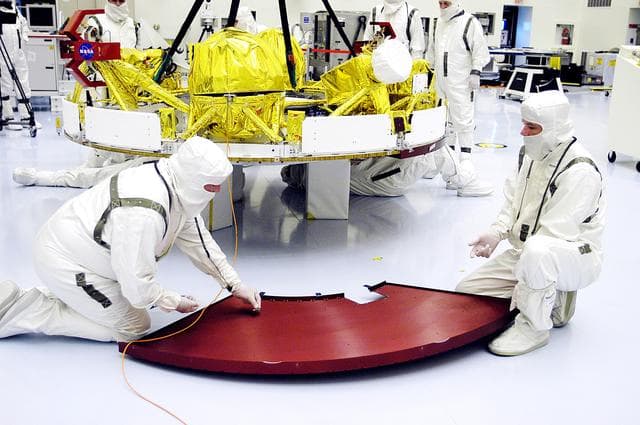
NASA image: KENNEDY SPACE CENTER, FLA. - In the Payload Hazardous Servicing Facility, workers check one of the cruise stage solar panel protective covers on Mars Exploration Rover 1 (MER-1).  The cruise stage will be integrated with the aeroshell, the entry vehicle.   NASA’s twin Mars Exploration Rovers are designed to study the history of water on Mars. These robotic geologists are equipped with a robotic arm, a drilling tool, three spectrometers, and four pairs of cameras that allow them to have a human-like, 3D view of the terrain. Each rover could travel as far as 100 meters in one day to act as Mars scientists' eyes and hands, exploring an environment where humans can’t yet go.  The MER-1 is scheduled to launch June 25 from Launch Pad 17-A, Cape Canaveral Air Force Station.
Image
May 19, 2003

KENNEDY SPACE CENTER, FLA. - In the Payload Hazardous Servicing Facility, workers check one of the cruise stage solar panel protective covers on Mars Exploration Rover 1 (MER-1). The cruise stage will be integrated with the aeroshell, the entry vehicle. NASA’s twin Mars Exploration Rovers are designed to study the history of water on Mars. These robotic geologists are equipped with a robotic arm, a drilling tool, three spectrometers, and four pairs of cameras that allow them to have a human-like, 3D view of the terrain. Each rover could travel as far as 100 meters in one day to act as Mars scientists' eyes and hands, exploring an environment where humans can’t yet go. The MER-1 is scheduled to launch June 25 from Launch Pad 17-A, Cape Canaveral Air Force Station.
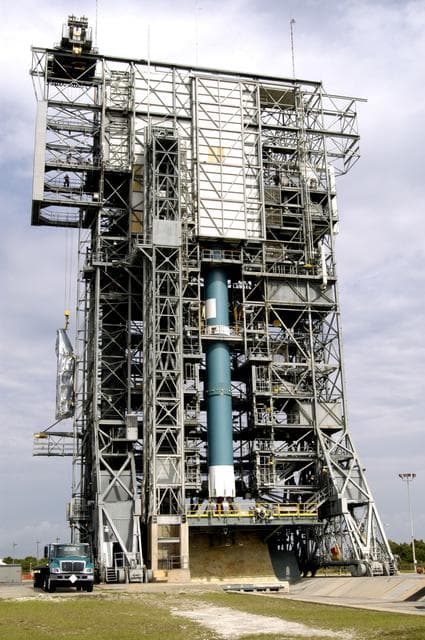
NASA image: KENNEDY SPACE CENTER, FLA. - At Launch Complex 17-A, Cape Canaveral Air Force Station, the second half of the fairing for the Mars Exploration Rover 2 (MER-2/MER-A) is lifted up the outside of the launch tower.  Visible on another side is the Delta II rocket that will carry the payload into space.  The fairing will be installed around the payload for protection during launch.  The MER Mission consists of two identical rovers designed to cover roughly 110 yards each Martian day over various terrain. Each rover will carry five scientific instruments that will allow it to search for evidence of liquid water that may have been present in the planet's past.  Identical to each other, the rovers will land at different regions of Mars.  Launch date for MER-A  is scheduled for June 5.
Image
Apr 30, 2003

KENNEDY SPACE CENTER, FLA. - At Launch Complex 17-A, Cape Canaveral Air Force Station, the second half of the fairing for the Mars Exploration Rover 2 (MER-2/MER-A) is lifted up the outside of the launch tower. Visible on another side is the Delta II rocket that will carry the payload into space. The fairing will be installed around the payload for protection during launch. The MER Mission consists of two identical rovers designed to cover roughly 110 yards each Martian day over various terrain. Each rover will carry five scientific instruments that will allow it to search for evidence of liquid water that may have been present in the planet's past. Identical to each other, the rovers will land at different regions of Mars. Launch date for MER-A is scheduled for June 5.
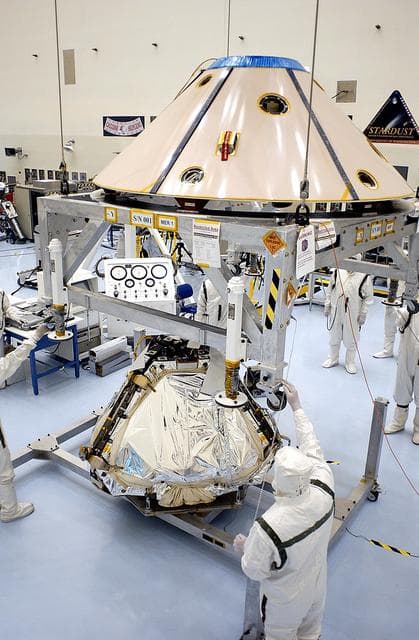
NASA image: KENNEDY SPACE CENTER, FLA. - Workers in the Payload Hazardous Servicing Facility guide the backshell being lowered over the Mars Exploration Rover 1 (MER-1).  The backshell is a protective cover for the rover.  NASA's twin Mars Exploration Rovers are designed to study the history of water on Mars. These robotic geologists are equipped with a robotic arm, a drilling tool, three spectrometers, and four pairs of cameras that allow them to have a human-like, 3D view of the terrain. Each rover could travel as far as 100 meters in one day to act as Mars scientists' eyes and hands, exploring an environment where humans can't yet go.  MER-1 is scheduled to launch June 25 as MER-B aboard a Delta II rocket from Cape Canaveral Air Force Station.
Image
May 10, 2003

KENNEDY SPACE CENTER, FLA. - Workers in the Payload Hazardous Servicing Facility guide the backshell being lowered over the Mars Exploration Rover 1 (MER-1). The backshell is a protective cover for the rover. NASA's twin Mars Exploration Rovers are designed to study the history of water on Mars. These robotic geologists are equipped with a robotic arm, a drilling tool, three spectrometers, and four pairs of cameras that allow them to have a human-like, 3D view of the terrain. Each rover could travel as far as 100 meters in one day to act as Mars scientists' eyes and hands, exploring an environment where humans can't yet go. MER-1 is scheduled to launch June 25 as MER-B aboard a Delta II rocket from Cape Canaveral Air Force Station.
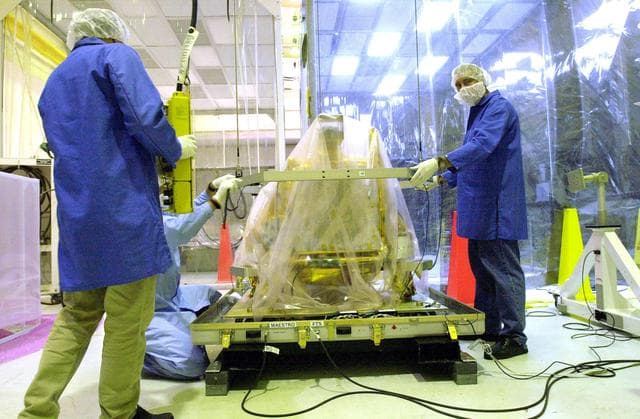
NASA image: KENNEDY SPACE CENTER, FLA. - In the Payload Hazardous Servicing Facility, workers lower the backshell with the Mars Exploration Rover 1 (MER-1) onto the heat shield.  The two components form the aeroshell that will protect the rover on its journey to Mars.  NASA's twin Mars Exploration Rovers are designed to study the history of water on Mars. These robotic geologists are equipped with a robotic arm, a drilling tool, three spectrometers, and four pairs of cameras that allow them to have a human-like, 3D view of the terrain. Each rover could travel as far as 100 meters in one day to act as Mars scientists' eyes and hands, exploring an environment where humans can't yet go.  MER-1 is scheduled to launch June 25 as MER-B aboard a Delta II rocket from Cape Canaveral Air Force Station.
Image
May 15, 2003

KENNEDY SPACE CENTER, FLA. - In the Payload Hazardous Servicing Facility, workers lower the backshell with the Mars Exploration Rover 1 (MER-1) onto the heat shield. The two components form the aeroshell that will protect the rover on its journey to Mars. NASA's twin Mars Exploration Rovers are designed to study the history of water on Mars. These robotic geologists are equipped with a robotic arm, a drilling tool, three spectrometers, and four pairs of cameras that allow them to have a human-like, 3D view of the terrain. Each rover could travel as far as 100 meters in one day to act as Mars scientists' eyes and hands, exploring an environment where humans can't yet go. MER-1 is scheduled to launch June 25 as MER-B aboard a Delta II rocket from Cape Canaveral Air Force Station.

NASA image: KENNEDY SPACE CENTER, FLA. -  Workers at Vandenberg Air Force Base, Calif., prepare to move the SciSat-1 spacecraft.  SciSat-1 weighs approximately 330 pounds and will be placed in a 400-mile-high polar orbit to investigate processes that control the distribution of ozone in the upper atmosphere.  The scientific mission of SciSat-1 is to measure and understand the chemical processes that control the distribution of ozone in the Earth’s atmosphere, particularly at high altitudes.  The data from the satellite will provide Canadian and international scientists with improved measurements relating to global ozone processes and help policymakers assess existing environmental policy and develop protective measures for improving the health of our atmosphere, preventing further ozone depletion.  The mission is designed to last two years.
Image
Jun 26, 2003

KENNEDY SPACE CENTER, FLA. - Workers at Vandenberg Air Force Base, Calif., prepare to move the SciSat-1 spacecraft. SciSat-1 weighs approximately 330 pounds and will be placed in a 400-mile-high polar orbit to investigate processes that control the distribution of ozone in the upper atmosphere. The scientific mission of SciSat-1 is to measure and understand the chemical processes that control the distribution of ozone in the Earth’s atmosphere, particularly at high altitudes. The data from the satellite will provide Canadian and international scientists with improved measurements relating to global ozone processes and help policymakers assess existing environmental policy and develop protective measures for improving the health of our atmosphere, preventing further ozone depletion. The mission is designed to last two years.
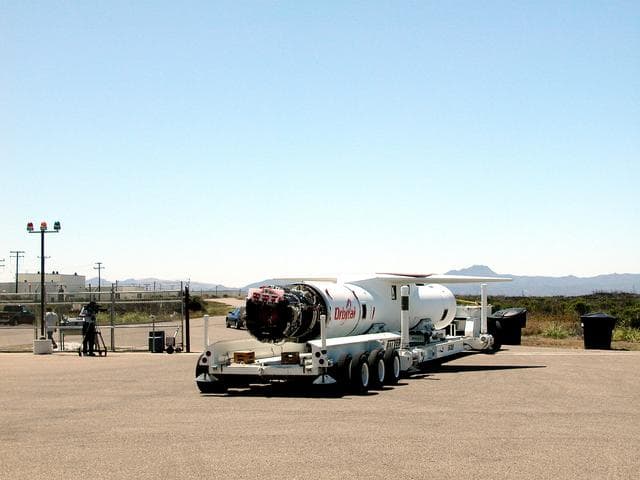
NASA image: KENNEDY SPACE CENTER, FLA. -   At Vandenberg Air Force Base, Calif., the Pegasus launch vehicle is moved toward its hangar.  The Pegasus will carry the SciSat-1 spacecraft in a 400-mile-high polar orbit to investigate processes that control the distribution of ozone in the upper atmosphere.  The scientific mission of SciSat-1 is to measure and understand the chemical processes that control the distribution of ozone in the Earth’s atmosphere, particularly at high altitudes.  The data from the satellite will provide Canadian and international scientists with improved measurements relating to global ozone processes and help policymakers assess existing environmental policy and develop protective measures for improving the health of our atmosphere, preventing further ozone depletion.  The mission is designed to last two years.
Image
Jun 27, 2003

KENNEDY SPACE CENTER, FLA. - At Vandenberg Air Force Base, Calif., the Pegasus launch vehicle is moved toward its hangar. The Pegasus will carry the SciSat-1 spacecraft in a 400-mile-high polar orbit to investigate processes that control the distribution of ozone in the upper atmosphere. The scientific mission of SciSat-1 is to measure and understand the chemical processes that control the distribution of ozone in the Earth’s atmosphere, particularly at high altitudes. The data from the satellite will provide Canadian and international scientists with improved measurements relating to global ozone processes and help policymakers assess existing environmental policy and develop protective measures for improving the health of our atmosphere, preventing further ozone depletion. The mission is designed to last two years.
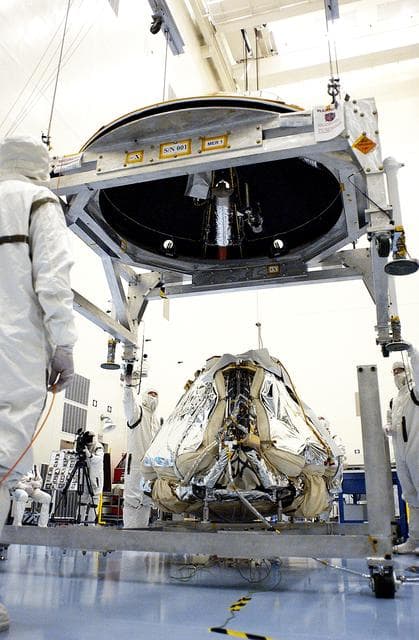
NASA image: KENNEDY SPACE CENTER, FLA. - Workers in the Payload Hazardous Servicing Facility lower the backshell over the Mars Exploration Rover 1 (MER-1).  The backshell is a protective cover for the rover.  NASA's twin Mars Exploration Rovers are designed to study the history of water on Mars. These robotic geologists are equipped with a robotic arm, a drilling tool, three spectrometers, and four pairs of cameras that allow them to have a human-like, 3D view of the terrain. Each rover could travel as far as 100 meters in one day to act as Mars scientists' eyes and hands, exploring an environment where humans can't yet go.  MER-1 is scheduled to launch June 25 as MER-B aboard a Delta II rocket from Cape Canaveral Air Force Station.
Image
May 10, 2003

KENNEDY SPACE CENTER, FLA. - Workers in the Payload Hazardous Servicing Facility lower the backshell over the Mars Exploration Rover 1 (MER-1). The backshell is a protective cover for the rover. NASA's twin Mars Exploration Rovers are designed to study the history of water on Mars. These robotic geologists are equipped with a robotic arm, a drilling tool, three spectrometers, and four pairs of cameras that allow them to have a human-like, 3D view of the terrain. Each rover could travel as far as 100 meters in one day to act as Mars scientists' eyes and hands, exploring an environment where humans can't yet go. MER-1 is scheduled to launch June 25 as MER-B aboard a Delta II rocket from Cape Canaveral Air Force Station.

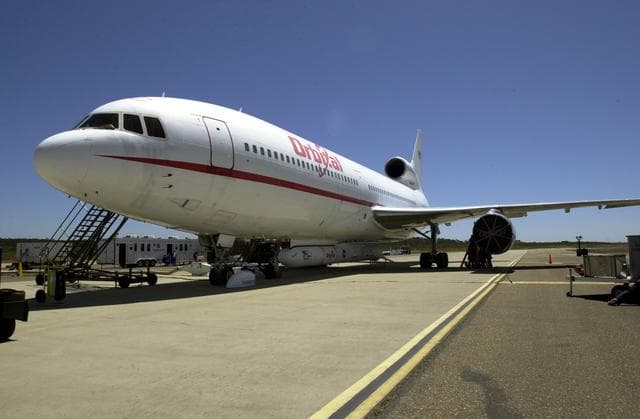
NASA image: VANDENBERG AIR FORCE BASE, CALIF. -  The L-1011 carrier aircraft is ready for flight after undergoing a Combined Systems Test, an integrated test involving the Pegasus launch vehicle, SciSat-1 spacecraft and L-1011 aircraft.  The SciSat-1 weighs approximately 330 pounds and after launch will be placed in a 400-mile-high polar orbit to investigate processes that control the distribution of ozone in the upper atmosphere. The data from the satellite will provide Canadian and international scientists with improved measurements relating to global ozone processes and help policymakers assess existing environmental policy and develop protective measures for improving the health of our atmosphere, preventing further ozone depletion. The mission is designed to last two years.
Image
Aug 9, 2003

VANDENBERG AIR FORCE BASE, CALIF. - The L-1011 carrier aircraft is ready for flight after undergoing a Combined Systems Test, an integrated test involving the Pegasus launch vehicle, SciSat-1 spacecraft and L-1011 aircraft. The SciSat-1 weighs approximately 330 pounds and after launch will be placed in a 400-mile-high polar orbit to investigate processes that control the distribution of ozone in the upper atmosphere. The data from the satellite will provide Canadian and international scientists with improved measurements relating to global ozone processes and help policymakers assess existing environmental policy and develop protective measures for improving the health of our atmosphere, preventing further ozone depletion. The mission is designed to last two years.

NASA image: KENNEDY SPACE CENTER, FLA. - In the Payload Hazardous Servicing Facility, workers check the attachment between the backshell (above) and heat shield (below) surrounding the Mars Exploration Rover 1 (MER-1).  The aeroshell will protect the rover on its journey to Mars.  NASA's twin Mars Exploration Rovers are designed to study the history of water on Mars. These robotic geologists are equipped with a robotic arm, a drilling tool, three spectrometers, and four pairs of cameras that allow them to have a human-like, 3D view of the terrain. Each rover could travel as far as 100 meters in one day to act as Mars scientists' eyes and hands, exploring an environment where humans can't yet go.  MER-1 is scheduled to launch June 25 as MER-B aboard a Delta II rocket from Cape Canaveral Air Force Station.
Image
May 15, 2003

KENNEDY SPACE CENTER, FLA. - In the Payload Hazardous Servicing Facility, workers check the attachment between the backshell (above) and heat shield (below) surrounding the Mars Exploration Rover 1 (MER-1). The aeroshell will protect the rover on its journey to Mars. NASA's twin Mars Exploration Rovers are designed to study the history of water on Mars. These robotic geologists are equipped with a robotic arm, a drilling tool, three spectrometers, and four pairs of cameras that allow them to have a human-like, 3D view of the terrain. Each rover could travel as far as 100 meters in one day to act as Mars scientists' eyes and hands, exploring an environment where humans can't yet go. MER-1 is scheduled to launch June 25 as MER-B aboard a Delta II rocket from Cape Canaveral Air Force Station.

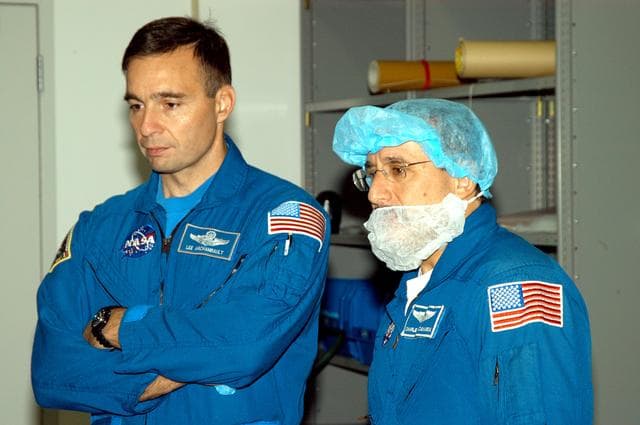
NASA image: KENNEDY SPACE CENTER, FLA. -  In the Space Station Processing Facility, astronaut Lee Archambault and STS-114 Mission Specialist Charles Camarda watch as crew members work with equipment that will be used on the mission.  Archambault supports launch and landing operations at the Kennedy Space Center as an Astronaut Office representative. Crew members are at KSC for equipment familiarization.  STS-114 is classified as Logistics Flight 1 to the International Space Station, delivering new supplies and replacing one of the orbital outpost’s Control Moment Gyroscopes (CMGs). STS-114 will also carry a Raffaello Multi-Purpose Logistics Module and the External Stowage Platform-2.  The crew is slated to conduct at least three spacewalks: They will demonstrate repair techniques of the Shuttle’s Thermal Protection System,  replace the failed CMG with one delivered by the Shuttle, and  install the External Stowage Platform.
Image
Jan 27, 2004

KENNEDY SPACE CENTER, FLA. - In the Space Station Processing Facility, astronaut Lee Archambault and STS-114 Mission Specialist Charles Camarda watch as crew members work with equipment that will be used on the mission. Archambault supports launch and landing operations at the Kennedy Space Center as an Astronaut Office representative. Crew members are at KSC for equipment familiarization. STS-114 is classified as Logistics Flight 1 to the International Space Station, delivering new supplies and replacing one of the orbital outpost’s Control Moment Gyroscopes (CMGs). STS-114 will also carry a Raffaello Multi-Purpose Logistics Module and the External Stowage Platform-2. The crew is slated to conduct at least three spacewalks: They will demonstrate repair techniques of the Shuttle’s Thermal Protection System, replace the failed CMG with one delivered by the Shuttle, and install the External Stowage Platform.
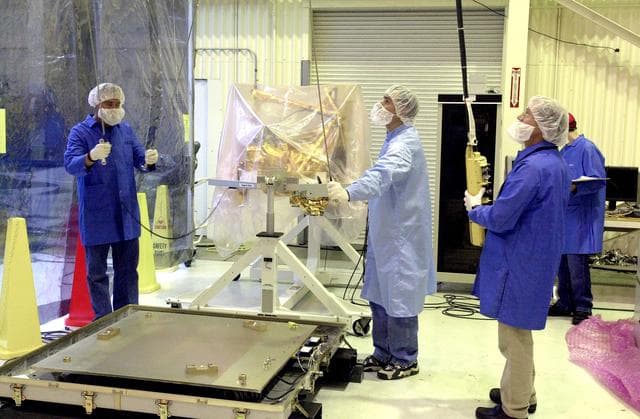
NASA image: VANDENBERG AIR FORCE BASE, CALIF.  -  Outside the clean room at Vandenberg Air Force Base, Calif., the SciSat-1 spacecraft (background) has been removed from the shipping container mounting base (lower left) and placed on the handling fixture. Sci-Sat, which will undergo instrument checkout and spacecraft functional testing, weighs approximately 330 pounds and after launch will be placed in a 400-mile-high polar orbit to investigate processes that control the distribution of ozone in the upper atmosphere. The data from the satellite will provide Canadian and international scientists with improved measurements relating to global ozone processes and help policymakers assess existing environmental policy and develop protective measures for improving the health of our atmosphere, preventing further ozone depletion. The mission is designed to last two years.
Image
Jun 26, 2003

VANDENBERG AIR FORCE BASE, CALIF. - Outside the clean room at Vandenberg Air Force Base, Calif., the SciSat-1 spacecraft (background) has been removed from the shipping container mounting base (lower left) and placed on the handling fixture. Sci-Sat, which will undergo instrument checkout and spacecraft functional testing, weighs approximately 330 pounds and after launch will be placed in a 400-mile-high polar orbit to investigate processes that control the distribution of ozone in the upper atmosphere. The data from the satellite will provide Canadian and international scientists with improved measurements relating to global ozone processes and help policymakers assess existing environmental policy and develop protective measures for improving the health of our atmosphere, preventing further ozone depletion. The mission is designed to last two years.
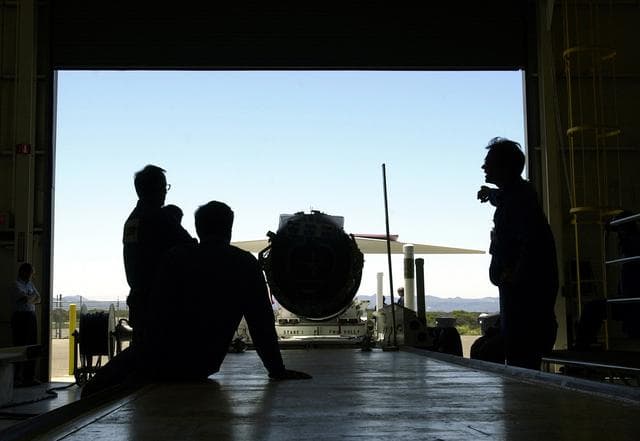
NASA image: KENNEDY SPACE CENTER, FLA. -   Inside the hangar at Vandenberg Air Force Base, Calif., workers wait for the Pegasus launch vehicle to be moved inside.  The Pegasus will carry the SciSat-1 spacecraft in a 400-mile-high polar orbit to investigate processes that control the distribution of ozone in the upper atmosphere.  The scientific mission of SciSat-1 is to measure and understand the chemical processes that control the distribution of ozone in the Earth’s atmosphere, particularly at high altitudes.  The data from the satellite will provide Canadian and international scientists with improved measurements relating to global ozone processes and help policymakers assess existing environmental policy and develop protective measures for improving the health of our atmosphere, preventing further ozone depletion.  The mission is designed to last two years.
Image
Jun 27, 2003

KENNEDY SPACE CENTER, FLA. - Inside the hangar at Vandenberg Air Force Base, Calif., workers wait for the Pegasus launch vehicle to be moved inside. The Pegasus will carry the SciSat-1 spacecraft in a 400-mile-high polar orbit to investigate processes that control the distribution of ozone in the upper atmosphere. The scientific mission of SciSat-1 is to measure and understand the chemical processes that control the distribution of ozone in the Earth’s atmosphere, particularly at high altitudes. The data from the satellite will provide Canadian and international scientists with improved measurements relating to global ozone processes and help policymakers assess existing environmental policy and develop protective measures for improving the health of our atmosphere, preventing further ozone depletion. The mission is designed to last two years.

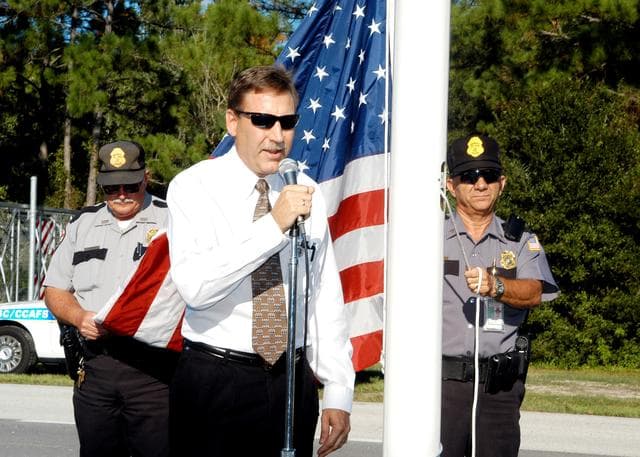
NASA image: KENNEDY SPACE CENTER, FLA.  -  Daniel L. Tweed, with the Facilities Division, NASA Spaceport Services, addresses attendees at the ribbon cutting for the KSC Security gates.  Tweed was project manager.  The two new Security gates on Kennedy Parkway (Gate 2) and NASA Parkway (Gate 3) were activated Aug. 1, allowing the general public to have access to the new Space Commerce Way, which will provide access to the Research Park and KSC Visitor Complex, and providing an alternate route for the general public between Titusville and Merritt Island that is accessible 24 hours a day.  The gates are staffed 24 hours daily.  Others taking part in the ribbon cutting were Center Director Jim Kennedy; Chief, Protective & Safe Guards Office, Calvin L. Burch; SGS Deputy Program Manager William A. Sample; and Bobby Porter, with Oneida Construction.
Image
Aug 27, 2003

KENNEDY SPACE CENTER, FLA. - Daniel L. Tweed, with the Facilities Division, NASA Spaceport Services, addresses attendees at the ribbon cutting for the KSC Security gates. Tweed was project manager. The two new Security gates on Kennedy Parkway (Gate 2) and NASA Parkway (Gate 3) were activated Aug. 1, allowing the general public to have access to the new Space Commerce Way, which will provide access to the Research Park and KSC Visitor Complex, and providing an alternate route for the general public between Titusville and Merritt Island that is accessible 24 hours a day. The gates are staffed 24 hours daily. Others taking part in the ribbon cutting were Center Director Jim Kennedy; Chief, Protective & Safe Guards Office, Calvin L. Burch; SGS Deputy Program Manager William A. Sample; and Bobby Porter, with Oneida Construction.

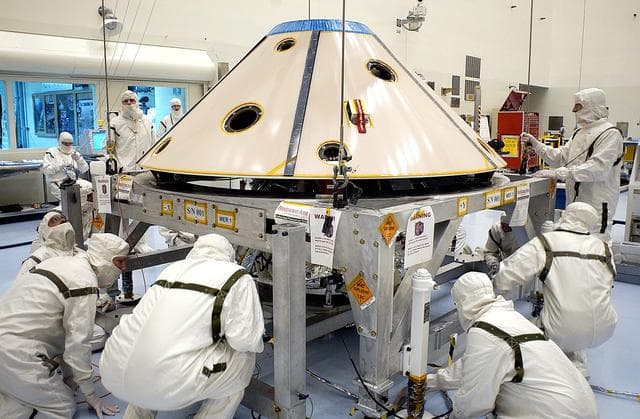
NASA image: KENNEDY SPACE CENTER, FLA. - Workers in the Payload Hazardous Servicing Facility check the placement of the backshell over the Mars Exploration Rover 1 (MER-1).  The backshell is a protective cover for the rover.  NASA's twin Mars Exploration Rovers are designed to study the history of water on Mars. These robotic geologists are equipped with a robotic arm, a drilling tool, three spectrometers, and four pairs of cameras that allow them to have a human-like, 3D view of the terrain. Each rover could travel as far as 100 meters in one day to act as Mars scientists' eyes and hands, exploring an environment where humans can't yet go.  MER-1 is scheduled to launch June 25 as MER-B aboard a Delta II rocket from Cape Canaveral Air Force Station.
Image
May 10, 2003

KENNEDY SPACE CENTER, FLA. - Workers in the Payload Hazardous Servicing Facility check the placement of the backshell over the Mars Exploration Rover 1 (MER-1). The backshell is a protective cover for the rover. NASA's twin Mars Exploration Rovers are designed to study the history of water on Mars. These robotic geologists are equipped with a robotic arm, a drilling tool, three spectrometers, and four pairs of cameras that allow them to have a human-like, 3D view of the terrain. Each rover could travel as far as 100 meters in one day to act as Mars scientists' eyes and hands, exploring an environment where humans can't yet go. MER-1 is scheduled to launch June 25 as MER-B aboard a Delta II rocket from Cape Canaveral Air Force Station.

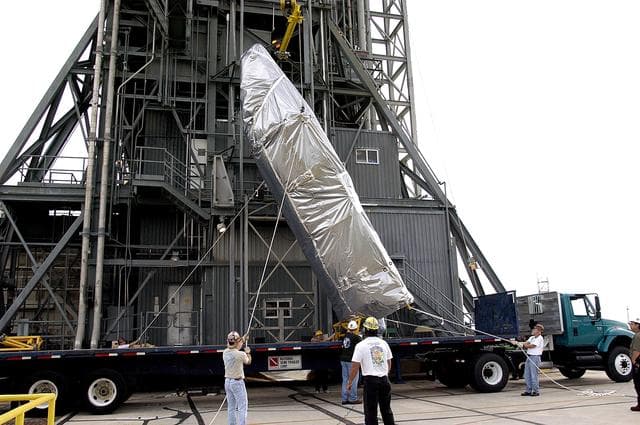
NASA image: KENNEDY SPACE CENTER, FLA. - At Launch Complex 17-A, Cape Canaveral Air Force Station, the second half of the fairing for the Mars Exploration Rover 2 (MER-2/MER-A) is raised to a vertical position for its lift up the launch tower.  The fairing will be installed around the payload for protection during launch.  The MER Mission consists of two identical rovers designed to cover roughly 110 yards each Martian day over various terrain. Each rover will carry five scientific instruments that will allow it to search for evidence of liquid water that may have been present in the planet's past.  Identical to each other, the rovers will land at different regions of Mars.  Launch date for MER-A  is scheduled for June 5.
Image
Apr 30, 2003

KENNEDY SPACE CENTER, FLA. - At Launch Complex 17-A, Cape Canaveral Air Force Station, the second half of the fairing for the Mars Exploration Rover 2 (MER-2/MER-A) is raised to a vertical position for its lift up the launch tower. The fairing will be installed around the payload for protection during launch. The MER Mission consists of two identical rovers designed to cover roughly 110 yards each Martian day over various terrain. Each rover will carry five scientific instruments that will allow it to search for evidence of liquid water that may have been present in the planet's past. Identical to each other, the rovers will land at different regions of Mars. Launch date for MER-A is scheduled for June 5.

KENNEDY SPACE CENTER, FLA. - At Launch Complex 17-A, Cape Canaveral Air Force Station, the second half of the...

NASA image: The backshell for the Mars Exploration Rover 1 (MER-1) is moved toward the rover (foreground, left).  The backshell is a protective cover for the rover.  NASA's twin Mars Exploration Rovers are designed to study the history of water on Mars. These robotic geologists are equipped with a robotic arm, a drilling tool, three spectrometers, and four pairs of cameras that allow them to have a human-like, 3D view of the terrain. Each rover could travel as far as 100 meters in one day to act as Mars scientists' eyes and hands, exploring an environment where humans can't yet go.  MER-1 is scheduled to launch June 25 as MER-B aboard a Delta II rocket from Cape Canaveral Air Force Station.
Image
May 10, 2003

The backshell for the Mars Exploration Rover 1 (MER-1) is moved toward the rover (foreground, left). The backshell is a protective cover for the rover. NASA's twin Mars Exploration Rovers are designed to study the history of water on Mars. These robotic geologists are equipped with a robotic arm, a drilling tool, three spectrometers, and four pairs of cameras that allow them to have a human-like, 3D view of the terrain. Each rover could travel as far as 100 meters in one day to act as Mars scientists' eyes and hands, exploring an environment where humans can't yet go. MER-1 is scheduled to launch June 25 as MER-B aboard a Delta II rocket from Cape Canaveral Air Force Station.

The backshell for the Mars Exploration Rover 1 (MER-1) is moved toward the rover (foreground, left). The backshell...

PreviousPage 89 of 100Next

Frequently Asked Questions About NASA Images

Are NASA images free to use?+
Yes, most NASA images are in the public domain and are free to use for educational, informational, and personal purposes. NASA's media usage guidelines state that NASA material is not copyrighted unless otherwise noted. However, the NASA logo and certain insignia are protected. Some images may include identifiable individuals or third-party content that requires additional permissions. Always check the specific image's usage rights and credit NASA as the source.
How many images does NASA have?+
NASA's Image and Video Library contains over 140,000 publicly accessible images, videos, and audio files spanning the agency's entire history, from the Mercury program of the 1960s to the latest James Webb Space Telescope discoveries. The collection grows daily as new missions capture imagery and archival materials are digitized. Individual mission archives, such as Mars rover photos, contain hundreds of thousands of additional images.
Can I download NASA images?+
Yes, you can download NASA images in multiple resolutions directly from this gallery. Each image detail page provides download links for original (full resolution), large (1920px), medium (960px), small (480px), and thumbnail sizes. NASA encourages the public to use these images for education, media, and personal projects. High-resolution originals are ideal for printing and professional use.

Explore More NASA Content

Astronomy Picture of the Day

Daily curated space image

Mars Rover Photos

Curiosity & Perseverance images

Earth from Space

DSCOVR EPIC daily images

Launch Schedule

Upcoming rocket launches

Space News

Mission updates & discoveries

KENNEDY SPACE CENTER, FLA. - The SciSat-1 spacecraft is revealed after being uncrated at Vandenberg Air Force Base,...

KSC
KSC

KENNEDY SPACE CENTER, FLA. - Workers in the Payload Hazardous Servicing Facility lower the backshell over the Mars...

KSC

KENNEDY SPACE CENTER, FLA. - In the high bay clean room at the Astrotech Space Operations processing facilities near...

KSC

KENNEDY SPACE CENTER, FLA. - In the Space Station Processing Facility, astronaut Stephen Frick and STS-114 Mission...

KSC

KENNEDY SPACE CENTER, FLA. - In the Space Station Processing Facility, STS-114 Mission Specialist Andrew Thomas...

KSC

KENNEDY SPACE CENTER, FLA. - In the Payload Hazardous Servicing Facility, workers check one of the cruise stage...

KSC

KENNEDY SPACE CENTER, FLA. - At Launch Complex 17-A, Cape Canaveral Air Force Station, the second half of the...

KSC

KENNEDY SPACE CENTER, FLA. - Workers in the Payload Hazardous Servicing Facility guide the backshell being lowered...

KSC

KENNEDY SPACE CENTER, FLA. - In the Payload Hazardous Servicing Facility, workers lower the backshell with the Mars...

KSC

KENNEDY SPACE CENTER, FLA. - Workers at Vandenberg Air Force Base, Calif., prepare to move the SciSat-1 spacecraft....

KSC

KENNEDY SPACE CENTER, FLA. - At Vandenberg Air Force Base, Calif., the Pegasus launch vehicle is moved toward its...

KSC

KENNEDY SPACE CENTER, FLA. - Workers in the Payload Hazardous Servicing Facility lower the backshell over the Mars...

KSC

VANDENBERG AIR FORCE BASE, CALIF. - The L-1011 carrier aircraft is ready for flight after undergoing a Combined...

KSC

KENNEDY SPACE CENTER, FLA. - In the Payload Hazardous Servicing Facility, workers check the attachment between the...

KSC

KENNEDY SPACE CENTER, FLA. - In the Space Station Processing Facility, astronaut Lee Archambault and STS-114 Mission...

KSC

VANDENBERG AIR FORCE BASE, CALIF. - Outside the clean room at Vandenberg Air Force Base, Calif., the SciSat-1...

KSC

KENNEDY SPACE CENTER, FLA. - Inside the hangar at Vandenberg Air Force Base, Calif., workers wait for the Pegasus...

KSC

KENNEDY SPACE CENTER, FLA. - Daniel L. Tweed, with the Facilities Division, NASA Spaceport Services, addresses...

KSC

KENNEDY SPACE CENTER, FLA. - Workers in the Payload Hazardous Servicing Facility check the placement of the...

KSC
KSC
KSC