
Image
Dec 8, 2017
NASA's BARREL Mission in Sweden
The faint green glow of aurora can be seen above the clouds at Esrange Space Center in this photo from Aug. 23,...
GSFC

Image
Dec 8, 2017
Ballooning in the constant sun of the South Pole summer
The BARREL team at the South African research station, SANAE IV, lay out the 130-foot-long balloon on the ground to...
GSFC

Image
Dec 8, 2017
NASA’s Hubble Sees a Cosmic Caterpillar
This light-year-long knot of interstellar gas and dust resembles a caterpillar on its way to a feast. But the meat...
GSFC

Image
Dec 8, 2017
Ballooning in the constant sun of the South Pole summer
The BARREL instrument in Antarctica– prior to being encased in its protective box – destined to float beneath a...
GSFC

Image
Dec 8, 2017
NASA's BARREL Mission in Sweden
The BARREL team inflates the balloon to launch their fifth scientific payload from Esrange Space Center near Kiruna,...
GSFC

Image
Dec 8, 2017
Ballooning in the constant sun of the South Pole summer
The Halley station team members assisted the BARREL team with the launches. Here, one gives the thumbs up to start...
GSFC

Image
Dec 8, 2017
Ballooning in the constant sun of the South Pole summer
A group picture of all the researchers – from various science projects -- at the South African research station,...
GSFC

Image
Dec 8, 2017
Ballooning in the constant sun of the South Pole summer
A view looking over the payload – the instruments that fly under a balloon – while the BARREL balloon inflates. The...
GSFC

Image
Dec 8, 2017
Ballooning in the constant sun of the South Pole summer
The BARREL team at Halley Research Station in Antarctica, work to inflate a balloon. The long tube on the left is...
GSFC

Image
Dec 8, 2017
NASA's BARREL Mission in Sweden
Four reindeer walk past the BARREL payload on the launch pad at Esrange Space Center near Kiruna, Sweden. The BARREL...
GSFC

Image
Dec 8, 2017
NASA's BARREL Mission in Sweden
The first BARREL balloon is inflated just before its launch on Aug. 13, 2016, from Esrange Space Center near Kiruna,...
GSFC

Image
Dec 8, 2017
NASA's BARREL Mission in Sweden
A BARREL payload sits on the launch pad at Esrange Space Center near Kiruna, Sweden. The BARREL team is at Esrange...
GSFC

Image
Dec 8, 2017
NASA's BARREL Mission in Sweden
A member of the BARREL team prepares a payload for launch from Esrange Space Center on Aug. 29, 2016. Throughout...
GSFC

Image
Dec 8, 2017
NASA's BARREL Mission in Sweden
Prior to launch, the BARREL team works on the payload from the launch pad at Esrange Space Center near Kiruna,...
GSFC
Image
Jan 13, 2004
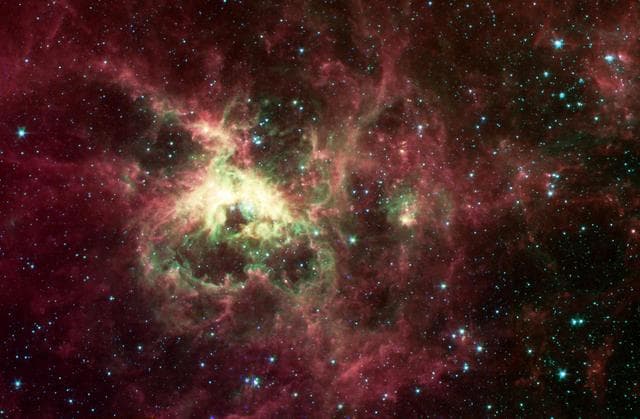
The Tarantula Nebula
NASA Spitzer Space Telescope, formerly known as the Space Infrared Telescope Facility, has captured in stunning...
JPL

Image
Dec 8, 2017
Hubble Sees a “Behemoth” Bleeding Atmosphere Around a Warm Exoplanet
Astronomers using NASA’s Hubble Space Telescope have discovered an immense cloud of hydrogen dubbed “The Behemoth”...
GSFC

Image
Dec 8, 2017
NASA's BARREL Mission in Sweden
A BARREL team member recovers the second payload after it landed. The BARREL team is at Esrange Space Center near...
GSFC

Image
Dec 8, 2017
Ballooning in the constant sun of the South Pole summer
While large compared to a human, BARREL balloons are actually much smaller than typical science balloons, which can...
GSFC

Image
Dec 8, 2017
NASA's BARREL Mission in Sweden
The third BARREL balloon floats towards the stratosphere on Aug. 21, 2016. This payload flew for nearly 30 hours,...
GSFC

Image
Dec 8, 2017
Ballooning in the constant sun of the South Pole summer
Members of the BARREL team in Antarctica jump up and down in what they call the Low Wind Dance as they hope for the...
GSFC

Image
Dec 8, 2017
NASA’s BARREL Mission Launches 20 Balloons
A BARREL balloon floats into the sky as it is partially filled. When fully inflated, each balloon is 90 feet in...
GSFC
Image
Mar 13, 1989
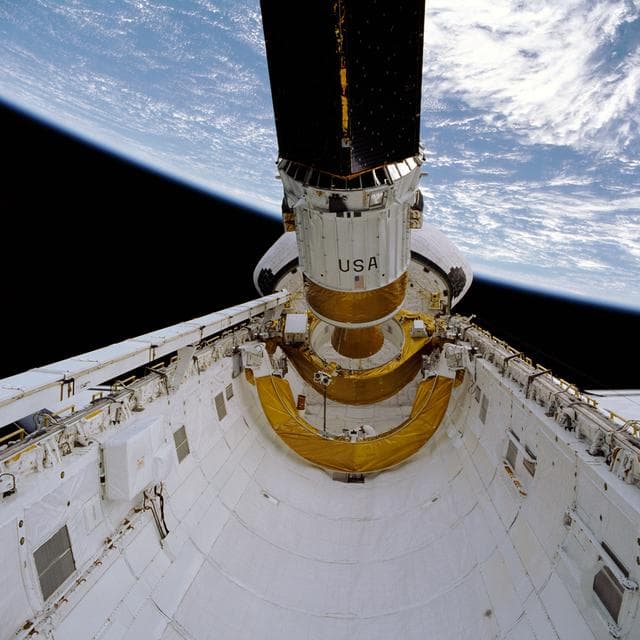
STS-29 IUS / TDRS-D deployment from Discovery, OV-103, payload bay
STS029-71-026 (13 March 1989) --- The Tracking and Data Relay Satellite (TDRS-D) is tilted in the cargo bay prior to...
JSC
Video
Jul 25, 2022
Your Orbiting Laboratory: Space Station Benefits
The International Space Station is a modern marvel. Only 400 kilometers (250 miles) above our heads, it streaks...
HQ
![NASA image: NASA Science Live: Our Next Solar Cycle [Episode 21]](/_next/image?url=https%3A%2F%2Fimages-assets.nasa.gov%2Fvideo%2FNASA%20Science%20Live%20Our%20Next%20Solar%20Cycle%2FNASA%20Science%20Live%20Our%20Next%20Solar%20Cycle~thumb.jpg&w=1920&q=75)
Video
Sep 15, 2020
NASA Science Live: Our Next Solar Cycle [Episode 21]
The Sun goes through regular cycles of activity approximately every 11 years, and tracking these cycles is a key...
HQ