CosmosObservatory
Explore
Solar System
Live
Learn
Tools
About
Cosmos Observatory
ToolsAbout
Cosmos Observatory

Explore the universe through NASA data, real-time ISS tracking, Mars rover imagery, asteroid monitoring, and comprehensive space encyclopedia. Your gateway to the cosmos.

Explore

  • APOD
  • Mars Rovers
  • Earth Imagery
  • NASA Gallery
  • ISS Tracker

Data

  • Asteroids
  • Solar System
  • Exoplanets
  • Space Weather
  • Launches

Tools

  • Glossary
  • News
  • Calculators

Legal

  • About
  • Privacy Policy
  • Terms of Use
  • Space Tools
  • Contact

Stay updated with the cosmos

Get weekly digests of APOD highlights, upcoming launches, and space events.

© 2026 Cosmos Observatory. All rights reserved. Built with for space enthusiasts.

This website is not affiliated with, maintained, authorized, endorsed by, or in any way officially connected with NASA or any of its subsidiaries or affiliates. All NASA imagery is in the public domain unless otherwise noted. Data sourced from NASA Open APIs, Launch Library 2, and other open data services.

NASA Gallery

Explore NASA's vast collection of space images, videos, and audio from missions past and present.

  1. Home
  2. /
  3. NASA Gallery

NASA's Image and Video Library: A Visual Archive of Space Exploration

NASA's Image and Video Library is one of the most comprehensive public archives of space imagery in the world, containing over 140,000 images, videos, and audio recordings spanning more than six decades of space exploration. From the earliest Mercury and Gemini missions through the Apollo Moon landings, the Space Shuttle era, and today's cutting-edge observations from the James Webb Space Telescope, this collection documents humanity's journey into the cosmos.

The library includes imagery from diverse sources: telescopes like Hubble and Webb that capture deep-space nebulae, galaxies, and exoplanets; planetary missions like the Mars rovers ( browse Mars photos) and Cassini at Saturn; Earth observation satellites ( see EPIC imagery); astronaut photography from the ISS; and documentation of rocket launches, spacecraft assembly, and ground testing. Most NASA images are in the public domain and free to download at full resolution for educational, editorial, and personal use.

Use the search bar above to find specific subjects — try queries like "Apollo 11," "Hubble Deep Field," "Mars surface," or "astronaut EVA." You can also filter by media type (image, video, or audio). For a daily curated experience, visit the Astronomy Picture of the Day.

Showing results for "Low"

5,652 results found - Page 72 of 236

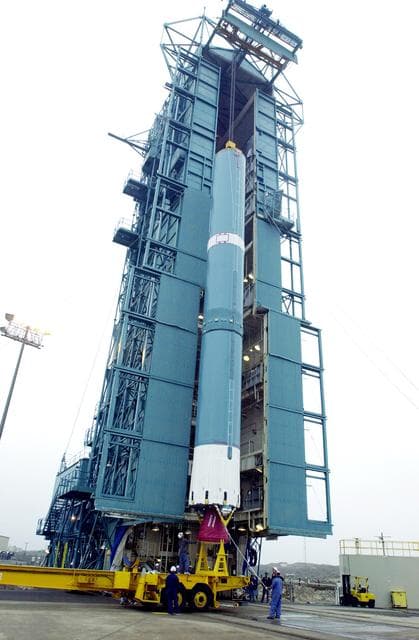
NASA image: VANDENBERG AFB, CALIF. -  The first stage of the Delta II launch vehicle for the Gravity Probe B experiment is ready to be lifted up the mobile service tower on Space Launch Complex 2, Vandenberg Air Force Base, Calif.  The Gravity Probe B will launch a payload of four gyroscopes into low-Earth polar orbit to test two extraordinary predictions of Albert Einstein’s general theory of relativity: the geodetic effect (how space and time are warped by the presence of the Earth) and frame dragging (how Earth’s rotation drags space and time around with it). Once in orbit, for 18 months each gyroscope’s spin axis will be monitored as it travels through local spacetime, observing and measuring these effects.  The experiment was developed by Stanford University, Lockheed Martin and NASA’s Marshall Space Flight Center.  The targeted launch date is Dec. 6, 2003.
Image
Sep 15, 2003

VANDENBERG AFB, CALIF. - The first stage of the Delta II launch vehicle for the Gravity Probe B experiment is ready to be lifted up the mobile service tower on Space Launch Complex 2, Vandenberg Air Force Base, Calif. The Gravity Probe B will launch a payload of four gyroscopes into low-Earth polar orbit to test two extraordinary predictions of Albert Einstein’s general theory of relativity: the geodetic effect (how space and time are warped by the presence of the Earth) and frame dragging (how Earth’s rotation drags space and time around with it). Once in orbit, for 18 months each gyroscope’s spin axis will be monitored as it travels through local spacetime, observing and measuring these effects. The experiment was developed by Stanford University, Lockheed Martin and NASA’s Marshall Space Flight Center. The targeted launch date is Dec. 6, 2003.

VANDENBERG AFB, CALIF. - The first stage of the Delta II launch vehicle for the Gravity Probe B experiment is ready...

KSC
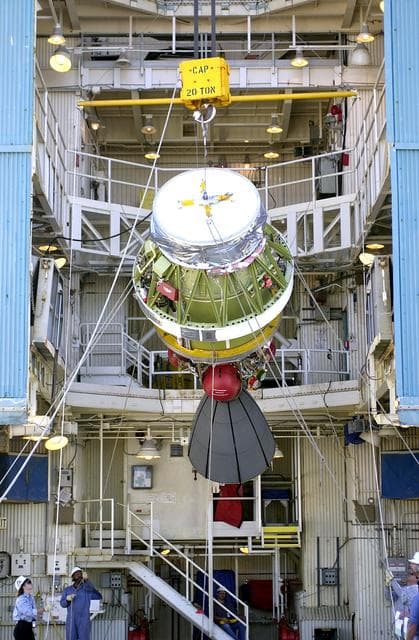
NASA image: VANDENBERG AFB, CALIF. -  The second stage of the Delta II launch vehicle for the Gravity Probe B experiment is lifted up the mobile service tower on Space Launch Complex 2, Vandenberg Air Force Base, Calif.  The Gravity Probe B will launch a payload of four gyroscopes into low-Earth polar orbit to test two extraordinary predictions of Albert Einstein’s general theory of relativity: the geodetic effect (how space and time are warped by the presence of the Earth) and frame dragging (how Earth’s rotation drags space and time around with it). Once in orbit, for 18 months each gyroscope’s spin axis will be monitored as it travels through local spacetime, observing and measuring these effects.  The experiment was developed by Stanford University, Lockheed Martin and NASA’s Marshall Space Flight Center.  The targeted launch date is Dec. 6, 2003.
Image
Sep 18, 2003

VANDENBERG AFB, CALIF. - The second stage of the Delta II launch vehicle for the Gravity Probe B experiment is lifted up the mobile service tower on Space Launch Complex 2, Vandenberg Air Force Base, Calif. The Gravity Probe B will launch a payload of four gyroscopes into low-Earth polar orbit to test two extraordinary predictions of Albert Einstein’s general theory of relativity: the geodetic effect (how space and time are warped by the presence of the Earth) and frame dragging (how Earth’s rotation drags space and time around with it). Once in orbit, for 18 months each gyroscope’s spin axis will be monitored as it travels through local spacetime, observing and measuring these effects. The experiment was developed by Stanford University, Lockheed Martin and NASA’s Marshall Space Flight Center. The targeted launch date is Dec. 6, 2003.
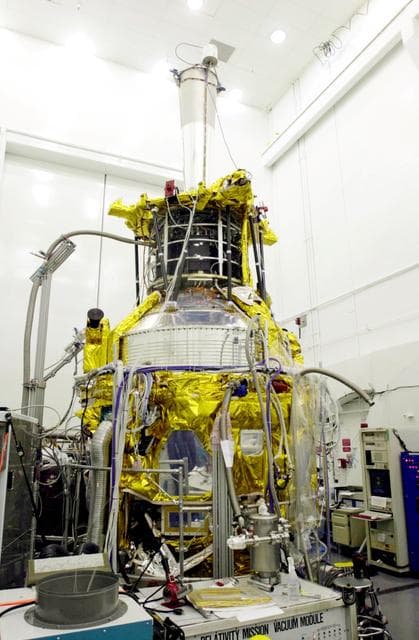
NASA image: VANDENBERG AFB, CALIF. -   In the spacecraft processing facility on North Vandenberg Air Force Base, the Gravity Probe B experiment sits on an assembly and test stand where it has been subject to various prelaunch testing.  The Gravity Probe B will launch a payload of four gyroscopes into low-Earth polar orbit to test two extraordinary predictions of Albert Einstein’s general theory of relativity: the geodetic effect (how space and time are warped by the presence of the Earth) and frame dragging (how Earth’s rotation drags space and time around with it). Once in orbit, for 18 months each gyroscope’s spin axis will be monitored as it travels through local spacetime, observing and measuring these effects.  The experiment was developed by Stanford University, Lockheed Martin and NASA’s Marshall Space Flight Center.   The targeted launch date is Dec. 6, 2003.
Image
Sep 12, 2003

VANDENBERG AFB, CALIF. - In the spacecraft processing facility on North Vandenberg Air Force Base, the Gravity Probe B experiment sits on an assembly and test stand where it has been subject to various prelaunch testing. The Gravity Probe B will launch a payload of four gyroscopes into low-Earth polar orbit to test two extraordinary predictions of Albert Einstein’s general theory of relativity: the geodetic effect (how space and time are warped by the presence of the Earth) and frame dragging (how Earth’s rotation drags space and time around with it). Once in orbit, for 18 months each gyroscope’s spin axis will be monitored as it travels through local spacetime, observing and measuring these effects. The experiment was developed by Stanford University, Lockheed Martin and NASA’s Marshall Space Flight Center. The targeted launch date is Dec. 6, 2003.
NASA image: VANDENBERG AFB, CALIF. -   The first stage of the Delta II launch vehicle for the Gravity Probe B experiment is lifted up the mobile service tower on Space Launch Complex 2, Vandenberg Air Force Base, Calif.  The Gravity Probe B will launch a payload of four gyroscopes into low-Earth polar orbit to test two extraordinary predictions of Albert Einstein’s general theory of relativity: the geodetic effect (how space and time are warped by the presence of the Earth) and frame dragging (how Earth’s rotation drags space and time around with it). Once in orbit, for 18 months each gyroscope’s spin axis will be monitored as it travels through local spacetime, observing and measuring these effects.  The experiment was developed by Stanford University, Lockheed Martin and NASA’s Marshall Space Flight Center.  The targeted launch date is Dec. 6, 2003.
Image
Sep 15, 2003

VANDENBERG AFB, CALIF. - The first stage of the Delta II launch vehicle for the Gravity Probe B experiment is lifted up the mobile service tower on Space Launch Complex 2, Vandenberg Air Force Base, Calif. The Gravity Probe B will launch a payload of four gyroscopes into low-Earth polar orbit to test two extraordinary predictions of Albert Einstein’s general theory of relativity: the geodetic effect (how space and time are warped by the presence of the Earth) and frame dragging (how Earth’s rotation drags space and time around with it). Once in orbit, for 18 months each gyroscope’s spin axis will be monitored as it travels through local spacetime, observing and measuring these effects. The experiment was developed by Stanford University, Lockheed Martin and NASA’s Marshall Space Flight Center. The targeted launch date is Dec. 6, 2003.
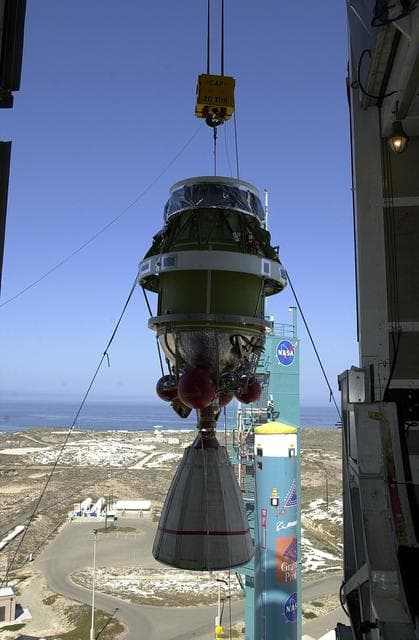
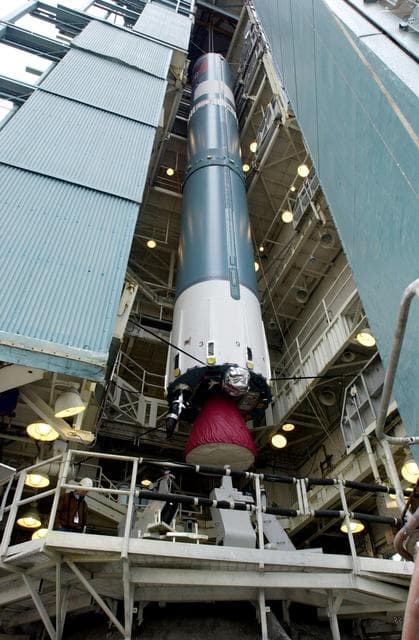
NASA image: VANDENBERG AFB, CALIF. -  Viewed from inside, the second stage of the Delta II launch vehicle for the Gravity Probe B experiment is lifted up the mobile service tower on Space Launch Complex 2, Vandenberg Air Force Base, Calif.   Behind it is the first stage of the Delta II.  The Gravity Probe B will launch a payload of four gyroscopes into low-Earth polar orbit to test two extraordinary predictions of Albert Einstein’s general theory of relativity: the geodetic effect (how space and time are warped by the presence of the Earth) and frame dragging (how Earth’s rotation drags space and time around with it). Once in orbit, for 18 months each gyroscope’s spin axis will be monitored as it travels through local spacetime, observing and measuring these effects.  The experiment was developed by Stanford University, Lockheed Martin and NASA’s Marshall Space Flight Center.  The targeted launch date is Dec. 6, 2003.
Image
Sep 18, 2003

VANDENBERG AFB, CALIF. - Viewed from inside, the second stage of the Delta II launch vehicle for the Gravity Probe B experiment is lifted up the mobile service tower on Space Launch Complex 2, Vandenberg Air Force Base, Calif. Behind it is the first stage of the Delta II. The Gravity Probe B will launch a payload of four gyroscopes into low-Earth polar orbit to test two extraordinary predictions of Albert Einstein’s general theory of relativity: the geodetic effect (how space and time are warped by the presence of the Earth) and frame dragging (how Earth’s rotation drags space and time around with it). Once in orbit, for 18 months each gyroscope’s spin axis will be monitored as it travels through local spacetime, observing and measuring these effects. The experiment was developed by Stanford University, Lockheed Martin and NASA’s Marshall Space Flight Center. The targeted launch date is Dec. 6, 2003.

NASA image: Strong Extratropical Cyclone Over the US Midwest
Image
Dec 8, 2017

Strong Extratropical Cyclone Over the US Midwest

NASA image acquired October 26, 2010 The storm that swept across the center of the United States on October 26 and...

GSFC
NASA image: Satellite Shows Developing U.S. Nor'easter
Image
Dec 8, 2017

Satellite Shows Developing U.S. Nor'easter

National Weather Service forecasters have been tracking a low pressure area that moved from the Midwest into the...

GSFC
NASA image: Checkout Tests of X-59 Landing Gear
Image
Apr 19, 2023

Checkout Tests of X-59 Landing Gear

Technicians perform landing gear checkout testing at Lockheed Martin Skunk Works in Palmdale, California. These...

LRC
NASA image: Engine Test Fit Install
Image
Oct 28, 2022

Engine Test Fit Install

A Lockheed Martin Skunk Works technician takes a break for a photo. Note that the technician is wearing protective...

LRC
NASA image: Manufacturing Area From Above
Image
Aug 18, 2021

Manufacturing Area From Above

A panoramic side view of the left top of the X-59 supersonic plane with the tail on and the nose in the process of...

LRC
NASA image: SEG 210 Forebody
Image
Jul 28, 2020

SEG 210 Forebody

Event: SEG 210 Forebody A Lockheed Martin technician works on the ejection seat support structure and once complete,...

LRC
NASA image: Move to Fuel Barn
Image
Feb 18, 2022

Move to Fuel Barn

The X-59 is transported to the fuel barn at Lockheed Martin in Fort Worth, Texas to undergo fuel tank calibration...

LRC
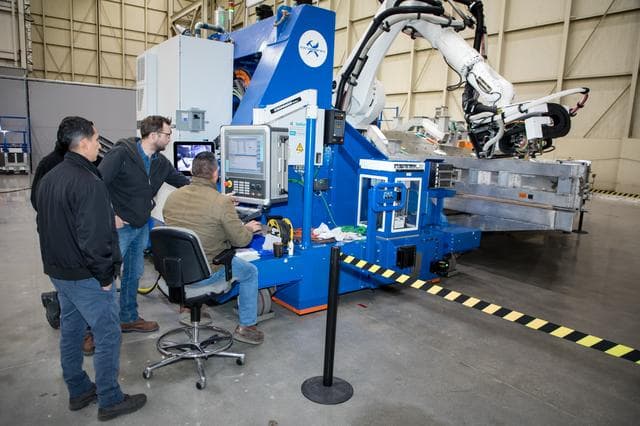
NASA image: SEG 410 Main Wing, COBRA Drillng Machine, Drilling Lower Wing Sk
Image
Jan 7, 2020

SEG 410 Main Wing, COBRA Drillng Machine, Drilling Lower Wing Sk

Lockheed Martin Photography By Garry Tice 1011 Lockheed Way, Palmdale, Ca. 93599 Event: SEG 410 Main Wing, COBRA...

HQ
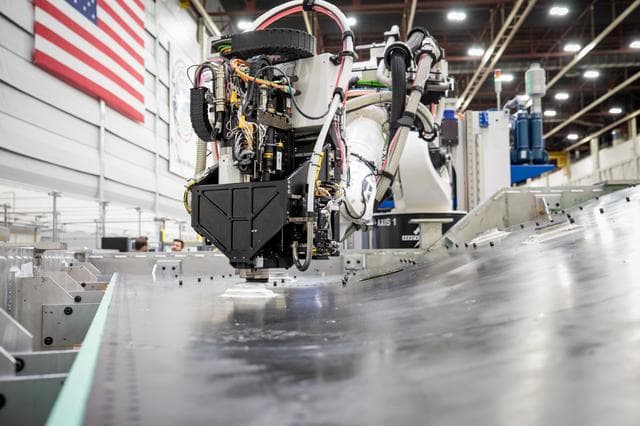
NASA image: SEG 410 Main Wing, COBRA Drillng Machine, Drilling Lower Wing Sk
Image
Jan 7, 2020

SEG 410 Main Wing, COBRA Drillng Machine, Drilling Lower Wing Sk

Lockheed Martin Photography By Garry Tice 1011 Lockheed Way, Palmdale, Ca. 93599 Event: SEG 410 Main Wing, COBRA...

HQ
NASA image: Fuel Barn Testing
Image
Mar 1, 2022

Fuel Barn Testing

The X-59 sits in the fuel barn at Lockheed Martin in Fort Worth, Texas. While in the fuel barn, the X-59 underwent...

LRC
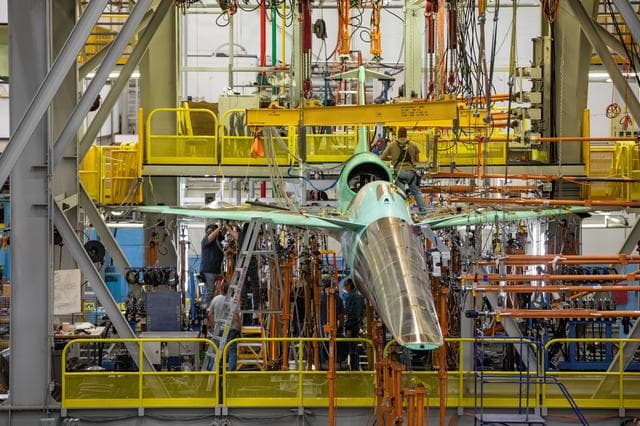
NASA image: X-59 - Various Angles in Test Fixture
Image
Jan 10, 2022

X-59 - Various Angles in Test Fixture

NASA’s X-59 undergoes a structural stress test at Lockheed Martin’s facility at Fort Worth, Texas. The X-59 is a...

LRC
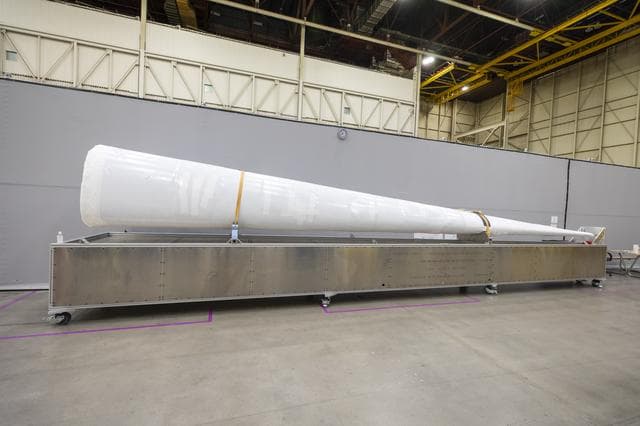
NASA image: SEG 230 Nose
Image
Aug 11, 2020

SEG 230 Nose

Event: SEG 230 Nose The X-59’s nose is wrapped up safely and rests on a dolly before the team temporarily attaches...

LRC
NASA image: Move to Fuel Barn
Image
Feb 18, 2022

Move to Fuel Barn

The X-59 is transported to the fuel barn at Lockheed Martin in Fort Worth, Texas to undergo fuel tank calibration...

LRC
NASA image: Manufacturing Area From Above
Image
Aug 26, 2021

Manufacturing Area From Above

A overhead view of the X-59 with its nose on. The X-59’s nose is 38-feet long – approximately one third of the...

LRC
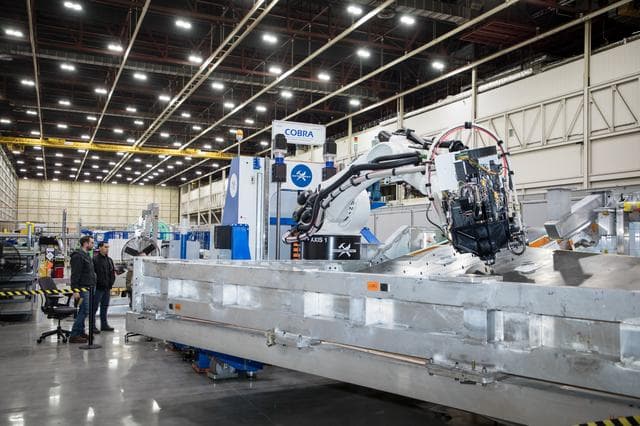
NASA image: SEG 410 Main Wing, COBRA Drillng Machine, Drilling Lower Wing Sk
Image
Jan 7, 2020

SEG 410 Main Wing, COBRA Drillng Machine, Drilling Lower Wing Sk

Lockheed Martin Photography By Garry Tice 1011 Lockheed Way, Palmdale, Ca. 93599 Event: SEG 410 Main Wing, COBRA...

HQ
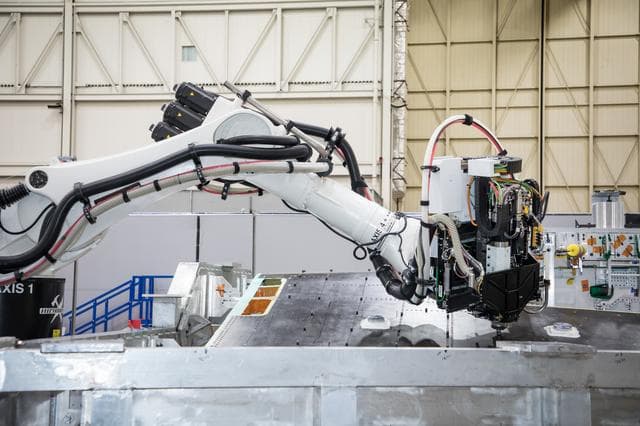
NASA image: SEG 410 Main Wing, COBRA Drillng Machine, Drilling Lower Wing Sk
Image
Jan 7, 2020

SEG 410 Main Wing, COBRA Drillng Machine, Drilling Lower Wing Sk

Lockheed Martin Photography By Garry Tice 1011 Lockheed Way, Palmdale, Ca. 93599 Event: SEG 410 Main Wing, COBRA...

HQ
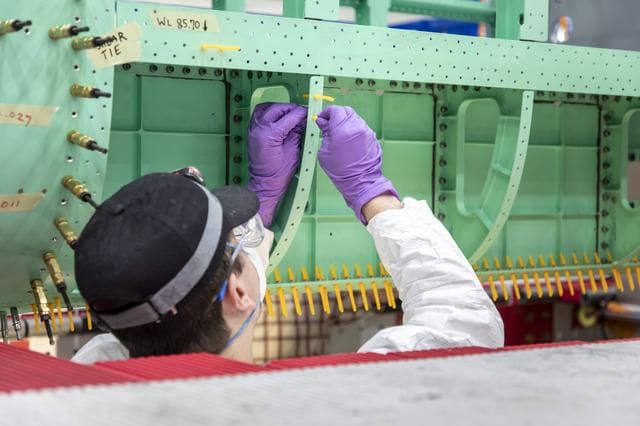
NASA image: LRC-2022-H1_P_X-59-8
Image
Jul 22, 2020

LRC-2022-H1_P_X-59-8

A Lockheed Martin technician prepares holes for installation of the fuselage panel on the X-59. The fuselage is the...

LRC
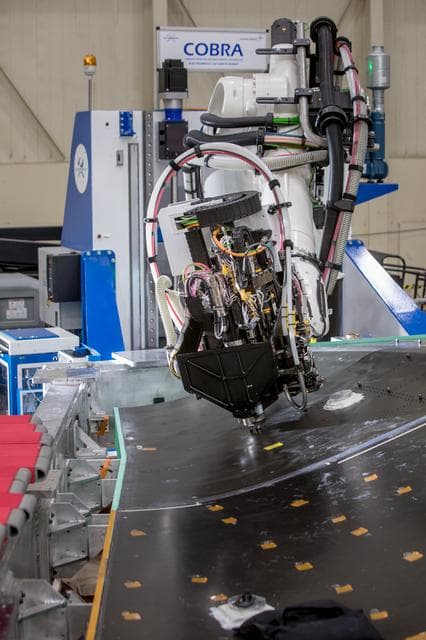
NASA image: SEG 410 Main Wing, COBRA Drillng Machine, Drilling Lower Wing Sk
Image
Dec 23, 2019

SEG 410 Main Wing, COBRA Drillng Machine, Drilling Lower Wing Sk

Lockheed Martin Photography By Garry Tice 1011 Lockheed Way, Palmdale, Ca. 93599 Event: SEG 410 Main Wing, COBRA...

HQ
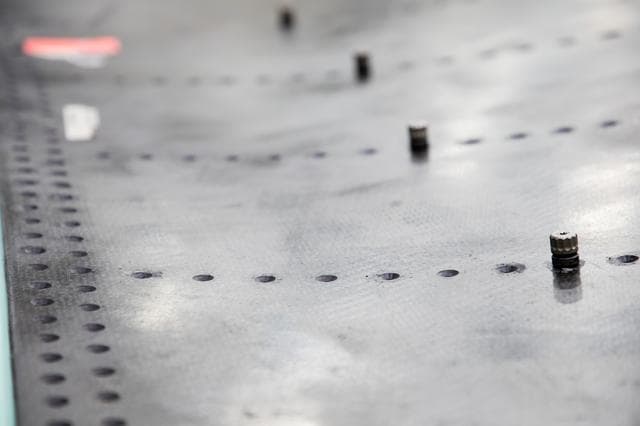
NASA image: SEG 410 Main Wing, COBRA Drillng Machine, Drilling Lower Wing Sk
Image
Jan 7, 2020

SEG 410 Main Wing, COBRA Drillng Machine, Drilling Lower Wing Sk

Lockheed Martin Photography By Garry Tice 1011 Lockheed Way, Palmdale, Ca. 93599 Event: SEG 410 Main Wing, COBRA...

HQ
PreviousPage 72 of 100Next

Frequently Asked Questions About NASA Images

Are NASA images free to use?+
Yes, most NASA images are in the public domain and are free to use for educational, informational, and personal purposes. NASA's media usage guidelines state that NASA material is not copyrighted unless otherwise noted. However, the NASA logo and certain insignia are protected. Some images may include identifiable individuals or third-party content that requires additional permissions. Always check the specific image's usage rights and credit NASA as the source.
How many images does NASA have?+
NASA's Image and Video Library contains over 140,000 publicly accessible images, videos, and audio files spanning the agency's entire history, from the Mercury program of the 1960s to the latest James Webb Space Telescope discoveries. The collection grows daily as new missions capture imagery and archival materials are digitized. Individual mission archives, such as Mars rover photos, contain hundreds of thousands of additional images.
Can I download NASA images?+
Yes, you can download NASA images in multiple resolutions directly from this gallery. Each image detail page provides download links for original (full resolution), large (1920px), medium (960px), small (480px), and thumbnail sizes. NASA encourages the public to use these images for education, media, and personal projects. High-resolution originals are ideal for printing and professional use.

Explore More NASA Content

Astronomy Picture of the Day

Daily curated space image

Mars Rover Photos

Curiosity & Perseverance images

Earth from Space

DSCOVR EPIC daily images

Launch Schedule

Upcoming rocket launches

Space News

Mission updates & discoveries

VANDENBERG AFB, CALIF. - The second stage of the Delta II launch vehicle for the Gravity Probe B experiment is...

KSC

VANDENBERG AFB, CALIF. - In the spacecraft processing facility on North Vandenberg Air Force Base, the Gravity Probe...

KSC

VANDENBERG AFB, CALIF. - The first stage of the Delta II launch vehicle for the Gravity Probe B experiment is lifted...

KSC

VANDENBERG AFB, CALIF. - Viewed from inside, the second stage of the Delta II launch vehicle for the Gravity Probe B...

KSC