CosmosObservatory
Explore
Solar System
Live
Learn
Tools
About
Cosmos Observatory
ToolsAbout
Cosmos Observatory

Explore the universe through NASA data, real-time ISS tracking, Mars rover imagery, asteroid monitoring, and comprehensive space encyclopedia. Your gateway to the cosmos.

Explore

  • APOD
  • Mars Rovers
  • Earth Imagery
  • NASA Gallery
  • ISS Tracker

Data

  • Asteroids
  • Solar System
  • Exoplanets
  • Space Weather
  • Launches

Tools

  • Glossary
  • News
  • Calculators

Legal

  • About
  • Privacy Policy
  • Terms of Use
  • Space Tools
  • Contact

Stay updated with the cosmos

Get weekly digests of APOD highlights, upcoming launches, and space events.

© 2026 Cosmos Observatory. All rights reserved. Built with for space enthusiasts.

This website is not affiliated with, maintained, authorized, endorsed by, or in any way officially connected with NASA or any of its subsidiaries or affiliates. All NASA imagery is in the public domain unless otherwise noted. Data sourced from NASA Open APIs, Launch Library 2, and other open data services.

NASA Gallery

Explore NASA's vast collection of space images, videos, and audio from missions past and present.

  1. Home
  2. /
  3. NASA Gallery

NASA's Image and Video Library: A Visual Archive of Space Exploration

NASA's Image and Video Library is one of the most comprehensive public archives of space imagery in the world, containing over 140,000 images, videos, and audio recordings spanning more than six decades of space exploration. From the earliest Mercury and Gemini missions through the Apollo Moon landings, the Space Shuttle era, and today's cutting-edge observations from the James Webb Space Telescope, this collection documents humanity's journey into the cosmos.

The library includes imagery from diverse sources: telescopes like Hubble and Webb that capture deep-space nebulae, galaxies, and exoplanets; planetary missions like the Mars rovers ( browse Mars photos) and Cassini at Saturn; Earth observation satellites ( see EPIC imagery); astronaut photography from the ISS; and documentation of rocket launches, spacecraft assembly, and ground testing. Most NASA images are in the public domain and free to download at full resolution for educational, editorial, and personal use.

Use the search bar above to find specific subjects — try queries like "Apollo 11," "Hubble Deep Field," "Mars surface," or "astronaut EVA." You can also filter by media type (image, video, or audio). For a daily curated experience, visit the Astronomy Picture of the Day.

Showing results for "Employee"

4,256 results found - Page 58 of 178

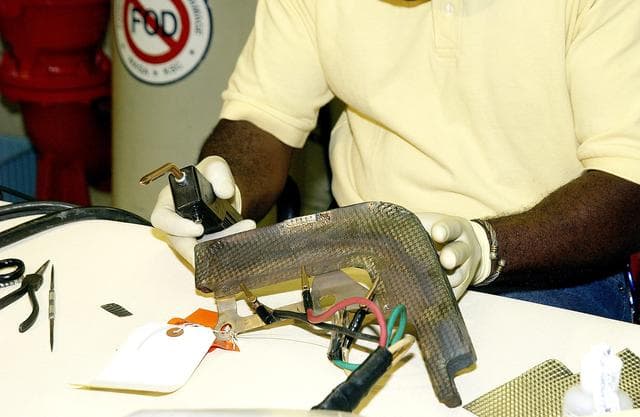
NASA image: KENNEDY SPACE CENTER, FLA. - United Space Alliance employee Anthony Simmons checks the electroweld he performed on an insulator inside a Reinforced Carbon Carbon panel.   The gray carbon composite RCC panels are attached to the leading edge of the wing of the orbiters to withstand the aerodynamic forces experienced during launch and reentry, which can reach as high as 800 pounds per square foot.  The operating range of RCC is from minus 250º F to about 3,000º F, the temperature produced by friction with the atmosphere during reentry.
Image
Sep 16, 2003

KENNEDY SPACE CENTER, FLA. - United Space Alliance employee Anthony Simmons checks the electroweld he performed on an insulator inside a Reinforced Carbon Carbon panel. The gray carbon composite RCC panels are attached to the leading edge of the wing of the orbiters to withstand the aerodynamic forces experienced during launch and reentry, which can reach as high as 800 pounds per square foot. The operating range of RCC is from minus 250º F to about 3,000º F, the temperature produced by friction with the atmosphere during reentry.

KENNEDY SPACE CENTER, FLA. - United Space Alliance employee Anthony Simmons checks the electroweld he performed on...

KSC
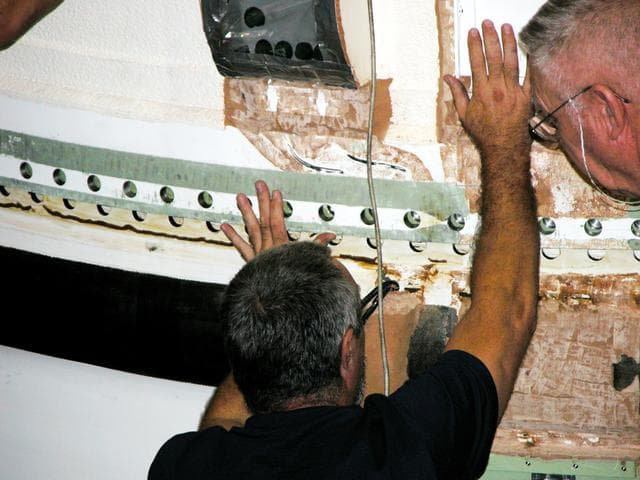
NASA image: KENNEDY SPACE CENTER, FLA. -  In the Vehicle Assembly Building, a KSC employee separates the forward assembly (nose cap and frustum) from a solid rocket booster (SRB) after removing the bolts.  The destacking is part of time and cycle activities.  The SRB was part of the stack on Atlantis originally scheduled for a March 1, 2003, launch on mission STS-114.  The SRBs and external tank were demated in February 2003.   The mission is now scheduled to occur no earlier than Sept. 12, 2004, on Atlantis.
Image
Dec 9, 2003

KENNEDY SPACE CENTER, FLA. - In the Vehicle Assembly Building, a KSC employee separates the forward assembly (nose cap and frustum) from a solid rocket booster (SRB) after removing the bolts. The destacking is part of time and cycle activities. The SRB was part of the stack on Atlantis originally scheduled for a March 1, 2003, launch on mission STS-114. The SRBs and external tank were demated in February 2003. The mission is now scheduled to occur no earlier than Sept. 12, 2004, on Atlantis.

KENNEDY SPACE CENTER, FLA. - In the Vehicle Assembly Building, a KSC employee separates the forward assembly (nose...

KSC
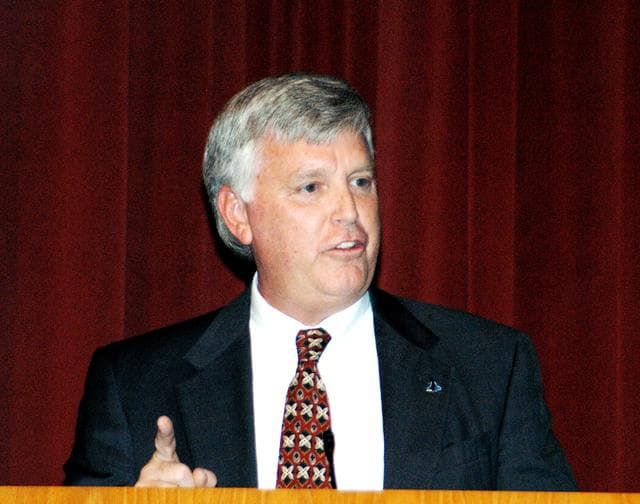
NASA image: KENNEDY SPACE CENTER, FLA. -  KSC Deputy Director James W. Kennedy addresses a group of KSC employees assembled in the KSC Training Auditorium. The occasion is the announcement of Kennedy as the next director of the NASA Kennedy Space Center (KSC) in Florida. He has served as KSC's deputy director since November 2002. He will succeed KSC Director Roy D. Bridges, who was appointed on June 13 to lead NASA's Langley Research Center, Hampton, Va.
Image
Jun 26, 2003

KENNEDY SPACE CENTER, FLA. - KSC Deputy Director James W. Kennedy addresses a group of KSC employees assembled in the KSC Training Auditorium. The occasion is the announcement of Kennedy as the next director of the NASA Kennedy Space Center (KSC) in Florida. He has served as KSC's deputy director since November 2002. He will succeed KSC Director Roy D. Bridges, who was appointed on June 13 to lead NASA's Langley Research Center, Hampton, Va.

KENNEDY SPACE CENTER, FLA. - KSC Deputy Director James W. Kennedy addresses a group of KSC employees assembled in...

KSC
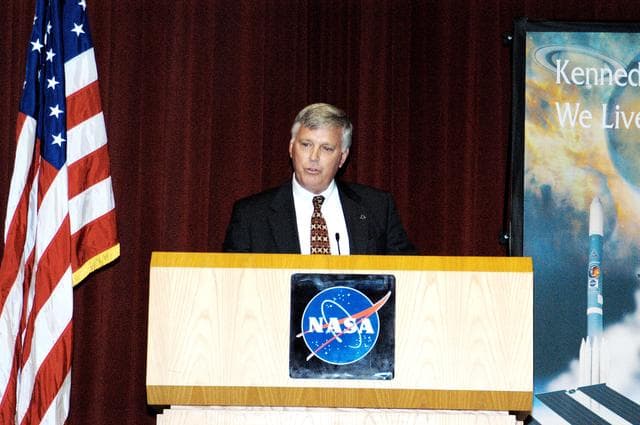
NASA image: KENNEDY SPACE CENTER, FLA. -  KSC Deputy Director James W. Kennedy addresses a group of KSC employees assembled in the KSC Training Auditorium. The occasion is the announcement of Kennedy as the next director of the NASA Kennedy Space Center (KSC) in Florida. He has served as KSC's deputy director since November 2002. He will succeed KSC Director Roy D. Bridges, who was appointed on June 13 to lead NASA's Langley Research Center, Hampton, Va.
Image
Jun 26, 2003

KENNEDY SPACE CENTER, FLA. - KSC Deputy Director James W. Kennedy addresses a group of KSC employees assembled in the KSC Training Auditorium. The occasion is the announcement of Kennedy as the next director of the NASA Kennedy Space Center (KSC) in Florida. He has served as KSC's deputy director since November 2002. He will succeed KSC Director Roy D. Bridges, who was appointed on June 13 to lead NASA's Langley Research Center, Hampton, Va.

KENNEDY SPACE CENTER, FLA. - KSC Deputy Director James W. Kennedy addresses a group of KSC employees assembled in...

KSC
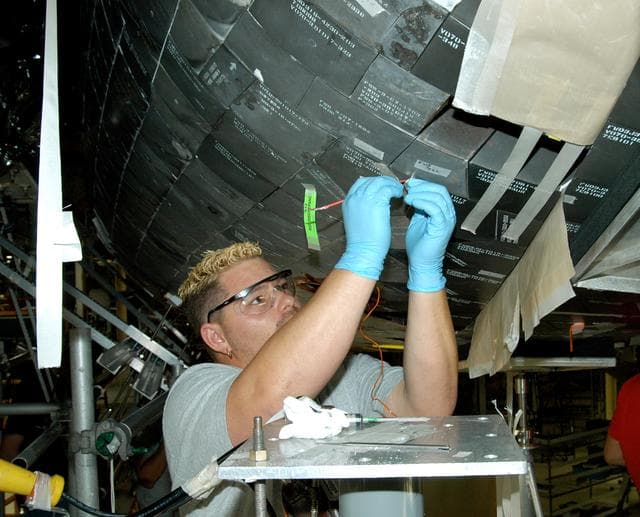
NASA image: KENNEDY SPACE CENTER, FLA. -  In the Orbiter Processing Facility, KSC employee Chris Moore repairs tile on the forward area of the orbiter Discovery. The vehicle has undergone Orbiter Major Modifications in the past year, which includes tile check and repair. The tiles are part of the Orbiter Thermal Protection System, thermal shields to protect against temperatures as high as 3,000° Fahrenheit, which are produced during descent for landing. Discovery is scheduled to fly on mission STS-121 to the International Space Station.
Image
Dec 9, 2003

KENNEDY SPACE CENTER, FLA. - In the Orbiter Processing Facility, KSC employee Chris Moore repairs tile on the forward area of the orbiter Discovery. The vehicle has undergone Orbiter Major Modifications in the past year, which includes tile check and repair. The tiles are part of the Orbiter Thermal Protection System, thermal shields to protect against temperatures as high as 3,000° Fahrenheit, which are produced during descent for landing. Discovery is scheduled to fly on mission STS-121 to the International Space Station.

KENNEDY SPACE CENTER, FLA. - In the Orbiter Processing Facility, KSC employee Chris Moore repairs tile on the...

KSC
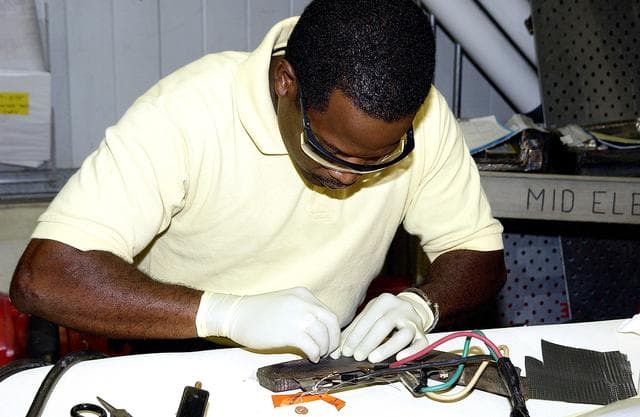
NASA image: KENNEDY SPACE CENTER, FLA. -  United Space Alliance employee Anthony Simmons prepares to electroweld a crack formed in the insulator inside a Reinforced Carbon Carbon panel.   The gray carbon composite RCC panels are attached to the leading edge of the wing of the orbiters to withstand the aerodynamic forces experienced during launch and reentry, which can reach as high as 800 pounds per square foot.  The operating range of RCC is from minus 250º F to about 3,000º F, the temperature produced by friction with the atmosphere during reentry.
Image
Sep 16, 2003

KENNEDY SPACE CENTER, FLA. - United Space Alliance employee Anthony Simmons prepares to electroweld a crack formed in the insulator inside a Reinforced Carbon Carbon panel. The gray carbon composite RCC panels are attached to the leading edge of the wing of the orbiters to withstand the aerodynamic forces experienced during launch and reentry, which can reach as high as 800 pounds per square foot. The operating range of RCC is from minus 250º F to about 3,000º F, the temperature produced by friction with the atmosphere during reentry.

KENNEDY SPACE CENTER, FLA. - United Space Alliance employee Anthony Simmons prepares to electroweld a crack formed...

KSC
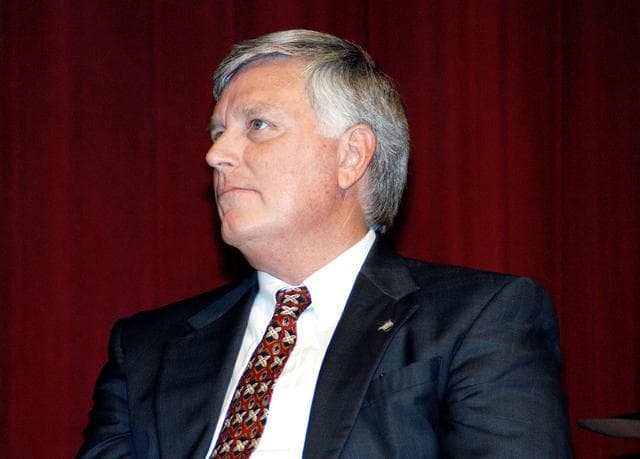
NASA image: KENNEDY SPACE CENTER, FLA. -  KSC Deputy Director James W. Kennedy receives the news of his appointment as the next director of the NASA Kennedy Space Center (KSC) before a group of KSC employees assembled in the KSC Training Auditorium. Kennedy has served as KSC's deputy director since November 2002. He will succeed KSC Director Roy D. Bridges, who was appointed on June 13 to lead NASA's Langley Research Center, Hampton, Va.
Image
Jun 26, 2003

KENNEDY SPACE CENTER, FLA. - KSC Deputy Director James W. Kennedy receives the news of his appointment as the next director of the NASA Kennedy Space Center (KSC) before a group of KSC employees assembled in the KSC Training Auditorium. Kennedy has served as KSC's deputy director since November 2002. He will succeed KSC Director Roy D. Bridges, who was appointed on June 13 to lead NASA's Langley Research Center, Hampton, Va.

KENNEDY SPACE CENTER, FLA. - KSC Deputy Director James W. Kennedy receives the news of his appointment as the next...

KSC
NASA image: KENNEDY SPACE CENTER, FLA. -  NASA Associate Administrator for Space Flight William F. Readdy addresses a group of KSC employees assembled in the KSC Training Auditorium.  The occasion is the announcement of James W. Kennedy as the next director of the NASA Kennedy Space Center (KSC) in Florida. Kennedy has served as KSC's deputy director since November 2002. He will succeed KSC Director Roy D. Bridges, who was appointed on June 13 to lead NASA's Langley Research Center, Hampton, Va.
Image
Jun 26, 2003

KENNEDY SPACE CENTER, FLA. - NASA Associate Administrator for Space Flight William F. Readdy addresses a group of KSC employees assembled in the KSC Training Auditorium. The occasion is the announcement of James W. Kennedy as the next director of the NASA Kennedy Space Center (KSC) in Florida. Kennedy has served as KSC's deputy director since November 2002. He will succeed KSC Director Roy D. Bridges, who was appointed on June 13 to lead NASA's Langley Research Center, Hampton, Va.

KENNEDY SPACE CENTER, FLA. - NASA Associate Administrator for Space Flight William F. Readdy addresses a group of...

KSC
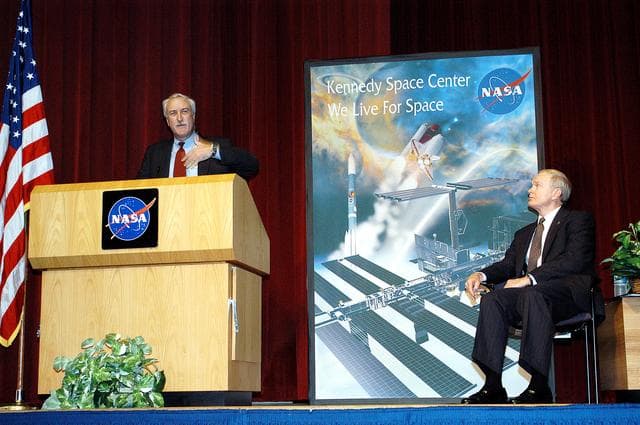
NASA image: KENNEDY SPACE CENTER, FLA. -  NASA Administrator Sean O'Keefe addresses a group of KSC employees assembled in the KSC Training Auditorium. KSC Director Roy D. Bridges (right) also spoke.  The occasion is the announcement of James W. Kennedy as the next director of the NASA Kennedy Space Center (KSC) in Florida. Kennedy has served as KSC's deputy director since November 2002. He will succeed Bridges, who was appointed on June 13 to lead NASA's Langley Research Center, Hampton, Va.
Image
Jun 26, 2003

KENNEDY SPACE CENTER, FLA. - NASA Administrator Sean O'Keefe addresses a group of KSC employees assembled in the KSC Training Auditorium. KSC Director Roy D. Bridges (right) also spoke. The occasion is the announcement of James W. Kennedy as the next director of the NASA Kennedy Space Center (KSC) in Florida. Kennedy has served as KSC's deputy director since November 2002. He will succeed Bridges, who was appointed on June 13 to lead NASA's Langley Research Center, Hampton, Va.

KENNEDY SPACE CENTER, FLA. - NASA Administrator Sean O'Keefe addresses a group of KSC employees assembled in the KSC...

KSC
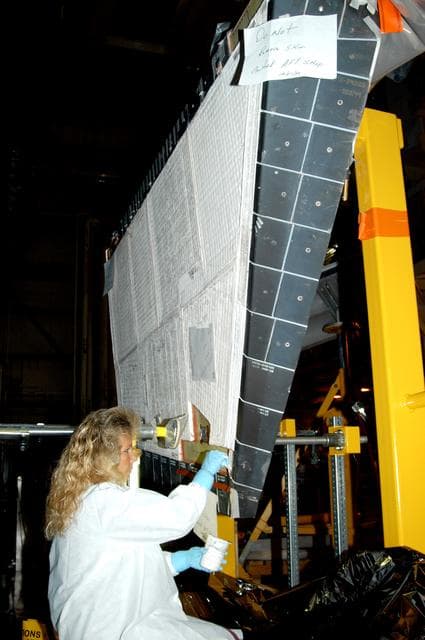
NASA image: KENNEDY SPACE CENTER, FLA. -  In the Orbiter Processing Facility, KSC employee Nadine Phillips prepares an area on the orbiter Discovery for blanket installation.  The blankets are part of the Orbiter Thermal Protection System, thermal shields to protect against temperatures as high as 3,000° Fahrenheit, which are produced during descent for landing. Discovery is scheduled to fly on mission STS-121 to the International Space Station.
Image
Dec 9, 2003

KENNEDY SPACE CENTER, FLA. - In the Orbiter Processing Facility, KSC employee Nadine Phillips prepares an area on the orbiter Discovery for blanket installation. The blankets are part of the Orbiter Thermal Protection System, thermal shields to protect against temperatures as high as 3,000° Fahrenheit, which are produced during descent for landing. Discovery is scheduled to fly on mission STS-121 to the International Space Station.

KENNEDY SPACE CENTER, FLA. - In the Orbiter Processing Facility, KSC employee Nadine Phillips prepares an area on...

KSC
NASA image: KENNEDY SPACE CENTER, FLA. -  KSC Deputy Director James W. Kennedy (left) and KSC Director Roy D. Bridges shake hands before a group of KSC employees assembled in the KSC Training Auditorium. The occasion is the announcement of Kennedy as the next director of the NASA Kennedy Space Center (KSC) in Florida. Kennedy has served as KSC's deputy director since November 2002. He will succeed Bridges, who was appointed on June 13 to lead NASA's Langley Research Center, Hampton, Va.
Image
Jun 26, 2003

KENNEDY SPACE CENTER, FLA. - KSC Deputy Director James W. Kennedy (left) and KSC Director Roy D. Bridges shake hands before a group of KSC employees assembled in the KSC Training Auditorium. The occasion is the announcement of Kennedy as the next director of the NASA Kennedy Space Center (KSC) in Florida. Kennedy has served as KSC's deputy director since November 2002. He will succeed Bridges, who was appointed on June 13 to lead NASA's Langley Research Center, Hampton, Va.

KENNEDY SPACE CENTER, FLA. - KSC Deputy Director James W. Kennedy (left) and KSC Director Roy D. Bridges shake hands...

KSC
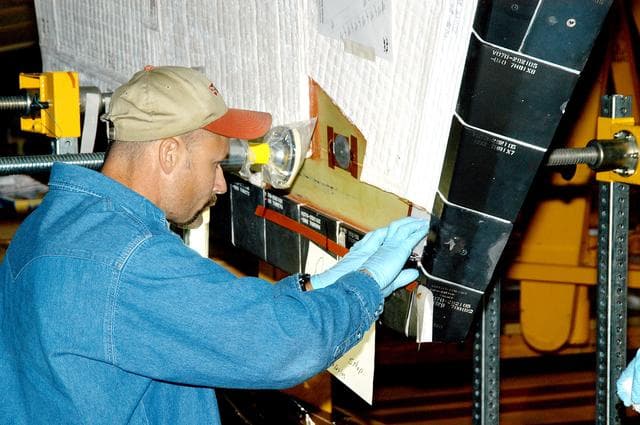
NASA image: KENNEDY SPACE CENTER, FLA. -  In the Orbiter Processing Facility, KSC employee Joel Smith prepares an area on the orbiter Discovery for blanket installation.  The blankets are part of the Orbiter Thermal Protection System, thermal shields to protect against temperatures as high as 3,000° Fahrenheit, which are produced during descent for landing. Discovery is scheduled to fly on mission STS-121 to the International Space Station.
Image
Dec 9, 2003

KENNEDY SPACE CENTER, FLA. - In the Orbiter Processing Facility, KSC employee Joel Smith prepares an area on the orbiter Discovery for blanket installation. The blankets are part of the Orbiter Thermal Protection System, thermal shields to protect against temperatures as high as 3,000° Fahrenheit, which are produced during descent for landing. Discovery is scheduled to fly on mission STS-121 to the International Space Station.

KENNEDY SPACE CENTER, FLA. - In the Orbiter Processing Facility, KSC employee Joel Smith prepares an area on the...

KSC
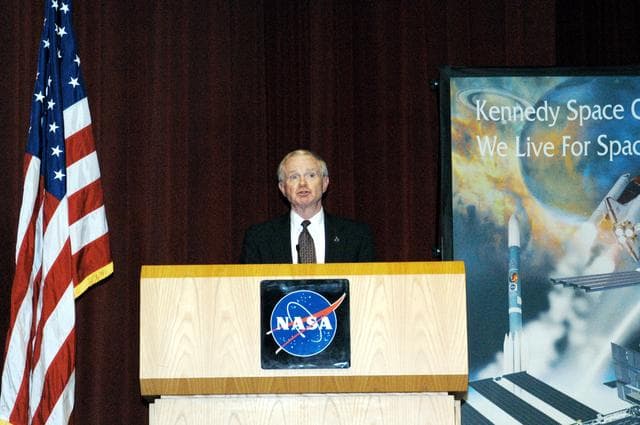
NASA image: KENNEDY SPACE CENTER, FLA. -  KSC Director Roy D. Bridges addresses a group of KSC employees assembled in the KSC Training Auditorium. The occasion is the announcement of James W. Kennedy as the next director of the NASA Kennedy Space Center (KSC) in Florida. Kennedy has served as KSC's deputy director since November 2002. He will succeed Bridges, who was appointed on June 13 to lead NASA's Langley Research Center, Hampton, Va.
Image
Jun 26, 2003

KENNEDY SPACE CENTER, FLA. - KSC Director Roy D. Bridges addresses a group of KSC employees assembled in the KSC Training Auditorium. The occasion is the announcement of James W. Kennedy as the next director of the NASA Kennedy Space Center (KSC) in Florida. Kennedy has served as KSC's deputy director since November 2002. He will succeed Bridges, who was appointed on June 13 to lead NASA's Langley Research Center, Hampton, Va.

KENNEDY SPACE CENTER, FLA. - KSC Director Roy D. Bridges addresses a group of KSC employees assembled in the KSC...

KSC
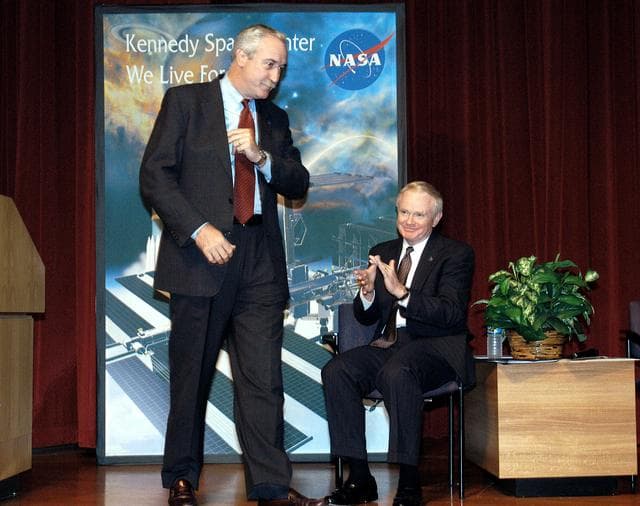
NASA image: KENNEDY SPACE CENTER, FLA. -  NASA Administrator Sean O'Keefe (left) receives the applause of KSC Director Roy D. Bridges (right) and a group of KSC employees assembled in the KSC Training Auditorium.  The occasion is the announcement of James W. Kennedy as the next director of the NASA Kennedy Space Center (KSC) in Florida. Kennedy has served as KSC's deputy director since November 2002. He will succeed Bridges, who was appointed on June 13 to lead NASA's Langley Research Center, Hampton, Va.
Image
Jun 26, 2003

KENNEDY SPACE CENTER, FLA. - NASA Administrator Sean O'Keefe (left) receives the applause of KSC Director Roy D. Bridges (right) and a group of KSC employees assembled in the KSC Training Auditorium. The occasion is the announcement of James W. Kennedy as the next director of the NASA Kennedy Space Center (KSC) in Florida. Kennedy has served as KSC's deputy director since November 2002. He will succeed Bridges, who was appointed on June 13 to lead NASA's Langley Research Center, Hampton, Va.

KENNEDY SPACE CENTER, FLA. - NASA Administrator Sean O'Keefe (left) receives the applause of KSC Director Roy D....

KSC
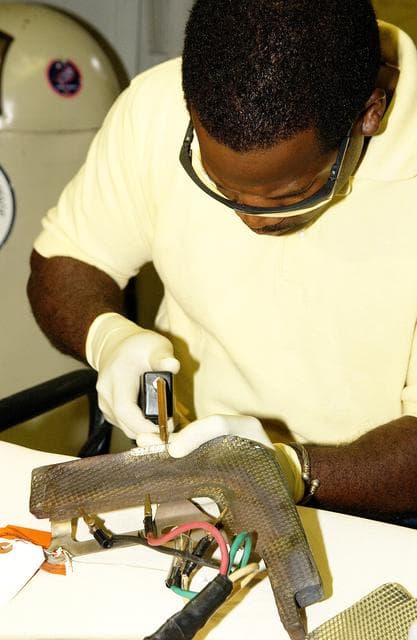
NASA image: KENNEDY SPACE CENTER, FLA. -   United Space Alliance employee Anthony Simmons continues electrowelding on an insulator inside a Reinforced Carbon Carbon panel.   The gray carbon composite RCC panels are attached to the leading edge of the wing of the orbiters to withstand the aerodynamic forces experienced during launch and reentry, which can reach as high as 800 pounds per square foot.  The operating range of RCC is from minus 250º F to about 3,000º F, the temperature produced by friction with the atmosphere during reentry.
Image
Sep 16, 2003

KENNEDY SPACE CENTER, FLA. - United Space Alliance employee Anthony Simmons continues electrowelding on an insulator inside a Reinforced Carbon Carbon panel. The gray carbon composite RCC panels are attached to the leading edge of the wing of the orbiters to withstand the aerodynamic forces experienced during launch and reentry, which can reach as high as 800 pounds per square foot. The operating range of RCC is from minus 250º F to about 3,000º F, the temperature produced by friction with the atmosphere during reentry.

KENNEDY SPACE CENTER, FLA. - United Space Alliance employee Anthony Simmons continues electrowelding on an insulator...

KSC
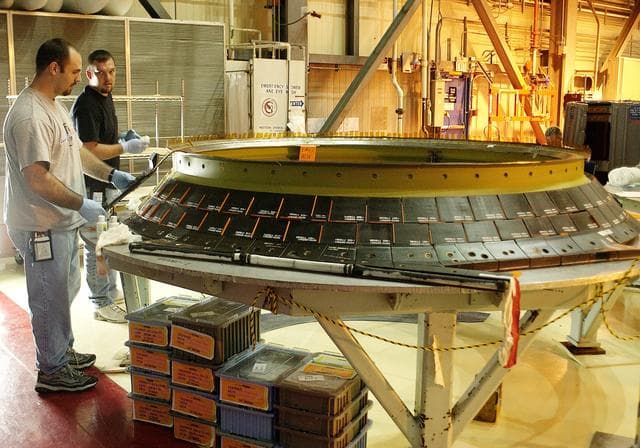
NASA image: KENNEDY SPACE CENTER, FLA. -  United Space Alliance employees Jeremy Schwarz (left) and Chris Keeling install new tiles on the heat shield of main engine 1 for the orbiter Discovery.  A heat shield is a protective layer on a spacecraft designed to protect it from the high temperatures, usually those that result from aerobraking during reentry into the Earth’s atmosphere.
Image
Sep 23, 2003

KENNEDY SPACE CENTER, FLA. - United Space Alliance employees Jeremy Schwarz (left) and Chris Keeling install new tiles on the heat shield of main engine 1 for the orbiter Discovery. A heat shield is a protective layer on a spacecraft designed to protect it from the high temperatures, usually those that result from aerobraking during reentry into the Earth’s atmosphere.

KENNEDY SPACE CENTER, FLA. - United Space Alliance employees Jeremy Schwarz (left) and Chris Keeling install new...

KSC
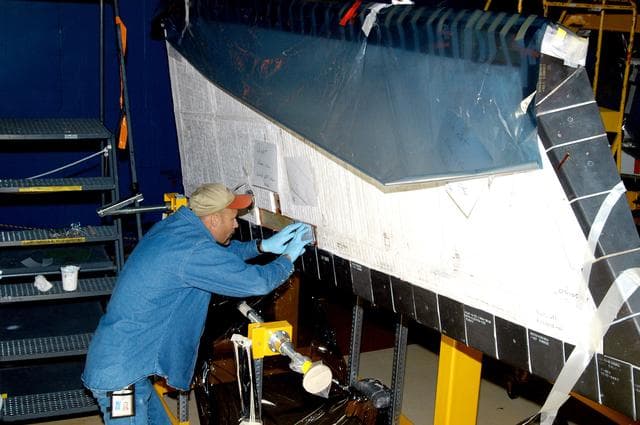
NASA image: KENNEDY SPACE CENTER, FLA. -  In the Orbiter Processing Facility, KSC employee Joel Smith prepares an area on the orbiter Discovery for blanket installation.  The blankets are part of the Orbiter Thermal Protection System, thermal shields to protect against temperatures as high as 3,000° Fahrenheit, which are produced during descent for landing. Discovery is scheduled to fly on mission STS-121 to the International Space Station.
Image
Dec 9, 2003

KENNEDY SPACE CENTER, FLA. - In the Orbiter Processing Facility, KSC employee Joel Smith prepares an area on the orbiter Discovery for blanket installation. The blankets are part of the Orbiter Thermal Protection System, thermal shields to protect against temperatures as high as 3,000° Fahrenheit, which are produced during descent for landing. Discovery is scheduled to fly on mission STS-121 to the International Space Station.

KENNEDY SPACE CENTER, FLA. - In the Orbiter Processing Facility, KSC employee Joel Smith prepares an area on the...

KSC
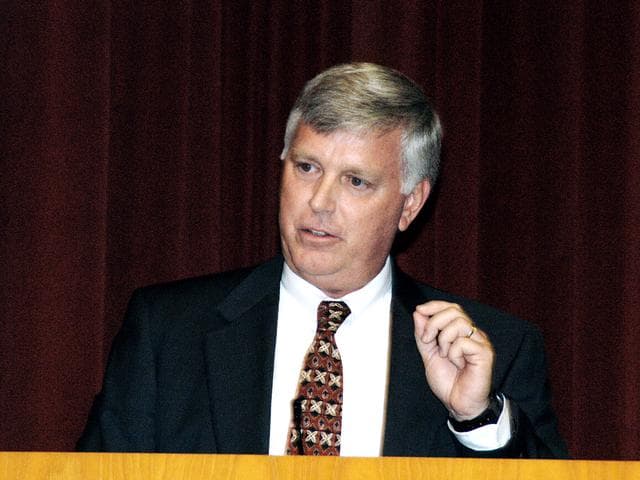
NASA image: KENNEDY SPACE CENTER, FLA. -  KSC Deputy Director James W. Kennedy addresses a group of KSC employees assembled in the KSC Training Auditorium. The occasion is the announcement of Kennedy as the next director of the NASA Kennedy Space Center (KSC) in Florida. He has served as KSC's deputy director since November 2002. He will succeed KSC Director Roy D. Bridges, who was appointed on June 13 to lead NASA's Langley Research Center, Hampton, Va.
Image
Jun 26, 2003

KENNEDY SPACE CENTER, FLA. - KSC Deputy Director James W. Kennedy addresses a group of KSC employees assembled in the KSC Training Auditorium. The occasion is the announcement of Kennedy as the next director of the NASA Kennedy Space Center (KSC) in Florida. He has served as KSC's deputy director since November 2002. He will succeed KSC Director Roy D. Bridges, who was appointed on June 13 to lead NASA's Langley Research Center, Hampton, Va.

KENNEDY SPACE CENTER, FLA. - KSC Deputy Director James W. Kennedy addresses a group of KSC employees assembled in...

KSC
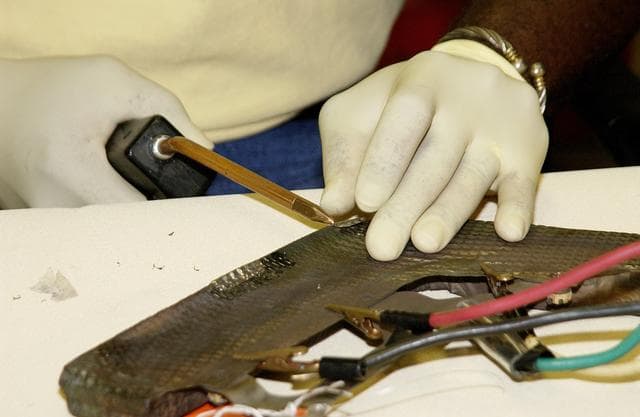
NASA image: KENNEDY SPACE CENTER, FLA. -   United Space Alliance employee Anthony Simmons continues electrowelding on an insulator inside a Reinforced Carbon Carbon panel.   The gray carbon composite RCC panels are attached to the leading edge of the wing of the orbiters to withstand the aerodynamic forces experienced during launch and reentry, which can reach as high as 800 pounds per square foot.  The operating range of RCC is from minus 250º F to about 3,000º F, the temperature produced by friction with the atmosphere during reentry.
Image
Sep 16, 2003

KENNEDY SPACE CENTER, FLA. - United Space Alliance employee Anthony Simmons continues electrowelding on an insulator inside a Reinforced Carbon Carbon panel. The gray carbon composite RCC panels are attached to the leading edge of the wing of the orbiters to withstand the aerodynamic forces experienced during launch and reentry, which can reach as high as 800 pounds per square foot. The operating range of RCC is from minus 250º F to about 3,000º F, the temperature produced by friction with the atmosphere during reentry.

KENNEDY SPACE CENTER, FLA. - United Space Alliance employee Anthony Simmons continues electrowelding on an insulator...

KSC
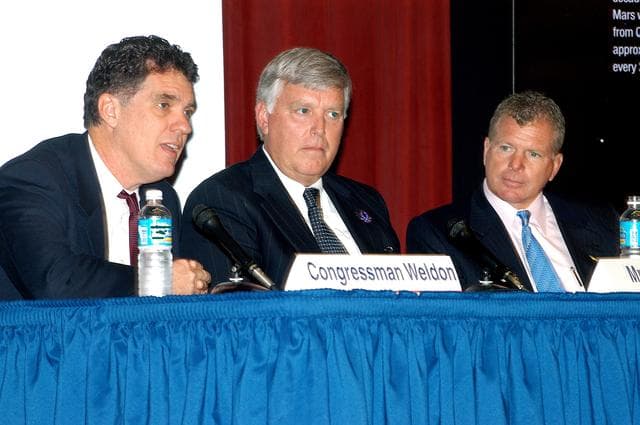
NASA image: KENNEDY SPACE CENTER, FLA. -- In a Town Hall meeting at KSC, Center Director Jim Kennedy (center) joined U.S. Reps. Dave Weldon (left) and Tom Feeney (right) to discuss the new mission for NASA outlined by President George W. Bush Jan. 14.  The congressmen and Kennedy also answered questions from employees in the audience.
Image
Jan 16, 2004

KENNEDY SPACE CENTER, FLA. -- In a Town Hall meeting at KSC, Center Director Jim Kennedy (center) joined U.S. Reps. Dave Weldon (left) and Tom Feeney (right) to discuss the new mission for NASA outlined by President George W. Bush Jan. 14. The congressmen and Kennedy also answered questions from employees in the audience.

KENNEDY SPACE CENTER, FLA. -- In a Town Hall meeting at KSC, Center Director Jim Kennedy (center) joined U.S. Reps....

KSC
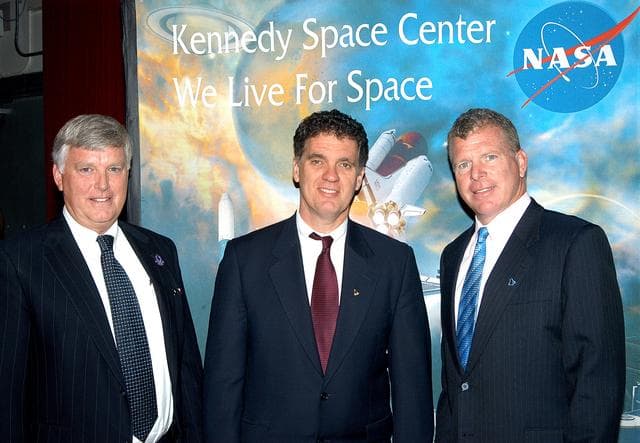
NASA image: KENNEDY SPACE CENTER, FLA. --After a Town Hall meeting at KSC, Center Director Jim Kennedy and U.S. Reps. Dave Weldon and Tom Feeney pause for a photo before heading to the NASA-KSC News Center for a press conference.  Weldon and Feeney discussed the new mission for NASA outlined by President George W. Bush Jan. 14.  The congressmen and Kennedy also answered questions from employees in the audience.
Image
Jan 16, 2004

KENNEDY SPACE CENTER, FLA. --After a Town Hall meeting at KSC, Center Director Jim Kennedy and U.S. Reps. Dave Weldon and Tom Feeney pause for a photo before heading to the NASA-KSC News Center for a press conference. Weldon and Feeney discussed the new mission for NASA outlined by President George W. Bush Jan. 14. The congressmen and Kennedy also answered questions from employees in the audience.

KENNEDY SPACE CENTER, FLA. --After a Town Hall meeting at KSC, Center Director Jim Kennedy and U.S. Reps. Dave...

KSC
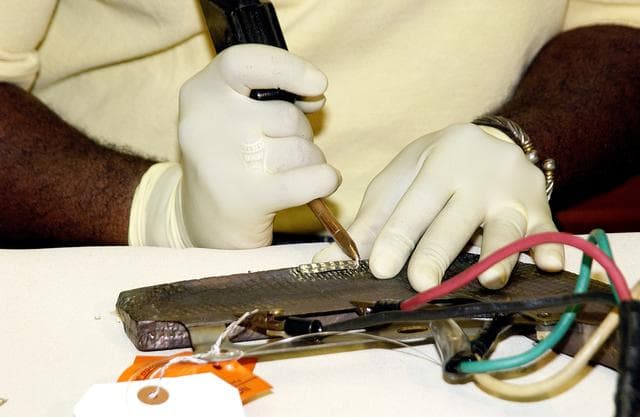
NASA image: KENNEDY SPACE CENTER, FLA. -  United Space Alliance employee Anthony Simmons electrowelds a crack formed in the insulator inside a Reinforced Carbon Carbon panel.   The gray carbon composite RCC panels are attached to the leading edge of the wing of the orbiters to withstand the aerodynamic forces experienced during launch and reentry, which can reach as high as 800 pounds per square foot.  The operating range of RCC is from minus 250º F to about 3,000º F, the temperature produced by friction with the atmosphere during reentry.
Image
Sep 16, 2003

KENNEDY SPACE CENTER, FLA. - United Space Alliance employee Anthony Simmons electrowelds a crack formed in the insulator inside a Reinforced Carbon Carbon panel. The gray carbon composite RCC panels are attached to the leading edge of the wing of the orbiters to withstand the aerodynamic forces experienced during launch and reentry, which can reach as high as 800 pounds per square foot. The operating range of RCC is from minus 250º F to about 3,000º F, the temperature produced by friction with the atmosphere during reentry.

KENNEDY SPACE CENTER, FLA. - United Space Alliance employee Anthony Simmons electrowelds a crack formed in the...

KSC
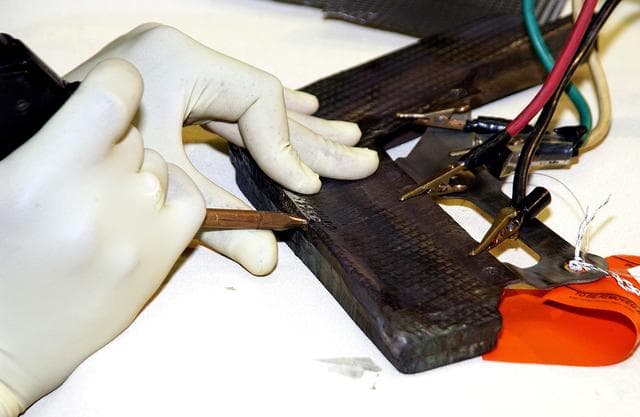
NASA image: KENNEDY SPACE CENTER, FLA. -  United Space Alliance employee Anthony Simmons electrowelds a crack formed in the insulator inside a Reinforced Carbon Carbon panel.   The gray carbon composite RCC panels are attached to the leading edge of the wing of the orbiters to withstand the aerodynamic forces experienced during launch and reentry, which can reach as high as 800 pounds per square foot.  The operating range of RCC is from minus 250º F to about 3,000º F, the temperature produced by friction with the atmosphere during reentry.
Image
Sep 16, 2003

KENNEDY SPACE CENTER, FLA. - United Space Alliance employee Anthony Simmons electrowelds a crack formed in the insulator inside a Reinforced Carbon Carbon panel. The gray carbon composite RCC panels are attached to the leading edge of the wing of the orbiters to withstand the aerodynamic forces experienced during launch and reentry, which can reach as high as 800 pounds per square foot. The operating range of RCC is from minus 250º F to about 3,000º F, the temperature produced by friction with the atmosphere during reentry.

KENNEDY SPACE CENTER, FLA. - United Space Alliance employee Anthony Simmons electrowelds a crack formed in the...

KSC
NASA image: KENNEDY SPACE CENTER, FLA. -  NASA Administrator Sean O'Keefe (left) congratulates James W. Kennedy (right)  before a group of KSC employees assembled in the KSC Training Auditorium.  The occasion is the announcement of Kennedy as the next director of the NASA Kennedy Space Center (KSC) in Florida. Kennedy has served as KSC's deputy director since November 2002. He will succeed KSC Director Roy D. Bridges, who was appointed on June 13 to lead NASA's Langley Research Center, Hampton, Va.
Image
Jun 26, 2003

KENNEDY SPACE CENTER, FLA. - NASA Administrator Sean O'Keefe (left) congratulates James W. Kennedy (right) before a group of KSC employees assembled in the KSC Training Auditorium. The occasion is the announcement of Kennedy as the next director of the NASA Kennedy Space Center (KSC) in Florida. Kennedy has served as KSC's deputy director since November 2002. He will succeed KSC Director Roy D. Bridges, who was appointed on June 13 to lead NASA's Langley Research Center, Hampton, Va.

KENNEDY SPACE CENTER, FLA. - NASA Administrator Sean O'Keefe (left) congratulates James W. Kennedy (right) before a...

KSC
PreviousPage 58 of 100Next

Frequently Asked Questions About NASA Images

Are NASA images free to use?+
Yes, most NASA images are in the public domain and are free to use for educational, informational, and personal purposes. NASA's media usage guidelines state that NASA material is not copyrighted unless otherwise noted. However, the NASA logo and certain insignia are protected. Some images may include identifiable individuals or third-party content that requires additional permissions. Always check the specific image's usage rights and credit NASA as the source.
How many images does NASA have?+
NASA's Image and Video Library contains over 140,000 publicly accessible images, videos, and audio files spanning the agency's entire history, from the Mercury program of the 1960s to the latest James Webb Space Telescope discoveries. The collection grows daily as new missions capture imagery and archival materials are digitized. Individual mission archives, such as Mars rover photos, contain hundreds of thousands of additional images.
Can I download NASA images?+
Yes, you can download NASA images in multiple resolutions directly from this gallery. Each image detail page provides download links for original (full resolution), large (1920px), medium (960px), small (480px), and thumbnail sizes. NASA encourages the public to use these images for education, media, and personal projects. High-resolution originals are ideal for printing and professional use.

Explore More NASA Content

Astronomy Picture of the Day

Daily curated space image

Mars Rover Photos

Curiosity & Perseverance images

Earth from Space

DSCOVR EPIC daily images

Launch Schedule

Upcoming rocket launches

Space News

Mission updates & discoveries