CosmosObservatory
Explore
Solar System
Live
Learn
Tools
About
Cosmos Observatory
ToolsAbout
Cosmos Observatory

Explore the universe through NASA data, real-time ISS tracking, Mars rover imagery, asteroid monitoring, and comprehensive space encyclopedia. Your gateway to the cosmos.

Explore

  • APOD
  • Mars Rovers
  • Earth Imagery
  • NASA Gallery
  • ISS Tracker

Data

  • Asteroids
  • Solar System
  • Exoplanets
  • Space Weather
  • Launches

Tools

  • Glossary
  • News
  • Calculators

Legal

  • About
  • Privacy Policy
  • Terms of Use
  • Space Tools
  • Contact

Stay updated with the cosmos

Get weekly digests of APOD highlights, upcoming launches, and space events.

© 2026 Cosmos Observatory. All rights reserved. Built with for space enthusiasts.

This website is not affiliated with, maintained, authorized, endorsed by, or in any way officially connected with NASA or any of its subsidiaries or affiliates. All NASA imagery is in the public domain unless otherwise noted. Data sourced from NASA Open APIs, Launch Library 2, and other open data services.

NASA Gallery

Explore NASA's vast collection of space images, videos, and audio from missions past and present.

  1. Home
  2. /
  3. NASA Gallery

NASA's Image and Video Library: A Visual Archive of Space Exploration

NASA's Image and Video Library is one of the most comprehensive public archives of space imagery in the world, containing over 140,000 images, videos, and audio recordings spanning more than six decades of space exploration. From the earliest Mercury and Gemini missions through the Apollo Moon landings, the Space Shuttle era, and today's cutting-edge observations from the James Webb Space Telescope, this collection documents humanity's journey into the cosmos.

The library includes imagery from diverse sources: telescopes like Hubble and Webb that capture deep-space nebulae, galaxies, and exoplanets; planetary missions like the Mars rovers ( browse Mars photos) and Cassini at Saturn; Earth observation satellites ( see EPIC imagery); astronaut photography from the ISS; and documentation of rocket launches, spacecraft assembly, and ground testing. Most NASA images are in the public domain and free to download at full resolution for educational, editorial, and personal use.

Use the search bar above to find specific subjects — try queries like "Apollo 11," "Hubble Deep Field," "Mars surface," or "astronaut EVA." You can also filter by media type (image, video, or audio). For a daily curated experience, visit the Astronomy Picture of the Day.

Showing results for "explain"

1,037 results found - Page 4 of 44

NASA image: ML-1 and ML-2 Comparison Infographic
Image
Mar 28, 2024

ML-1 and ML-2 Comparison Infographic

This infographic explains NASA’s mobile launchers designed for the agency's Artemis missions to send the Space...

KSC
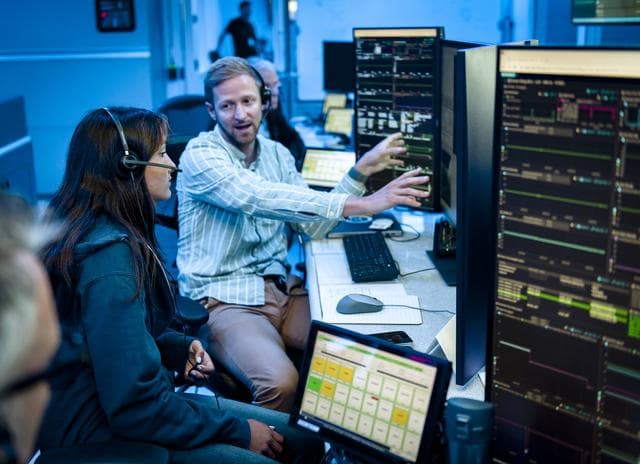
NASA image: VIPER Family Day
Image
Aug 14, 2024

VIPER Family Day

Arno Rogg explains the Volatiles Investigating Polar Exploration Rover (VIPER) mission to visitors in the...

ARC
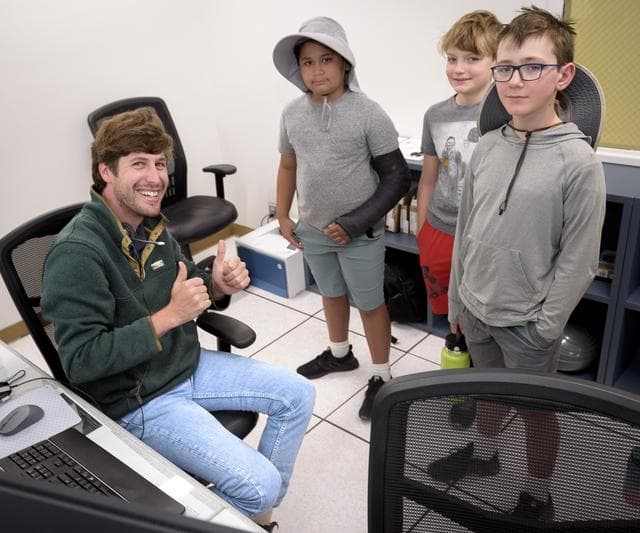
NASA image: VIPER Family Day
Image
Aug 14, 2024

VIPER Family Day

Jasper Wolfe, left, explains the Volatiles Investigating Polar Exploration Rover (VIPER) mission to visitors in the...

ARC
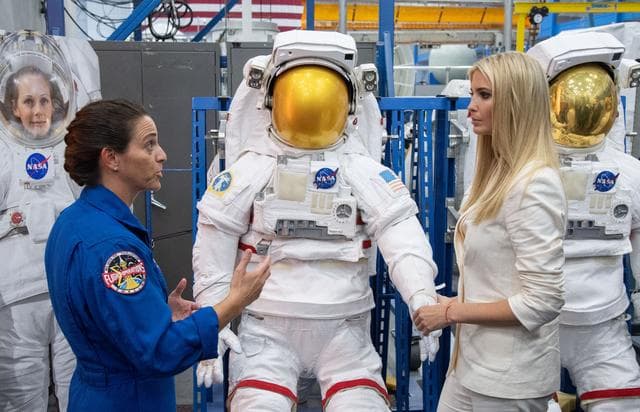
NASA image: jsc2018e083423
Image
Sep 20, 2018

jsc2018e083423

jsc2018e083423 – (Sept. 20, 2018) – NASA Astronaut Nicole Mann explains how spacesuits work to Advisor to the...

JSC
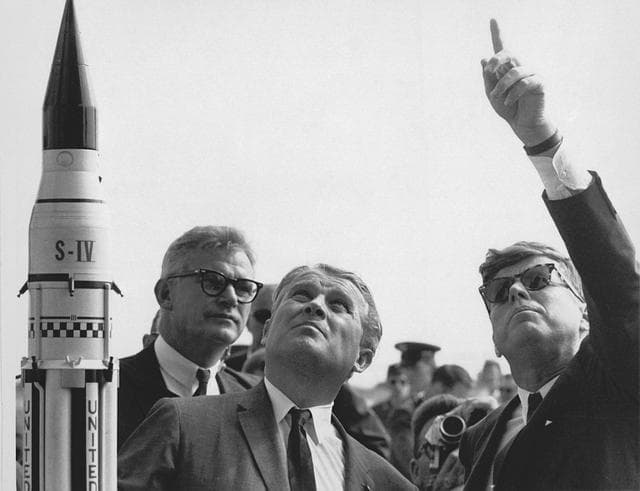
NASA image: KSC-64p-0145
Image
Nov 16, 1963

KSC-64p-0145

KENNEDY SPACE CENTER, FLA. -- Dr. Werner Von Braun explains the Saturn system to President John F. Kennedy at...

KSC
NASA image: KSC-78pc-0468
Image
Oct 1, 1978

KSC-78pc-0468

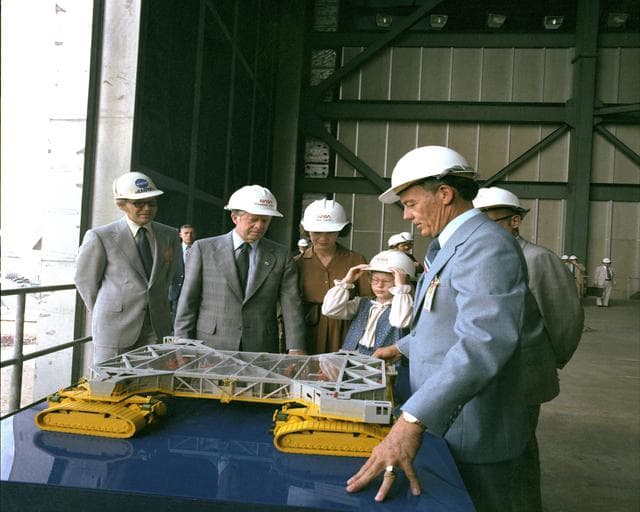
KENNEDY SPACE CENTER, FLA. -- President Jimmy Carter, with wife Rosalynn and daughter Amy, listen to Center Director...

KSC
NASA image: Microgravity Environment Provided on the International Space Station (ISS) Extend Our Understanding of Colloidal Engineering
Video
Feb 16, 2023

Microgravity Environment Provided on the International Space Station (ISS) Extend Our Understanding of Colloidal Engineering

Dr. William Meyer, Dr. Matthew Lynch, and Ronald Sicker explain the value of microgravity environment research being...

GRC
NASA image: Getting Involved in the Advanced Colloid Experiment (ACE) Program
Video
Jun 6, 2023

Getting Involved in the Advanced Colloid Experiment (ACE) Program

Ronald Sicker, Light Microscopy Module Payload Manager from NASA Glenn Research Center, explains the way you can get...

GRC
NASA image: Professor Gerold Willing on Quantum Sensitized Solar Cells – Long Version
Video
Feb 3, 2023

Professor Gerold Willing on Quantum Sensitized Solar Cells – Long Version

Professor Gerold Willing working with NASA Glenn Research Center explains the research onboard the International...

GRC
NASA image: Van Allen Probes Instrument Overview
Video
Nov 9, 2012

Van Allen Probes Instrument Overview

The Van Allen Probes (formerly the Radiation Belt Storm Probes, RBSP) will explore the Van Allen Radiation Belts in...

GSFC
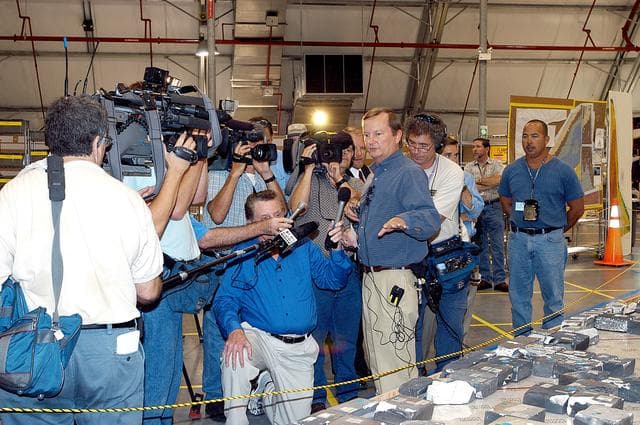
NASA image: KENNEDY SPACE CENTER, FLA. - In the Columbia Debris Hangar,  Shuttle Launch Director Mike Leinbach  points to some of the tiles recovered from the orbiter as he explains to the media about activities that have taken place since the Columbia accident on Feb. 1, 2003.  STS-107 debris recovery and reconstruction operations are winding down.  To date, nearly 84,000 pieces of debris have been recovered and sent to KSC. That represents about 38 percent of the dry weight of Columbia, equaling almost 85,000 pounds.
Image
Jun 4, 2003

KENNEDY SPACE CENTER, FLA. - In the Columbia Debris Hangar, Shuttle Launch Director Mike Leinbach points to some of the tiles recovered from the orbiter as he explains to the media about activities that have taken place since the Columbia accident on Feb. 1, 2003. STS-107 debris recovery and reconstruction operations are winding down. To date, nearly 84,000 pieces of debris have been recovered and sent to KSC. That represents about 38 percent of the dry weight of Columbia, equaling almost 85,000 pounds.

KENNEDY SPACE CENTER, FLA. - In the Columbia Debris Hangar, Shuttle Launch Director Mike Leinbach points to some of...

KSC
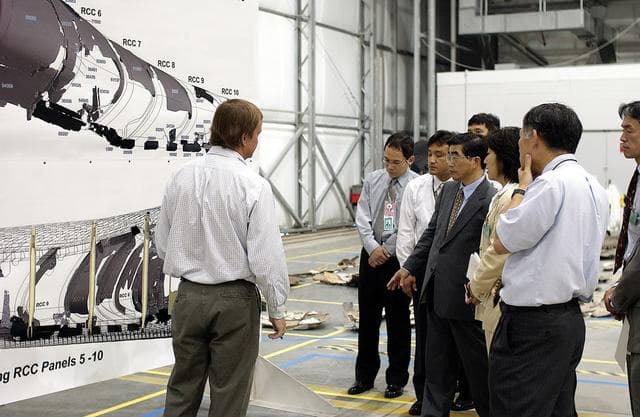
NASA image: KENNEDY SPACE CENTER, FLA. -    Shuttle Launch Director Mike Leinbach (left) explains recovery and reconstruction efforts of Columbia to the Executive Director of NASDA Koji Yamamoto (second from left) and others visiting the Columbia Debris Hangar.   Mr. Yamamoto is at KSC for a welcome ceremony involving the arrival of the newest Space Station module, the Japanese Experiment Module/pressurized module.
Image
Jun 12, 2003

KENNEDY SPACE CENTER, FLA. - Shuttle Launch Director Mike Leinbach (left) explains recovery and reconstruction efforts of Columbia to the Executive Director of NASDA Koji Yamamoto (second from left) and others visiting the Columbia Debris Hangar. Mr. Yamamoto is at KSC for a welcome ceremony involving the arrival of the newest Space Station module, the Japanese Experiment Module/pressurized module.

KENNEDY SPACE CENTER, FLA. - Shuttle Launch Director Mike Leinbach (left) explains recovery and reconstruction...

KSC
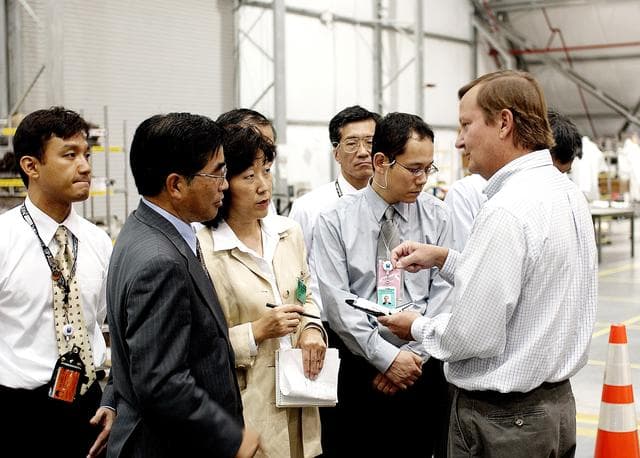
NASA image: KENNEDY SPACE CENTER, FLA. -   Shuttle Launch Director Mike Leinbach (right) explains recovery and reconstruction efforts of Columbia to the Executive Director of NASDA Koji Yamamoto (second from left) and others visiting the Columbia Debris Hangar.   Mr. Yamamoto is at KSC for a welcome ceremony involving the arrival of the newest Space Station module, the Japanese Experiment Module/pressurized module.
Image
Jun 12, 2003

KENNEDY SPACE CENTER, FLA. - Shuttle Launch Director Mike Leinbach (right) explains recovery and reconstruction efforts of Columbia to the Executive Director of NASDA Koji Yamamoto (second from left) and others visiting the Columbia Debris Hangar. Mr. Yamamoto is at KSC for a welcome ceremony involving the arrival of the newest Space Station module, the Japanese Experiment Module/pressurized module.

KENNEDY SPACE CENTER, FLA. - Shuttle Launch Director Mike Leinbach (right) explains recovery and reconstruction...

KSC
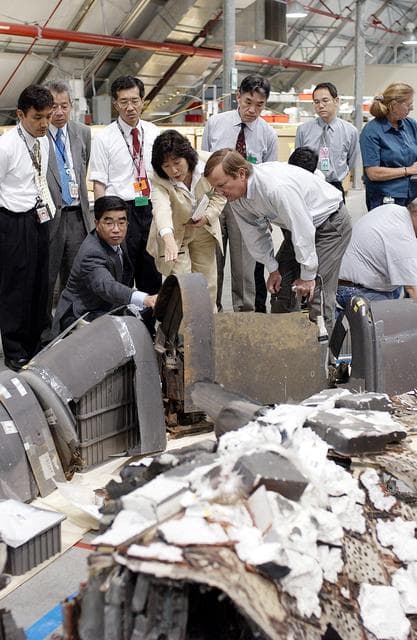
NASA image: KENNEDY SPACE CENTER, FLA. -  On a KSC visit, Executive Director of NASDA Koji Yamamoto (kneeling, left) reaches out to a piece of Columbia debris in the Columbia Debris Hangar.  At right is Shuttle Launch Director Mike Leinbach, who is explaining recovery and reconstruction efforts.  Mr. Yamamoto is at KSC for a welcome ceremony involving the arrival of the newest Space Station module, the Japanese Experiment Module/pressurized module.
Image
Jun 12, 2003

KENNEDY SPACE CENTER, FLA. - On a KSC visit, Executive Director of NASDA Koji Yamamoto (kneeling, left) reaches out to a piece of Columbia debris in the Columbia Debris Hangar. At right is Shuttle Launch Director Mike Leinbach, who is explaining recovery and reconstruction efforts. Mr. Yamamoto is at KSC for a welcome ceremony involving the arrival of the newest Space Station module, the Japanese Experiment Module/pressurized module.

KENNEDY SPACE CENTER, FLA. - On a KSC visit, Executive Director of NASDA Koji Yamamoto (kneeling, left) reaches out...

KSC
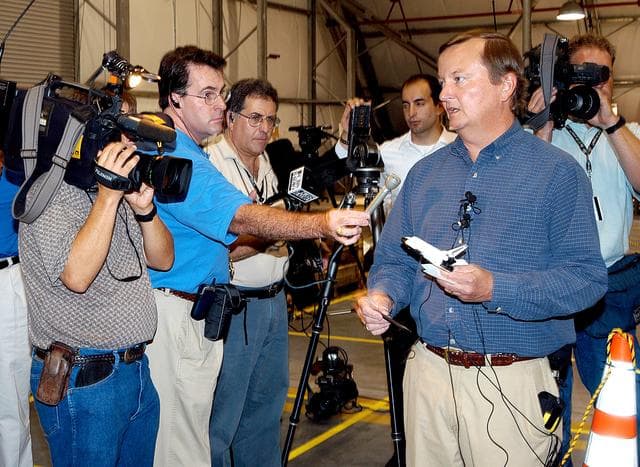
NASA image: KENNEDY SPACE CENTER, FLA. - In the Columbia Debris Hangar,  Shuttle Launch Director Mike Leinbach  points to some of the debris as he explains to the media about activities that have taken place since the Columbia accident on Feb. 1, 2003.  STS-107 debris recovery and reconstruction operations are winding down.  To date, nearly 84,000 pieces of debris have been recovered and sent to KSC. That represents about 38 percent of the dry weight of Columbia, equaling almost 85,000 pounds.
Image
Jun 4, 2003

KENNEDY SPACE CENTER, FLA. - In the Columbia Debris Hangar, Shuttle Launch Director Mike Leinbach points to some of the debris as he explains to the media about activities that have taken place since the Columbia accident on Feb. 1, 2003. STS-107 debris recovery and reconstruction operations are winding down. To date, nearly 84,000 pieces of debris have been recovered and sent to KSC. That represents about 38 percent of the dry weight of Columbia, equaling almost 85,000 pounds.

KENNEDY SPACE CENTER, FLA. - In the Columbia Debris Hangar, Shuttle Launch Director Mike Leinbach points to some of...

KSC
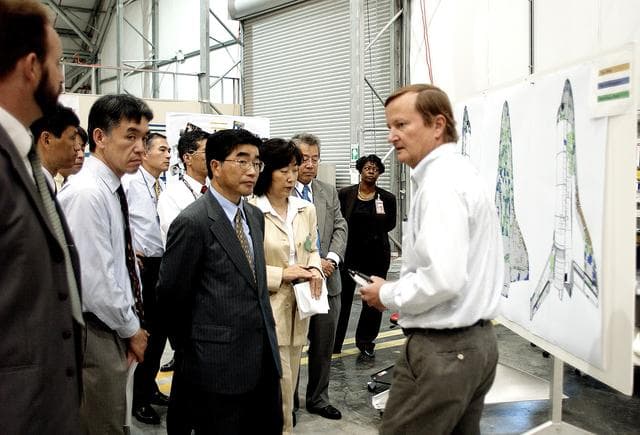
NASA image: KENNEDY SPACE CENTER, FLA. -  Shuttle Launch Director Mike Leinbach (right) explains recovery and reconstruction efforts of Columbia to the Executive Director of NASDA Koji Yamamoto (center, foreground) and others visiting the Columbia Debris Hangar.   Mr. Yamamoto is at KSC for a welcome ceremony involving the arrival of the newest Space Station module, the Japanese Experiment Module/pressurized module.
Image
Jun 12, 2003

KENNEDY SPACE CENTER, FLA. - Shuttle Launch Director Mike Leinbach (right) explains recovery and reconstruction efforts of Columbia to the Executive Director of NASDA Koji Yamamoto (center, foreground) and others visiting the Columbia Debris Hangar. Mr. Yamamoto is at KSC for a welcome ceremony involving the arrival of the newest Space Station module, the Japanese Experiment Module/pressurized module.

KENNEDY SPACE CENTER, FLA. - Shuttle Launch Director Mike Leinbach (right) explains recovery and reconstruction...

KSC
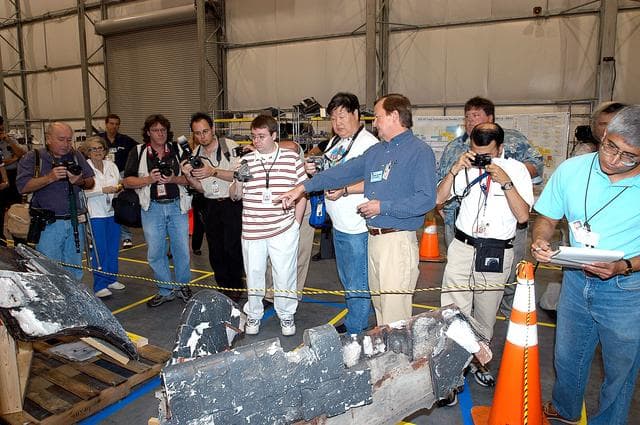
NASA image: KENNEDY SPACE CENTER, FLA. - In the Columbia Debris Hangar,  Shuttle Launch Director Mike Leinbach  points to some of the debris as he explains to the media about activities that have taken place since the Columbia accident on Feb. 1, 2003.  STS-107 debris recovery and reconstruction operations are winding down.  To date, nearly 84,000 pieces of debris have been recovered and sent to KSC. That represents about 38 percent of the dry weight of Columbia, equaling almost 85,000 pounds.
Image
Jun 4, 2003

KENNEDY SPACE CENTER, FLA. - In the Columbia Debris Hangar, Shuttle Launch Director Mike Leinbach points to some of the debris as he explains to the media about activities that have taken place since the Columbia accident on Feb. 1, 2003. STS-107 debris recovery and reconstruction operations are winding down. To date, nearly 84,000 pieces of debris have been recovered and sent to KSC. That represents about 38 percent of the dry weight of Columbia, equaling almost 85,000 pounds.

KENNEDY SPACE CENTER, FLA. - In the Columbia Debris Hangar, Shuttle Launch Director Mike Leinbach points to some of...

KSC
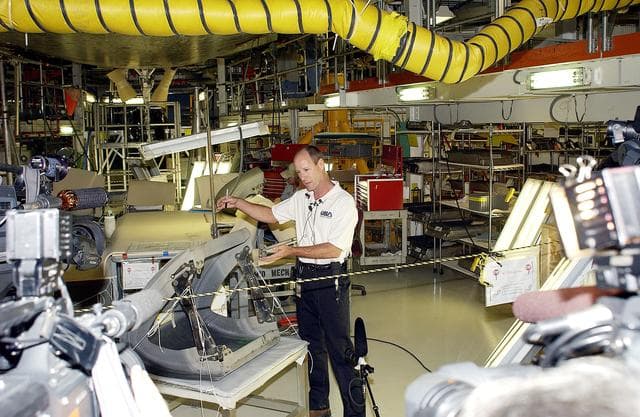
NASA image: KENNEDY SPACE CENTER, FLA. -  In the Orbiter Processing Facility (OPF), Rick Beckwith, an orbiter engineer with United Space Alliance, explains to the media the reinstallation of the Reinforced Carbon-Carbon panels on Atlantis’ wing leading edge.  The media was invited to tour the OPF at KSC and to see the orbiter Atlantis as it is being prepared for Return to Flight.  Both local and national reporters representing print and TV networks were able to see work in progress on Atlantis, also including wiring inspections and checks of the engines in the Orbital Maneuvering System.
Image
Sep 26, 2003

KENNEDY SPACE CENTER, FLA. - In the Orbiter Processing Facility (OPF), Rick Beckwith, an orbiter engineer with United Space Alliance, explains to the media the reinstallation of the Reinforced Carbon-Carbon panels on Atlantis’ wing leading edge. The media was invited to tour the OPF at KSC and to see the orbiter Atlantis as it is being prepared for Return to Flight. Both local and national reporters representing print and TV networks were able to see work in progress on Atlantis, also including wiring inspections and checks of the engines in the Orbital Maneuvering System.

KENNEDY SPACE CENTER, FLA. - In the Orbiter Processing Facility (OPF), Rick Beckwith, an orbiter engineer with...

KSC
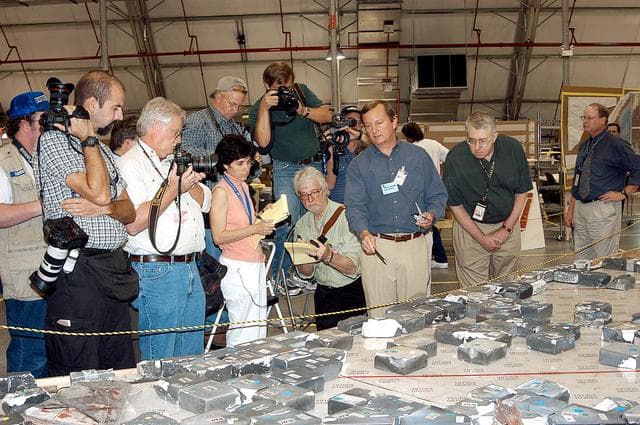
NASA image: KENNEDY SPACE CENTER, FLA. -  In the Columbia Debris Hangar,  Shuttle Launch Director Mike Leinbach  (center) points to some of the tiles recovered from the orbiter as he explains to the media about activities that have taken place since the Columbia accident on Feb. 1, 2003.  STS-107 debris recovery and reconstruction operations are winding down.  To date, nearly 84,000 pieces of debris have been recovered and sent to KSC. That represents about 38 percent of the dry weight of Columbia, equaling almost 85,000 pounds.
Image
Jun 4, 2003

KENNEDY SPACE CENTER, FLA. - In the Columbia Debris Hangar, Shuttle Launch Director Mike Leinbach (center) points to some of the tiles recovered from the orbiter as he explains to the media about activities that have taken place since the Columbia accident on Feb. 1, 2003. STS-107 debris recovery and reconstruction operations are winding down. To date, nearly 84,000 pieces of debris have been recovered and sent to KSC. That represents about 38 percent of the dry weight of Columbia, equaling almost 85,000 pounds.

KENNEDY SPACE CENTER, FLA. - In the Columbia Debris Hangar, Shuttle Launch Director Mike Leinbach (center) points to...

KSC
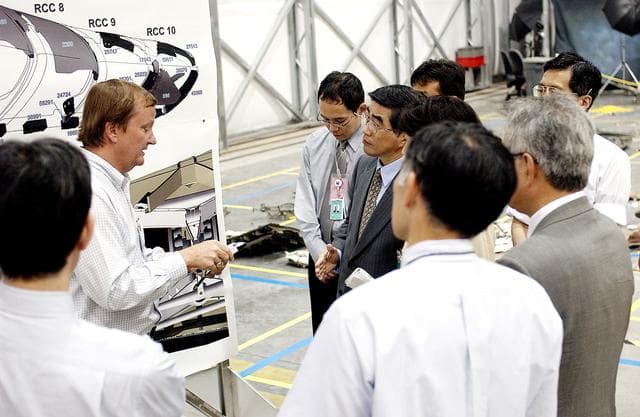
NASA image: KENNEDY SPACE CENTER, FLA. -  Shuttle Launch Director Mike Leinbach (second from left) explains recovery and reconstruction efforts of Columbia to the Executive Director of NASDA Koji Yamamoto (fourth from left) and others visiting the Columbia Debris Hangar.   Mr. Yamamoto is at KSC for a welcome ceremony involving the arrival of the newest Space Station module, the Japanese Experiment Module/pressurized module.
Image
Jun 12, 2003

KENNEDY SPACE CENTER, FLA. - Shuttle Launch Director Mike Leinbach (second from left) explains recovery and reconstruction efforts of Columbia to the Executive Director of NASDA Koji Yamamoto (fourth from left) and others visiting the Columbia Debris Hangar. Mr. Yamamoto is at KSC for a welcome ceremony involving the arrival of the newest Space Station module, the Japanese Experiment Module/pressurized module.

KENNEDY SPACE CENTER, FLA. - Shuttle Launch Director Mike Leinbach (second from left) explains recovery and...

KSC
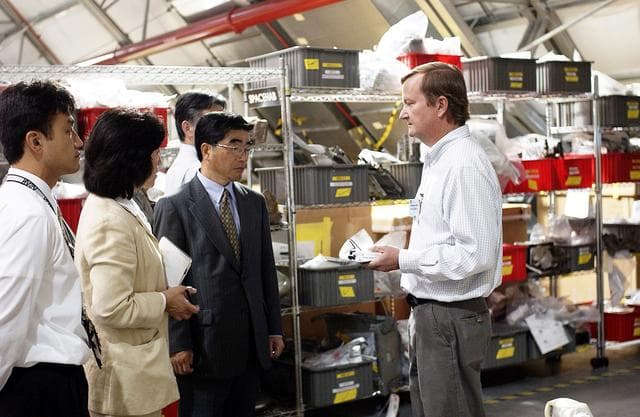
NASA image: KENNEDY SPACE CENTER, FLA. -  Shuttle Launch Director Mike Leinbach (right) explains recovery and reconstruction efforts of Columbia to the Executive Director of NASDA Koji Yamamoto (third from left) and others visiting the Columbia Debris Hangar.   Mr. Yamamoto is at KSC for a welcome ceremony involving the arrival of the newest Space Station module, the Japanese Experiment Module/pressurized module.
Image
Jun 12, 2003

KENNEDY SPACE CENTER, FLA. - Shuttle Launch Director Mike Leinbach (right) explains recovery and reconstruction efforts of Columbia to the Executive Director of NASDA Koji Yamamoto (third from left) and others visiting the Columbia Debris Hangar. Mr. Yamamoto is at KSC for a welcome ceremony involving the arrival of the newest Space Station module, the Japanese Experiment Module/pressurized module.

KENNEDY SPACE CENTER, FLA. - Shuttle Launch Director Mike Leinbach (right) explains recovery and reconstruction...

KSC
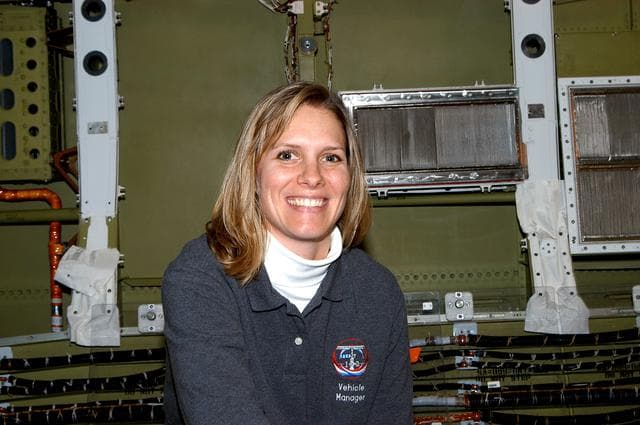
NASA image: KENNEDY SPACE CENTER, FLA. -  NASA Vehicle Manager for Discovery, Stephanie Stilson poses for a photo after working with a KSC Web team who were filming a special feature for the KSC Web.  Stilson explained her role in the recent Orbiter Major Modification period, which included inspection, modifications and reservicing of most systems onboard. The work on Discovery also included the installation of a Multifunction Electronic Display Subsystem (MEDS) - a state-of-the-art “glass cockpit.”  The orbiter is now being prepared for eventual launch on a future mission.
Image
Jan 22, 2004

KENNEDY SPACE CENTER, FLA. - NASA Vehicle Manager for Discovery, Stephanie Stilson poses for a photo after working with a KSC Web team who were filming a special feature for the KSC Web. Stilson explained her role in the recent Orbiter Major Modification period, which included inspection, modifications and reservicing of most systems onboard. The work on Discovery also included the installation of a Multifunction Electronic Display Subsystem (MEDS) - a state-of-the-art “glass cockpit.” The orbiter is now being prepared for eventual launch on a future mission.

KENNEDY SPACE CENTER, FLA. - NASA Vehicle Manager for Discovery, Stephanie Stilson poses for a photo after working...

KSC
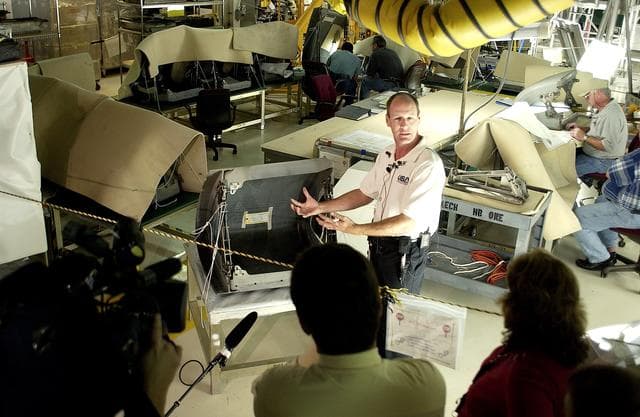
NASA image: KENNEDY SPACE CENTER, FLA. -  In the Orbiter Processing Facility (OPF), Rick Beckwith, an orbiter engineer with United Space Alliance, explains to the media the reinstallation of the Reinforced Carbon-Carbon panels on the orbiter Atlantis’ wing leading edge.  The media was invited to tour the OPF at KSC and to see the orbiter Atlantis as it is being prepared for Return to Flight.  Both local and national reporters representing print and TV networks were able to see work in progress on Atlantis, also including wiring inspections and checks of the engines in the Orbital Maneuvering System.
Image
Sep 26, 2003

KENNEDY SPACE CENTER, FLA. - In the Orbiter Processing Facility (OPF), Rick Beckwith, an orbiter engineer with United Space Alliance, explains to the media the reinstallation of the Reinforced Carbon-Carbon panels on the orbiter Atlantis’ wing leading edge. The media was invited to tour the OPF at KSC and to see the orbiter Atlantis as it is being prepared for Return to Flight. Both local and national reporters representing print and TV networks were able to see work in progress on Atlantis, also including wiring inspections and checks of the engines in the Orbital Maneuvering System.

KENNEDY SPACE CENTER, FLA. - In the Orbiter Processing Facility (OPF), Rick Beckwith, an orbiter engineer with...

KSC
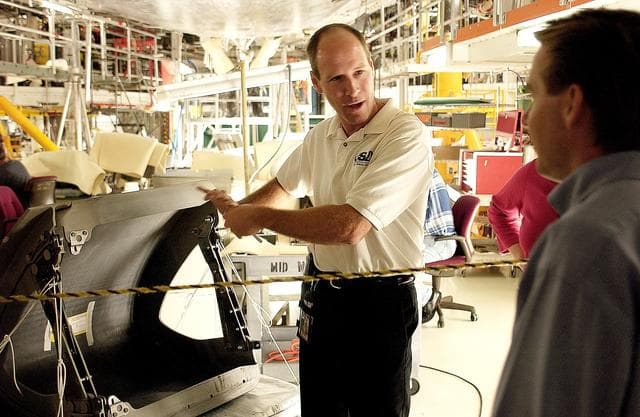
NASA image: KENNEDY SPACE CENTER, FLA. -  In the Orbiter Processing Facility, Rick Beckwith (center), an orbiter engineer with United Space Alliance, explains to the media the reinstallation of the Reinforced Carbon-Carbon panels on the orbiter Atlantis’ wing leading edge.  The media was invited to tour the OPF at KSC and to see the orbiter Atlantis as it is being prepared for Return to Flight.  Both local and national reporters representing print and TV networks were able to see work in progress on Atlantis, also including wiring inspections and checks of the engines in the Orbital Maneuvering System.
Image
Sep 26, 2003

KENNEDY SPACE CENTER, FLA. - In the Orbiter Processing Facility, Rick Beckwith (center), an orbiter engineer with United Space Alliance, explains to the media the reinstallation of the Reinforced Carbon-Carbon panels on the orbiter Atlantis’ wing leading edge. The media was invited to tour the OPF at KSC and to see the orbiter Atlantis as it is being prepared for Return to Flight. Both local and national reporters representing print and TV networks were able to see work in progress on Atlantis, also including wiring inspections and checks of the engines in the Orbital Maneuvering System.

KENNEDY SPACE CENTER, FLA. - In the Orbiter Processing Facility, Rick Beckwith (center), an orbiter engineer with...

PreviousPage 4 of 44Next

Frequently Asked Questions About NASA Images

Are NASA images free to use?+
Yes, most NASA images are in the public domain and are free to use for educational, informational, and personal purposes. NASA's media usage guidelines state that NASA material is not copyrighted unless otherwise noted. However, the NASA logo and certain insignia are protected. Some images may include identifiable individuals or third-party content that requires additional permissions. Always check the specific image's usage rights and credit NASA as the source.
How many images does NASA have?+
NASA's Image and Video Library contains over 140,000 publicly accessible images, videos, and audio files spanning the agency's entire history, from the Mercury program of the 1960s to the latest James Webb Space Telescope discoveries. The collection grows daily as new missions capture imagery and archival materials are digitized. Individual mission archives, such as Mars rover photos, contain hundreds of thousands of additional images.
Can I download NASA images?+
Yes, you can download NASA images in multiple resolutions directly from this gallery. Each image detail page provides download links for original (full resolution), large (1920px), medium (960px), small (480px), and thumbnail sizes. NASA encourages the public to use these images for education, media, and personal projects. High-resolution originals are ideal for printing and professional use.

Explore More NASA Content

Astronomy Picture of the Day

Daily curated space image

Mars Rover Photos

Curiosity & Perseverance images

Earth from Space

DSCOVR EPIC daily images

Launch Schedule

Upcoming rocket launches

Space News

Mission updates & discoveries

KSC