CosmosObservatory
Explore
Solar System
Live
Learn
Tools
About
Cosmos Observatory
ToolsAbout
Cosmos Observatory

Explore the universe through NASA data, real-time ISS tracking, Mars rover imagery, asteroid monitoring, and comprehensive space encyclopedia. Your gateway to the cosmos.

Explore

  • APOD
  • Mars Rovers
  • Earth Imagery
  • NASA Gallery
  • ISS Tracker

Data

  • Asteroids
  • Solar System
  • Exoplanets
  • Space Weather
  • Launches

Tools

  • Glossary
  • News
  • Calculators

Legal

  • About
  • Privacy Policy
  • Terms of Use
  • Space Tools
  • Contact

Stay updated with the cosmos

Get weekly digests of APOD highlights, upcoming launches, and space events.

© 2026 Cosmos Observatory. All rights reserved. Built with for space enthusiasts.

This website is not affiliated with, maintained, authorized, endorsed by, or in any way officially connected with NASA or any of its subsidiaries or affiliates. All NASA imagery is in the public domain unless otherwise noted. Data sourced from NASA Open APIs, Launch Library 2, and other open data services.

NASA Gallery

Explore NASA's vast collection of space images, videos, and audio from missions past and present.

  1. Home
  2. /
  3. NASA Gallery

NASA's Image and Video Library: A Visual Archive of Space Exploration

NASA's Image and Video Library is one of the most comprehensive public archives of space imagery in the world, containing over 140,000 images, videos, and audio recordings spanning more than six decades of space exploration. From the earliest Mercury and Gemini missions through the Apollo Moon landings, the Space Shuttle era, and today's cutting-edge observations from the James Webb Space Telescope, this collection documents humanity's journey into the cosmos.

The library includes imagery from diverse sources: telescopes like Hubble and Webb that capture deep-space nebulae, galaxies, and exoplanets; planetary missions like the Mars rovers ( browse Mars photos) and Cassini at Saturn; Earth observation satellites ( see EPIC imagery); astronaut photography from the ISS; and documentation of rocket launches, spacecraft assembly, and ground testing. Most NASA images are in the public domain and free to download at full resolution for educational, editorial, and personal use.

Use the search bar above to find specific subjects — try queries like "Apollo 11," "Hubble Deep Field," "Mars surface," or "astronaut EVA." You can also filter by media type (image, video, or audio). For a daily curated experience, visit the Astronomy Picture of the Day.

Showing results for "BAYS"

14,884 results found - Page 38 of 621

NASA image: EGS Artist Photos - Vehicle Assembly Building
Image
Jun 21, 2018

EGS Artist Photos - Vehicle Assembly Building

The iconic Vehicle Assembly Building (VAB) casts a reflection in a surrounding waterway at NASA's Kennedy Space...

KSC
NASA image: EGS Artist Photos - Vehicle Assembly Building
Image
Jun 21, 2018

EGS Artist Photos - Vehicle Assembly Building

A sunrise panoramic view of the iconic Vehicle Assembly Building (VAB) and surrounding waterways at NASA's Kennedy...

KSC
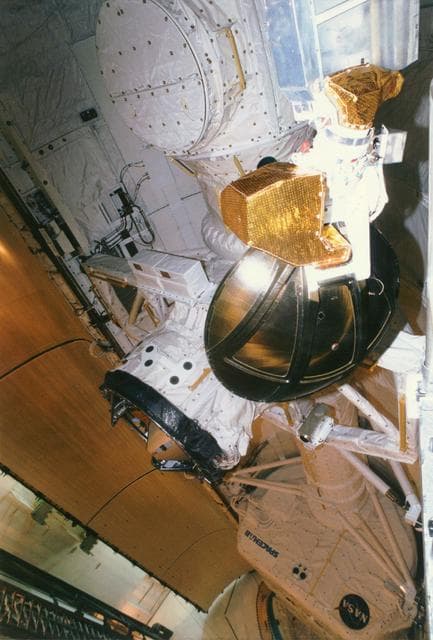
NASA image: KENNEDY SPACE CENTER, FLA. -  The orbiter Ku-band antenna looms large in this view of the Space Shuttle Atlantis' payload bay.  Visible just past the antenna system - stowed on the starboard side of the payload bay wall - is the Orbiter Docking System (ODS), and connected to the ODS via a tunnel is the Spacehab Double Module in the aft area of the payload bay.  This photograph was taken from the starboard wing platform on the fifth level of the Payload Changeout Room (PCR) at Launch Pad 39A.  Work is under way in the PCR to close Atlantis' payload bay doors for flight.  Atlantis currently is being targeted for liftoff on Mission STS-79, the fourth docking of the U.S. Shuttle to the Russian Space Station Mir, around Sept. 12.
Image
Aug 22, 1996

KENNEDY SPACE CENTER, FLA. - The orbiter Ku-band antenna looms large in this view of the Space Shuttle Atlantis' payload bay. Visible just past the antenna system - stowed on the starboard side of the payload bay wall - is the Orbiter Docking System (ODS), and connected to the ODS via a tunnel is the Spacehab Double Module in the aft area of the payload bay. This photograph was taken from the starboard wing platform on the fifth level of the Payload Changeout Room (PCR) at Launch Pad 39A. Work is under way in the PCR to close Atlantis' payload bay doors for flight. Atlantis currently is being targeted for liftoff on Mission STS-79, the fourth docking of the U.S. Shuttle to the Russian Space Station Mir, around Sept. 12.

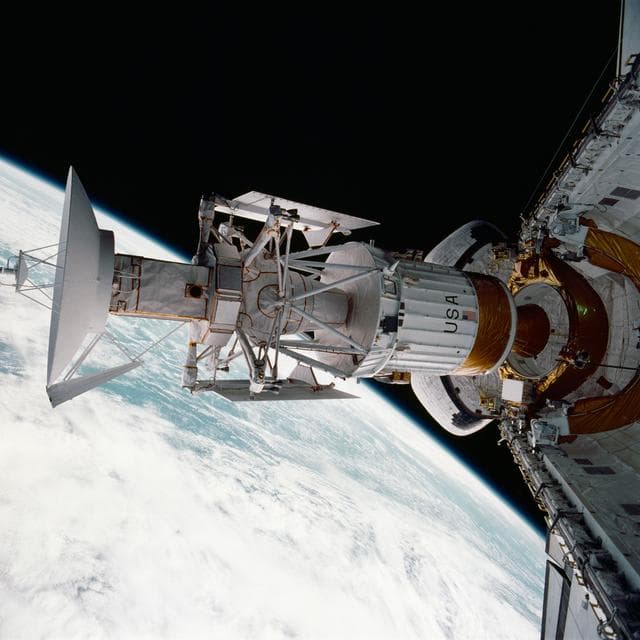
NASA image: STS-30 Magellan spacecraft & IUS deployment from Atlantis' payload bay (PLB)
Image
May 4, 1989

STS-30 Magellan spacecraft & IUS deployment from Atlantis' payload bay (PLB)

STS030-72-047 (4 May 1989) --- In the early evening hours of Atlantis?s first day in space for the four-day STS-30...

JSC
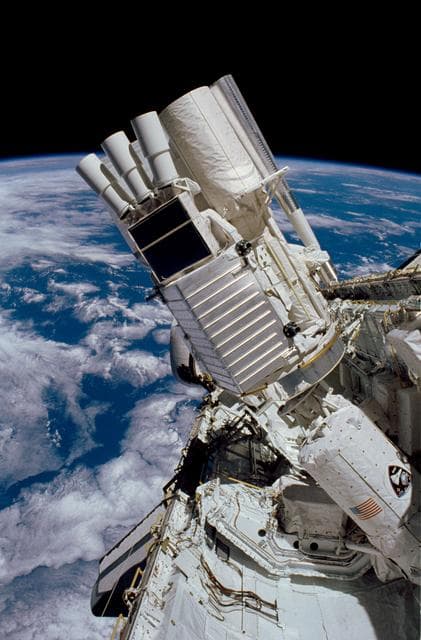
NASA image: STS-35 ASTRO-1 telescopes documented in OV-102's payload bay (PLB)
Image
Dec 10, 1990

STS-35 ASTRO-1 telescopes documented in OV-102's payload bay (PLB)

STS035-13-008 (2-10 Dec. 1990) --- The various components of the Astro-1 payload are seen backdropped against the...

JSC
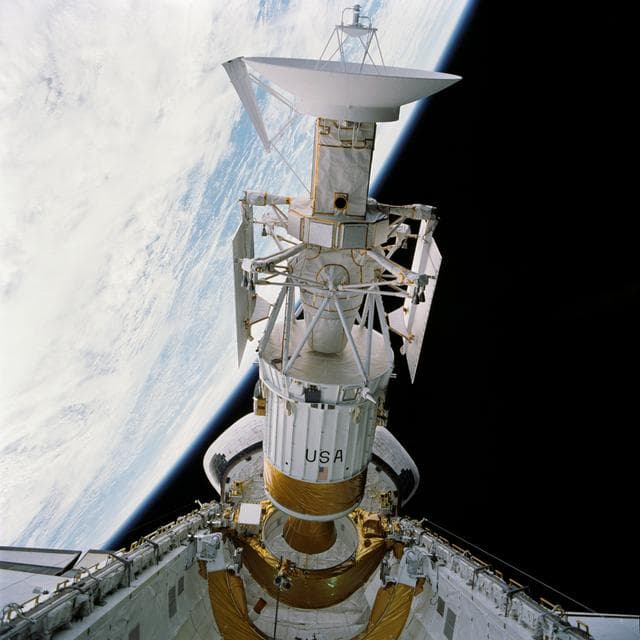
NASA image: STS-30 Magellan spacecraft & IUS deployment from Atlantis' payload bay (PLB)
Image
May 4, 1989

STS-30 Magellan spacecraft & IUS deployment from Atlantis' payload bay (PLB)

STS030-72-046 (4 May 1989) --- In the early evening hours of the Space Shuttle Atlantis' first day in space for the...

JSC
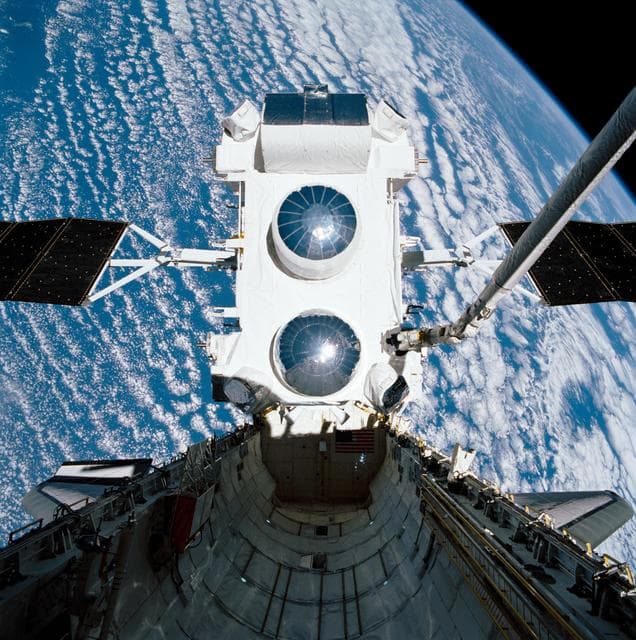
NASA image: STS-37 Gamma Ray Observatory (GRO) held by RMS over OV-104's payload bay
Image
Apr 7, 1991

STS-37 Gamma Ray Observatory (GRO) held by RMS over OV-104's payload bay

STS037-99-098 (7 April 1991) --- Backdropped against clouds over water, the Gamma Ray Observatory (GRO) is still in...

JSC
NASA image: Media Event with Northrop Grumman at VAB Highbay 2
Image
Aug 16, 2019

Media Event with Northrop Grumman at VAB Highbay 2

Elected officials and guests visit after a ribbon cutting ceremony on Aug. 16, 2019, in High Bay 2 of the Vehicle...

KSC
NASA image: Media Event with Northrop Grumman at VAB Highbay 2
Image
Aug 16, 2019

Media Event with Northrop Grumman at VAB Highbay 2

Legislators, invited guests and members of the media attend a ribbon cutting ceremony on Aug. 16, 2019, in High Bay...

KSC
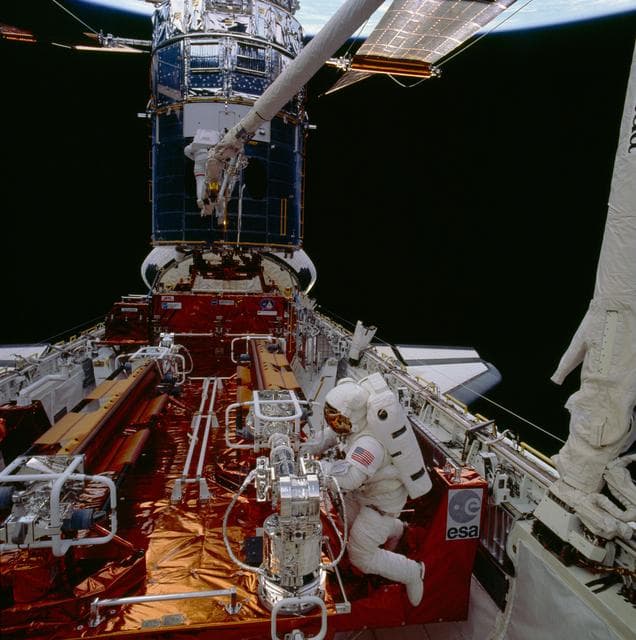
NASA image: Astronauts Musgrave and Hoffman during first STS-61 EVA
Image
Dec 5, 1993

Astronauts Musgrave and Hoffman during first STS-61 EVA

STS061-86-048 (5 Dec 1993) --- Astronauts F. Story Musgrave (foreground) and Jeffrey A. Hoffman are pictured near...

JSC
NASA image: Media Event with Northrop Grumman at VAB Highbay 2
Image
Aug 16, 2019

Media Event with Northrop Grumman at VAB Highbay 2

Legislators, invited guests and members of the media attend a ribbon cutting ceremony on Aug. 16, 2019, in High Bay...

KSC
NASA image: Media Event with Northrop Grumman at VAB Highbay 2
Image
Aug 16, 2019

Media Event with Northrop Grumman at VAB Highbay 2

Legislators and invited guests clap during a ribbon cutting ceremony on Aug. 16, 2019, in High Bay 2 of the Vehicle...

KSC
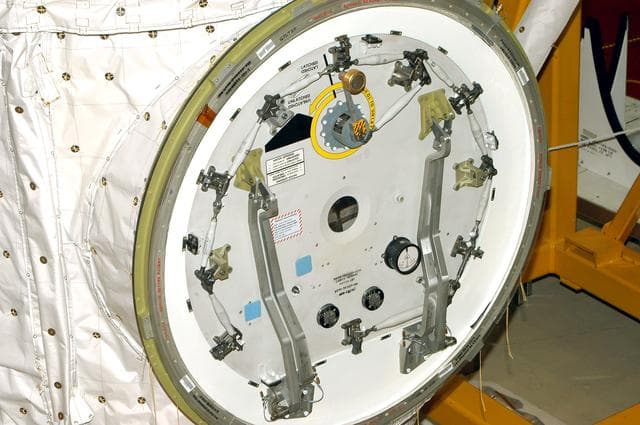
NASA image: KENNEDY SPACE CENTER, FLA. -  Seen in the photo is one end of the airlock that is installed in the payload bay of orbiter Discovery.  The airlock is normally located inside the middeck of the spacecraft’s pressurized crew cabin. The airlock is sized to accommodate two fully suited flight crew members simultaneously. Support functions include airlock depressurization and repressurization, extravehicular activity equipment recharge, liquid-cooled garment water cooling, EVA equipment checkout, donning and communications. The outer hatch isolates the airlock from the unpressurized payload bay when closed and permits the EVA crew members to exit from the airlock to the payload bay when open.
Image
Jan 22, 2004

KENNEDY SPACE CENTER, FLA. - Seen in the photo is one end of the airlock that is installed in the payload bay of orbiter Discovery. The airlock is normally located inside the middeck of the spacecraft’s pressurized crew cabin. The airlock is sized to accommodate two fully suited flight crew members simultaneously. Support functions include airlock depressurization and repressurization, extravehicular activity equipment recharge, liquid-cooled garment water cooling, EVA equipment checkout, donning and communications. The outer hatch isolates the airlock from the unpressurized payload bay when closed and permits the EVA crew members to exit from the airlock to the payload bay when open.

KENNEDY SPACE CENTER, FLA. - Seen in the photo is one end of the airlock that is installed in the payload bay of...
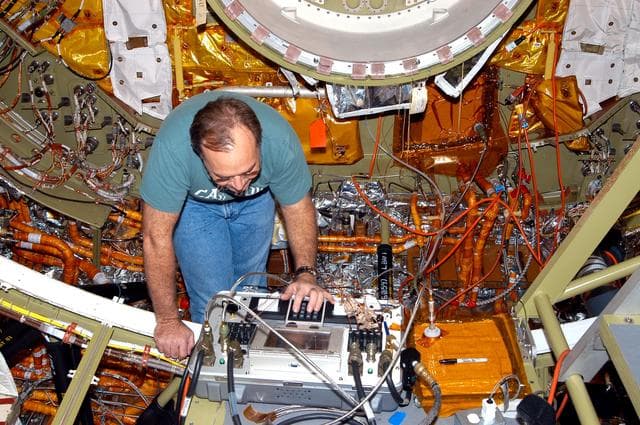
NASA image: KENNEDY SPACE CENTER, FLA. -  In the Orbiter Processing Facility, a worker checks out part of the equipment in the airlock, at one end of Discovery’s payload bay.  The airlock is sized to accommodate two fully suited flight crew members simultaneously. Support functions include airlock depressurization and repressurization, extravehicular activity equipment recharge, liquid-cooled garment water cooling, EVA equipment checkout, donning and communications. The outer hatch isolates the airlock from the unpressurized payload bay when closed and permits the EVA crew members to exit from the airlock to the payload bay when open.
Image
Jan 22, 2004

KENNEDY SPACE CENTER, FLA. - In the Orbiter Processing Facility, a worker checks out part of the equipment in the airlock, at one end of Discovery’s payload bay. The airlock is sized to accommodate two fully suited flight crew members simultaneously. Support functions include airlock depressurization and repressurization, extravehicular activity equipment recharge, liquid-cooled garment water cooling, EVA equipment checkout, donning and communications. The outer hatch isolates the airlock from the unpressurized payload bay when closed and permits the EVA crew members to exit from the airlock to the payload bay when open.

KENNEDY SPACE CENTER, FLA. - In the Orbiter Processing Facility, a worker checks out part of the equipment in the...
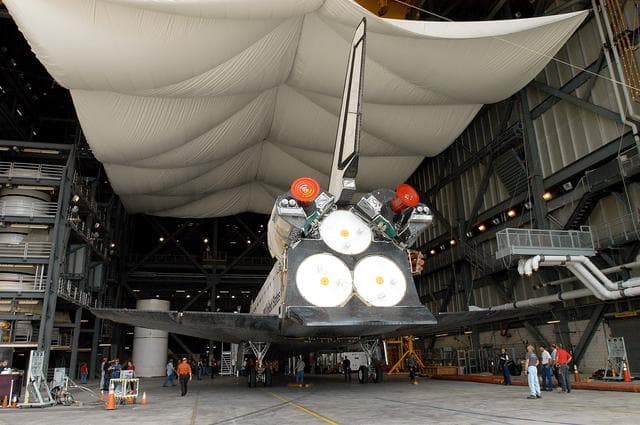
NASA image: KENNEDY SPACE CENTER, FLA. - The Space Shuttle orbiter Atlantis arrives in high bay 4 of the Vehicle Assembly Building (VAB).  It was towed from the Orbiter Processing Facility (OPF) to allow work to be performed in the bay that can only be accomplished while it is empty. Work scheduled in the processing facility includes annual validation of the bay's cranes, work platforms, lifting mechanisms, and jack stands. Atlantis will remain in the VAB for about 10 days, then return to the OPF as work resumes to prepare it for launch in September 2004 on the first return-to-flight mission, STS-114.
Image
Dec 5, 2003

KENNEDY SPACE CENTER, FLA. - The Space Shuttle orbiter Atlantis arrives in high bay 4 of the Vehicle Assembly Building (VAB). It was towed from the Orbiter Processing Facility (OPF) to allow work to be performed in the bay that can only be accomplished while it is empty. Work scheduled in the processing facility includes annual validation of the bay's cranes, work platforms, lifting mechanisms, and jack stands. Atlantis will remain in the VAB for about 10 days, then return to the OPF as work resumes to prepare it for launch in September 2004 on the first return-to-flight mission, STS-114.

KENNEDY SPACE CENTER, FLA. - The Space Shuttle orbiter Atlantis arrives in high bay 4 of the Vehicle Assembly...

KSC
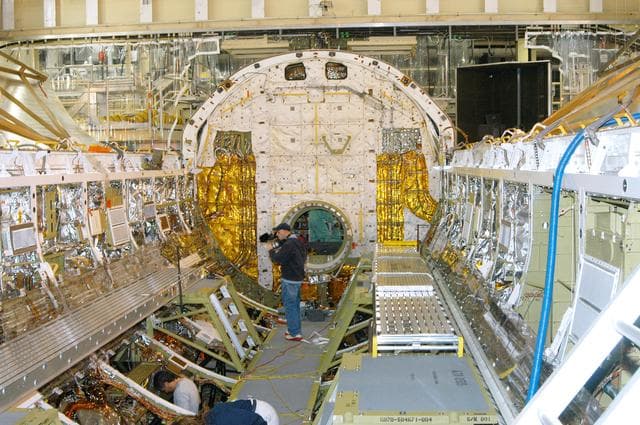
NASA image: KENNEDY SPACE CENTER, FLA. -  In the Orbiter Processing Facility, a cameraman films part of Discovery’s payload bay for a special feature on the KSC Web.  In the background is the open hatch of the airlock, located inside the middeck of the spacecraft’s pressurized crew cabin. The airlock is sized to accommodate two fully suited flight crew members simultaneously. Support functions include airlock depressurization and repressurization, extravehicular activity equipment recharge, liquid-cooled garment water cooling, EVA equipment checkout, donning and communications. The outer hatch isolates the airlock from the unpressurized payload bay when closed and permits the EVA crew members to exit from the airlock to the payload bay when open.
Image
Jan 22, 2004

KENNEDY SPACE CENTER, FLA. - In the Orbiter Processing Facility, a cameraman films part of Discovery’s payload bay for a special feature on the KSC Web. In the background is the open hatch of the airlock, located inside the middeck of the spacecraft’s pressurized crew cabin. The airlock is sized to accommodate two fully suited flight crew members simultaneously. Support functions include airlock depressurization and repressurization, extravehicular activity equipment recharge, liquid-cooled garment water cooling, EVA equipment checkout, donning and communications. The outer hatch isolates the airlock from the unpressurized payload bay when closed and permits the EVA crew members to exit from the airlock to the payload bay when open.

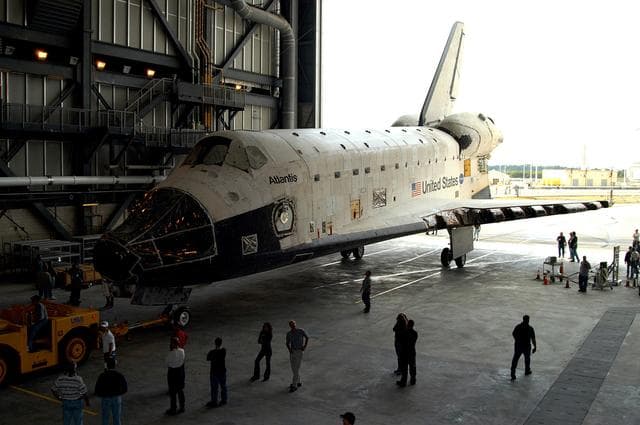
NASA image: KENNEDY SPACE CENTER, FLA. - The Space Shuttle orbiter Atlantis is moved into high bay 4 of the Vehicle Assembly Building (VAB).  It was towed from the Orbiter Processing Facility (OPF) to allow work to be performed in the bay that can only be accomplished while it is empty. Work scheduled in the processing facility includes annual validation of the bay's cranes, work platforms, lifting mechanisms, and jack stands. Atlantis will remain in the VAB for about 10 days, then return to the OPF as work resumes to prepare it for launch in September 2004 on the first return-to-flight mission, STS-114.
Image
Dec 5, 2003

KENNEDY SPACE CENTER, FLA. - The Space Shuttle orbiter Atlantis is moved into high bay 4 of the Vehicle Assembly Building (VAB). It was towed from the Orbiter Processing Facility (OPF) to allow work to be performed in the bay that can only be accomplished while it is empty. Work scheduled in the processing facility includes annual validation of the bay's cranes, work platforms, lifting mechanisms, and jack stands. Atlantis will remain in the VAB for about 10 days, then return to the OPF as work resumes to prepare it for launch in September 2004 on the first return-to-flight mission, STS-114.

KENNEDY SPACE CENTER, FLA. - The Space Shuttle orbiter Atlantis is moved into high bay 4 of the Vehicle Assembly...
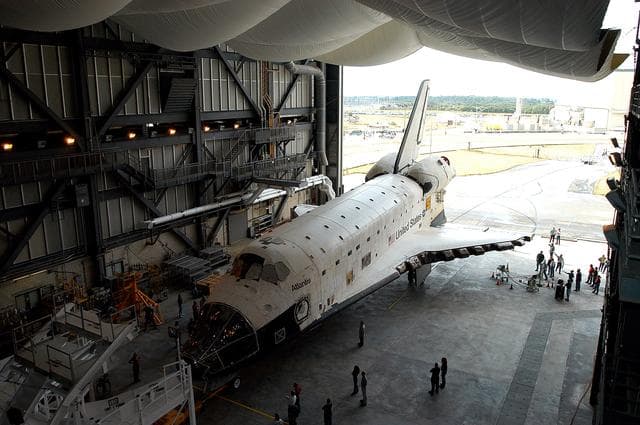
NASA image: KENNEDY SPACE CENTER, FLA. - The Space Shuttle orbiter Atlantis is almost in position in high bay 4 of the Vehicle Assembly Building (VAB).  It was towed from the Orbiter Processing Facility (OPF) to allow work to be performed in the bay that can only be accomplished while it is empty. Work scheduled in the processing facility includes annual validation of the bay's cranes, work platforms, lifting mechanisms, and jack stands. Atlantis will remain in the VAB for about 10 days, then return to the OPF as work resumes to prepare it for launch in September 2004 on the first return-to-flight mission, STS-114.
Image
Dec 5, 2003

KENNEDY SPACE CENTER, FLA. - The Space Shuttle orbiter Atlantis is almost in position in high bay 4 of the Vehicle Assembly Building (VAB). It was towed from the Orbiter Processing Facility (OPF) to allow work to be performed in the bay that can only be accomplished while it is empty. Work scheduled in the processing facility includes annual validation of the bay's cranes, work platforms, lifting mechanisms, and jack stands. Atlantis will remain in the VAB for about 10 days, then return to the OPF as work resumes to prepare it for launch in September 2004 on the first return-to-flight mission, STS-114.

KENNEDY SPACE CENTER, FLA. - The Space Shuttle orbiter Atlantis is almost in position in high bay 4 of the Vehicle...
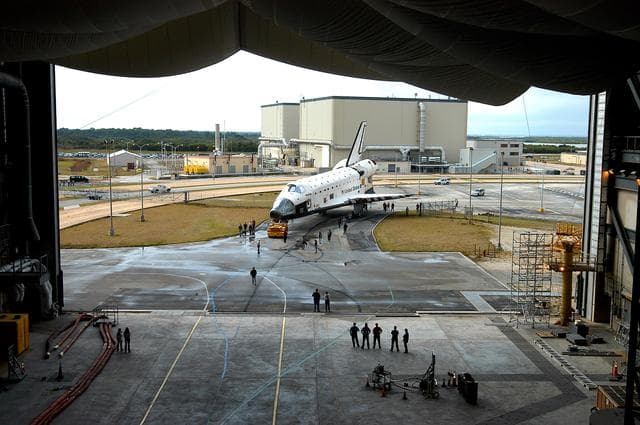
NASA image: KENNEDY SPACE CENTER, FLA. - The Space Shuttle orbiter Atlantis approaches high bay 4 of the Vehicle Assembly Building (VAB).  It was towed from the Orbiter Processing Facility (OPF) to allow work to be performed in the bay that can only be accomplished while it is empty. Work scheduled in the processing facility includes annual validation of the bay's cranes, work platforms, lifting mechanisms, and jack stands. Atlantis will remain in the VAB for about 10 days, then return to the OPF as work resumes to prepare it for launch in September 2004 on the first return-to-flight mission, STS-114.
Image
Dec 5, 2003

KENNEDY SPACE CENTER, FLA. - The Space Shuttle orbiter Atlantis approaches high bay 4 of the Vehicle Assembly Building (VAB). It was towed from the Orbiter Processing Facility (OPF) to allow work to be performed in the bay that can only be accomplished while it is empty. Work scheduled in the processing facility includes annual validation of the bay's cranes, work platforms, lifting mechanisms, and jack stands. Atlantis will remain in the VAB for about 10 days, then return to the OPF as work resumes to prepare it for launch in September 2004 on the first return-to-flight mission, STS-114.

KENNEDY SPACE CENTER, FLA. - The Space Shuttle orbiter Atlantis approaches high bay 4 of the Vehicle Assembly...

KSC
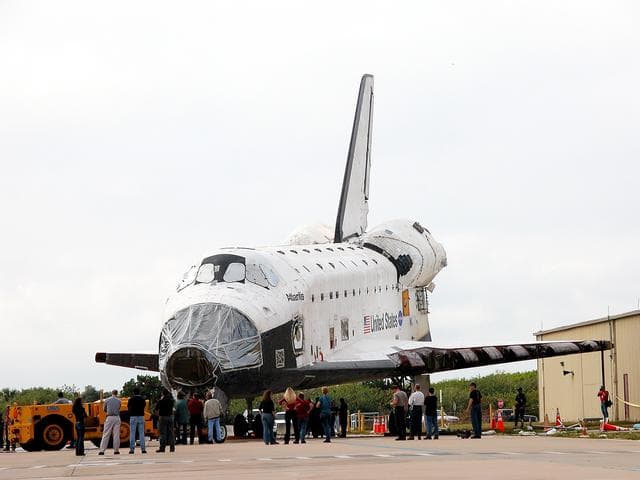
NASA image: KENNEDY SPACE CENTER, FLA. - Workers walk with Space Shuttle orbiter Atlantis from the Orbiter Processing Facility (OPF) to the Vehicle Assembly Building (VAB) high bay 4. The move will allow work to be performed in the OPF that can only be accomplished while the bay is empty. Work scheduled in the processing facility includes annual validation of the bay's cranes, work platforms, lifting mechanisms, and jack stands. Atlantis will remain in the VAB for about 10 days, then return to the OPF as work resumes to prepare it for launch in September 2004 on the first return-to-flight mission, STS-114.
Image
Dec 5, 2003

KENNEDY SPACE CENTER, FLA. - Workers walk with Space Shuttle orbiter Atlantis from the Orbiter Processing Facility (OPF) to the Vehicle Assembly Building (VAB) high bay 4. The move will allow work to be performed in the OPF that can only be accomplished while the bay is empty. Work scheduled in the processing facility includes annual validation of the bay's cranes, work platforms, lifting mechanisms, and jack stands. Atlantis will remain in the VAB for about 10 days, then return to the OPF as work resumes to prepare it for launch in September 2004 on the first return-to-flight mission, STS-114.

KENNEDY SPACE CENTER, FLA. - Workers walk with Space Shuttle orbiter Atlantis from the Orbiter Processing Facility...
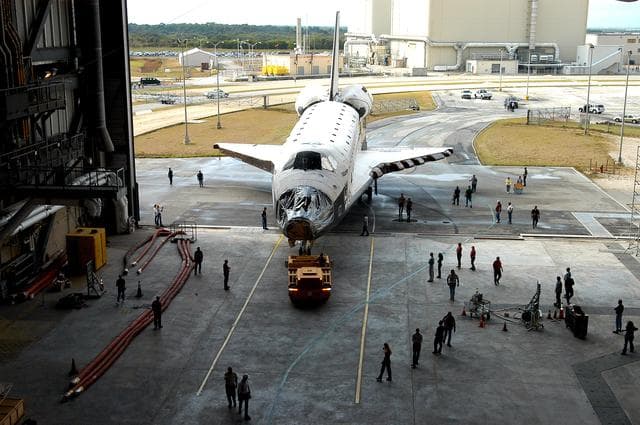
NASA image: KENNEDY SPACE CENTER, FLA. - The Space Shuttle orbiter Atlantis moves into high bay 4 of the Vehicle Assembly Building (VAB).  It was towed from the Orbiter Processing Facility (OPF) to allow work to be performed in the bay that can only be accomplished while it is empty. Work scheduled in the processing facility includes annual validation of the bay's cranes, work platforms, lifting mechanisms, and jack stands. Atlantis will remain in the VAB for about 10 days, then return to the OPF as work resumes to prepare it for launch in September 2004 on the first return-to-flight mission, STS-114.
Image
Dec 5, 2003

KENNEDY SPACE CENTER, FLA. - The Space Shuttle orbiter Atlantis moves into high bay 4 of the Vehicle Assembly Building (VAB). It was towed from the Orbiter Processing Facility (OPF) to allow work to be performed in the bay that can only be accomplished while it is empty. Work scheduled in the processing facility includes annual validation of the bay's cranes, work platforms, lifting mechanisms, and jack stands. Atlantis will remain in the VAB for about 10 days, then return to the OPF as work resumes to prepare it for launch in September 2004 on the first return-to-flight mission, STS-114.

KENNEDY SPACE CENTER, FLA. - The Space Shuttle orbiter Atlantis moves into high bay 4 of the Vehicle Assembly...

KSC
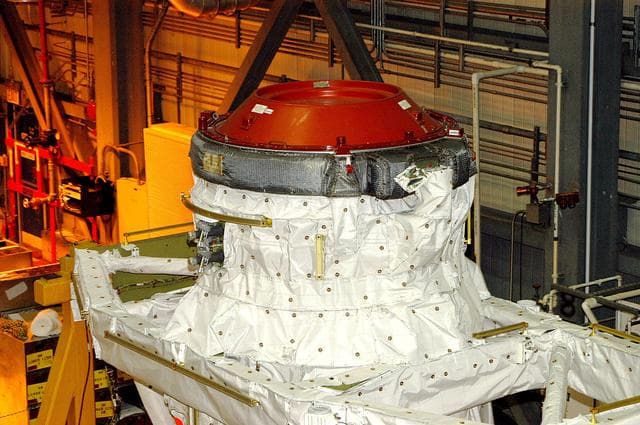
NASA image: KENNEDY SPACE CENTER, FLA. -  Seen in the photo is one end of the airlock that is installed in the payload bay of orbiter Discovery.  The airlock is normally located inside the middeck of the spacecraft’s pressurized crew cabin. The airlock is sized to accommodate two fully suited flight crew members simultaneously. Support functions include airlock depressurization and repressurization, extravehicular activity equipment recharge, liquid-cooled garment water cooling, EVA equipment checkout, donning and communications. The outer hatch isolates the airlock from the unpressurized payload bay when closed and permits the EVA crew members to exit from the airlock to the payload bay when open.
Image
Jan 22, 2004

KENNEDY SPACE CENTER, FLA. - Seen in the photo is one end of the airlock that is installed in the payload bay of orbiter Discovery. The airlock is normally located inside the middeck of the spacecraft’s pressurized crew cabin. The airlock is sized to accommodate two fully suited flight crew members simultaneously. Support functions include airlock depressurization and repressurization, extravehicular activity equipment recharge, liquid-cooled garment water cooling, EVA equipment checkout, donning and communications. The outer hatch isolates the airlock from the unpressurized payload bay when closed and permits the EVA crew members to exit from the airlock to the payload bay when open.

KENNEDY SPACE CENTER, FLA. - Seen in the photo is one end of the airlock that is installed in the payload bay of...
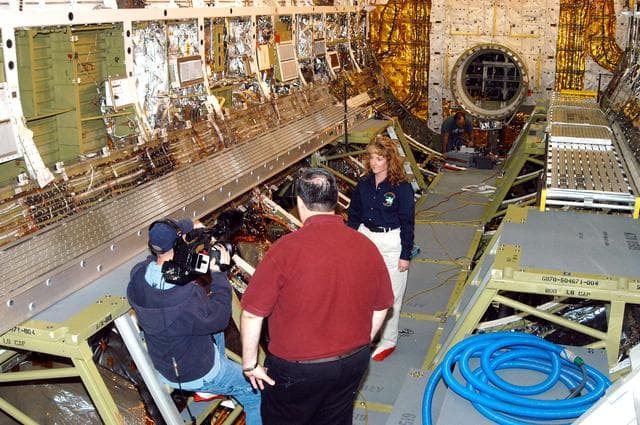
NASA image: KENNEDY SPACE CENTER, FLA. -  Standing inside Discovery’s payload bay, Carol Scott (right), lead orbiter engineer, talks about her job as part of a special feature for the KSC Web.  With his back to the camera is Bill Kallus, Media manager in the KSC Web Studio.  Behind Scott can be seen the open hatch of the airlock, which provides support functions such as airlock depressurization and repressurization, extravehicular activity equipment recharge, liquid-cooled garment water cooling, EVA equipment checkout, donning and communications. The outer hatch isolates the airlock from the unpressurized payload bay when closed and permits the EVA crew members to exit from the airlock to the payload bay when open.
Image
Jan 22, 2004

KENNEDY SPACE CENTER, FLA. - Standing inside Discovery’s payload bay, Carol Scott (right), lead orbiter engineer, talks about her job as part of a special feature for the KSC Web. With his back to the camera is Bill Kallus, Media manager in the KSC Web Studio. Behind Scott can be seen the open hatch of the airlock, which provides support functions such as airlock depressurization and repressurization, extravehicular activity equipment recharge, liquid-cooled garment water cooling, EVA equipment checkout, donning and communications. The outer hatch isolates the airlock from the unpressurized payload bay when closed and permits the EVA crew members to exit from the airlock to the payload bay when open.

KENNEDY SPACE CENTER, FLA. - Standing inside Discovery’s payload bay, Carol Scott (right), lead orbiter engineer,...
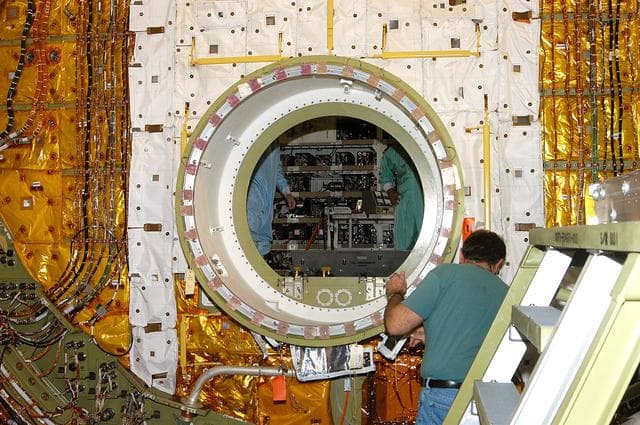
NASA image: KENNEDY SPACE CENTER, FLA. -  A worker in the Orbiter Processing Facility checks the open hatch of the airlock in Discovery’s payload bay. The airlock is normally located inside the middeck of the spacecraft’s pressurized crew cabin. The airlock is sized to accommodate two fully suited flight crew members simultaneously. Support functions include airlock depressurization and repressurization, extravehicular activity equipment recharge, liquid-cooled garment water cooling, EVA equipment checkout, donning and communications. The outer hatch isolates the airlock from the unpressurized payload bay when closed and permits the EVA crew members to exit from the airlock to the payload bay when open.
Image
Jan 22, 2004

KENNEDY SPACE CENTER, FLA. - A worker in the Orbiter Processing Facility checks the open hatch of the airlock in Discovery’s payload bay. The airlock is normally located inside the middeck of the spacecraft’s pressurized crew cabin. The airlock is sized to accommodate two fully suited flight crew members simultaneously. Support functions include airlock depressurization and repressurization, extravehicular activity equipment recharge, liquid-cooled garment water cooling, EVA equipment checkout, donning and communications. The outer hatch isolates the airlock from the unpressurized payload bay when closed and permits the EVA crew members to exit from the airlock to the payload bay when open.

KENNEDY SPACE CENTER, FLA. - A worker in the Orbiter Processing Facility checks the open hatch of the airlock in...

PreviousPage 38 of 100Next

Frequently Asked Questions About NASA Images

Are NASA images free to use?+
Yes, most NASA images are in the public domain and are free to use for educational, informational, and personal purposes. NASA's media usage guidelines state that NASA material is not copyrighted unless otherwise noted. However, the NASA logo and certain insignia are protected. Some images may include identifiable individuals or third-party content that requires additional permissions. Always check the specific image's usage rights and credit NASA as the source.
How many images does NASA have?+
NASA's Image and Video Library contains over 140,000 publicly accessible images, videos, and audio files spanning the agency's entire history, from the Mercury program of the 1960s to the latest James Webb Space Telescope discoveries. The collection grows daily as new missions capture imagery and archival materials are digitized. Individual mission archives, such as Mars rover photos, contain hundreds of thousands of additional images.
Can I download NASA images?+
Yes, you can download NASA images in multiple resolutions directly from this gallery. Each image detail page provides download links for original (full resolution), large (1920px), medium (960px), small (480px), and thumbnail sizes. NASA encourages the public to use these images for education, media, and personal projects. High-resolution originals are ideal for printing and professional use.

Explore More NASA Content

Astronomy Picture of the Day

Daily curated space image

Mars Rover Photos

Curiosity & Perseverance images

Earth from Space

DSCOVR EPIC daily images

Launch Schedule

Upcoming rocket launches

Space News

Mission updates & discoveries

KENNEDY SPACE CENTER, FLA. - The orbiter Ku-band antenna looms large in this view of the Space Shuttle Atlantis'...

KSC
KSC
KSC

KENNEDY SPACE CENTER, FLA. - In the Orbiter Processing Facility, a cameraman films part of Discovery’s payload bay...

KSC
KSC
KSC
KSC
KSC
KSC
KSC