CosmosObservatory
Explore
Solar System
Live
Learn
Tools
About
Cosmos Observatory
ToolsAbout
Cosmos Observatory

Explore the universe through NASA data, real-time ISS tracking, Mars rover imagery, asteroid monitoring, and comprehensive space encyclopedia. Your gateway to the cosmos.

Explore

  • APOD
  • Mars Rovers
  • Earth Imagery
  • NASA Gallery
  • ISS Tracker

Data

  • Asteroids
  • Solar System
  • Exoplanets
  • Space Weather
  • Launches

Tools

  • Glossary
  • News
  • Calculators

Legal

  • About
  • Privacy Policy
  • Terms of Use
  • Space Tools
  • Contact

Stay updated with the cosmos

Get weekly digests of APOD highlights, upcoming launches, and space events.

© 2026 Cosmos Observatory. All rights reserved. Built with for space enthusiasts.

This website is not affiliated with, maintained, authorized, endorsed by, or in any way officially connected with NASA or any of its subsidiaries or affiliates. All NASA imagery is in the public domain unless otherwise noted. Data sourced from NASA Open APIs, Launch Library 2, and other open data services.

NASA Gallery

Explore NASA's vast collection of space images, videos, and audio from missions past and present.

  1. Home
  2. /
  3. NASA Gallery

NASA's Image and Video Library: A Visual Archive of Space Exploration

NASA's Image and Video Library is one of the most comprehensive public archives of space imagery in the world, containing over 140,000 images, videos, and audio recordings spanning more than six decades of space exploration. From the earliest Mercury and Gemini missions through the Apollo Moon landings, the Space Shuttle era, and today's cutting-edge observations from the James Webb Space Telescope, this collection documents humanity's journey into the cosmos.

The library includes imagery from diverse sources: telescopes like Hubble and Webb that capture deep-space nebulae, galaxies, and exoplanets; planetary missions like the Mars rovers ( browse Mars photos) and Cassini at Saturn; Earth observation satellites ( see EPIC imagery); astronaut photography from the ISS; and documentation of rocket launches, spacecraft assembly, and ground testing. Most NASA images are in the public domain and free to download at full resolution for educational, editorial, and personal use.

Use the search bar above to find specific subjects — try queries like "Apollo 11," "Hubble Deep Field," "Mars surface," or "astronaut EVA." You can also filter by media type (image, video, or audio). For a daily curated experience, visit the Astronomy Picture of the Day.

Showing results for "GA"

4,204 results found - Page 29 of 176

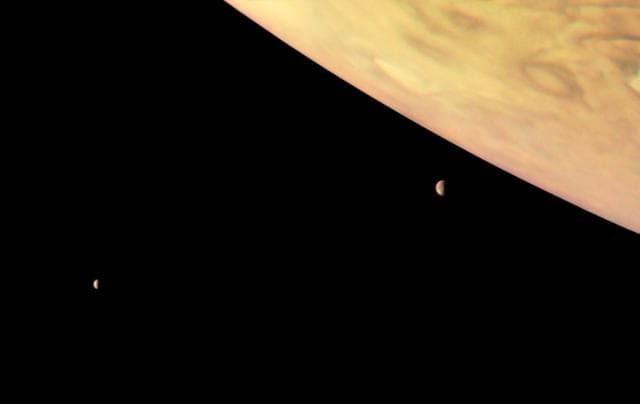
NASA image: Juno Observes Jupiter, Io and Europa
Image
Oct 6, 2017

Juno Observes Jupiter, Io and Europa

This color-enhanced image of Jupiter and two of its largest moons -- Io and Europa -- was captured by NASA's Juno...

JPL
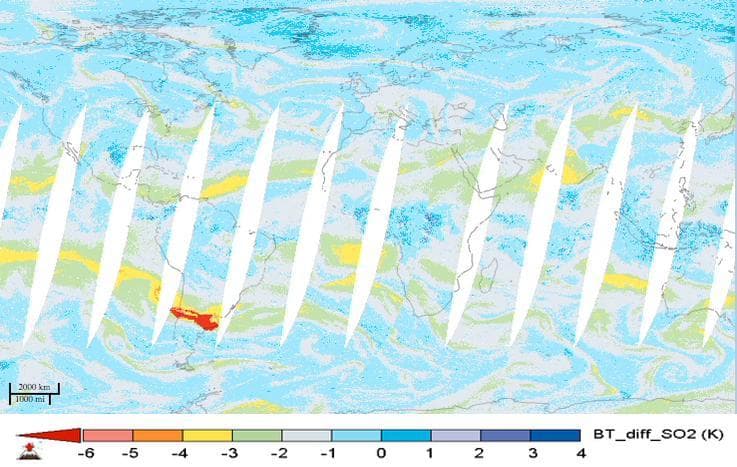
NASA image: NASA AIRS Instrument Tracks Transport of Sulfur Dioxide from Chilean Volcanic Eruption Animation
Image
May 7, 2015

NASA AIRS Instrument Tracks Transport of Sulfur Dioxide from Chilean Volcanic Eruption Animation

For the first time in 40 years, the Calbuco volcano in southern Chile erupted on April 22, 2015. The eruption caused...

JPL
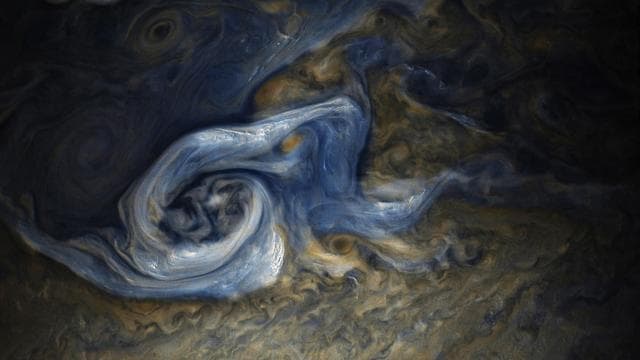
NASA image: Jovian Tempest
Image
Oct 24, 2017

Jovian Tempest

This color-enhanced image of a massive, raging storm in Jupiter's northern hemisphere was captured by NASA's Juno...

JPL
NASA image: Hubble Reveals Stellar Fireworks in ‘Skyrocket’ Galaxy
Image
Jun 29, 2016

Hubble Reveals Stellar Fireworks in ‘Skyrocket’ Galaxy

Fireworks shows are not just confined to Earth’s skies. NASA’s Hubble Space Telescope has captured a spectacular...

GSFC
NASA image: Hubble Reveals Stellar Fireworks in ‘Skyrocket’ Galaxy
Image
Dec 8, 2017

Hubble Reveals Stellar Fireworks in ‘Skyrocket’ Galaxy

Fireworks shows are not just confined to Earth’s skies. NASA’s Hubble Space Telescope has captured a spectacular...

GSFC
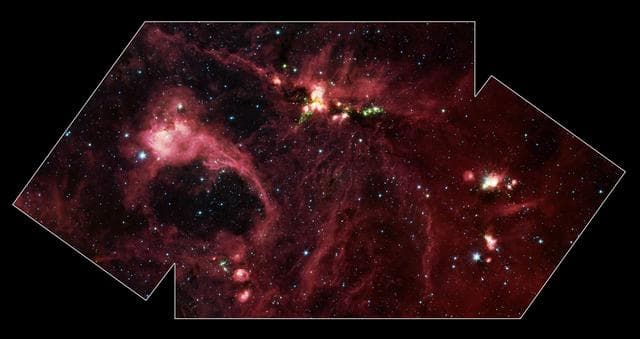
NASA image: Nursery of Giants
Image
Apr 13, 2004

Nursery of Giants

Hidden behind a shroud of dust in the constellation Cygnus is a stellar nursery called DR21, which is giving birth...

JPL
NASA image: NASA’s Hubble Sees a Cosmic Caterpillar
Image
Dec 8, 2017

NASA’s Hubble Sees a Cosmic Caterpillar

This light-year-long knot of interstellar gas and dust resembles a caterpillar on its way to a feast. But the meat...

GSFC
NASA image: Hubble Looks at Light and Dark in the Universe
Image
Dec 8, 2017

Hubble Looks at Light and Dark in the Universe

This new NASA/ESA Hubble Space Telescope image shows a variety of intriguing cosmic phenomena. Surrounded by bright...

GSFC
NASA image: Wide View of 'Mystic Mountain'
Image
Dec 8, 2017

Wide View of 'Mystic Mountain'

NASA image release April 22, 2010 This craggy fantasy mountaintop enshrouded by wispy clouds looks like a bizarre...

GSFC
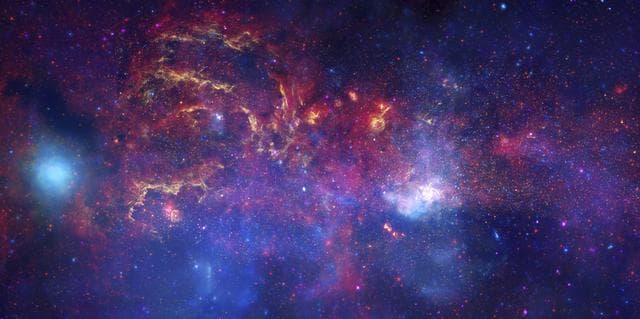
NASA image: Great Observatories Unique Views of the Milky Way
Image
Nov 10, 2009

Great Observatories Unique Views of the Milky Way

In celebration of the International Year of Astronomy 2009, NASA's Great Observatories -- the Hubble Space...

JPL
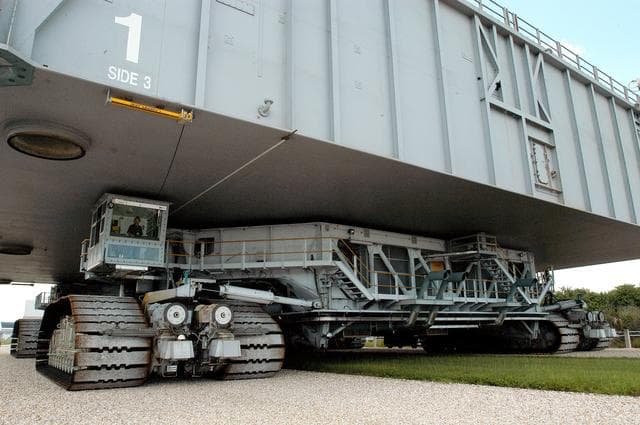
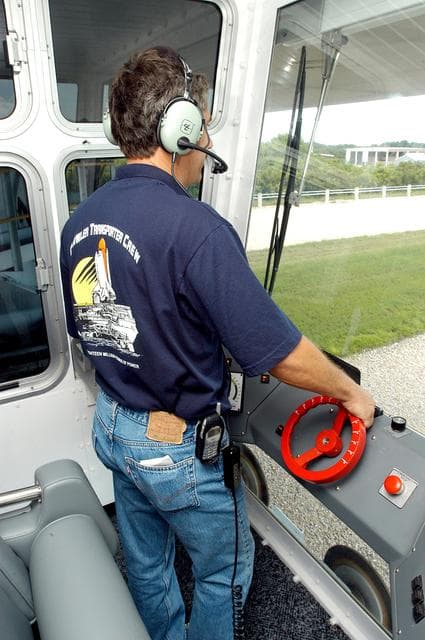
NASA image: KENNEDY SPACE CENTER, FLA.  -  A closeup of crawler-transporter (CT) number 2 shows the cab (left, above the tracks) that recently underwent modifications.  The CT is transporting a Mobile Launch Platform (MLP) on a test run to the pad.  The CT moves Space Shuttle vehicles, situated on the MLP, between the VAB and launch pad.  Moving on four double-tracked crawlers, the CT uses a laser guidance system and a leveling system for the journey that keeps the top of a Space Shuttle vertical within plus- or minus-10 minutes of arc.  The system enables the CT-MLP-Shuttle to negotiate the ramp leading to the launch pads and keep the load level.  Unloaded, the CT weighs 6 million pounds.  Seen on top of the MLP are two tail service masts that support the fluid, gas and electrical requirements of the orbiter’s liquid oxygen and liquid hydrogen aft umbilicals.
Image
Aug 18, 2003

KENNEDY SPACE CENTER, FLA. - A closeup of crawler-transporter (CT) number 2 shows the cab (left, above the tracks) that recently underwent modifications. The CT is transporting a Mobile Launch Platform (MLP) on a test run to the pad. The CT moves Space Shuttle vehicles, situated on the MLP, between the VAB and launch pad. Moving on four double-tracked crawlers, the CT uses a laser guidance system and a leveling system for the journey that keeps the top of a Space Shuttle vertical within plus- or minus-10 minutes of arc. The system enables the CT-MLP-Shuttle to negotiate the ramp leading to the launch pads and keep the load level. Unloaded, the CT weighs 6 million pounds. Seen on top of the MLP are two tail service masts that support the fluid, gas and electrical requirements of the orbiter’s liquid oxygen and liquid hydrogen aft umbilicals.
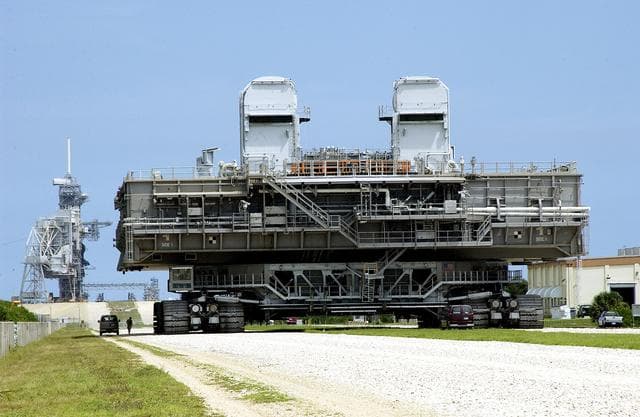
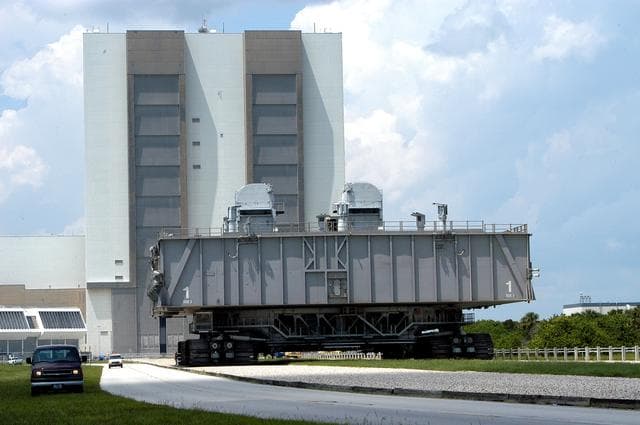
NASA image: KENNEDY SPACE CENTER, FLA.  -   Crawler-transporter (CT) number 2 nears the launch pad with a Mobile Launcher Platform (MLP) on top.  After recent modifications to the cab and muffler system, the CT was taken on a test run.   The CT moves Space Shuttle vehicles, situated on the MLP, between the VAB and launch pad.  Moving on four double-tracked crawlers, the CT uses a laser guidance system and a leveling system for the journey that keeps the top of a Space Shuttle vertical within plus- or minus-10 minutes of arc.  The system enables the CT-MLP-Shuttle to negotiate the ramp leading to the launch pads and keep the load level.  Unloaded, the CT weighs 6 million pounds.  Seen on top of the MLP are two tail service masts that support the fluid, gas and electrical requirements of the orbiter’s liquid oxygen and liquid hydrogen aft umbilicals.
Image
Aug 19, 2003

KENNEDY SPACE CENTER, FLA. - Crawler-transporter (CT) number 2 nears the launch pad with a Mobile Launcher Platform (MLP) on top. After recent modifications to the cab and muffler system, the CT was taken on a test run. The CT moves Space Shuttle vehicles, situated on the MLP, between the VAB and launch pad. Moving on four double-tracked crawlers, the CT uses a laser guidance system and a leveling system for the journey that keeps the top of a Space Shuttle vertical within plus- or minus-10 minutes of arc. The system enables the CT-MLP-Shuttle to negotiate the ramp leading to the launch pads and keep the load level. Unloaded, the CT weighs 6 million pounds. Seen on top of the MLP are two tail service masts that support the fluid, gas and electrical requirements of the orbiter’s liquid oxygen and liquid hydrogen aft umbilicals.
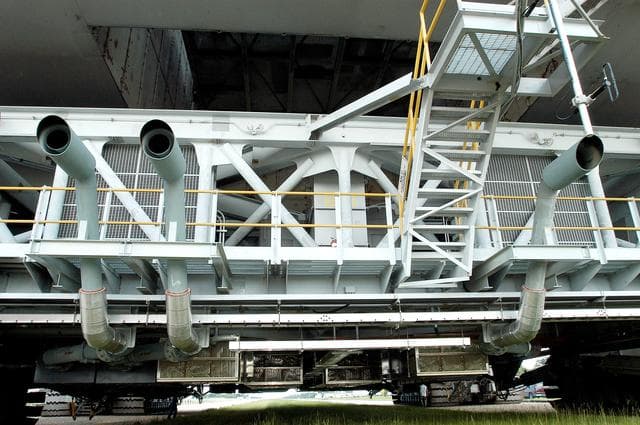
NASA image: KENNEDY SPACE CENTER, FLA.  -  A closeup of crawler-transportation (CT) number 2 shows the new muffler system on the vehicle.  The CT also recently underwent modifications to the cab.   The CT is transporting a Mobile Launch Platform (MLP).  The CT moves Space Shuttle vehicles, situated on the MLP, between the VAB and launch pad.  Moving on four double-tracked crawlers, the CT uses a laser guidance system and a leveling system for the journey that keeps the top of a Space Shuttle vertical within plus- or minus-10 minutes of arc.  The system enables the CT-MLP-Shuttle to negotiate the ramp leading to the launch pads and keep the load level.  Unloaded, the CT weighs 6 million pounds.  Seen on top of the MLP are two tail service masts that support the fluid, gas and electrical requirements of the orbiter’s liquid oxygen and liquid hydrogen aft umbilicals.
Image
Aug 18, 2003

KENNEDY SPACE CENTER, FLA. - A closeup of crawler-transportation (CT) number 2 shows the new muffler system on the vehicle. The CT also recently underwent modifications to the cab. The CT is transporting a Mobile Launch Platform (MLP). The CT moves Space Shuttle vehicles, situated on the MLP, between the VAB and launch pad. Moving on four double-tracked crawlers, the CT uses a laser guidance system and a leveling system for the journey that keeps the top of a Space Shuttle vertical within plus- or minus-10 minutes of arc. The system enables the CT-MLP-Shuttle to negotiate the ramp leading to the launch pads and keep the load level. Unloaded, the CT weighs 6 million pounds. Seen on top of the MLP are two tail service masts that support the fluid, gas and electrical requirements of the orbiter’s liquid oxygen and liquid hydrogen aft umbilicals.
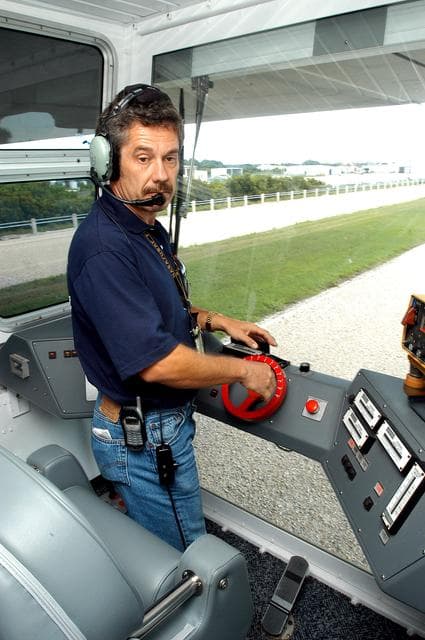
NASA image: KENNEDY SPACE CENTER, FLA.  - Inside the cab of crawler-transporter (CT) number 2, driver Sam Dove, with United Space Alliance, operates the vehicle on a test run to the launch pad.  The CT recently underwent modifications to the cab.   The CT is transporting a Mobile Launch Platform (MLP).  The CT moves Space Shuttle vehicles, situated on the MLP, between the VAB and launch pad.  Moving on four double-tracked crawlers, the CT uses a laser guidance system and a leveling system for the journey that keeps the top of a Space Shuttle vertical within plus- or minus-10 minutes of arc.  The system enables the CT-MLP-Shuttle to negotiate the ramp leading to the launch pads and keep the load level.  Unloaded, the CT weighs 6 million pounds.  Seen on top of the MLP are two tail service masts that support the fluid, gas and electrical requirements of the orbiter’s liquid oxygen and liquid hydrogen aft umbilicals.
Image
Aug 18, 2003

KENNEDY SPACE CENTER, FLA. - Inside the cab of crawler-transporter (CT) number 2, driver Sam Dove, with United Space Alliance, operates the vehicle on a test run to the launch pad. The CT recently underwent modifications to the cab. The CT is transporting a Mobile Launch Platform (MLP). The CT moves Space Shuttle vehicles, situated on the MLP, between the VAB and launch pad. Moving on four double-tracked crawlers, the CT uses a laser guidance system and a leveling system for the journey that keeps the top of a Space Shuttle vertical within plus- or minus-10 minutes of arc. The system enables the CT-MLP-Shuttle to negotiate the ramp leading to the launch pads and keep the load level. Unloaded, the CT weighs 6 million pounds. Seen on top of the MLP are two tail service masts that support the fluid, gas and electrical requirements of the orbiter’s liquid oxygen and liquid hydrogen aft umbilicals.

NASA image: KENNEDY SPACE CENTER, FLA.  -  Crawler-transporter (CT) number 2, moves away from the Vehicle Assembly Building with a Mobile Launcher Platform (MLP) on top on a test run to the launch pad.  The CT recently underwent modifications to the cab.  The CT moves Space Shuttle vehicles, situated on the MLP, between the VAB and launch pad.  Moving on four double-tracked crawlers, the CT uses a laser guidance system and a leveling system for the journey that keeps the top of a Space Shuttle vertical within plus- or minus-10 minutes of arc.  The system enables the CT-MLP-Shuttle to negotiate the ramp leading to the launch pads and keep the load level.  Unloaded, the CT weighs 6 million pounds.  Seen on top of the MLP are two tail service masts that support the fluid, gas and electrical requirements of the orbiter’s liquid oxygen and liquid hydrogen aft umbilicals.
Image
Aug 18, 2003

KENNEDY SPACE CENTER, FLA. - Crawler-transporter (CT) number 2, moves away from the Vehicle Assembly Building with a Mobile Launcher Platform (MLP) on top on a test run to the launch pad. The CT recently underwent modifications to the cab. The CT moves Space Shuttle vehicles, situated on the MLP, between the VAB and launch pad. Moving on four double-tracked crawlers, the CT uses a laser guidance system and a leveling system for the journey that keeps the top of a Space Shuttle vertical within plus- or minus-10 minutes of arc. The system enables the CT-MLP-Shuttle to negotiate the ramp leading to the launch pads and keep the load level. Unloaded, the CT weighs 6 million pounds. Seen on top of the MLP are two tail service masts that support the fluid, gas and electrical requirements of the orbiter’s liquid oxygen and liquid hydrogen aft umbilicals.

NASA image: KENNEDY SPACE CENTER, FLA.  -  Inside the cab of crawler-transporter (CT) number 2, driver Sam Dove, with United Space Alliance, operates the vehicle on a test run to the launch pad.  The CT recently underwent modifications to the cab.   The CT is transporting a Mobile Launch Platform (MLP).  The CT moves Space Shuttle vehicles, situated on the MLP, between the VAB and launch pad.  Moving on four double-tracked crawlers, the CT uses a laser guidance system and a leveling system for the journey that keeps the top of a Space Shuttle vertical within plus- or minus-10 minutes of arc.  The system enables the CT-MLP-Shuttle to negotiate the ramp leading to the launch pads and keep the load level.  Unloaded, the CT weighs 6 million pounds.  Seen on top of the MLP are two tail service masts that support the fluid, gas and electrical requirements of the orbiter’s liquid oxygen and liquid hydrogen aft umbilicals.
Image
Aug 18, 2003

KENNEDY SPACE CENTER, FLA. - Inside the cab of crawler-transporter (CT) number 2, driver Sam Dove, with United Space Alliance, operates the vehicle on a test run to the launch pad. The CT recently underwent modifications to the cab. The CT is transporting a Mobile Launch Platform (MLP). The CT moves Space Shuttle vehicles, situated on the MLP, between the VAB and launch pad. Moving on four double-tracked crawlers, the CT uses a laser guidance system and a leveling system for the journey that keeps the top of a Space Shuttle vertical within plus- or minus-10 minutes of arc. The system enables the CT-MLP-Shuttle to negotiate the ramp leading to the launch pads and keep the load level. Unloaded, the CT weighs 6 million pounds. Seen on top of the MLP are two tail service masts that support the fluid, gas and electrical requirements of the orbiter’s liquid oxygen and liquid hydrogen aft umbilicals.

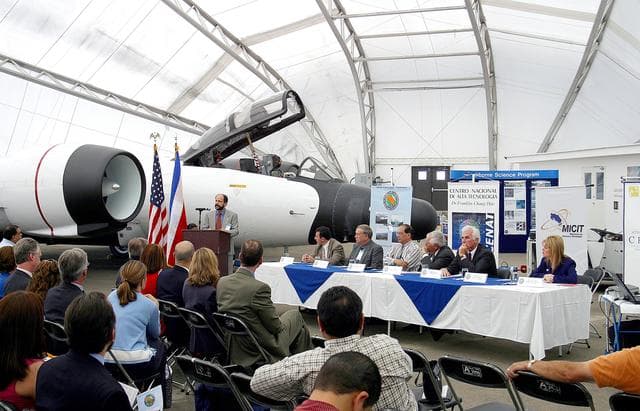
NASA image: KENNEDY SPACE CENTER, FLA. -  At the airport in San Jose, Costa Rica, the NASA hangar is dedicated. The speaker is Hermann Faith, executive director, Costa Rica-USA (CRUSA) Foundation. At the table are (from left) Dr. Jorge Andres Diaz, head scientiest CARTA mission; Gary Shelton, NASA deployment manager; Dr. Pedro Leon, general director, National Center for Advanced Technology (CENAT); Dr. Rogelio Pardo, minister of science and tchnology; John Danilovioch, U.S. ambassador to Costa Rica; and Lic. Vilma Lopez, subdirector, Civil Aviation (DGAC).  NASA KSC has been testing its Aircraft-based Volcanic Emission Mass Spectrometer (AVEMS) in flights over the Turrialba volcano and in the crater, sampling and analyzing fresh volcanic gases in their natural chemical state.  The AVEMS system has been developed for use in the Space Shuttle program, to detect toxic gas leaks and emissions in the Shuttle’s aft compartment and the crew compartment.
Image
Mar 31, 2003

KENNEDY SPACE CENTER, FLA. - At the airport in San Jose, Costa Rica, the NASA hangar is dedicated. The speaker is Hermann Faith, executive director, Costa Rica-USA (CRUSA) Foundation. At the table are (from left) Dr. Jorge Andres Diaz, head scientiest CARTA mission; Gary Shelton, NASA deployment manager; Dr. Pedro Leon, general director, National Center for Advanced Technology (CENAT); Dr. Rogelio Pardo, minister of science and tchnology; John Danilovioch, U.S. ambassador to Costa Rica; and Lic. Vilma Lopez, subdirector, Civil Aviation (DGAC). NASA KSC has been testing its Aircraft-based Volcanic Emission Mass Spectrometer (AVEMS) in flights over the Turrialba volcano and in the crater, sampling and analyzing fresh volcanic gases in their natural chemical state. The AVEMS system has been developed for use in the Space Shuttle program, to detect toxic gas leaks and emissions in the Shuttle’s aft compartment and the crew compartment.

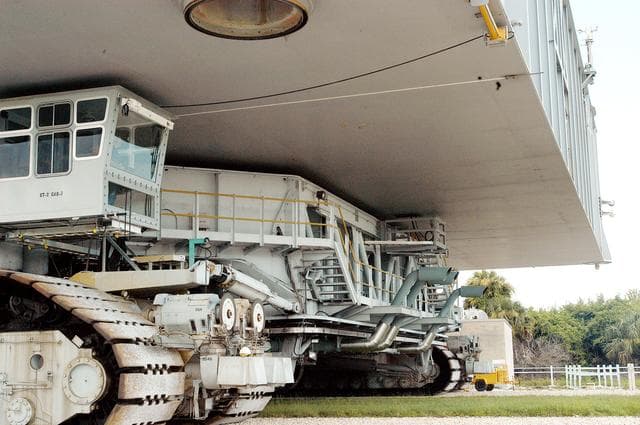
NASA image: KENNEDY SPACE CENTER, FLA.  -  A closeup of crawler-transporter (CT) number 2 shows the cab, at left, that recently underwent modifications.  The CT is transporting a Mobile Launch Platform (MLP) on a test run to the pad.  The CT moves Space Shuttle vehicles, situated on the MLP, between the VAB and launch pad.  Moving on four double-tracked crawlers, the CT uses a laser guidance system and a leveling system for the journey that keeps the top of a Space Shuttle vertical within plus- or minus-10 minutes of arc.  The system enables the CT-MLP-Shuttle to negotiate the ramp leading to the launch pads and keep the load level.  Unloaded, the CT weighs 6 million pounds.  Seen on top of the MLP are two tail service masts that support the fluid, gas and electrical requirements of the orbiter’s liquid oxygen and liquid hydrogen aft umbilicals.
Image
Aug 18, 2003

KENNEDY SPACE CENTER, FLA. - A closeup of crawler-transporter (CT) number 2 shows the cab, at left, that recently underwent modifications. The CT is transporting a Mobile Launch Platform (MLP) on a test run to the pad. The CT moves Space Shuttle vehicles, situated on the MLP, between the VAB and launch pad. Moving on four double-tracked crawlers, the CT uses a laser guidance system and a leveling system for the journey that keeps the top of a Space Shuttle vertical within plus- or minus-10 minutes of arc. The system enables the CT-MLP-Shuttle to negotiate the ramp leading to the launch pads and keep the load level. Unloaded, the CT weighs 6 million pounds. Seen on top of the MLP are two tail service masts that support the fluid, gas and electrical requirements of the orbiter’s liquid oxygen and liquid hydrogen aft umbilicals.

NASA image: A Galactic Spectacle
Image
Aug 5, 2010

A Galactic Spectacle

NASA image release August 5, 2010 A beautiful new image of two colliding galaxies has been released by NASA's Great...

GSFC
NASA image: Cepheus C and Cepheus B Region by Spitzer (One-Instrument)
Image
May 30, 2019

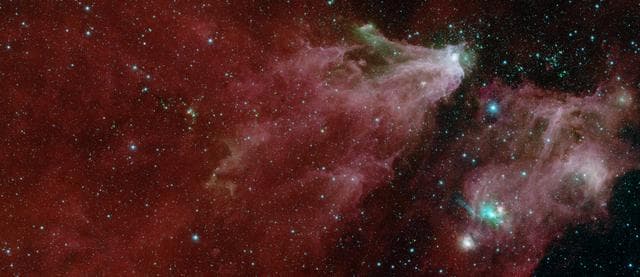
Cepheus C and Cepheus B Region by Spitzer (One-Instrument)

This image shows data from NASA's Spitzer Space Telescope, from the IRAC instrument, with colors corresponding to...

JPL
NASA image: Declining Methane Emissions in the Los Angeles Basin
Image
May 15, 2023

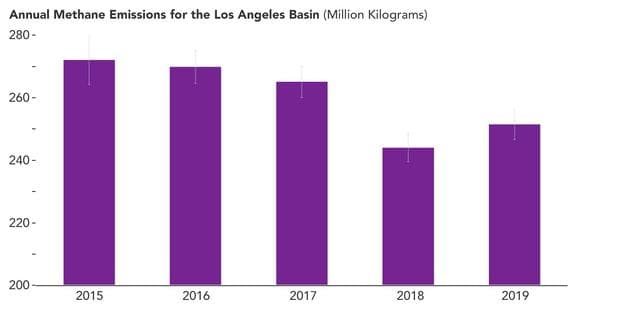
Declining Methane Emissions in the Los Angeles Basin

A February 2023 study by researchers at NASA's Jet Propulsion Laboratory in Southern California analyzed data on...

JPL
NASA image: Space Science
Image
Oct 7, 2004

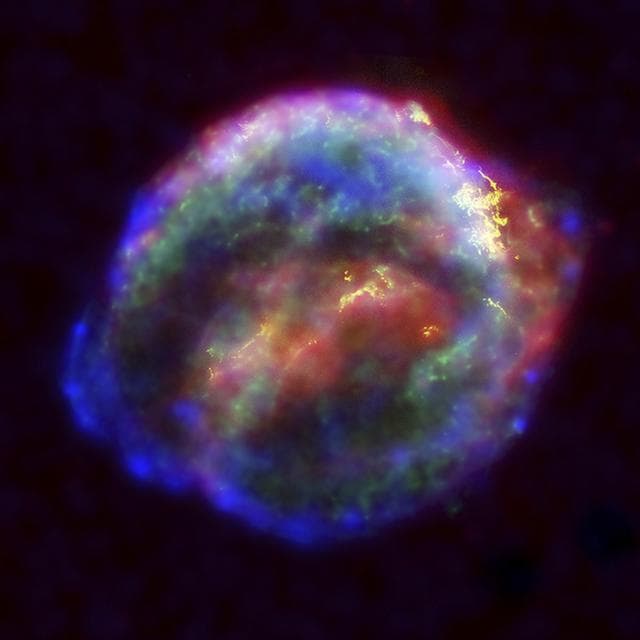
Space Science

Four hundred years ago, sky watchers, including the famous astronomer Johannes Kepler, best known as the discoverer...

MSFC
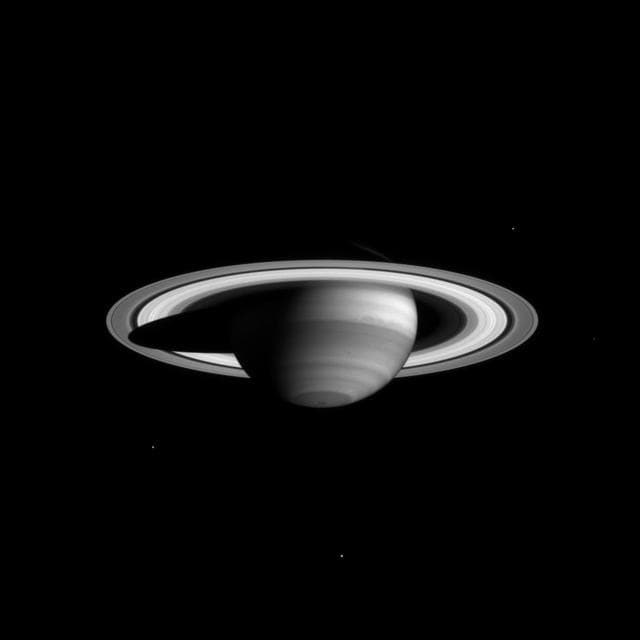
NASA image: Saturn Methane Image
Image
Mar 5, 2004

Saturn Methane Image

NASA's Cassini narrow angle camera took this image of Saturn on Feb. 16, 2004, from a distance of 66.1 million...

JPL
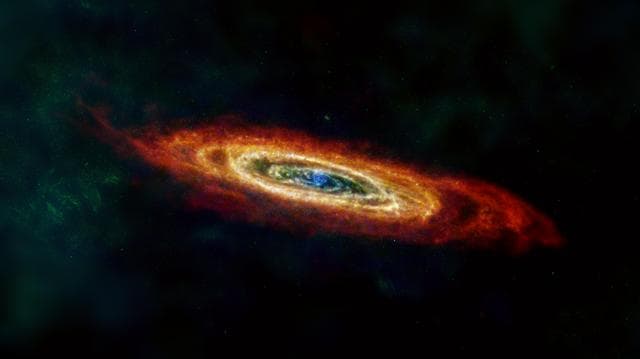
NASA image: Andromeda Galaxy Imaged by Herschel, Planck, IRAS, COBE
Image
Jun 16, 2022

Andromeda Galaxy Imaged by Herschel, Planck, IRAS, COBE

This image of the Andromeda galaxy, or M31, includes data from the ESA (European Space Agency) Herschel mission,...

JPL
PreviousPage 29 of 100Next

Frequently Asked Questions About NASA Images

Are NASA images free to use?+
Yes, most NASA images are in the public domain and are free to use for educational, informational, and personal purposes. NASA's media usage guidelines state that NASA material is not copyrighted unless otherwise noted. However, the NASA logo and certain insignia are protected. Some images may include identifiable individuals or third-party content that requires additional permissions. Always check the specific image's usage rights and credit NASA as the source.
How many images does NASA have?+
NASA's Image and Video Library contains over 140,000 publicly accessible images, videos, and audio files spanning the agency's entire history, from the Mercury program of the 1960s to the latest James Webb Space Telescope discoveries. The collection grows daily as new missions capture imagery and archival materials are digitized. Individual mission archives, such as Mars rover photos, contain hundreds of thousands of additional images.
Can I download NASA images?+
Yes, you can download NASA images in multiple resolutions directly from this gallery. Each image detail page provides download links for original (full resolution), large (1920px), medium (960px), small (480px), and thumbnail sizes. NASA encourages the public to use these images for education, media, and personal projects. High-resolution originals are ideal for printing and professional use.

Explore More NASA Content

Astronomy Picture of the Day

Daily curated space image

Mars Rover Photos

Curiosity & Perseverance images

Earth from Space

DSCOVR EPIC daily images

Launch Schedule

Upcoming rocket launches

Space News

Mission updates & discoveries

KENNEDY SPACE CENTER, FLA. - A closeup of crawler-transporter (CT) number 2 shows the cab (left, above the tracks)...

KSC

KENNEDY SPACE CENTER, FLA. - Crawler-transporter (CT) number 2 nears the launch pad with a Mobile Launcher Platform...

KSC

KENNEDY SPACE CENTER, FLA. - A closeup of crawler-transportation (CT) number 2 shows the new muffler system on the...

KSC

KENNEDY SPACE CENTER, FLA. - Inside the cab of crawler-transporter (CT) number 2, driver Sam Dove, with United Space...

KSC

KENNEDY SPACE CENTER, FLA. - Crawler-transporter (CT) number 2, moves away from the Vehicle Assembly Building with a...

KSC

KENNEDY SPACE CENTER, FLA. - Inside the cab of crawler-transporter (CT) number 2, driver Sam Dove, with United Space...

KSC

KENNEDY SPACE CENTER, FLA. - At the airport in San Jose, Costa Rica, the NASA hangar is dedicated. The speaker is...

KSC

KENNEDY SPACE CENTER, FLA. - A closeup of crawler-transporter (CT) number 2 shows the cab, at left, that recently...

KSC