CosmosObservatory
Explore
Solar System
Live
Learn
Tools
About
Cosmos Observatory
ToolsAbout
Cosmos Observatory

Explore the universe through NASA data, real-time ISS tracking, Mars rover imagery, asteroid monitoring, and comprehensive space encyclopedia. Your gateway to the cosmos.

Explore

  • APOD
  • Mars Rovers
  • Earth Imagery
  • NASA Gallery
  • ISS Tracker

Data

  • Asteroids
  • Solar System
  • Exoplanets
  • Space Weather
  • Launches

Tools

  • Glossary
  • News
  • Calculators

Legal

  • About
  • Privacy Policy
  • Terms of Use
  • Space Tools
  • Contact

Stay updated with the cosmos

Get weekly digests of APOD highlights, upcoming launches, and space events.

© 2026 Cosmos Observatory. All rights reserved. Built with for space enthusiasts.

This website is not affiliated with, maintained, authorized, endorsed by, or in any way officially connected with NASA or any of its subsidiaries or affiliates. All NASA imagery is in the public domain unless otherwise noted. Data sourced from NASA Open APIs, Launch Library 2, and other open data services.

NASA Gallery

Explore NASA's vast collection of space images, videos, and audio from missions past and present.

  1. Home
  2. /
  3. NASA Gallery

NASA's Image and Video Library: A Visual Archive of Space Exploration

NASA's Image and Video Library is one of the most comprehensive public archives of space imagery in the world, containing over 140,000 images, videos, and audio recordings spanning more than six decades of space exploration. From the earliest Mercury and Gemini missions through the Apollo Moon landings, the Space Shuttle era, and today's cutting-edge observations from the James Webb Space Telescope, this collection documents humanity's journey into the cosmos.

The library includes imagery from diverse sources: telescopes like Hubble and Webb that capture deep-space nebulae, galaxies, and exoplanets; planetary missions like the Mars rovers ( browse Mars photos) and Cassini at Saturn; Earth observation satellites ( see EPIC imagery); astronaut photography from the ISS; and documentation of rocket launches, spacecraft assembly, and ground testing. Most NASA images are in the public domain and free to download at full resolution for educational, editorial, and personal use.

Use the search bar above to find specific subjects — try queries like "Apollo 11," "Hubble Deep Field," "Mars surface," or "astronaut EVA." You can also filter by media type (image, video, or audio). For a daily curated experience, visit the Astronomy Picture of the Day.

Showing results for "return to flight"

10,634 results found - Page 28 of 444

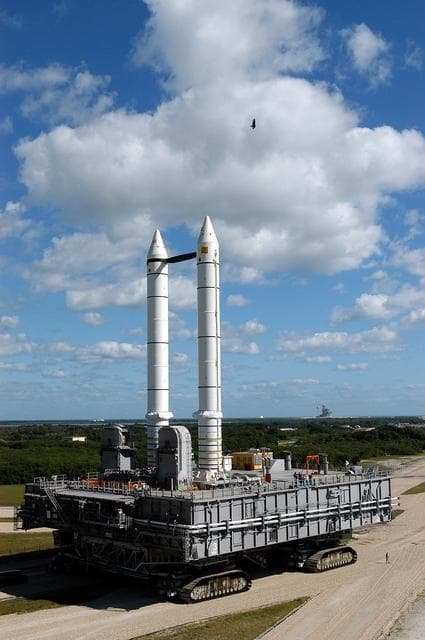
NASA image: KENNEDY SPACE CENTER, FLA. -  A high-flying bird takes a closer look at the Mobile Launcher Platform (MLP) number 3 with twin solid rocket boosters bolted to it as it crawls toward Launch Pad 39A, in the background.  The crawler is moving along the crawlerway at various speeds up to 1 mph in an effort to achieve vibration data gathering goals as it travels toward Launch Pad 39A and then returns.  The boosters are braced at the top for stability.  The primary purpose of these rollout tests is to gather data to develop future maintenance requirements on the transport equipment and the flight hardware. Various parts of the MLP and crawler transporter have been instrumented with vibration data collection equipment.
Image
Nov 21, 2003

KENNEDY SPACE CENTER, FLA. - A high-flying bird takes a closer look at the Mobile Launcher Platform (MLP) number 3 with twin solid rocket boosters bolted to it as it crawls toward Launch Pad 39A, in the background. The crawler is moving along the crawlerway at various speeds up to 1 mph in an effort to achieve vibration data gathering goals as it travels toward Launch Pad 39A and then returns. The boosters are braced at the top for stability. The primary purpose of these rollout tests is to gather data to develop future maintenance requirements on the transport equipment and the flight hardware. Various parts of the MLP and crawler transporter have been instrumented with vibration data collection equipment.

KENNEDY SPACE CENTER, FLA. - A high-flying bird takes a closer look at the Mobile Launcher Platform (MLP) number 3...

KSC
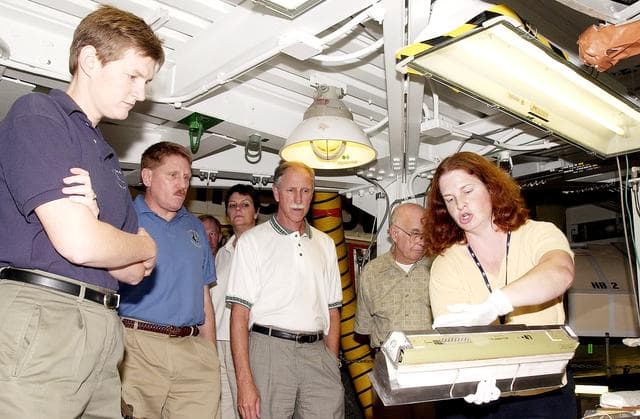
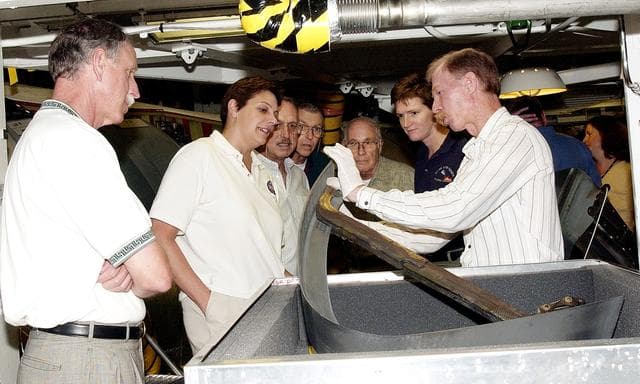
NASA image: KENNEDY SPACE CENTER, FLA.  -  NASA worker Joy Huff (right) shows a leading edge subsystems (LESS) with tile bonded to it to members of the Stafford-Covey Return to Flight Task Group (SCTG).  From left are Dr. Amy Donahue, David Lengyel, Dr. Kathryn Clark,  Richard Covey, former Space Shuttle commander, and William Wegner.  Covey is co-chair of the SCTG along with Thomas P. Stafford, Apollo commander.  Chartered by NASA Administrator Sean O’Keefe, the task group will perform an independent assessment of NASA’s implementation of the final recommendations by the Columbia Accident Investigation Board.
Image
Aug 6, 2003

KENNEDY SPACE CENTER, FLA. - NASA worker Joy Huff (right) shows a leading edge subsystems (LESS) with tile bonded to it to members of the Stafford-Covey Return to Flight Task Group (SCTG). From left are Dr. Amy Donahue, David Lengyel, Dr. Kathryn Clark, Richard Covey, former Space Shuttle commander, and William Wegner. Covey is co-chair of the SCTG along with Thomas P. Stafford, Apollo commander. Chartered by NASA Administrator Sean O’Keefe, the task group will perform an independent assessment of NASA’s implementation of the final recommendations by the Columbia Accident Investigation Board.

KENNEDY SPACE CENTER, FLA. - NASA worker Joy Huff (right) shows a leading edge subsystems (LESS) with tile bonded to...
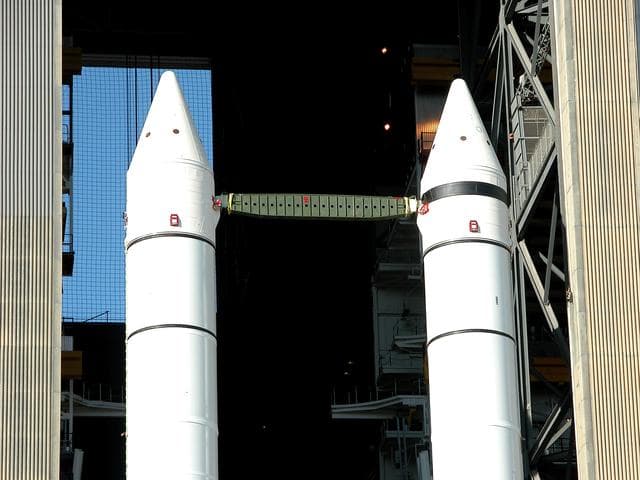
NASA image: KENNEDY SPACE CENTER, FLA. -  As the crawler transporter slowly moves the Mobile Launcher Platform (MLP) out of the Vehicle Assembly Building, the two solid rocket boosters on top are framed in the doorway.  The move is in support of engineering analysis vibration tests on the crawler and MLP.  The crawler is moving at various speeds up to 1 mph in an effort to achieve vibration data gathering goals as it leaves the VAB and then returns.  The boosters are braced at the top for stability.  The primary purpose of these rollout tests is to gather data to develop future maintenance requirements on the transport equipment and the flight hardware. Various parts of the MLP and crawler transporter have been instrumented with vibration data collection equipment.
Image
Nov 17, 2003

KENNEDY SPACE CENTER, FLA. - As the crawler transporter slowly moves the Mobile Launcher Platform (MLP) out of the Vehicle Assembly Building, the two solid rocket boosters on top are framed in the doorway. The move is in support of engineering analysis vibration tests on the crawler and MLP. The crawler is moving at various speeds up to 1 mph in an effort to achieve vibration data gathering goals as it leaves the VAB and then returns. The boosters are braced at the top for stability. The primary purpose of these rollout tests is to gather data to develop future maintenance requirements on the transport equipment and the flight hardware. Various parts of the MLP and crawler transporter have been instrumented with vibration data collection equipment.
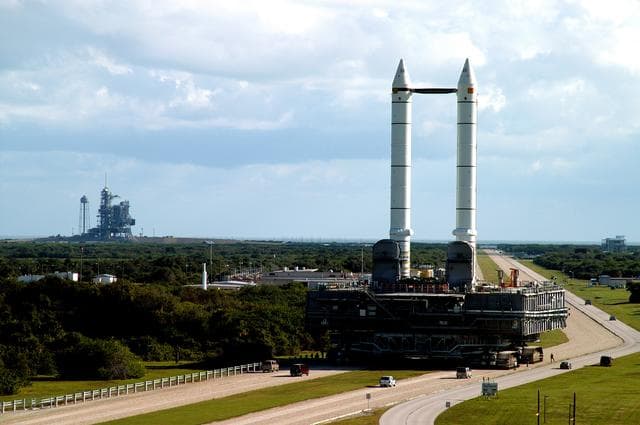
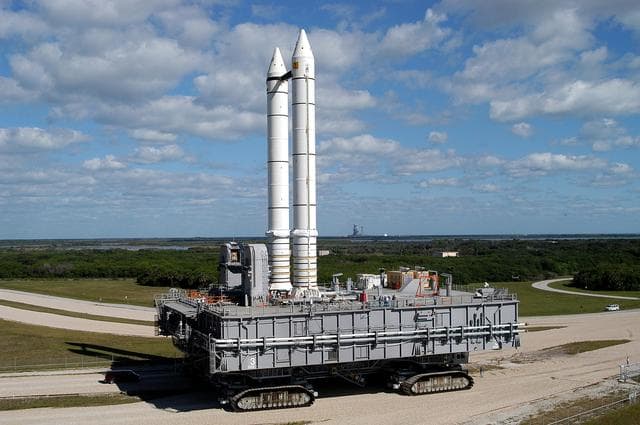
NASA image: KENNEDY SPACE CENTER, FLA. -  The crawler transporter slowly moves the Mobile Launcher Platform (MLP), carrying a set of twin solid rocket boosters, along the crawlerway in support of engineering analysis vibration tests on the crawler and MLP.   In the distance, at left, is Launch Pad 39A. The crawler is moving at various speeds up to 1 mph in an effort to achieve vibration data gathering goals as it leaves the VAB and then returns.  The boosters are braced at the top for stability.  The primary purpose of these rollout tests is to gather data to develop future maintenance requirements on the transport equipment and the flight hardware. Various parts of the MLP and crawler transporter have been instrumented with vibration data collection equipment.
Image
Nov 17, 2003

KENNEDY SPACE CENTER, FLA. - The crawler transporter slowly moves the Mobile Launcher Platform (MLP), carrying a set of twin solid rocket boosters, along the crawlerway in support of engineering analysis vibration tests on the crawler and MLP. In the distance, at left, is Launch Pad 39A. The crawler is moving at various speeds up to 1 mph in an effort to achieve vibration data gathering goals as it leaves the VAB and then returns. The boosters are braced at the top for stability. The primary purpose of these rollout tests is to gather data to develop future maintenance requirements on the transport equipment and the flight hardware. Various parts of the MLP and crawler transporter have been instrumented with vibration data collection equipment.

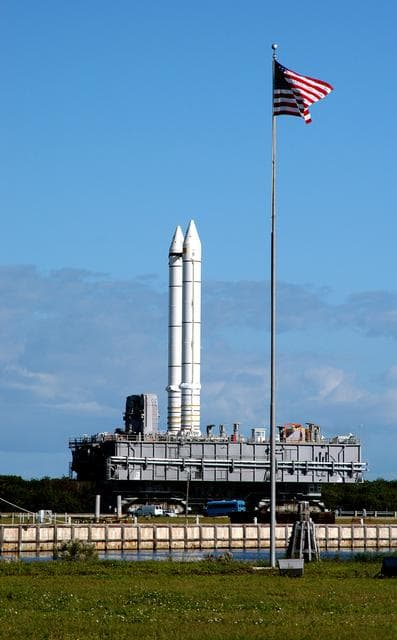
NASA image: KENNEDY SPACE CENTER, FLA. - Carrying a set of twin solid rocket boosters, the crawler transporter slowly moves the Mobile Launcher Platform (MLP) past the NASA-KSC News Center where the U.S. flag flies daily.  The journey is in support of engineering analysis vibration tests on the crawler and MLP. The crawler is moving at various speeds up to 1 mph in an effort to achieve vibration data gathering goals as it leaves the VAB and then returns.  The boosters are braced at the top for stability.  The primary purpose of these rollout tests is to gather data to develop future maintenance requirements on the transport equipment and the flight hardware. Various parts of the MLP and crawler transporter have been instrumented with vibration data collection equipment.
Image
Nov 17, 2003

KENNEDY SPACE CENTER, FLA. - Carrying a set of twin solid rocket boosters, the crawler transporter slowly moves the Mobile Launcher Platform (MLP) past the NASA-KSC News Center where the U.S. flag flies daily. The journey is in support of engineering analysis vibration tests on the crawler and MLP. The crawler is moving at various speeds up to 1 mph in an effort to achieve vibration data gathering goals as it leaves the VAB and then returns. The boosters are braced at the top for stability. The primary purpose of these rollout tests is to gather data to develop future maintenance requirements on the transport equipment and the flight hardware. Various parts of the MLP and crawler transporter have been instrumented with vibration data collection equipment.

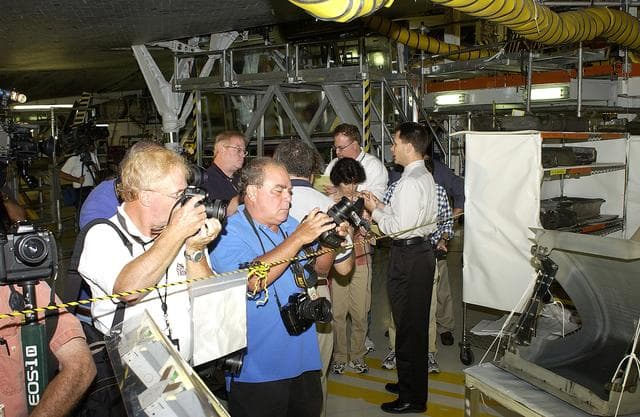
NASA image: KENNEDY SPACE CENTER, FLA. -  In the Orbiter Processing Facility, while a few photographers (left) set up for photos of a Reinforced Carbon-Carbon panel at far right, NASA Vehicle Manager Scott Thurston (right) talks to other media.   The media was invited to see the orbiter Atlantis as it is being prepared for Return to Flight.  Both local and national reporters representing print and TV networks were able to see work in progress on Atlantis, including the reinstallation of the Reinforced Carbon-Carbon panels on the orbiter’s wing leading edge; wiring inspections; and checks of the engines in the Orbital Maneuvering System.
Image
Sep 26, 2003

KENNEDY SPACE CENTER, FLA. - In the Orbiter Processing Facility, while a few photographers (left) set up for photos of a Reinforced Carbon-Carbon panel at far right, NASA Vehicle Manager Scott Thurston (right) talks to other media. The media was invited to see the orbiter Atlantis as it is being prepared for Return to Flight. Both local and national reporters representing print and TV networks were able to see work in progress on Atlantis, including the reinstallation of the Reinforced Carbon-Carbon panels on the orbiter’s wing leading edge; wiring inspections; and checks of the engines in the Orbital Maneuvering System.

KENNEDY SPACE CENTER, FLA. - In the Orbiter Processing Facility, while a few photographers (left) set up for photos...
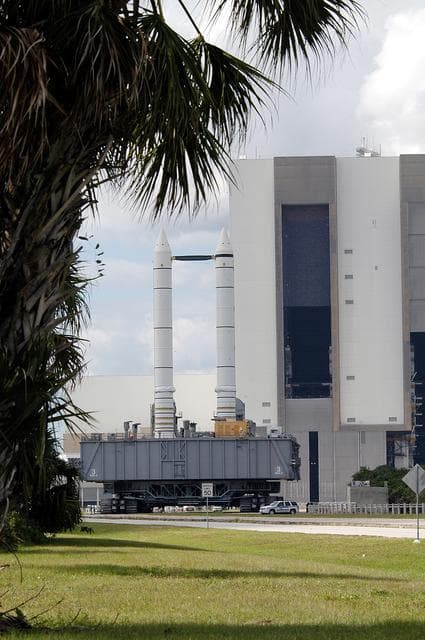
NASA image: KENNEDY SPACE CENTER, FLA. -  Mobile Launcher Platform (MLP) number 3 and a set of twin solid rocket boosters, atop the crawler-transporter, crawls away from the Vehicle Assembly Building in support of the second engineering analysis vibration test on the crawler and MLP. The crawler is moving at various speeds up to 1 mph in an effort to achieve vibration data gathering goals as it leaves the VAB, travels toward Launch Pad 39A and then returns.  The boosters are braced at the top for stability.  The primary purpose of these rollout tests is to gather data to develop future maintenance requirements on the transport equipment and the flight hardware. Various parts of the MLP and crawler transporter have been instrumented with vibration data collection equipment.
Image
Nov 21, 2003

KENNEDY SPACE CENTER, FLA. - Mobile Launcher Platform (MLP) number 3 and a set of twin solid rocket boosters, atop the crawler-transporter, crawls away from the Vehicle Assembly Building in support of the second engineering analysis vibration test on the crawler and MLP. The crawler is moving at various speeds up to 1 mph in an effort to achieve vibration data gathering goals as it leaves the VAB, travels toward Launch Pad 39A and then returns. The boosters are braced at the top for stability. The primary purpose of these rollout tests is to gather data to develop future maintenance requirements on the transport equipment and the flight hardware. Various parts of the MLP and crawler transporter have been instrumented with vibration data collection equipment.
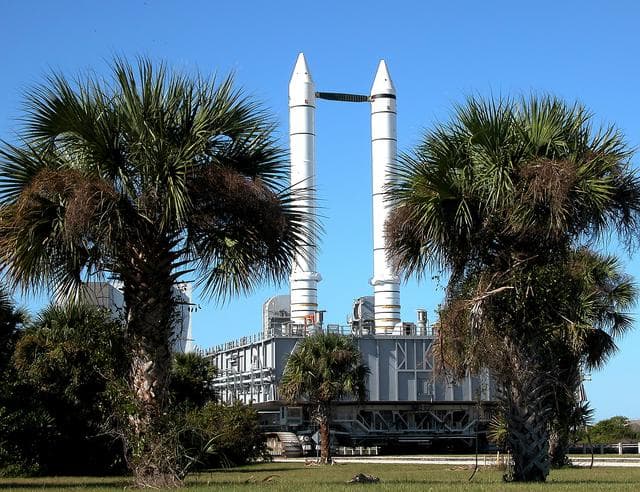
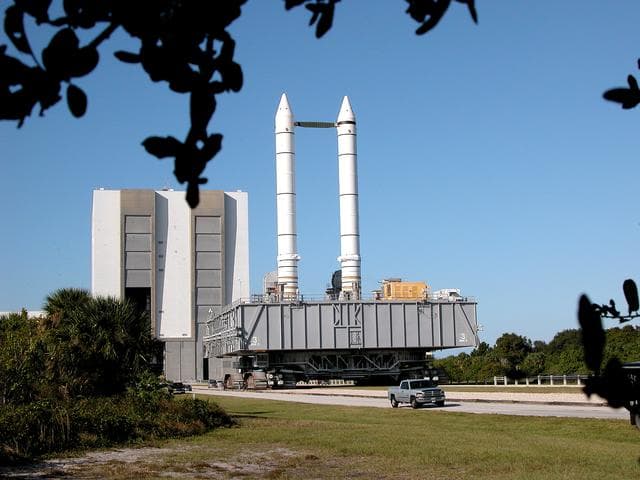
NASA image: KENNEDY SPACE CENTER, FLA. -  Framed between palm trees, solid rocket boosters loom above the Mobile Launcher Platform (MLP) as the crawler transporter slowly moves it along the crawlerway.  The journey is in support of engineering analysis vibration tests on the crawler and MLP.  The crawler is moving at various speeds up to 1 mph in an effort to achieve vibration data gathering goals as it leaves the VAB and then returns.  The boosters are braced at the top for stability. The primary purpose of these rollout tests is to gather data to develop future maintenance requirements on the transport equipment and the flight hardware. Various parts of the MLP and crawler transporter have been instrumented with vibration data collection equipment.
Image
Nov 17, 2003

KENNEDY SPACE CENTER, FLA. - Framed between palm trees, solid rocket boosters loom above the Mobile Launcher Platform (MLP) as the crawler transporter slowly moves it along the crawlerway. The journey is in support of engineering analysis vibration tests on the crawler and MLP. The crawler is moving at various speeds up to 1 mph in an effort to achieve vibration data gathering goals as it leaves the VAB and then returns. The boosters are braced at the top for stability. The primary purpose of these rollout tests is to gather data to develop future maintenance requirements on the transport equipment and the flight hardware. Various parts of the MLP and crawler transporter have been instrumented with vibration data collection equipment.

NASA image: KENNEDY SPACE CENTER, FLA. -  Mobile Launcher Platform (MLP) number 3 and a set of twin solid rocket boosters, atop the crawler-transporter, inch along the crawlerway in support of the second engineering analysis vibration test on the crawler and MLP. The crawler is moving at various speeds up to 1 mph in an effort to achieve vibration data gathering goals as it leaves the VAB, travels toward Launch Pad 39A (on the horizon) and then returns.  The boosters are braced at the top for stability.  The primary purpose of these rollout tests is to gather data to develop future maintenance requirements on the transport equipment and the flight hardware. Various parts of the MLP and crawler transporter have been instrumented with vibration data collection equipment.
Image
Nov 21, 2003

KENNEDY SPACE CENTER, FLA. - Mobile Launcher Platform (MLP) number 3 and a set of twin solid rocket boosters, atop the crawler-transporter, inch along the crawlerway in support of the second engineering analysis vibration test on the crawler and MLP. The crawler is moving at various speeds up to 1 mph in an effort to achieve vibration data gathering goals as it leaves the VAB, travels toward Launch Pad 39A (on the horizon) and then returns. The boosters are braced at the top for stability. The primary purpose of these rollout tests is to gather data to develop future maintenance requirements on the transport equipment and the flight hardware. Various parts of the MLP and crawler transporter have been instrumented with vibration data collection equipment.

NASA image: KENNEDY SPACE CENTER, FLA.  - On a tour of the Orbiter Processing Facility, members of the Stafford-Covey Return to Flight Task Group (RTFTG) look at a Reinforced Carbon-Carbon panels with a T-seal held by Tom Roberts, with United Space Alliance.  From left are Richard O. Covey, former Space Shuttle commander, Dr. Kathryn Clark, James Adamson, Joe Engle, William Wegner and Dr. Amy Donahue.  Chairing the task group are Covey and Thomas P. Stafford, Apollo commander.  Chartered by NASA Administrator Sean O’Keefe, the task group will perform an independent assessment of NASA’s implementation of the final recommendations by the Columbia Accident Investigation Board.
Image
Aug 6, 2003

KENNEDY SPACE CENTER, FLA. - On a tour of the Orbiter Processing Facility, members of the Stafford-Covey Return to Flight Task Group (RTFTG) look at a Reinforced Carbon-Carbon panels with a T-seal held by Tom Roberts, with United Space Alliance. From left are Richard O. Covey, former Space Shuttle commander, Dr. Kathryn Clark, James Adamson, Joe Engle, William Wegner and Dr. Amy Donahue. Chairing the task group are Covey and Thomas P. Stafford, Apollo commander. Chartered by NASA Administrator Sean O’Keefe, the task group will perform an independent assessment of NASA’s implementation of the final recommendations by the Columbia Accident Investigation Board.

KENNEDY SPACE CENTER, FLA. - On a tour of the Orbiter Processing Facility, members of the Stafford-Covey Return to...
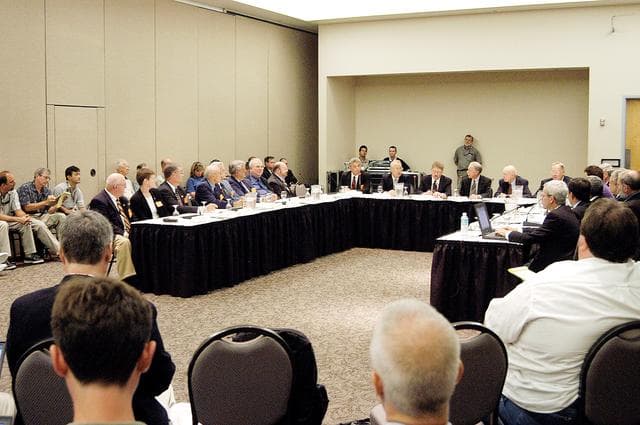
NASA image: KENNEDY SPACE CENTER, FLA.  -  The Return To Flight Task Group (RTFTG) holds its first public meeting at the Debus Center, KSC Visitor Complex.   The group is co-chaired by former Shuttle commander Richard O. Covey and retired Air Force Lt. Gen. Thomas P. Stafford, who was an Apollo commander.  The RTFTG was at KSC to conduct organizational activities, tour Space Shuttle facilities and receive briefings on Shuttle-related topics.  The task group was chartered by NASA Administrator Sean O’Keefe to perform an independent assessment of NASA’s implementation of the final recommendations of the Columbia Accident Investigation Board.
Image
Aug 7, 2003

KENNEDY SPACE CENTER, FLA. - The Return To Flight Task Group (RTFTG) holds its first public meeting at the Debus Center, KSC Visitor Complex. The group is co-chaired by former Shuttle commander Richard O. Covey and retired Air Force Lt. Gen. Thomas P. Stafford, who was an Apollo commander. The RTFTG was at KSC to conduct organizational activities, tour Space Shuttle facilities and receive briefings on Shuttle-related topics. The task group was chartered by NASA Administrator Sean O’Keefe to perform an independent assessment of NASA’s implementation of the final recommendations of the Columbia Accident Investigation Board.

KENNEDY SPACE CENTER, FLA. - The Return To Flight Task Group (RTFTG) holds its first public meeting at the Debus...
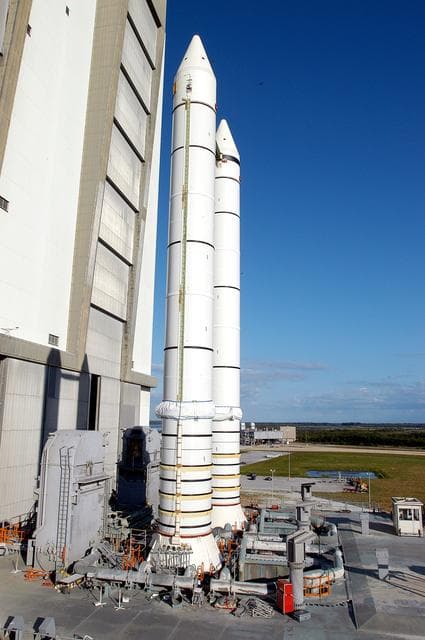
NASA image: KENNEDY SPACE CENTER, FLA. -  The crawler transporter slowly moves the Mobile Launcher Platform (MLP), carrying a set of twin solid rocket boosters, away from the Vehicle Assembly Building (VAB) in support of engineering analysis vibration tests on the crawler and MLP.   The crawler is moving at various speeds up to 1 mph in an effort to achieve vibration data gathering goals as it leaves the VAB and then returns.  The boosters are braced at the top for stability.  The primary purpose of these rollout tests is to gather data to develop future maintenance requirements on the transport equipment and the flight hardware. Various parts of the MLP and crawler transporter have been instrumented with vibration data collection equipment.
Image
Nov 17, 2003

KENNEDY SPACE CENTER, FLA. - The crawler transporter slowly moves the Mobile Launcher Platform (MLP), carrying a set of twin solid rocket boosters, away from the Vehicle Assembly Building (VAB) in support of engineering analysis vibration tests on the crawler and MLP. The crawler is moving at various speeds up to 1 mph in an effort to achieve vibration data gathering goals as it leaves the VAB and then returns. The boosters are braced at the top for stability. The primary purpose of these rollout tests is to gather data to develop future maintenance requirements on the transport equipment and the flight hardware. Various parts of the MLP and crawler transporter have been instrumented with vibration data collection equipment.

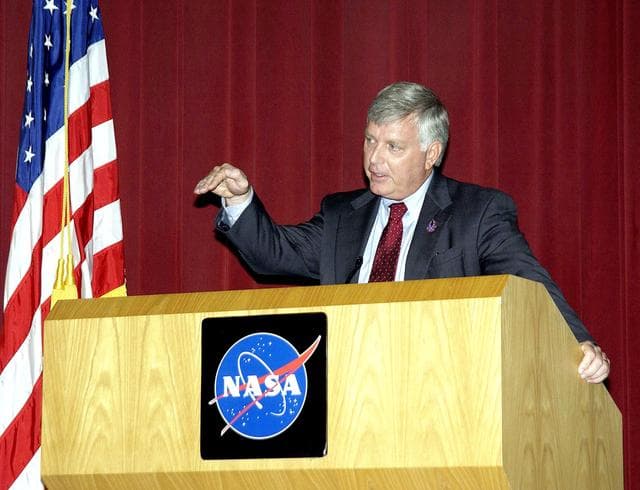
NASA image: KENNEDY SPACE CENTER, FLA. -  Center Director Jim Kennedy talks to employees during his first all-hands meeting. Making presentations were Dr. Woodrow Whitlow Jr., KSC deputy director;Tim Wilson, assistant chief engineer for Shuttle; and Bill Pickavance, vice president and deputy program manager, Florida operations, United Space Alliance..  Representatives from the Shuttle program and contractor team were on hand to discuss the Columbia Accident Investigation Board report and where KSC stands in its progress toward return to flight.
Image
Sep 17, 2003

KENNEDY SPACE CENTER, FLA. - Center Director Jim Kennedy talks to employees during his first all-hands meeting. Making presentations were Dr. Woodrow Whitlow Jr., KSC deputy director;Tim Wilson, assistant chief engineer for Shuttle; and Bill Pickavance, vice president and deputy program manager, Florida operations, United Space Alliance.. Representatives from the Shuttle program and contractor team were on hand to discuss the Columbia Accident Investigation Board report and where KSC stands in its progress toward return to flight.

KENNEDY SPACE CENTER, FLA. - Center Director Jim Kennedy talks to employees during his first all-hands meeting....

KSC
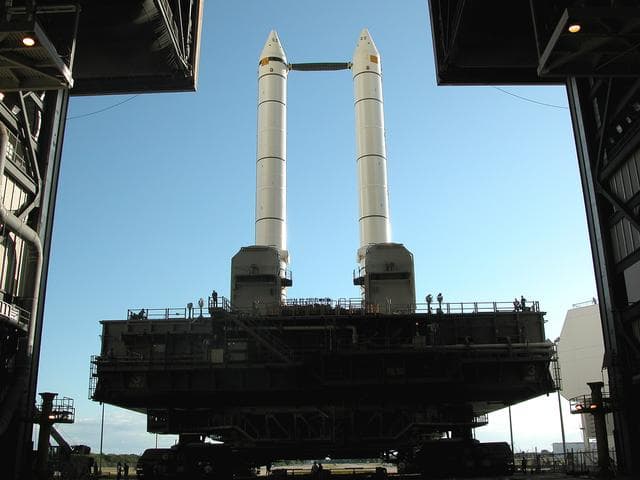
NASA image: KENNEDY SPACE CENTER, FLA. -  The crawler transporter has slowly moved the Mobile Launcher Platform (MLP), carrying a set of twin solid rocket boosters, out of the Vehicle Assembly Building (VAB) in support of engineering analysis vibration tests on the crawler and MLP. The crawler is moving at various speeds up to 1 mph in an effort to achieve vibration data gathering goals as it leaves the VAB and then returns.  The boosters are braced at the top for stability.  The primary purpose of these rollout tests is to gather data to develop future maintenance requirements on the transport equipment and the flight hardware. Various parts of the MLP and crawler transporter have been instrumented with vibration data collection equipment.
Image
Nov 17, 2003

KENNEDY SPACE CENTER, FLA. - The crawler transporter has slowly moved the Mobile Launcher Platform (MLP), carrying a set of twin solid rocket boosters, out of the Vehicle Assembly Building (VAB) in support of engineering analysis vibration tests on the crawler and MLP. The crawler is moving at various speeds up to 1 mph in an effort to achieve vibration data gathering goals as it leaves the VAB and then returns. The boosters are braced at the top for stability. The primary purpose of these rollout tests is to gather data to develop future maintenance requirements on the transport equipment and the flight hardware. Various parts of the MLP and crawler transporter have been instrumented with vibration data collection equipment.

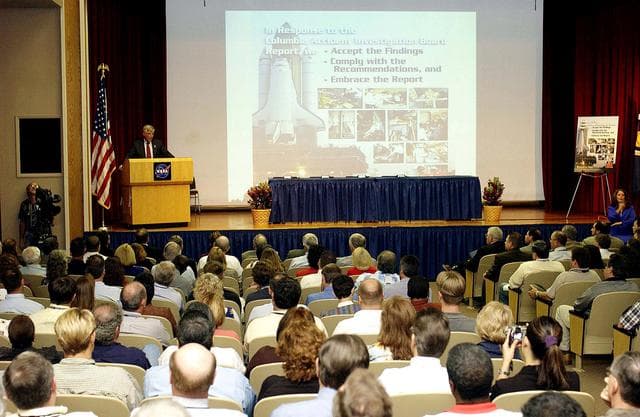
NASA image: KENNEDY SPACE CENTER, FLA. -  Center Director Jim Kennedy talks to employees during his first all-hands meeting. Making presentations were Dr. Woodrow Whitlow Jr., KSC deputy director; Tim Wilson, assistant chief engineer for Shuttle; and Bill Pickavance, vice president and deputy program manager, Florida operations, United Space Alliance.  Representatives from the Shuttle program and contractor team were on hand to discuss the Columbia Accident Investigation Board report and where KSC stands in its progress toward return to flight.
Image
Sep 17, 2003

KENNEDY SPACE CENTER, FLA. - Center Director Jim Kennedy talks to employees during his first all-hands meeting. Making presentations were Dr. Woodrow Whitlow Jr., KSC deputy director; Tim Wilson, assistant chief engineer for Shuttle; and Bill Pickavance, vice president and deputy program manager, Florida operations, United Space Alliance. Representatives from the Shuttle program and contractor team were on hand to discuss the Columbia Accident Investigation Board report and where KSC stands in its progress toward return to flight.

KENNEDY SPACE CENTER, FLA. - Center Director Jim Kennedy talks to employees during his first all-hands meeting....

KSC
NASA image: KENNEDY SPACE CENTER, FLA. -  The crawler transporter slowly moves the Mobile Launcher Platform (MLP), carrying a set of twin solid rocket boosters, away from the Vehicle Assembly Building (VAB) in support of engineering analysis vibration tests on the crawler and MLP.   The crawler is moving at various speeds up to 1 mph in an effort to achieve vibration data gathering goals as it leaves the VAB and then returns.  The boosters are braced at the top for stability.  The primary purpose of these rollout tests is to gather data to develop future maintenance requirements on the transport equipment and the flight hardware. Various parts of the MLP and crawler transporter have been instrumented with vibration data collection equipment.
Image
Nov 17, 2003

KENNEDY SPACE CENTER, FLA. - The crawler transporter slowly moves the Mobile Launcher Platform (MLP), carrying a set of twin solid rocket boosters, away from the Vehicle Assembly Building (VAB) in support of engineering analysis vibration tests on the crawler and MLP. The crawler is moving at various speeds up to 1 mph in an effort to achieve vibration data gathering goals as it leaves the VAB and then returns. The boosters are braced at the top for stability. The primary purpose of these rollout tests is to gather data to develop future maintenance requirements on the transport equipment and the flight hardware. Various parts of the MLP and crawler transporter have been instrumented with vibration data collection equipment.

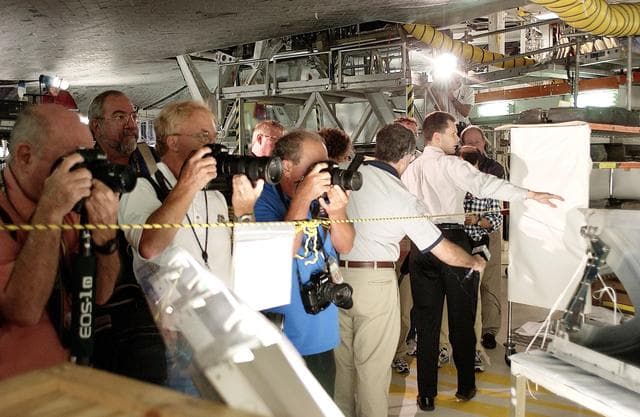
NASA image: KENNEDY SPACE CENTER, FLA. -  In the Orbiter Processing Facility,  while a few photographers (left) set up for photos, NASA Vehicle Manager Scott Thurston (right, with arm extended) talks about the Reinforced Carbon-Carbon panel at right.   The media was invited to see the orbiter Atlantis as it is being prepared for Return to Flight.  Both local and national reporters representing print and TV networks were able to see work in progress on Atlantis, including the reinstallation of the Reinforced Carbon-Carbon panels on the orbiter’s wing leading edge; wiring inspections; and checks of the engines in the Orbital Maneuvering System.
Image
Sep 26, 2003

KENNEDY SPACE CENTER, FLA. - In the Orbiter Processing Facility, while a few photographers (left) set up for photos, NASA Vehicle Manager Scott Thurston (right, with arm extended) talks about the Reinforced Carbon-Carbon panel at right. The media was invited to see the orbiter Atlantis as it is being prepared for Return to Flight. Both local and national reporters representing print and TV networks were able to see work in progress on Atlantis, including the reinstallation of the Reinforced Carbon-Carbon panels on the orbiter’s wing leading edge; wiring inspections; and checks of the engines in the Orbital Maneuvering System.

KENNEDY SPACE CENTER, FLA. - In the Orbiter Processing Facility, while a few photographers (left) set up for photos,...
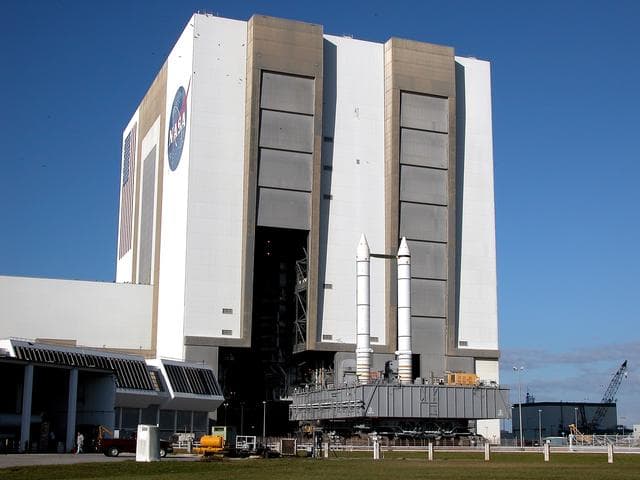
NASA image: KENNEDY SPACE CENTER, FLA. -  The crawler transporter slowly moves the Mobile Launcher Platform (MLP), carrying a set of twin solid rocket boosters, out of the Vehicle Assembly Building (VAB) in support of engineering analysis vibration tests on the crawler and MLP.   The crawler is moving at various speeds up to 1 mph in an effort to achieve vibration data gathering goals as it leaves the VAB and then returns.  The boosters are braced at the top for stability.  The primary purpose of these rollout tests is to gather data to develop future maintenance requirements on the transport equipment and the flight hardware. Various parts of the MLP and crawler transporter have been instrumented with vibration data collection equipment.
Image
Nov 17, 2003

KENNEDY SPACE CENTER, FLA. - The crawler transporter slowly moves the Mobile Launcher Platform (MLP), carrying a set of twin solid rocket boosters, out of the Vehicle Assembly Building (VAB) in support of engineering analysis vibration tests on the crawler and MLP. The crawler is moving at various speeds up to 1 mph in an effort to achieve vibration data gathering goals as it leaves the VAB and then returns. The boosters are braced at the top for stability. The primary purpose of these rollout tests is to gather data to develop future maintenance requirements on the transport equipment and the flight hardware. Various parts of the MLP and crawler transporter have been instrumented with vibration data collection equipment.

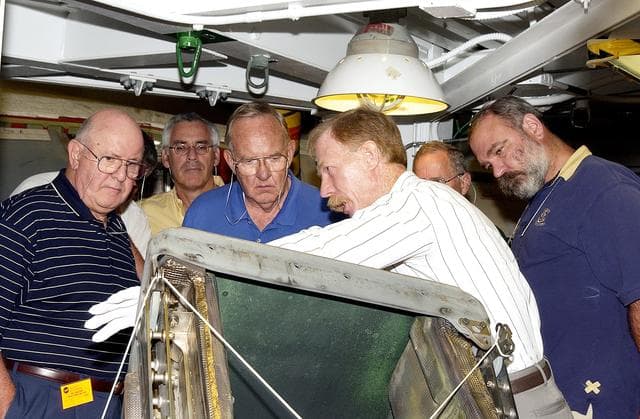
NASA image: KENNEDY SPACE CENTER, FLA.  - On a tour of the Orbiter Processing Facility, members of the Stafford-Covey Return to Flight Task Group (SCTG) look at one of the Reinforced Carbon-Carbon panels, being shown by Tom Roberts with United Space Alliance, from the orbiter Endeavour.  Chairing the task group are Richard O. Covey, former Space Shuttle commander, and Thomas P. Stafford, Apollo commander.  Chartered by NASA Administrator Sean O’Keefe, the task group will perform an independent assessment of NASA’s implementation of the final recommendations by the Columbia Accident Investigation Board.
Image
Aug 6, 2003

KENNEDY SPACE CENTER, FLA. - On a tour of the Orbiter Processing Facility, members of the Stafford-Covey Return to Flight Task Group (SCTG) look at one of the Reinforced Carbon-Carbon panels, being shown by Tom Roberts with United Space Alliance, from the orbiter Endeavour. Chairing the task group are Richard O. Covey, former Space Shuttle commander, and Thomas P. Stafford, Apollo commander. Chartered by NASA Administrator Sean O’Keefe, the task group will perform an independent assessment of NASA’s implementation of the final recommendations by the Columbia Accident Investigation Board.

KENNEDY SPACE CENTER, FLA. - On a tour of the Orbiter Processing Facility, members of the Stafford-Covey Return to...
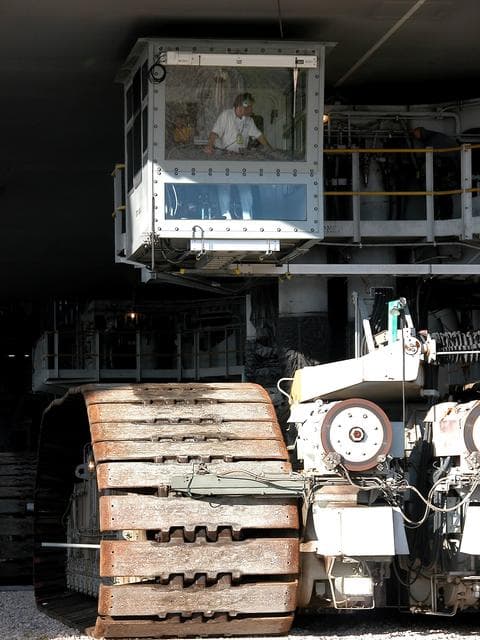
NASA image: KENNEDY SPACE CENTER, FLA. -  As the crawler transporter slowly moves the Mobile Launcher Platform (MLP) out of the Vehicle Assembly Building, the driver of the front control cab can be seen.  The MLP is carrying two solid rocket boosters for engineering analysis vibration tests on the crawler and MLP.    The crawler is moving at various speeds up to 1 mph in an effort to achieve vibration data gathering goals as it leaves the VAB and then returns.  The boosters are braced at the top for stability.  The primary purpose of these rollout tests is to gather data to develop future maintenance requirements on the transport equipment and the flight hardware. Various parts of the MLP and crawler transporter have been instrumented with vibration data collection equipment.
Image
Nov 17, 2003

KENNEDY SPACE CENTER, FLA. - As the crawler transporter slowly moves the Mobile Launcher Platform (MLP) out of the Vehicle Assembly Building, the driver of the front control cab can be seen. The MLP is carrying two solid rocket boosters for engineering analysis vibration tests on the crawler and MLP. The crawler is moving at various speeds up to 1 mph in an effort to achieve vibration data gathering goals as it leaves the VAB and then returns. The boosters are braced at the top for stability. The primary purpose of these rollout tests is to gather data to develop future maintenance requirements on the transport equipment and the flight hardware. Various parts of the MLP and crawler transporter have been instrumented with vibration data collection equipment.

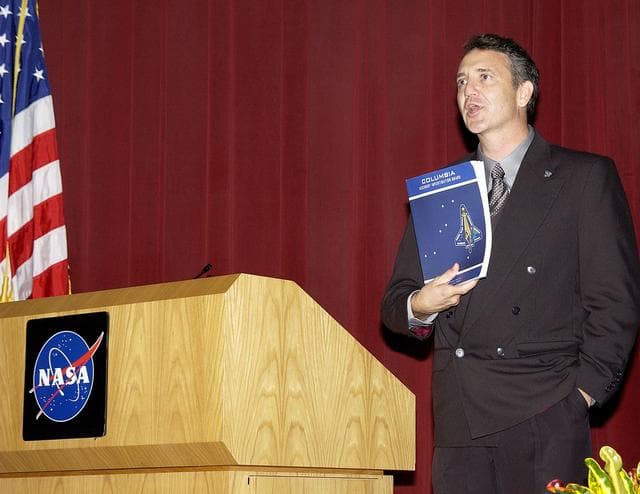
NASA image: KENNEDY SPACE CENTER, FLA. -  Tim Wilson, assistant chief engineer for Shuttle,  speaks to employees during Center Director Jim Kennedy’s first all-hands meeting for employees.  Also on the agenda was Dr. Woodrow Whitlow Jr., KSC deputy director, and Bill Pickavance, vice president and deputy program manager, Florida operations, United Space Alliance.  Representatives from the Shuttle program and contractor team were on hand to discuss the Columbia Accident Investigation Board report and where KSC stands in its progress toward return to flight.
Image
Sep 17, 2003

KENNEDY SPACE CENTER, FLA. - Tim Wilson, assistant chief engineer for Shuttle, speaks to employees during Center Director Jim Kennedy’s first all-hands meeting for employees. Also on the agenda was Dr. Woodrow Whitlow Jr., KSC deputy director, and Bill Pickavance, vice president and deputy program manager, Florida operations, United Space Alliance. Representatives from the Shuttle program and contractor team were on hand to discuss the Columbia Accident Investigation Board report and where KSC stands in its progress toward return to flight.

KENNEDY SPACE CENTER, FLA. - Tim Wilson, assistant chief engineer for Shuttle, speaks to employees during Center...

KSC
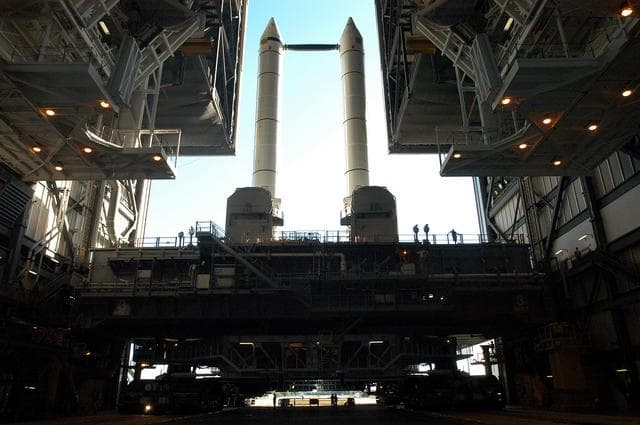
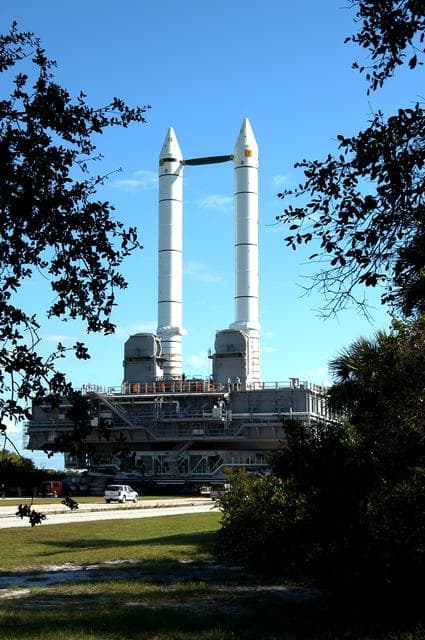
NASA image: KENNEDY SPACE CENTER, FLA. -   The crawler transporter is slowly moving the Mobile Launcher Platform (MLP), carrying a set of twin solid rocket boosters, out of the Vehicle Assembly Building (VAB) in support of engineering analysis vibration tests on the crawler and MLP. The crawler is moving at various speeds up to 1 mph in an effort to achieve vibration data gathering goals as it leaves the VAB and then returns.  The boosters are braced at the top for stability.  The primary purpose of these rollout tests is to gather data to develop future maintenance requirements on the transport equipment and the flight hardware. Various parts of the MLP and crawler transporter have been instrumented with vibration data collection equipment.
Image
Nov 17, 2003

KENNEDY SPACE CENTER, FLA. - The crawler transporter is slowly moving the Mobile Launcher Platform (MLP), carrying a set of twin solid rocket boosters, out of the Vehicle Assembly Building (VAB) in support of engineering analysis vibration tests on the crawler and MLP. The crawler is moving at various speeds up to 1 mph in an effort to achieve vibration data gathering goals as it leaves the VAB and then returns. The boosters are braced at the top for stability. The primary purpose of these rollout tests is to gather data to develop future maintenance requirements on the transport equipment and the flight hardware. Various parts of the MLP and crawler transporter have been instrumented with vibration data collection equipment.

NASA image: KENNEDY SPACE CENTER, FLA. -   The crawler transporter slowly moves the Mobile Launcher Platform (MLP), carrying a set of twin solid rocket boosters, along the crawlerway in support of engineering analysis vibration tests on the crawler and MLP.  The crawler is moving at various speeds up to 1 mph in an effort to achieve vibration data gathering goals as it leaves the VAB and then returns.  The boosters are braced at the top for stability.  The primary purpose of these rollout tests is to gather data to develop future maintenance requirements on the transport equipment and the flight hardware. Various parts of the MLP and crawler transporter have been instrumented with vibration data collection equipment.
Image
Nov 17, 2003

KENNEDY SPACE CENTER, FLA. - The crawler transporter slowly moves the Mobile Launcher Platform (MLP), carrying a set of twin solid rocket boosters, along the crawlerway in support of engineering analysis vibration tests on the crawler and MLP. The crawler is moving at various speeds up to 1 mph in an effort to achieve vibration data gathering goals as it leaves the VAB and then returns. The boosters are braced at the top for stability. The primary purpose of these rollout tests is to gather data to develop future maintenance requirements on the transport equipment and the flight hardware. Various parts of the MLP and crawler transporter have been instrumented with vibration data collection equipment.

KENNEDY SPACE CENTER, FLA. - The crawler transporter slowly moves the Mobile Launcher Platform (MLP), carrying a set...

NASA image: KSC-2014-4610
Image
Dec 1, 2014

KSC-2014-4610

SAN DIEGO, Calif. – An H60-S Seahawk helicopter lands on the deck of the USS Anchorage in the Pacific Ocean off the...

KSC
PreviousPage 28 of 100Next

Frequently Asked Questions About NASA Images

Are NASA images free to use?+
Yes, most NASA images are in the public domain and are free to use for educational, informational, and personal purposes. NASA's media usage guidelines state that NASA material is not copyrighted unless otherwise noted. However, the NASA logo and certain insignia are protected. Some images may include identifiable individuals or third-party content that requires additional permissions. Always check the specific image's usage rights and credit NASA as the source.
How many images does NASA have?+
NASA's Image and Video Library contains over 140,000 publicly accessible images, videos, and audio files spanning the agency's entire history, from the Mercury program of the 1960s to the latest James Webb Space Telescope discoveries. The collection grows daily as new missions capture imagery and archival materials are digitized. Individual mission archives, such as Mars rover photos, contain hundreds of thousands of additional images.
Can I download NASA images?+
Yes, you can download NASA images in multiple resolutions directly from this gallery. Each image detail page provides download links for original (full resolution), large (1920px), medium (960px), small (480px), and thumbnail sizes. NASA encourages the public to use these images for education, media, and personal projects. High-resolution originals are ideal for printing and professional use.

Explore More NASA Content

Astronomy Picture of the Day

Daily curated space image

Mars Rover Photos

Curiosity & Perseverance images

Earth from Space

DSCOVR EPIC daily images

Launch Schedule

Upcoming rocket launches

Space News

Mission updates & discoveries

KSC

KENNEDY SPACE CENTER, FLA. - As the crawler transporter slowly moves the Mobile Launcher Platform (MLP) out of the...

KSC

KENNEDY SPACE CENTER, FLA. - The crawler transporter slowly moves the Mobile Launcher Platform (MLP), carrying a set...

KSC

KENNEDY SPACE CENTER, FLA. - Carrying a set of twin solid rocket boosters, the crawler transporter slowly moves the...

KSC
KSC

KENNEDY SPACE CENTER, FLA. - Mobile Launcher Platform (MLP) number 3 and a set of twin solid rocket boosters, atop...

KSC

KENNEDY SPACE CENTER, FLA. - Framed between palm trees, solid rocket boosters loom above the Mobile Launcher...

KSC

KENNEDY SPACE CENTER, FLA. - Mobile Launcher Platform (MLP) number 3 and a set of twin solid rocket boosters, atop...

KSC
KSC
KSC

KENNEDY SPACE CENTER, FLA. - The crawler transporter slowly moves the Mobile Launcher Platform (MLP), carrying a set...

KSC

KENNEDY SPACE CENTER, FLA. - The crawler transporter has slowly moved the Mobile Launcher Platform (MLP), carrying a...

KSC

KENNEDY SPACE CENTER, FLA. - The crawler transporter slowly moves the Mobile Launcher Platform (MLP), carrying a set...

KSC
KSC

KENNEDY SPACE CENTER, FLA. - The crawler transporter slowly moves the Mobile Launcher Platform (MLP), carrying a set...

KSC
KSC

KENNEDY SPACE CENTER, FLA. - As the crawler transporter slowly moves the Mobile Launcher Platform (MLP) out of the...

KSC

KENNEDY SPACE CENTER, FLA. - The crawler transporter is slowly moving the Mobile Launcher Platform (MLP), carrying a...

KSC
KSC