CosmosObservatory
Explore
Solar System
Live
Learn
Tools
About
Cosmos Observatory
ToolsAbout
Cosmos Observatory

Explore the universe through NASA data, real-time ISS tracking, Mars rover imagery, asteroid monitoring, and comprehensive space encyclopedia. Your gateway to the cosmos.

Explore

  • APOD
  • Mars Rovers
  • Earth Imagery
  • NASA Gallery
  • ISS Tracker

Data

  • Asteroids
  • Solar System
  • Exoplanets
  • Space Weather
  • Launches

Tools

  • Glossary
  • News
  • Calculators

Legal

  • About
  • Privacy Policy
  • Terms of Use
  • Space Tools
  • Contact

Stay updated with the cosmos

Get weekly digests of APOD highlights, upcoming launches, and space events.

© 2026 Cosmos Observatory. All rights reserved. Built with for space enthusiasts.

This website is not affiliated with, maintained, authorized, endorsed by, or in any way officially connected with NASA or any of its subsidiaries or affiliates. All NASA imagery is in the public domain unless otherwise noted. Data sourced from NASA Open APIs, Launch Library 2, and other open data services.

NASA Gallery

Explore NASA's vast collection of space images, videos, and audio from missions past and present.

  1. Home
  2. /
  3. NASA Gallery

NASA's Image and Video Library: A Visual Archive of Space Exploration

NASA's Image and Video Library is one of the most comprehensive public archives of space imagery in the world, containing over 140,000 images, videos, and audio recordings spanning more than six decades of space exploration. From the earliest Mercury and Gemini missions through the Apollo Moon landings, the Space Shuttle era, and today's cutting-edge observations from the James Webb Space Telescope, this collection documents humanity's journey into the cosmos.

The library includes imagery from diverse sources: telescopes like Hubble and Webb that capture deep-space nebulae, galaxies, and exoplanets; planetary missions like the Mars rovers ( browse Mars photos) and Cassini at Saturn; Earth observation satellites ( see EPIC imagery); astronaut photography from the ISS; and documentation of rocket launches, spacecraft assembly, and ground testing. Most NASA images are in the public domain and free to download at full resolution for educational, editorial, and personal use.

Use the search bar above to find specific subjects — try queries like "Apollo 11," "Hubble Deep Field," "Mars surface," or "astronaut EVA." You can also filter by media type (image, video, or audio). For a daily curated experience, visit the Astronomy Picture of the Day.

Showing results for "Humans in Space"

11,402 results found - Page 28 of 476

NASA image: 0091 NEA Scout Music Rev29 02102021
Video
Feb 10, 2021

0091 NEA Scout Music Rev29 02102021

The Near-Earth Asteroid Scout, or NEA Scout, is a robotic reconnaissance mission that will deploy a 6U CubeSat to...

MSFC
NASA image: Det 3 Recovery of Boeing Starliner Boiler Plate
Image
Apr 18, 2019

Det 3 Recovery of Boeing Starliner Boiler Plate

Rescue team members lower the Boeing CST-100 Starliner training capsule, known as Boiler Plate 3, into the water at...

KSC
NASA image: Det 3 Recovery of Boeing Starliner Boiler Plate
Image
Apr 16, 2019

Det 3 Recovery of Boeing Starliner Boiler Plate

Rescue team members prepare an inflatable front porch that will be attached to the Boeing CST-100 Starliner training...

KSC
NASA image: SpaceX CRS-21 Scientific Payload Preparations: Cardinal Heart
Video
Dec 7, 2020

SpaceX CRS-21 Scientific Payload Preparations: Cardinal Heart

SpaceX CRS-21 Scientific Payload Preparations: Cardinal Heart Effect of Microgravity on Drug Responses Using...

KSC
NASA image: Science Verification Test Harvest
Video
Sep 30, 2019

Science Verification Test Harvest

Science Verification Test Harvest of new cultivars for their potential to grow in space.

KSC
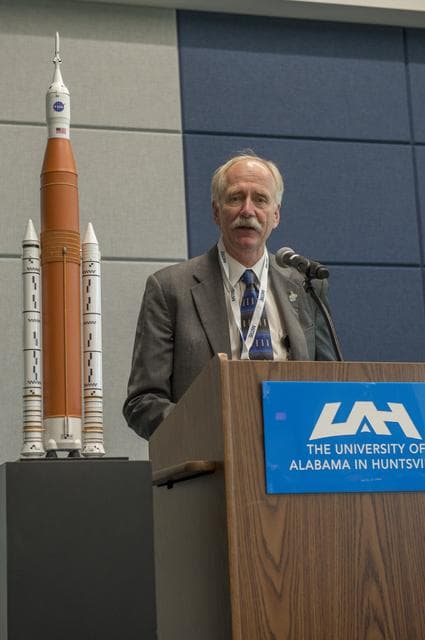
NASA image: 10th Annual Wernher von Braun Memorial Symposium
Image
Oct 26, 2017

10th Annual Wernher von Braun Memorial Symposium

William Gerstenmaier is guest speaker for luncheon on first day of Wernher von Braun Memorial Symposium. William...

MSFC
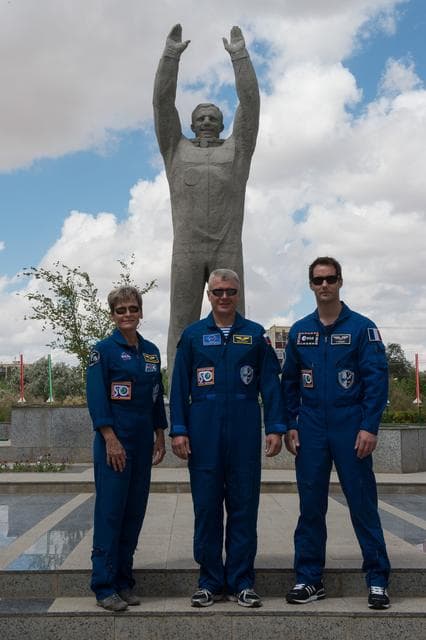
NASA image: During a tour of the town in Baikonur, Kazakhstan June 26, Expedition 48-49 backup crewmembers Peggy Whitson of NASA (left), Oleg Novitskiy of Roscosmos (center) and Thomas Pesquet of the European Space Agency (right) pose for pictures in front of a statue of Yuri Gagarin, the first human to fly in space. Whitson, Novitskiy and Pesquet are backups to Kate Rubins of NASA, Anatoly Ivanishin of Roscosmos and Takuya Onishi of the Japan Aerospace Exploration Agency, who are preparing for launch on July 7, Baikonur time, on the Soyuz MS-01 spacecraft for a planned four-month mission on the International Space Station...GCTC/Andrei Shelepin.
Image
Jun 26, 2016

During a tour of the town in Baikonur, Kazakhstan June 26, Expedition 48-49 backup crewmembers Peggy Whitson of NASA (left), Oleg Novitskiy of Roscosmos (center) and Thomas Pesquet of the European Space Agency (right) pose for pictures in front of a statue of Yuri Gagarin, the first human to fly in space. Whitson, Novitskiy and Pesquet are backups to Kate Rubins of NASA, Anatoly Ivanishin of Roscosmos and Takuya Onishi of the Japan Aerospace Exploration Agency, who are preparing for launch on July 7, Baikonur time, on the Soyuz MS-01 spacecraft for a planned four-month mission on the International Space Station...GCTC/Andrei Shelepin.

During a tour of the town in Baikonur, Kazakhstan June 26, Expedition 48-49 backup crewmembers Peggy Whitson of NASA...

NASA image: NASA’s Moon to Mars Plans, Artemis Lunar Program Gets Fast Tracked in 2019
Video
Dec 23, 2019

NASA’s Moon to Mars Plans, Artemis Lunar Program Gets Fast Tracked in 2019

Setting a bold goal in human space exploration with the Artemis program while celebrating Apollo’s historic first...

HQ
NASA image: NASA’s Moon to Mars Plans, Artemis Lunar Program Gets Fast Tracked in 2019
Video
Dec 23, 2019

NASA’s Moon to Mars Plans, Artemis Lunar Program Gets Fast Tracked in 2019

Setting a bold goal in human space exploration with the Artemis program while celebrating Apollo’s historic first...

HQ
NASA image: Artemis I Mission Trajectory
Video
Oct 10, 2019

Artemis I Mission Trajectory

Our Artemis program will return humans to the Moon by 2024. Artemis I, the first Artemis mission, will test all of...

HQ
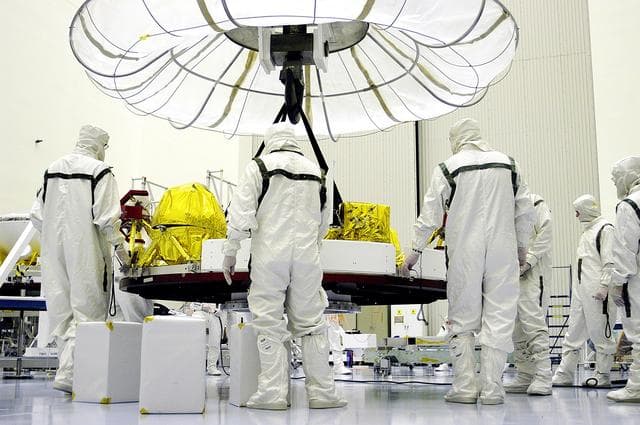
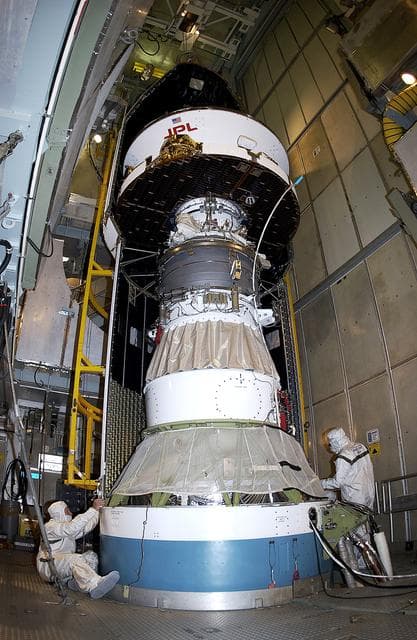
NASA image: KENNEDY SPACE CENTER, FLA. - In the Payload Hazardous Servicing Facility, workers stand by while an overhead crane again lifts the cruise stage of Mars Exploration Rover 1 (MER-1).  The cruise stage will be integrated with the aeroshell, the entry vehicle.   NASA’s twin Mars Exploration Rovers are designed to study the history of water on Mars. These robotic geologists are equipped with a robotic arm, a drilling tool, three spectrometers, and four pairs of cameras that allow them to have a human-like, 3D view of the terrain. Each rover could travel as far as 100 meters in one day to act as Mars scientists' eyes and hands, exploring an environment where humans can’t yet go.  The MER-1 is scheduled to launch June 25 from Launch Pad 17-A, Cape Canaveral Air Force Station.
Image
May 18, 2003

KENNEDY SPACE CENTER, FLA. - In the Payload Hazardous Servicing Facility, workers stand by while an overhead crane again lifts the cruise stage of Mars Exploration Rover 1 (MER-1). The cruise stage will be integrated with the aeroshell, the entry vehicle. NASA’s twin Mars Exploration Rovers are designed to study the history of water on Mars. These robotic geologists are equipped with a robotic arm, a drilling tool, three spectrometers, and four pairs of cameras that allow them to have a human-like, 3D view of the terrain. Each rover could travel as far as 100 meters in one day to act as Mars scientists' eyes and hands, exploring an environment where humans can’t yet go. The MER-1 is scheduled to launch June 25 from Launch Pad 17-A, Cape Canaveral Air Force Station.
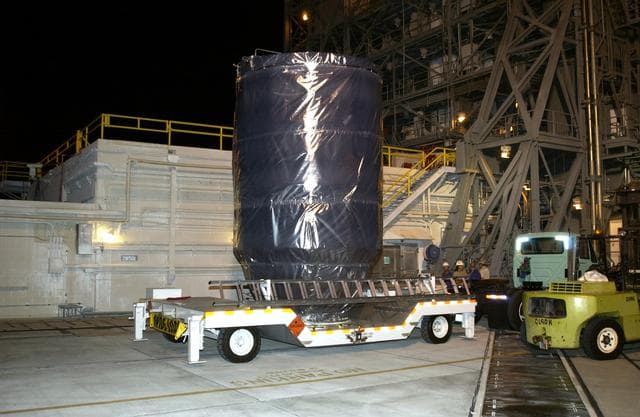
NASA image: KENNEDY SPACE CENTER, FLA. - The Mars Exploration Rover 2 (MER-2), inside the transport canister, has arrived at Launch Pad 17-A, Cape Canaveral Air Force Station, where it will be mated to the Delta II rocket for launch.  MER-2 is one of NASA's twin Mars Exploration Rovers designed to study the history of water on Mars. These robotic geologists are equipped with a robotic arm, a drilling tool, three spectrometers, and four pairs of cameras that allow them to have a human-like, 3D view of the terrain. Each rover could travel as far as 100 meters in one day to act as Mars scientists' eyes and hands, exploring an environment where humans can't yet go.  MER-2 is scheduled to launch no earlier than June 8 as MER-A.
Image
May 27, 2003

KENNEDY SPACE CENTER, FLA. - The Mars Exploration Rover 2 (MER-2), inside the transport canister, has arrived at Launch Pad 17-A, Cape Canaveral Air Force Station, where it will be mated to the Delta II rocket for launch. MER-2 is one of NASA's twin Mars Exploration Rovers designed to study the history of water on Mars. These robotic geologists are equipped with a robotic arm, a drilling tool, three spectrometers, and four pairs of cameras that allow them to have a human-like, 3D view of the terrain. Each rover could travel as far as 100 meters in one day to act as Mars scientists' eyes and hands, exploring an environment where humans can't yet go. MER-2 is scheduled to launch no earlier than June 8 as MER-A.
NASA image: KENNEDY SPACE CENTER, FLA. - At Launch Complex 17-A, Cape Canaveral Air Force Station, the first half of the fairing for the Mars Exploration Rover 2 (MER-2) is installed around the Mars Exploration Rover 2 (MER-2).  MER-2 is one of NASA's twin Mars Exploration Rovers designed to study the history of water on Mars. These robotic geologists are equipped with a robotic arm, a drilling tool, three spectrometers, and four pairs of cameras that allow them to have a human-like, 3D view of the terrain. Each rover could travel as far as 100 meters in one day to act as Mars scientists' eyes and hands, exploring an environment where humans can't yet go.  MER-2 is scheduled to launch no earlier than June 8 as MER-A, with two launch opportunities each day during the launch period that closes on June 19.
Image
May 31, 2003

KENNEDY SPACE CENTER, FLA. - At Launch Complex 17-A, Cape Canaveral Air Force Station, the first half of the fairing for the Mars Exploration Rover 2 (MER-2) is installed around the Mars Exploration Rover 2 (MER-2). MER-2 is one of NASA's twin Mars Exploration Rovers designed to study the history of water on Mars. These robotic geologists are equipped with a robotic arm, a drilling tool, three spectrometers, and four pairs of cameras that allow them to have a human-like, 3D view of the terrain. Each rover could travel as far as 100 meters in one day to act as Mars scientists' eyes and hands, exploring an environment where humans can't yet go. MER-2 is scheduled to launch no earlier than June 8 as MER-A, with two launch opportunities each day during the launch period that closes on June 19.

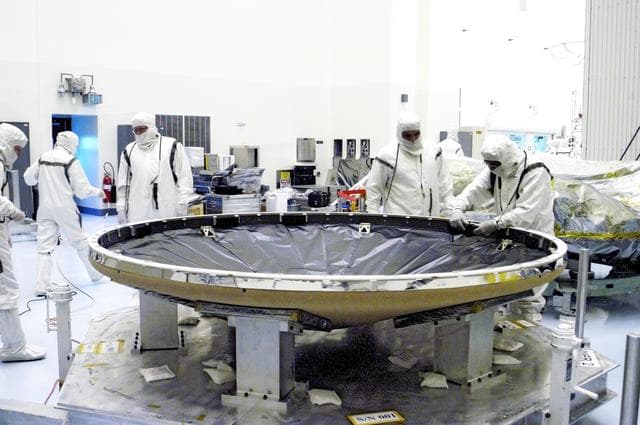
NASA image: KENNEDY SPACE CENTER, FLA. - Workers in the Payload Hazardous Servicing Facility prepare the heat shield that will be attached to the backshell, surrounding Mars Exploration Rover 1 (MER-1).  NASA's twin Mars Exploration Rovers are designed to study the history of water on Mars. These robotic geologists are equipped with a robotic arm, a drilling tool, three spectrometers, and four pairs of cameras that allow them to have a human-like, 3D view of the terrain. Each rover could travel as far as 100 meters in one day to act as Mars scientists' eyes and hands, exploring an environment where humans can't yet go.  MER-1 is scheduled to launch June 25 as MER-B aboard a Delta II rocket from Cape Canaveral Air Force Station.
Image
May 15, 2003

KENNEDY SPACE CENTER, FLA. - Workers in the Payload Hazardous Servicing Facility prepare the heat shield that will be attached to the backshell, surrounding Mars Exploration Rover 1 (MER-1). NASA's twin Mars Exploration Rovers are designed to study the history of water on Mars. These robotic geologists are equipped with a robotic arm, a drilling tool, three spectrometers, and four pairs of cameras that allow them to have a human-like, 3D view of the terrain. Each rover could travel as far as 100 meters in one day to act as Mars scientists' eyes and hands, exploring an environment where humans can't yet go. MER-1 is scheduled to launch June 25 as MER-B aboard a Delta II rocket from Cape Canaveral Air Force Station.

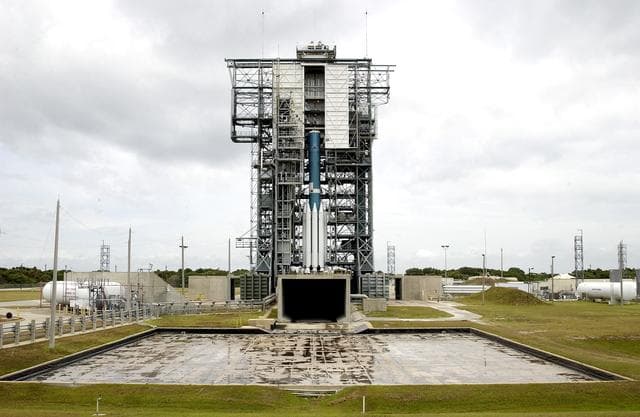
NASA image: KENNEDY SPACE CENTER, FLA. -  Erection of the Delta II rocket for the Mars Exploration Rover 1 (MER-1) launch on June 25 at Launch Complex 17-B, Cape Canaveral Air Force Station, is under way.  NASA’s twin Mars Exploration Rovers are designed to study the history of water on Mars. These robotic geologists are equipped with a robotic arm, a drilling tool, three spectrometers, and four pairs of cameras that allow them to have a human-like, 3D view of the terrain. Each rover could travel as far as 100 meters in one day to act as Mars scientists' eyes and hands, exploring an environment where humans can’t yet go.  MER-2 (MER-A) will launch June 5.
Image
May 22, 2003

KENNEDY SPACE CENTER, FLA. - Erection of the Delta II rocket for the Mars Exploration Rover 1 (MER-1) launch on June 25 at Launch Complex 17-B, Cape Canaveral Air Force Station, is under way. NASA’s twin Mars Exploration Rovers are designed to study the history of water on Mars. These robotic geologists are equipped with a robotic arm, a drilling tool, three spectrometers, and four pairs of cameras that allow them to have a human-like, 3D view of the terrain. Each rover could travel as far as 100 meters in one day to act as Mars scientists' eyes and hands, exploring an environment where humans can’t yet go. MER-2 (MER-A) will launch June 5.

KENNEDY SPACE CENTER, FLA. - Erection of the Delta II rocket for the Mars Exploration Rover 1 (MER-1) launch on June...
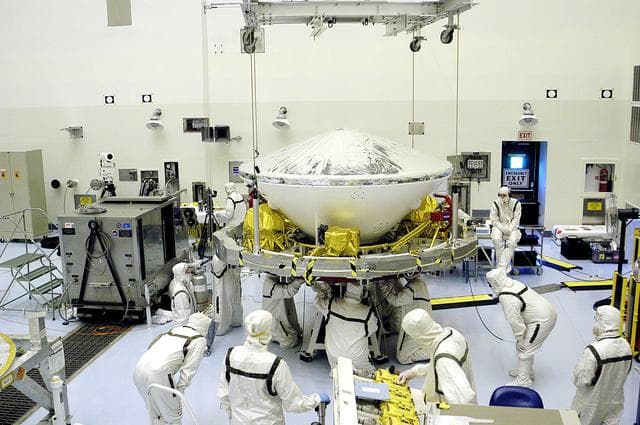
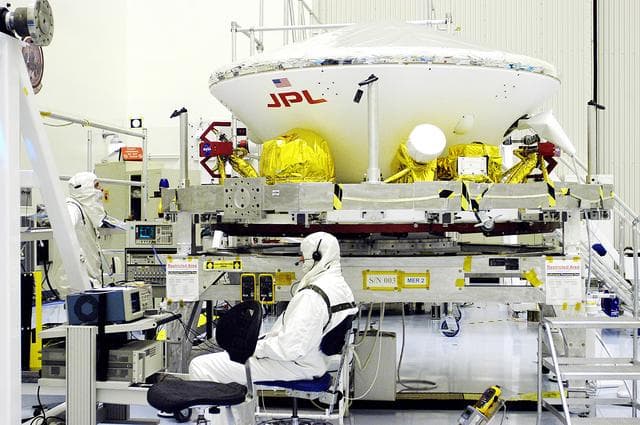
NASA image: KENNEDY SPACE CENTER, FLA. - In the Payload Hazardous Servicing Facility, workers prepare to lift the Mars Exploration Rover-1 (MER-B) onto a spin table during preflight processing of the spacecraft.  The rover is scheduled to launch aboard a Delta II rocket on June 25.  NASA’s twin Mars Exploration Rovers are designed to study the history of water on Mars. These robotic geologists are equipped with a robotic arm, a drilling tool, three spectrometers, and four pairs of cameras that allow them to have a human-like, 3D view of the terrain. Each rover could travel as far as 100 meters in one day to act as Mars scientists' eyes and hands, exploring an environment where humans are not yet able to go. The launch of MER-2 (MER-A) is tentatively set for June 8.
Image
May 29, 2003

KENNEDY SPACE CENTER, FLA. - In the Payload Hazardous Servicing Facility, workers prepare to lift the Mars Exploration Rover-1 (MER-B) onto a spin table during preflight processing of the spacecraft. The rover is scheduled to launch aboard a Delta II rocket on June 25. NASA’s twin Mars Exploration Rovers are designed to study the history of water on Mars. These robotic geologists are equipped with a robotic arm, a drilling tool, three spectrometers, and four pairs of cameras that allow them to have a human-like, 3D view of the terrain. Each rover could travel as far as 100 meters in one day to act as Mars scientists' eyes and hands, exploring an environment where humans are not yet able to go. The launch of MER-2 (MER-A) is tentatively set for June 8.

NASA image: KENNEDY SPACE CENTER, FLA. - The aeroshell, the entry vehicle for Mars Exploration Rover 1 (MER-1), is ready for integration with its cruise stage, seen here below the backshell.  What appears to be the top half of the aeroshell is the heat shield.  NASA’s twin Mars Exploration Rovers are designed to study the history of water on Mars. These robotic geologists are equipped with a robotic arm, a drilling tool, three spectrometers, and four pairs of cameras that allow them to have a human-like, 3D view of the terrain. Each rover could travel as far as 100 meters in one day to act as Mars scientists' eyes and hands, exploring an environment where humans can’t yet go.  The MER-1 is scheduled to launch June 25 from Launch Pad 17-A, Cape Canaveral Air Force Station.
Image
May 18, 2003

KENNEDY SPACE CENTER, FLA. - The aeroshell, the entry vehicle for Mars Exploration Rover 1 (MER-1), is ready for integration with its cruise stage, seen here below the backshell. What appears to be the top half of the aeroshell is the heat shield. NASA’s twin Mars Exploration Rovers are designed to study the history of water on Mars. These robotic geologists are equipped with a robotic arm, a drilling tool, three spectrometers, and four pairs of cameras that allow them to have a human-like, 3D view of the terrain. Each rover could travel as far as 100 meters in one day to act as Mars scientists' eyes and hands, exploring an environment where humans can’t yet go. The MER-1 is scheduled to launch June 25 from Launch Pad 17-A, Cape Canaveral Air Force Station.
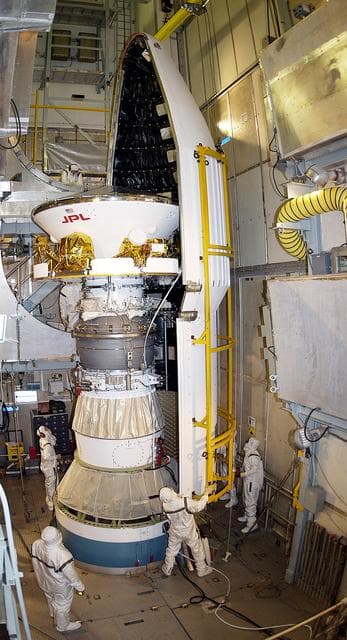
NASA image: KENNEDY SPACE CENTER, FLA. - At Launch Complex 17-A, Cape Canaveral Air Force Station, the first half of the fairing for the Mars Exploration Rover 2 (MER-2) closes in on the spacecraft.  MER-2 is one of NASA's twin Mars Exploration Rovers designed to study the history of water on Mars. These robotic geologists are equipped with a robotic arm, a drilling tool, three spectrometers, and four pairs of cameras that allow them to have a human-like, 3D view of the terrain. Each rover could travel as far as 100 meters in one day to act as Mars scientists' eyes and hands, exploring an environment where humans can't yet go.  MER-2 is scheduled to launch no earlier than June 8 as MER-A, with two launch opportunities each day during the launch period that closes on June 19.
Image
May 31, 2003

KENNEDY SPACE CENTER, FLA. - At Launch Complex 17-A, Cape Canaveral Air Force Station, the first half of the fairing for the Mars Exploration Rover 2 (MER-2) closes in on the spacecraft. MER-2 is one of NASA's twin Mars Exploration Rovers designed to study the history of water on Mars. These robotic geologists are equipped with a robotic arm, a drilling tool, three spectrometers, and four pairs of cameras that allow them to have a human-like, 3D view of the terrain. Each rover could travel as far as 100 meters in one day to act as Mars scientists' eyes and hands, exploring an environment where humans can't yet go. MER-2 is scheduled to launch no earlier than June 8 as MER-A, with two launch opportunities each day during the launch period that closes on June 19.

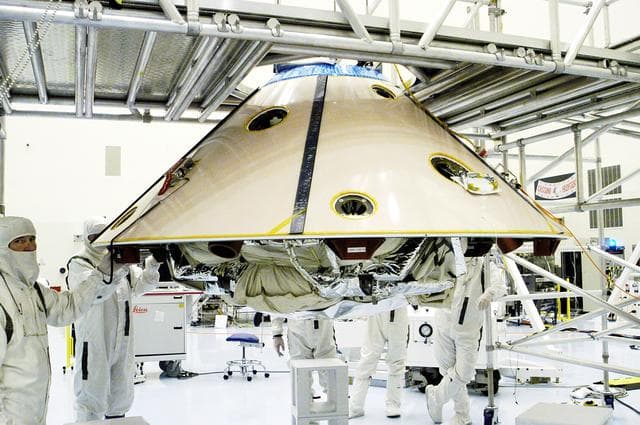
NASA image: KENNEDY SPACE CENTER, FLA. - Workers walk with the suspended backshell/ Mars Exploration Rover 1 (MER-1) as it travels across the floor of the Payload Hazardous Servicing Facility.  The backshell will be attached to the lower heat shield.  NASA's twin Mars Exploration Rovers are designed to study the history of water on Mars. These robotic geologists are equipped with a robotic arm, a drilling tool, three spectrometers, and four pairs of cameras that allow them to have a human-like, 3D view of the terrain. Each rover could travel as far as 100 meters in one day to act as Mars scientists' eyes and hands, exploring an environment where humans can't yet go.  MER-1 is scheduled to launch June 25 as MER-B aboard a Delta II rocket from Cape Canaveral Air Force Station.
Image
May 15, 2003

KENNEDY SPACE CENTER, FLA. - Workers walk with the suspended backshell/ Mars Exploration Rover 1 (MER-1) as it travels across the floor of the Payload Hazardous Servicing Facility. The backshell will be attached to the lower heat shield. NASA's twin Mars Exploration Rovers are designed to study the history of water on Mars. These robotic geologists are equipped with a robotic arm, a drilling tool, three spectrometers, and four pairs of cameras that allow them to have a human-like, 3D view of the terrain. Each rover could travel as far as 100 meters in one day to act as Mars scientists' eyes and hands, exploring an environment where humans can't yet go. MER-1 is scheduled to launch June 25 as MER-B aboard a Delta II rocket from Cape Canaveral Air Force Station.

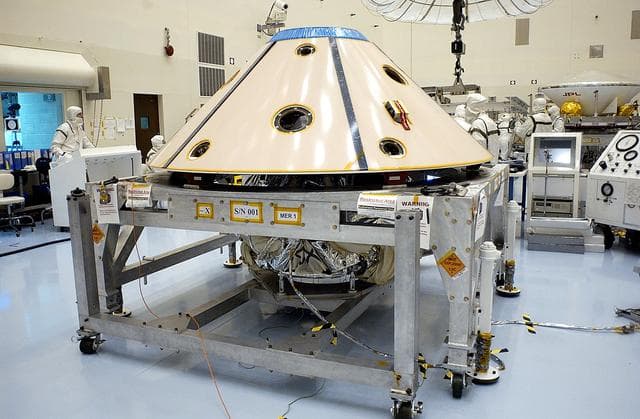
NASA image: KENNEDY SPACE CENTER, FLA. - The backshell is in place over the Mars Exploration Rover 1 (MER-1).  The backshell is a protective cover for the rover.  NASA's twin Mars Exploration Rovers are designed to study the history of water on Mars. These robotic geologists are equipped with a robotic arm, a drilling tool, three spectrometers, and four pairs of cameras that allow them to have a human-like, 3D view of the terrain. Each rover could travel as far as 100 meters in one day to act as Mars scientists' eyes and hands, exploring an environment where humans can't yet go.  MER-1 is scheduled to launch June 25 as MER-B aboard a Delta II rocket from Cape Canaveral Air Force Station.
Image
May 10, 2003

KENNEDY SPACE CENTER, FLA. - The backshell is in place over the Mars Exploration Rover 1 (MER-1). The backshell is a protective cover for the rover. NASA's twin Mars Exploration Rovers are designed to study the history of water on Mars. These robotic geologists are equipped with a robotic arm, a drilling tool, three spectrometers, and four pairs of cameras that allow them to have a human-like, 3D view of the terrain. Each rover could travel as far as 100 meters in one day to act as Mars scientists' eyes and hands, exploring an environment where humans can't yet go. MER-1 is scheduled to launch June 25 as MER-B aboard a Delta II rocket from Cape Canaveral Air Force Station.

KENNEDY SPACE CENTER, FLA. - The backshell is in place over the Mars Exploration Rover 1 (MER-1). The backshell is a...
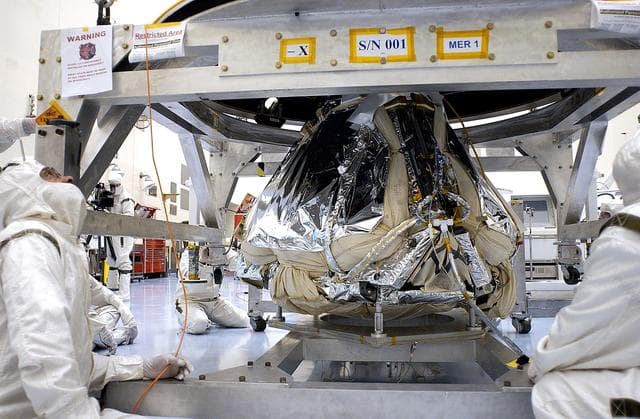
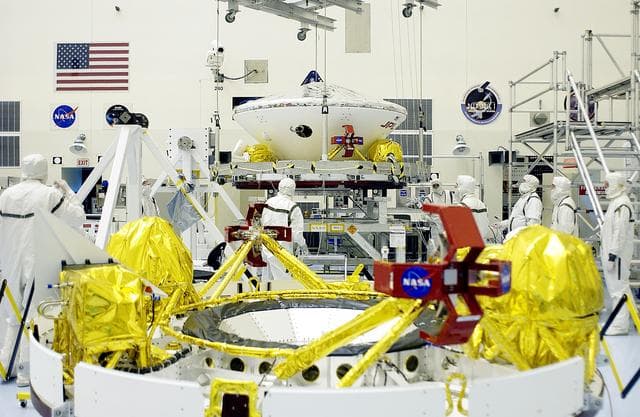
NASA image: KENNEDY SPACE CENTER, FLA. - Workers in the Payload Hazardous Servicing Facility lower the backshell over the Mars Exploration Rover 1 (MER-1).  The backshell is a protective cover for the rover.  NASA's twin Mars Exploration Rovers are designed to study the history of water on Mars. These robotic geologists are equipped with a robotic arm, a drilling tool, three spectrometers, and four pairs of cameras that allow them to have a human-like, 3D view of the terrain. Each rover could travel as far as 100 meters in one day to act as Mars scientists' eyes and hands, exploring an environment where humans can't yet go.  MER-1 is scheduled to launch June 25 as MER-B aboard a Delta II rocket from Cape Canaveral Air Force Station.
Image
May 10, 2003

KENNEDY SPACE CENTER, FLA. - Workers in the Payload Hazardous Servicing Facility lower the backshell over the Mars Exploration Rover 1 (MER-1). The backshell is a protective cover for the rover. NASA's twin Mars Exploration Rovers are designed to study the history of water on Mars. These robotic geologists are equipped with a robotic arm, a drilling tool, three spectrometers, and four pairs of cameras that allow them to have a human-like, 3D view of the terrain. Each rover could travel as far as 100 meters in one day to act as Mars scientists' eyes and hands, exploring an environment where humans can't yet go. MER-1 is scheduled to launch June 25 as MER-B aboard a Delta II rocket from Cape Canaveral Air Force Station.

NASA image: KENNEDY SPACE CENTER, FLA. - In the Payload Hazardous Servicing Facility, an overhead crane (background) is lifting the Mars Exploration Rover 2 (MER-2) to move it to a spin table.  In the foreground is the cruise stage for MER-1.  NASA’s twin Mars Exploration Rovers are designed to study the history of water on Mars. These robotic geologists are equipped with a robotic arm, a drilling tool, three spectrometers, and four pairs of cameras that allow them to have a human-like, 3D view of the terrain. Each rover could travel as far as 100 meters in one day to act as Mars scientists' eyes and hands, exploring an environment where humans can’t yet go.  The MER-2 is scheduled to launch June 5 from Launch Pad 17-A, Cape Canaveral Air Force Station.
Image
May 19, 2003

KENNEDY SPACE CENTER, FLA. - In the Payload Hazardous Servicing Facility, an overhead crane (background) is lifting the Mars Exploration Rover 2 (MER-2) to move it to a spin table. In the foreground is the cruise stage for MER-1. NASA’s twin Mars Exploration Rovers are designed to study the history of water on Mars. These robotic geologists are equipped with a robotic arm, a drilling tool, three spectrometers, and four pairs of cameras that allow them to have a human-like, 3D view of the terrain. Each rover could travel as far as 100 meters in one day to act as Mars scientists' eyes and hands, exploring an environment where humans can’t yet go. The MER-2 is scheduled to launch June 5 from Launch Pad 17-A, Cape Canaveral Air Force Station.
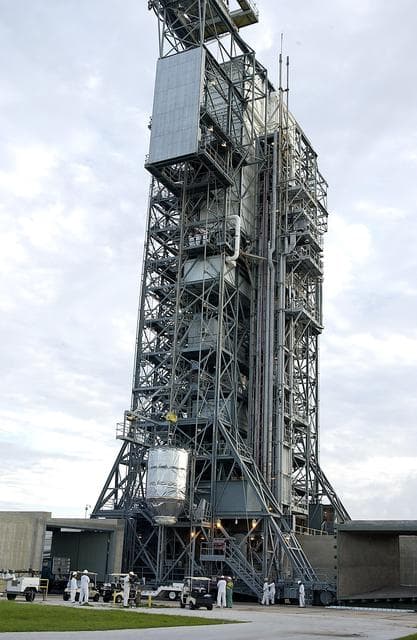
NASA image: KENNEDY SPACE CENTER, FLA. -  On Launch Pad 17-B, Cape Canaveral Air Force Station, the Mars Exploration Rover 1 (MER-B) is lifted up the tower for mating with the Delta rocket.  The second of twin rovers being sent to Mars, it is equipped with a robotic arm, a drilling tool, three spectrometers, and four pairs of cameras that allow it to have a human-like, 3D view of the terrain. Each rover could travel as far as 100 meters in one day to act as Mars scientists' eyes and hands, exploring an environment where humans can't yet go.  MER-B is scheduled to launch June 26 at one of two available times,  12:27:31 a.m. EDT or 1:08:45 a.m. EDT.
Image
Jun 17, 2003

KENNEDY SPACE CENTER, FLA. - On Launch Pad 17-B, Cape Canaveral Air Force Station, the Mars Exploration Rover 1 (MER-B) is lifted up the tower for mating with the Delta rocket. The second of twin rovers being sent to Mars, it is equipped with a robotic arm, a drilling tool, three spectrometers, and four pairs of cameras that allow it to have a human-like, 3D view of the terrain. Each rover could travel as far as 100 meters in one day to act as Mars scientists' eyes and hands, exploring an environment where humans can't yet go. MER-B is scheduled to launch June 26 at one of two available times, 12:27:31 a.m. EDT or 1:08:45 a.m. EDT.

KENNEDY SPACE CENTER, FLA. - On Launch Pad 17-B, Cape Canaveral Air Force Station, the Mars Exploration Rover 1...
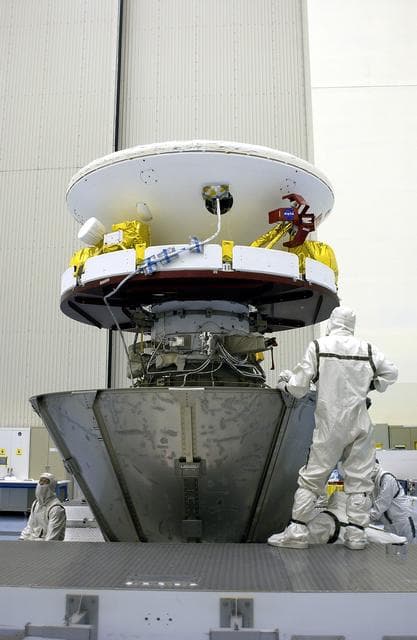
NASA image: KENNEDY SPACE CENTER, FLA. - Workers in the Payload Hazardous Servicing Facility secure the lower panels of a payload canister around Mars Exploration Rover 1 (MER-B).  The rover will be transported to Launch Complex 17-B, Cape Canaveral Air Force Station, for mating with the Delta rocket.  The second of twin rovers being sent to Mars, it is equipped with a robotic arm, a drilling tool, three spectrometers, and four pairs of cameras that allow it to have a human-like, 3D view of the terrain. Each rover could travel as far as 100 meters in one day to act as Mars scientists' eyes and hands, exploring an environment where humans can't yet go.  MER-B is scheduled to launch from Pad 17-B June 26 at one of two available times,  12:27:31 a.m. EDT or 1:08:45 a.m. EDT.
Image
Jun 13, 2003

KENNEDY SPACE CENTER, FLA. - Workers in the Payload Hazardous Servicing Facility secure the lower panels of a payload canister around Mars Exploration Rover 1 (MER-B). The rover will be transported to Launch Complex 17-B, Cape Canaveral Air Force Station, for mating with the Delta rocket. The second of twin rovers being sent to Mars, it is equipped with a robotic arm, a drilling tool, three spectrometers, and four pairs of cameras that allow it to have a human-like, 3D view of the terrain. Each rover could travel as far as 100 meters in one day to act as Mars scientists' eyes and hands, exploring an environment where humans can't yet go. MER-B is scheduled to launch from Pad 17-B June 26 at one of two available times, 12:27:31 a.m. EDT or 1:08:45 a.m. EDT.

PreviousPage 28 of 100Next

Frequently Asked Questions About NASA Images

Are NASA images free to use?+
Yes, most NASA images are in the public domain and are free to use for educational, informational, and personal purposes. NASA's media usage guidelines state that NASA material is not copyrighted unless otherwise noted. However, the NASA logo and certain insignia are protected. Some images may include identifiable individuals or third-party content that requires additional permissions. Always check the specific image's usage rights and credit NASA as the source.
How many images does NASA have?+
NASA's Image and Video Library contains over 140,000 publicly accessible images, videos, and audio files spanning the agency's entire history, from the Mercury program of the 1960s to the latest James Webb Space Telescope discoveries. The collection grows daily as new missions capture imagery and archival materials are digitized. Individual mission archives, such as Mars rover photos, contain hundreds of thousands of additional images.
Can I download NASA images?+
Yes, you can download NASA images in multiple resolutions directly from this gallery. Each image detail page provides download links for original (full resolution), large (1920px), medium (960px), small (480px), and thumbnail sizes. NASA encourages the public to use these images for education, media, and personal projects. High-resolution originals are ideal for printing and professional use.

Explore More NASA Content

Astronomy Picture of the Day

Daily curated space image

Mars Rover Photos

Curiosity & Perseverance images

Earth from Space

DSCOVR EPIC daily images

Launch Schedule

Upcoming rocket launches

Space News

Mission updates & discoveries

JSC

KENNEDY SPACE CENTER, FLA. - In the Payload Hazardous Servicing Facility, workers stand by while an overhead crane...

KSC

KENNEDY SPACE CENTER, FLA. - The Mars Exploration Rover 2 (MER-2), inside the transport canister, has arrived at...

KSC

KENNEDY SPACE CENTER, FLA. - At Launch Complex 17-A, Cape Canaveral Air Force Station, the first half of the fairing...

KSC

KENNEDY SPACE CENTER, FLA. - Workers in the Payload Hazardous Servicing Facility prepare the heat shield that will...

KSC
KSC

KENNEDY SPACE CENTER, FLA. - In the Payload Hazardous Servicing Facility, workers prepare to lift the Mars...

KSC

KENNEDY SPACE CENTER, FLA. - The aeroshell, the entry vehicle for Mars Exploration Rover 1 (MER-1), is ready for...

KSC

KENNEDY SPACE CENTER, FLA. - At Launch Complex 17-A, Cape Canaveral Air Force Station, the first half of the fairing...

KSC

KENNEDY SPACE CENTER, FLA. - Workers walk with the suspended backshell/ Mars Exploration Rover 1 (MER-1) as it...

KSC
KSC

KENNEDY SPACE CENTER, FLA. - Workers in the Payload Hazardous Servicing Facility lower the backshell over the Mars...

KSC

KENNEDY SPACE CENTER, FLA. - In the Payload Hazardous Servicing Facility, an overhead crane (background) is lifting...

KSC
KSC

KENNEDY SPACE CENTER, FLA. - Workers in the Payload Hazardous Servicing Facility secure the lower panels of a...

KSC