CosmosObservatory
Explore
Solar System
Live
Learn
Tools
About
Cosmos Observatory
ToolsAbout
Cosmos Observatory

Explore the universe through NASA data, real-time ISS tracking, Mars rover imagery, asteroid monitoring, and comprehensive space encyclopedia. Your gateway to the cosmos.

Explore

  • APOD
  • Mars Rovers
  • Earth Imagery
  • NASA Gallery
  • ISS Tracker

Data

  • Asteroids
  • Solar System
  • Exoplanets
  • Space Weather
  • Launches

Tools

  • Glossary
  • News
  • Calculators

Legal

  • About
  • Privacy Policy
  • Terms of Use
  • Space Tools
  • Contact

Stay updated with the cosmos

Get weekly digests of APOD highlights, upcoming launches, and space events.

© 2026 Cosmos Observatory. All rights reserved. Built with for space enthusiasts.

This website is not affiliated with, maintained, authorized, endorsed by, or in any way officially connected with NASA or any of its subsidiaries or affiliates. All NASA imagery is in the public domain unless otherwise noted. Data sourced from NASA Open APIs, Launch Library 2, and other open data services.

NASA Gallery

Explore NASA's vast collection of space images, videos, and audio from missions past and present.

  1. Home
  2. /
  3. NASA Gallery

NASA's Image and Video Library: A Visual Archive of Space Exploration

NASA's Image and Video Library is one of the most comprehensive public archives of space imagery in the world, containing over 140,000 images, videos, and audio recordings spanning more than six decades of space exploration. From the earliest Mercury and Gemini missions through the Apollo Moon landings, the Space Shuttle era, and today's cutting-edge observations from the James Webb Space Telescope, this collection documents humanity's journey into the cosmos.

The library includes imagery from diverse sources: telescopes like Hubble and Webb that capture deep-space nebulae, galaxies, and exoplanets; planetary missions like the Mars rovers ( browse Mars photos) and Cassini at Saturn; Earth observation satellites ( see EPIC imagery); astronaut photography from the ISS; and documentation of rocket launches, spacecraft assembly, and ground testing. Most NASA images are in the public domain and free to download at full resolution for educational, editorial, and personal use.

Use the search bar above to find specific subjects — try queries like "Apollo 11," "Hubble Deep Field," "Mars surface," or "astronaut EVA." You can also filter by media type (image, video, or audio). For a daily curated experience, visit the Astronomy Picture of the Day.

Showing results for "SHORT"

1,540 results found - Page 26 of 65

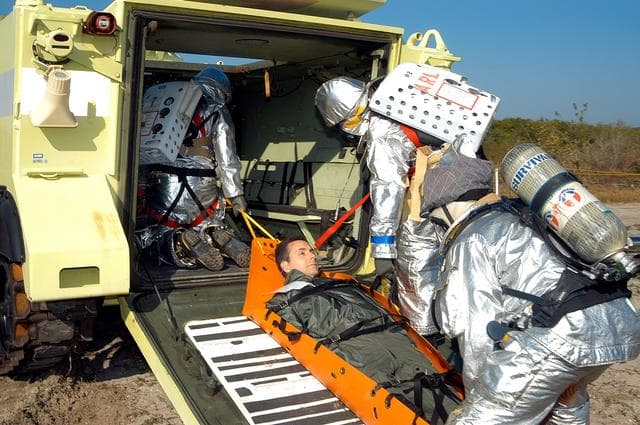
NASA image: KENNEDY SPACE CENTER, FLA. - An “injured” rescue worker is lifted into an M-113 armored personnel carrier provided for transportation during a “Mode VII” emergency landing simulation at Kennedy Space Center.  The purpose of the Mode VII is to exercise emergency preparedness personnel, equipment and facilities in rescuing astronauts from a downed orbiter and providing immediate medical attention.  This simulation presents an orbiter that has crashed short of the Shuttle Landing Facility in a wooded area 2-1/2 miles south of Runway 33.  Emergency crews are responding to the volunteer astronauts who are simulating various injuries inside the crew compartment mock-up.  Rescuers must remove the crew, provide triage and transport to hospitals those who need further treatment.  Local hospitals are participating in the exercise.
Image
Feb 18, 2004

KENNEDY SPACE CENTER, FLA. - An “injured” rescue worker is lifted into an M-113 armored personnel carrier provided for transportation during a “Mode VII” emergency landing simulation at Kennedy Space Center. The purpose of the Mode VII is to exercise emergency preparedness personnel, equipment and facilities in rescuing astronauts from a downed orbiter and providing immediate medical attention. This simulation presents an orbiter that has crashed short of the Shuttle Landing Facility in a wooded area 2-1/2 miles south of Runway 33. Emergency crews are responding to the volunteer astronauts who are simulating various injuries inside the crew compartment mock-up. Rescuers must remove the crew, provide triage and transport to hospitals those who need further treatment. Local hospitals are participating in the exercise.

KENNEDY SPACE CENTER, FLA. - An “injured” rescue worker is lifted into an M-113 armored personnel carrier provided...

KSC
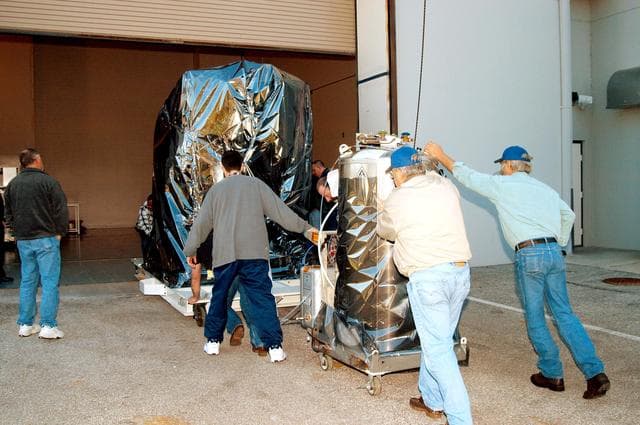
NASA image: KENNEDY SPACE CENTER, FLA. -  At the Astrotech Space Operations processing facilities near KSC, workers begin moving NASA’s MESSENGER spacecraft into the building  MESSENGER - short for MErcury Surface, Space ENvironment, GEochemistry and Ranging - is being taken into a high bay clean room where employees of the Johns Hopkins University Applied Physics Laboratory, builders of the spacecraft, will perform an initial state-of-health check.  Then processing for launch can begin, including checkout of the power systems, communications systems and control systems.  The thermal blankets will also be attached for flight.  MESSENGER will be launched May 11 on a six-year mission aboard a Boeing Delta II rocket.  Liftoff is targeted for 2:26 a.m. EDT on Tuesday, May 11.
Image
Mar 10, 2004

KENNEDY SPACE CENTER, FLA. - At the Astrotech Space Operations processing facilities near KSC, workers begin moving NASA’s MESSENGER spacecraft into the building MESSENGER - short for MErcury Surface, Space ENvironment, GEochemistry and Ranging - is being taken into a high bay clean room where employees of the Johns Hopkins University Applied Physics Laboratory, builders of the spacecraft, will perform an initial state-of-health check. Then processing for launch can begin, including checkout of the power systems, communications systems and control systems. The thermal blankets will also be attached for flight. MESSENGER will be launched May 11 on a six-year mission aboard a Boeing Delta II rocket. Liftoff is targeted for 2:26 a.m. EDT on Tuesday, May 11.
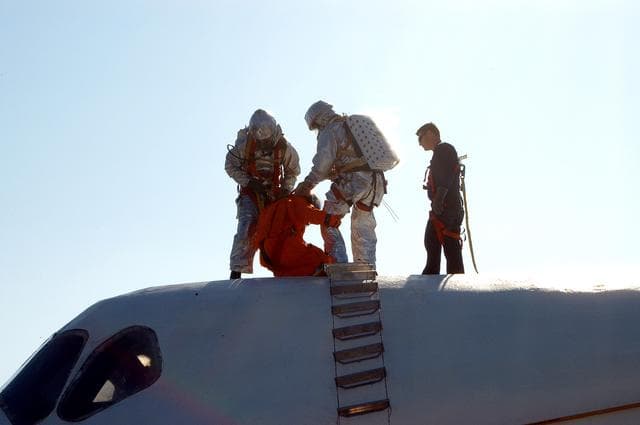
NASA image: KENNEDY SPACE CENTER, FLA. - Emergency crew members “rescue” an astronaut from inside the orbiter crew compartment mock-up that is the scene of a “Mode VII” emergency landing simulation at Kennedy Space Center.  The purpose of the Mode VII is to exercise emergency preparedness personnel, equipment and facilities in rescuing astronauts from a downed orbiter and providing immediate medical attention.  This simulation presents an orbiter that has crashed short of the Shuttle Landing Facility in a wooded area 2-1/2 miles south of Runway 33.  Emergency crews are responding to the volunteer “astronauts” who are simulating various injuries.  Rescuers must remove the crew, provide triage and transport to hospitals those who need further treatment.  Local hospitals are participating in the exercise.
Image
Feb 18, 2004

KENNEDY SPACE CENTER, FLA. - Emergency crew members “rescue” an astronaut from inside the orbiter crew compartment mock-up that is the scene of a “Mode VII” emergency landing simulation at Kennedy Space Center. The purpose of the Mode VII is to exercise emergency preparedness personnel, equipment and facilities in rescuing astronauts from a downed orbiter and providing immediate medical attention. This simulation presents an orbiter that has crashed short of the Shuttle Landing Facility in a wooded area 2-1/2 miles south of Runway 33. Emergency crews are responding to the volunteer “astronauts” who are simulating various injuries. Rescuers must remove the crew, provide triage and transport to hospitals those who need further treatment. Local hospitals are participating in the exercise.
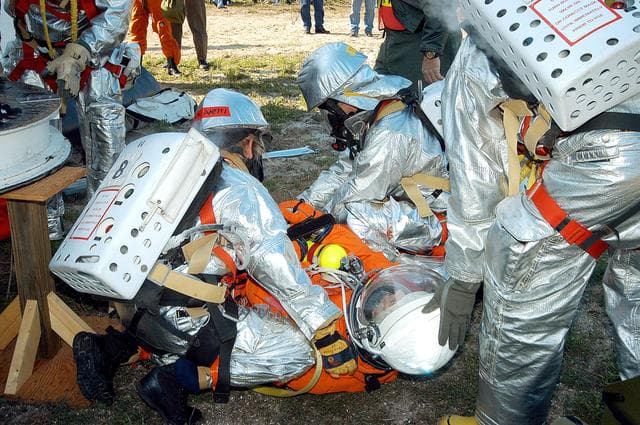
NASA image: KENNEDY SPACE CENTER, FLA. - Emergency crew members help an injured astronaut after removing him from the orbiter crew compartment mock-up during a “Mode VII” emergency landing simulation at Kennedy Space Center.  The purpose of the Mode VII is to exercise emergency preparedness personnel, equipment and facilities in rescuing astronauts from a downed orbiter and providing immediate medical attention.  This simulation presents an orbiter that has crashed short of the Shuttle Landing Facility in a wooded area 2-1/2 miles south of Runway 33.  Emergency crews are responding to the volunteer astronauts who are simulating various injuries.  Rescuers must remove the crew, provide triage and transport to hospitals those who need further treatment.  Local hospitals are participating in the exercise.
Image
Feb 18, 2004

KENNEDY SPACE CENTER, FLA. - Emergency crew members help an injured astronaut after removing him from the orbiter crew compartment mock-up during a “Mode VII” emergency landing simulation at Kennedy Space Center. The purpose of the Mode VII is to exercise emergency preparedness personnel, equipment and facilities in rescuing astronauts from a downed orbiter and providing immediate medical attention. This simulation presents an orbiter that has crashed short of the Shuttle Landing Facility in a wooded area 2-1/2 miles south of Runway 33. Emergency crews are responding to the volunteer astronauts who are simulating various injuries. Rescuers must remove the crew, provide triage and transport to hospitals those who need further treatment. Local hospitals are participating in the exercise.
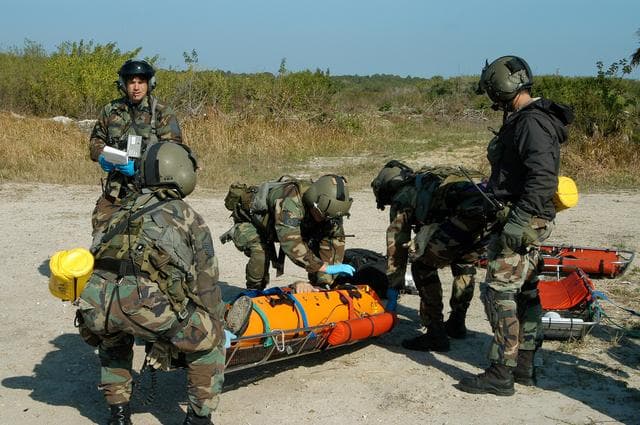
NASA image: KENNEDY SPACE CENTER, FLA. - A helicopter rescue team prepares another “injured” astronaut for transportation to a local hospital.  They are all taking part in a “Mode VII” emergency landing simulation at Kennedy Space Center.  The purpose of the Mode VII is to exercise emergency preparedness personnel, equipment and facilities in rescuing astronauts from a downed orbiter and providing immediate medical attention.  This simulation presents an orbiter that has crashed short of the Shuttle Landing Facility in a wooded area 2-1/2 miles south of Runway 33.  Emergency crews are responding to the volunteer “astronauts” who are simulating various injuries inside the crew compartment mock-up.  Rescuers must remove the crew, provide triage and transport to hospitals those who need further treatment.  Local hospitals are participating in the exercise.
Image
Feb 18, 2004

KENNEDY SPACE CENTER, FLA. - A helicopter rescue team prepares another “injured” astronaut for transportation to a local hospital. They are all taking part in a “Mode VII” emergency landing simulation at Kennedy Space Center. The purpose of the Mode VII is to exercise emergency preparedness personnel, equipment and facilities in rescuing astronauts from a downed orbiter and providing immediate medical attention. This simulation presents an orbiter that has crashed short of the Shuttle Landing Facility in a wooded area 2-1/2 miles south of Runway 33. Emergency crews are responding to the volunteer “astronauts” who are simulating various injuries inside the crew compartment mock-up. Rescuers must remove the crew, provide triage and transport to hospitals those who need further treatment. Local hospitals are participating in the exercise.
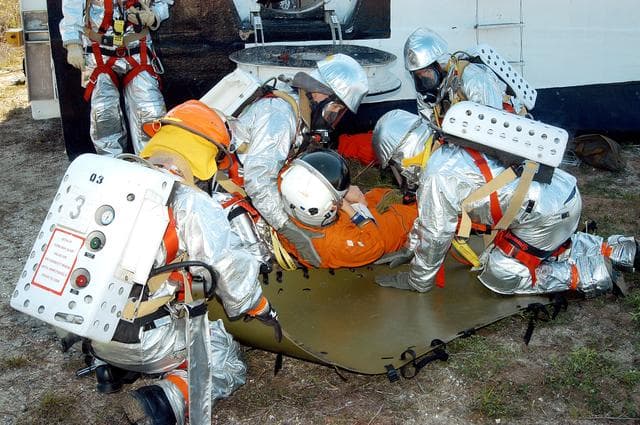
NASA image: KENNEDY SPACE CENTER, FLA. - Emergency crew members help an “injured” astronaut who was removed from the orbiter crew compartment mock-up during a “Mode VII” emergency landing simulation at Kennedy Space Center.  The purpose of the Mode VII is to exercise emergency preparedness personnel, equipment and facilities in rescuing astronauts from a downed orbiter and providing immediate medical attention.  This simulation presents an orbiter that has crashed short of the Shuttle Landing Facility in a wooded area 2-1/2 miles south of Runway 33.  Emergency crews are responding to the volunteer astronauts who are simulating various injuries.  Rescuers must remove the crew, provide triage and transport to hospitals those who need further treatment.  Local hospitals are participating in the exercise.
Image
Feb 18, 2004

KENNEDY SPACE CENTER, FLA. - Emergency crew members help an “injured” astronaut who was removed from the orbiter crew compartment mock-up during a “Mode VII” emergency landing simulation at Kennedy Space Center. The purpose of the Mode VII is to exercise emergency preparedness personnel, equipment and facilities in rescuing astronauts from a downed orbiter and providing immediate medical attention. This simulation presents an orbiter that has crashed short of the Shuttle Landing Facility in a wooded area 2-1/2 miles south of Runway 33. Emergency crews are responding to the volunteer astronauts who are simulating various injuries. Rescuers must remove the crew, provide triage and transport to hospitals those who need further treatment. Local hospitals are participating in the exercise.
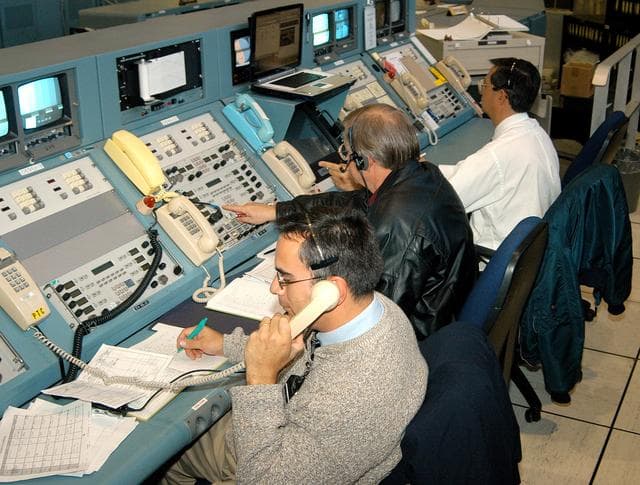
NASA image: KENNEDY SPACE CENTER, FLA. - In the Launch Control Center, officials monitor the “Mode VII” emergency landing simulation being conducted at Kennedy Space Center and managed and directed from the LCC.  From left are Dr. Luis Moreno and Dr. David Reed, with Bionetics Life Sciences, and Dr. Philip Scarpa, with the KSC Safety, Occupational Health and Environment Division.  The purpose of the Mode VII is to exercise emergency preparedness personnel, equipment and facilities in rescuing astronauts from a downed orbiter and providing immediate medical attention.  This simulation presents an orbiter that has crashed short of the Shuttle Landing Facility in a wooded area 2-1/2 miles south of Runway 33.  Emergency crews are responding to the volunteer “astronauts” who are simulating various injuries inside the crew compartment mock-up.  Rescuers must remove the crew, provide triage and transport to hospitals those who need further treatment.  Local hospitals are participating in the exercise.
Image
Feb 18, 2004

KENNEDY SPACE CENTER, FLA. - In the Launch Control Center, officials monitor the “Mode VII” emergency landing simulation being conducted at Kennedy Space Center and managed and directed from the LCC. From left are Dr. Luis Moreno and Dr. David Reed, with Bionetics Life Sciences, and Dr. Philip Scarpa, with the KSC Safety, Occupational Health and Environment Division. The purpose of the Mode VII is to exercise emergency preparedness personnel, equipment and facilities in rescuing astronauts from a downed orbiter and providing immediate medical attention. This simulation presents an orbiter that has crashed short of the Shuttle Landing Facility in a wooded area 2-1/2 miles south of Runway 33. Emergency crews are responding to the volunteer “astronauts” who are simulating various injuries inside the crew compartment mock-up. Rescuers must remove the crew, provide triage and transport to hospitals those who need further treatment. Local hospitals are participating in the exercise.
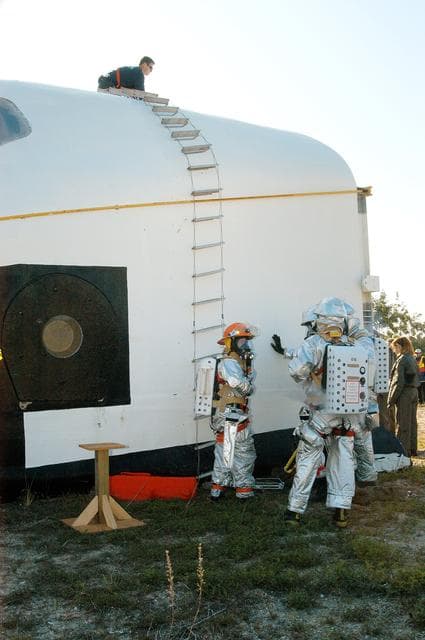
NASA image: KENNEDY SPACE CENTER, FLA. - Emergency crew members prepare to rescue another “astronaut” from inside the orbiter crew compartment mock-up that is the scene of a “Mode VII” emergency landing simulation at Kennedy Space Center.  The purpose of the Mode VII is to exercise emergency preparedness personnel, equipment and facilities in rescuing astronauts from a downed orbiter and providing immediate medical attention.  This simulation presents an orbiter that has crashed short of the Shuttle Landing Facility in a wooded area 2-1/2 miles south of Runway 33.  Emergency crews are responding to the volunteer astronauts who are simulating various injuries.  Rescuers must remove the crew, provide triage and transport to hospitals those who need further treatment.  Local hospitals are participating in the exercise.
Image
Feb 18, 2004

KENNEDY SPACE CENTER, FLA. - Emergency crew members prepare to rescue another “astronaut” from inside the orbiter crew compartment mock-up that is the scene of a “Mode VII” emergency landing simulation at Kennedy Space Center. The purpose of the Mode VII is to exercise emergency preparedness personnel, equipment and facilities in rescuing astronauts from a downed orbiter and providing immediate medical attention. This simulation presents an orbiter that has crashed short of the Shuttle Landing Facility in a wooded area 2-1/2 miles south of Runway 33. Emergency crews are responding to the volunteer astronauts who are simulating various injuries. Rescuers must remove the crew, provide triage and transport to hospitals those who need further treatment. Local hospitals are participating in the exercise.
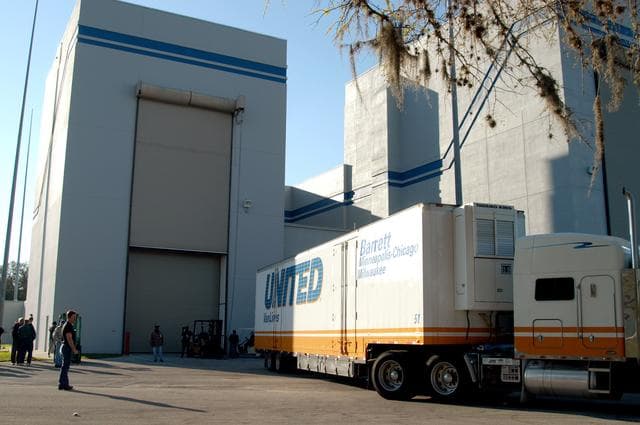
NASA image: KENNEDY SPACE CENTER, FLA. -  Shipped in an air-conditioned transportation van from NASA’s Goddard Space Flight Center in Greenbelt, Md., NASA’s MESSENGER spacecraft, the first Mercury orbiter, arrives at the Astrotech Space Operations processing facilities near KSC.    MESSENGER - short for MErcury Surface, Space ENvironment, GEochemistry and Ranging - will be offloaded and taken into a high bay clean room.  After the spacecraft is removed from its shipping container, employees of the Johns Hopkins University Applied Physics Laboratory, builders of the spacecraft, will perform an initial state-of-health check.  Then processing for launch can begin, including checkout of the power systems, communications systems and control systems.  The thermal blankets will also be attached for flight.  MESSENGER will be launched May 11 on a six-year mission aboard a Boeing Delta II rocket.  Liftoff is targeted for 2:26 a.m. EDT on Tuesday, May 11.
Image
Mar 10, 2004

KENNEDY SPACE CENTER, FLA. - Shipped in an air-conditioned transportation van from NASA’s Goddard Space Flight Center in Greenbelt, Md., NASA’s MESSENGER spacecraft, the first Mercury orbiter, arrives at the Astrotech Space Operations processing facilities near KSC. MESSENGER - short for MErcury Surface, Space ENvironment, GEochemistry and Ranging - will be offloaded and taken into a high bay clean room. After the spacecraft is removed from its shipping container, employees of the Johns Hopkins University Applied Physics Laboratory, builders of the spacecraft, will perform an initial state-of-health check. Then processing for launch can begin, including checkout of the power systems, communications systems and control systems. The thermal blankets will also be attached for flight. MESSENGER will be launched May 11 on a six-year mission aboard a Boeing Delta II rocket. Liftoff is targeted for 2:26 a.m. EDT on Tuesday, May 11.
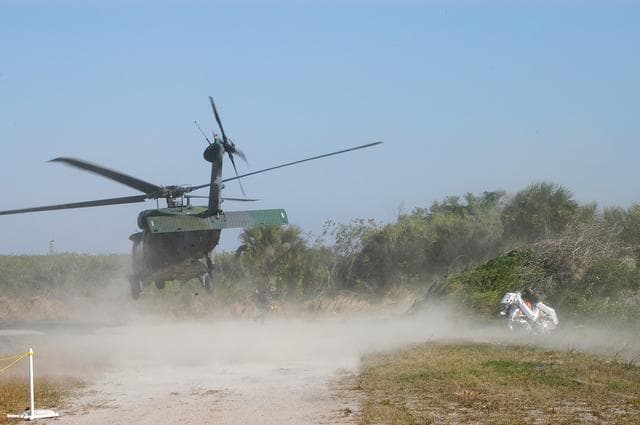
NASA image: KENNEDY SPACE CENTER, FLA. - A helicopter is landing near rescue team members taking part in a “Mode VII” emergency landing simulation at Kennedy Space Center.  The purpose of Mode VII is to exercise emergency preparedness personnel, equipment and facilities in rescuing astronauts from a downed orbiter and providing immediate medical attention.  This simulation presents an orbiter that has crashed short of the Shuttle Landing Facility in a wooded area 2-1/2 miles south of Runway 33.  Emergency crews are responding to the volunteer “astronauts” simulating various injuries inside an orbiter crew compartment mock-up.  Rescuers must remove the crew, provide triage and transport to hospitals those who need further treatment.  Local hospitals are participating in the exercise.
Image
Feb 18, 2004

KENNEDY SPACE CENTER, FLA. - A helicopter is landing near rescue team members taking part in a “Mode VII” emergency landing simulation at Kennedy Space Center. The purpose of Mode VII is to exercise emergency preparedness personnel, equipment and facilities in rescuing astronauts from a downed orbiter and providing immediate medical attention. This simulation presents an orbiter that has crashed short of the Shuttle Landing Facility in a wooded area 2-1/2 miles south of Runway 33. Emergency crews are responding to the volunteer “astronauts” simulating various injuries inside an orbiter crew compartment mock-up. Rescuers must remove the crew, provide triage and transport to hospitals those who need further treatment. Local hospitals are participating in the exercise.
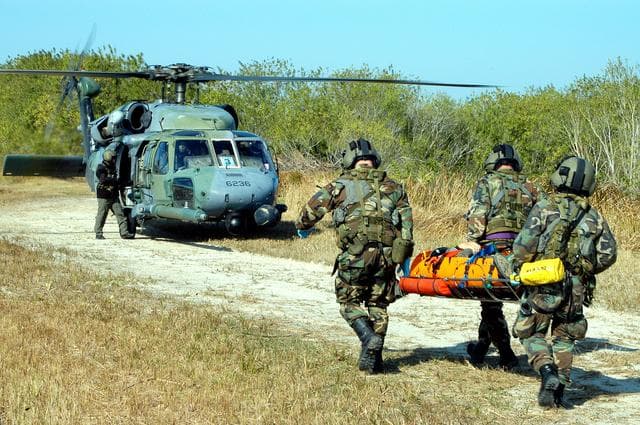
NASA image: KENNEDY SPACE CENTER, FLA. - A helicopter rescue team carries another “injured” astronaut to a helicopter for transportation to a local hospital.  They are all taking part in a “Mode VII” emergency landing simulation at Kennedy Space Center.  The purpose of the Mode VII is to exercise emergency preparedness personnel, equipment and facilities in rescuing astronauts from a downed orbiter and providing immediate medical attention.  This simulation presents an orbiter that has crashed short of the Shuttle Landing Facility in a wooded area 2-1/2 miles south of Runway 33.  Emergency crews are responding to the volunteer “astronauts” who are simulating various injuries inside the crew compartment mock-up.  Rescuers must remove the crew, provide triage and transport to hospitals those who need further treatment.  Local hospitals are participating in the exercise.
Image
Feb 18, 2004

KENNEDY SPACE CENTER, FLA. - A helicopter rescue team carries another “injured” astronaut to a helicopter for transportation to a local hospital. They are all taking part in a “Mode VII” emergency landing simulation at Kennedy Space Center. The purpose of the Mode VII is to exercise emergency preparedness personnel, equipment and facilities in rescuing astronauts from a downed orbiter and providing immediate medical attention. This simulation presents an orbiter that has crashed short of the Shuttle Landing Facility in a wooded area 2-1/2 miles south of Runway 33. Emergency crews are responding to the volunteer “astronauts” who are simulating various injuries inside the crew compartment mock-up. Rescuers must remove the crew, provide triage and transport to hospitals those who need further treatment. Local hospitals are participating in the exercise.
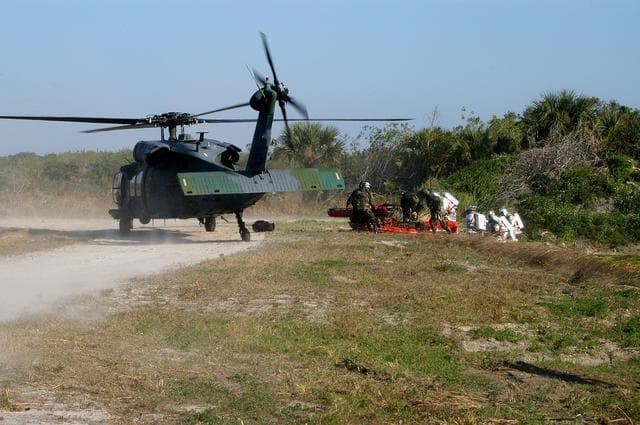
NASA image: KENNEDY SPACE CENTER, FLA. - In a “Mode VII” emergency landing simulation at Kennedy Space Center, a helicopter crew helps “rescued” astronauts.  The purpose of Mode VII is to exercise emergency preparedness personnel, equipment and facilities in rescuing astronauts from a downed orbiter and providing immediate medical attention.  This simulation presents an orbiter that has crashed short of the Shuttle Landing Facility in a wooded area 2-1/2 miles south of Runway 33.  Emergency crews are responding to the volunteer “astronauts” simulating various injuries inside an orbiter crew compartment mock-up.  Rescuers must remove the crew, provide triage and transport to hospitals those who need further treatment.  Local hospitals are participating in the exercise.
Image
Feb 18, 2004

KENNEDY SPACE CENTER, FLA. - In a “Mode VII” emergency landing simulation at Kennedy Space Center, a helicopter crew helps “rescued” astronauts. The purpose of Mode VII is to exercise emergency preparedness personnel, equipment and facilities in rescuing astronauts from a downed orbiter and providing immediate medical attention. This simulation presents an orbiter that has crashed short of the Shuttle Landing Facility in a wooded area 2-1/2 miles south of Runway 33. Emergency crews are responding to the volunteer “astronauts” simulating various injuries inside an orbiter crew compartment mock-up. Rescuers must remove the crew, provide triage and transport to hospitals those who need further treatment. Local hospitals are participating in the exercise.
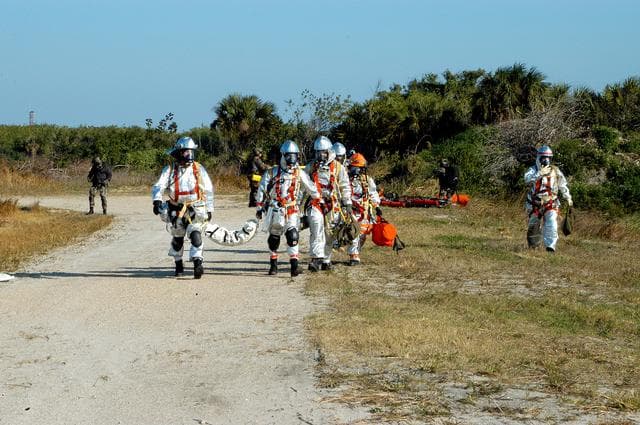
NASA image: KENNEDY SPACE CENTER, FLA. - Emergency crews leave the scene after a helicopter removed “rescued” astronauts from the scene.  They are taking part in a “Mode VII” emergency landing simulation at Kennedy Space Center, in order to exercise emergency preparedness personnel, equipment and facilities in rescuing astronauts from a downed orbiter and providing immediate medical attention.  This simulation presents an orbiter that has crashed short of the Shuttle Landing Facility in a wooded area 2-1/2 miles south of Runway 33.  Emergency crews are responding to the volunteer “astronauts” simulating various injuries inside an orbiter crew compartment mock-up.  Rescuers must remove the crew, provide triage and transport to hospitals those who need further treatment.  Local hospitals are participating in the exercise.
Image
Feb 18, 2004

KENNEDY SPACE CENTER, FLA. - Emergency crews leave the scene after a helicopter removed “rescued” astronauts from the scene. They are taking part in a “Mode VII” emergency landing simulation at Kennedy Space Center, in order to exercise emergency preparedness personnel, equipment and facilities in rescuing astronauts from a downed orbiter and providing immediate medical attention. This simulation presents an orbiter that has crashed short of the Shuttle Landing Facility in a wooded area 2-1/2 miles south of Runway 33. Emergency crews are responding to the volunteer “astronauts” simulating various injuries inside an orbiter crew compartment mock-up. Rescuers must remove the crew, provide triage and transport to hospitals those who need further treatment. Local hospitals are participating in the exercise.
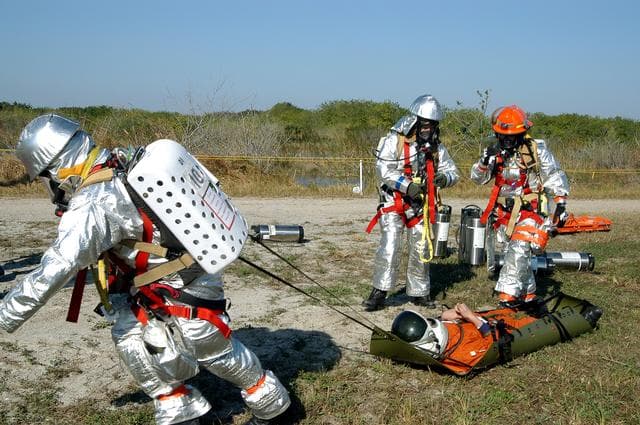
NASA image: KENNEDY SPACE CENTER, FLA. - Emergency crew members transport an “injured”  astronaut during a “Mode VII” emergency landing simulation at Kennedy Space Center.  The purpose of the Mode VII is to exercise emergency preparedness personnel, equipment and facilities in rescuing astronauts from a downed orbiter and providing immediate medical attention.  This simulation presents an orbiter that has crashed short of the Shuttle Landing Facility in a wooded area 2-1/2 miles south of Runway 33.  Emergency crews are responding to the volunteer astronauts who are simulating various injuries inside the crew compartment mock-up.  Rescuers must remove the crew, provide triage and transport to hospitals those who need further treatment.  Local hospitals are participating in the exercise.
Image
Feb 18, 2004

KENNEDY SPACE CENTER, FLA. - Emergency crew members transport an “injured” astronaut during a “Mode VII” emergency landing simulation at Kennedy Space Center. The purpose of the Mode VII is to exercise emergency preparedness personnel, equipment and facilities in rescuing astronauts from a downed orbiter and providing immediate medical attention. This simulation presents an orbiter that has crashed short of the Shuttle Landing Facility in a wooded area 2-1/2 miles south of Runway 33. Emergency crews are responding to the volunteer astronauts who are simulating various injuries inside the crew compartment mock-up. Rescuers must remove the crew, provide triage and transport to hospitals those who need further treatment. Local hospitals are participating in the exercise.
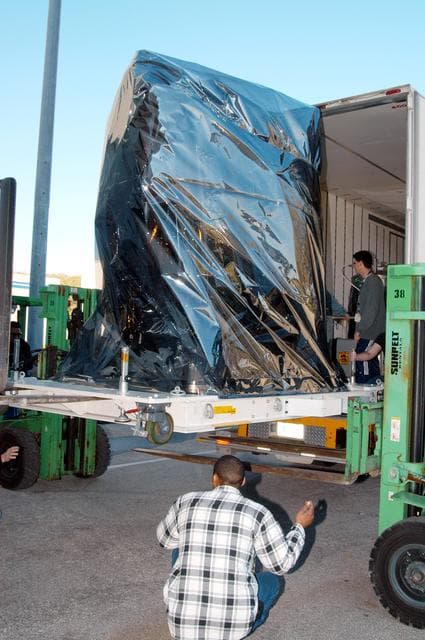
NASA image: KENNEDY SPACE CENTER, FLA. -  At the Astrotech Space Operations processing facilities near KSC, a lift helps offload NASA’s MESSENGER spacecraft shipped from NASA’s Goddard Space Flight Center in Greenbelt, Md.  MESSENGER - short for MErcury Surface, Space ENvironment, GEochemistry and Ranging - will be taken into a high bay clean room and employees of the Johns Hopkins University Applied Physics Laboratory, builders of the spacecraft, will perform an initial state-of-health check.  Then processing for launch can begin, including checkout of the power systems, communications systems and control systems.  The thermal blankets will also be attached for flight.  MESSENGER will be launched May 11 on a six-year mission aboard a Boeing Delta II rocket.  Liftoff is targeted for 2:26 a.m. EDT on Tuesday, May 11.
Image
Mar 10, 2004

KENNEDY SPACE CENTER, FLA. - At the Astrotech Space Operations processing facilities near KSC, a lift helps offload NASA’s MESSENGER spacecraft shipped from NASA’s Goddard Space Flight Center in Greenbelt, Md. MESSENGER - short for MErcury Surface, Space ENvironment, GEochemistry and Ranging - will be taken into a high bay clean room and employees of the Johns Hopkins University Applied Physics Laboratory, builders of the spacecraft, will perform an initial state-of-health check. Then processing for launch can begin, including checkout of the power systems, communications systems and control systems. The thermal blankets will also be attached for flight. MESSENGER will be launched May 11 on a six-year mission aboard a Boeing Delta II rocket. Liftoff is targeted for 2:26 a.m. EDT on Tuesday, May 11.
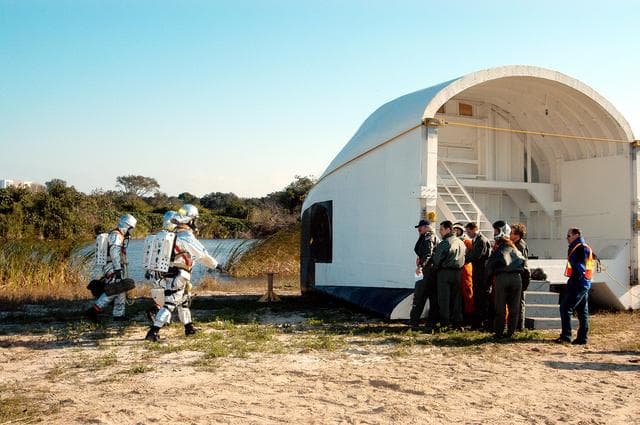
NASA image: KENNEDY SPACE CENTER, FLA. - Emergency crew members return to the orbiter crew compartment mock-up that is the scene of a “Mode VII” emergency landing simulation at Kennedy Space Center.  The purpose of the Mode VII is to exercise emergency preparedness personnel, equipment and facilities in rescuing astronauts from a downed orbiter and providing immediate medical attention.  This simulation presents an orbiter that has crashed short of the Shuttle Landing Facility in a wooded area 2-1/2 miles south of Runway 33.  Emergency crews are responding to the volunteer “astronauts” simulating various injuries inside the mock-up compartment.  Rescuers have had to remove the crew, provide triage and transport to hospitals those who need further treatment.  Local hospitals are participating in the exercise.
Image
Feb 18, 2004

KENNEDY SPACE CENTER, FLA. - Emergency crew members return to the orbiter crew compartment mock-up that is the scene of a “Mode VII” emergency landing simulation at Kennedy Space Center. The purpose of the Mode VII is to exercise emergency preparedness personnel, equipment and facilities in rescuing astronauts from a downed orbiter and providing immediate medical attention. This simulation presents an orbiter that has crashed short of the Shuttle Landing Facility in a wooded area 2-1/2 miles south of Runway 33. Emergency crews are responding to the volunteer “astronauts” simulating various injuries inside the mock-up compartment. Rescuers have had to remove the crew, provide triage and transport to hospitals those who need further treatment. Local hospitals are participating in the exercise.
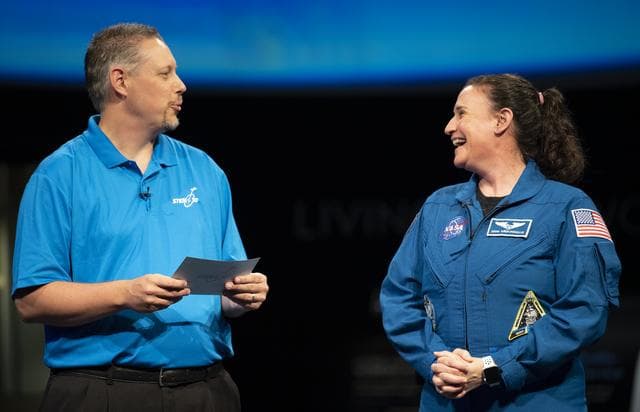
NASA image: Astronaut Auñón-Chancellor at NASM
Image
Jun 14, 2019

Astronaut Auñón-Chancellor at NASM

Marty Kelsey of the Smithsonian National Air and Space Museum asks NASA astronaut Serena Auñón-Chancellor questions...

HQ
NASA image: CCP Astronauts Bob Behnken and Doug Hurley - SpaceX Training
Image
Aug 30, 2018

CCP Astronauts Bob Behnken and Doug Hurley - SpaceX Training

NASA astronauts Doug Hurley and Bob Behnken familiarize themselves with SpaceX’s Crew Dragon, the spacecraft that...

KSC

NASA image: Mars InSight Social Media Briefing
Image
Nov 25, 2018

Mars InSight Social Media Briefing

Philippe Laudet, SEIS Project Manager, French National Space Agency (CNES) talks about Mars InSight during a social...

HQ
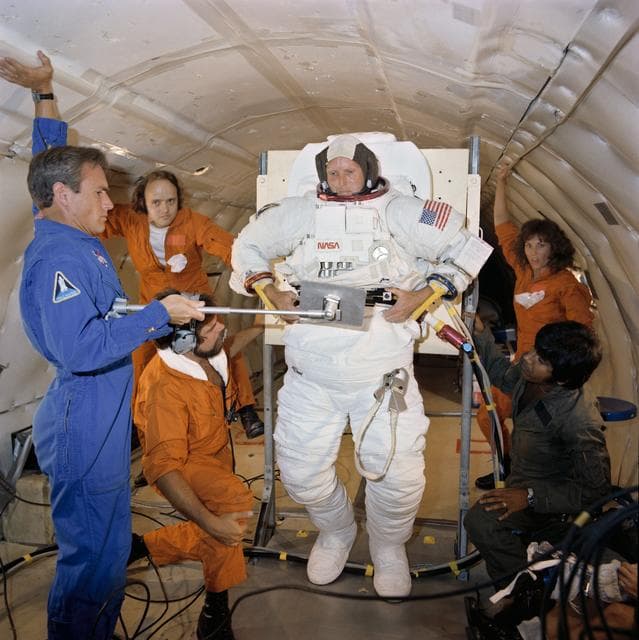
NASA image: Astronaut C. Gordon Fullerton in suit donning/doffing exercise
Image
Jul 22, 1981

Astronaut C. Gordon Fullerton in suit donning/doffing exercise

S81-34432 (July 1981) --- Astronaut C. Gordon Fullerton, STS-3 pilot, takes part in a suit donning and doffing...

JSC
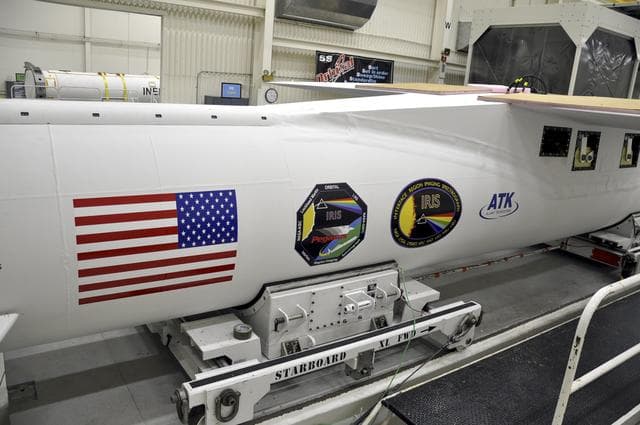
NASA image: KSC-2013-2486
Image
May 29, 2013

KSC-2013-2486

VANDENBERG AFB, Calif. - An Orbital Sciences Pegasus XL rocket undergoes launch preparations inside a hangar at...

KSC
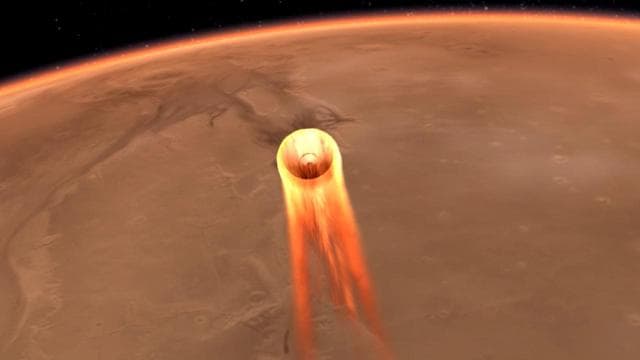
NASA image: InSight's Entry, Descent and Landing
Image
Oct 25, 2018

InSight's Entry, Descent and Landing

An artist's impression of InSight's Entry, Descent and Landing (EDL). InSight is short for Interior Exploration...

JPL
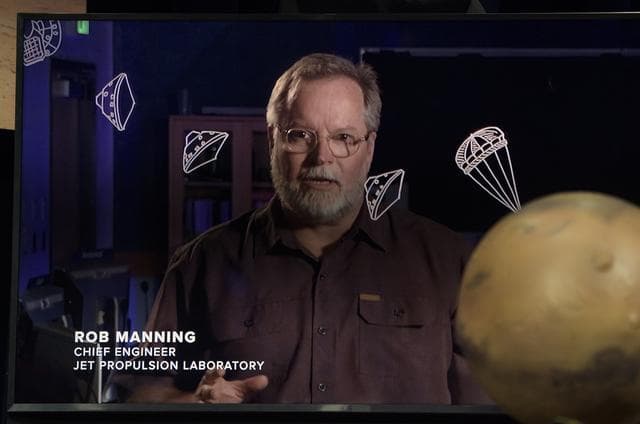
NASA image: Mars InSight Social Media Briefing
Image
Nov 25, 2018

Mars InSight Social Media Briefing

Jet Propulsion Laboratory Chief Engineer Rob Manning is seen in a video shown during a Mars InSight social media...

HQ
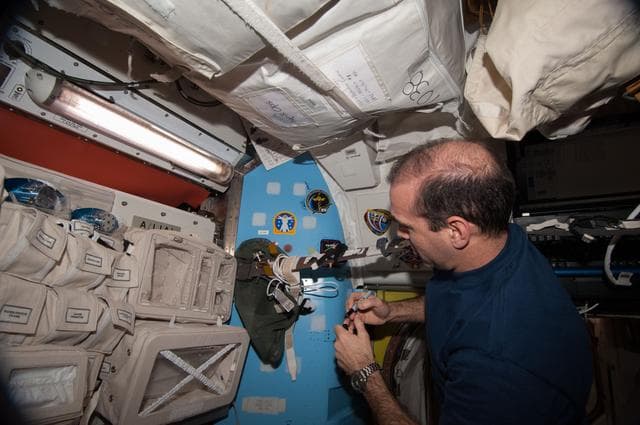
NASA image: Mastracchio signs Mission Patch in A/L
Image
May 13, 2014

Mastracchio signs Mission Patch in A/L

ISS039-E-020704 (13 May 2014) --- NASA astronaut Rick Mastracchio, Expedition 39 flight engineer, signs a wall in...

JSC
PreviousPage 26 of 65Next

Frequently Asked Questions About NASA Images

Are NASA images free to use?+
Yes, most NASA images are in the public domain and are free to use for educational, informational, and personal purposes. NASA's media usage guidelines state that NASA material is not copyrighted unless otherwise noted. However, the NASA logo and certain insignia are protected. Some images may include identifiable individuals or third-party content that requires additional permissions. Always check the specific image's usage rights and credit NASA as the source.
How many images does NASA have?+
NASA's Image and Video Library contains over 140,000 publicly accessible images, videos, and audio files spanning the agency's entire history, from the Mercury program of the 1960s to the latest James Webb Space Telescope discoveries. The collection grows daily as new missions capture imagery and archival materials are digitized. Individual mission archives, such as Mars rover photos, contain hundreds of thousands of additional images.
Can I download NASA images?+
Yes, you can download NASA images in multiple resolutions directly from this gallery. Each image detail page provides download links for original (full resolution), large (1920px), medium (960px), small (480px), and thumbnail sizes. NASA encourages the public to use these images for education, media, and personal projects. High-resolution originals are ideal for printing and professional use.

Explore More NASA Content

Astronomy Picture of the Day

Daily curated space image

Mars Rover Photos

Curiosity & Perseverance images

Earth from Space

DSCOVR EPIC daily images

Launch Schedule

Upcoming rocket launches

Space News

Mission updates & discoveries

KENNEDY SPACE CENTER, FLA. - At the Astrotech Space Operations processing facilities near KSC, workers begin moving...

KSC

KENNEDY SPACE CENTER, FLA. - Emergency crew members “rescue” an astronaut from inside the orbiter crew compartment...

KSC

KENNEDY SPACE CENTER, FLA. - Emergency crew members help an injured astronaut after removing him from the orbiter...

KSC

KENNEDY SPACE CENTER, FLA. - A helicopter rescue team prepares another “injured” astronaut for transportation to a...

KSC

KENNEDY SPACE CENTER, FLA. - Emergency crew members help an “injured” astronaut who was removed from the orbiter...

KSC

KENNEDY SPACE CENTER, FLA. - In the Launch Control Center, officials monitor the “Mode VII” emergency landing...

KSC

KENNEDY SPACE CENTER, FLA. - Emergency crew members prepare to rescue another “astronaut” from inside the orbiter...

KSC

KENNEDY SPACE CENTER, FLA. - Shipped in an air-conditioned transportation van from NASA’s Goddard Space Flight...

KSC

KENNEDY SPACE CENTER, FLA. - A helicopter is landing near rescue team members taking part in a “Mode VII” emergency...

KSC

KENNEDY SPACE CENTER, FLA. - A helicopter rescue team carries another “injured” astronaut to a helicopter for...

KSC

KENNEDY SPACE CENTER, FLA. - In a “Mode VII” emergency landing simulation at Kennedy Space Center, a helicopter crew...

KSC

KENNEDY SPACE CENTER, FLA. - Emergency crews leave the scene after a helicopter removed “rescued” astronauts from...

KSC

KENNEDY SPACE CENTER, FLA. - Emergency crew members transport an “injured” astronaut during a “Mode VII” emergency...

KSC

KENNEDY SPACE CENTER, FLA. - At the Astrotech Space Operations processing facilities near KSC, a lift helps offload...

KSC

KENNEDY SPACE CENTER, FLA. - Emergency crew members return to the orbiter crew compartment mock-up that is the scene...

KSC