CosmosObservatory
Explore
Solar System
Live
Learn
Tools
About
Cosmos Observatory
ToolsAbout
Cosmos Observatory

Explore the universe through NASA data, real-time ISS tracking, Mars rover imagery, asteroid monitoring, and comprehensive space encyclopedia. Your gateway to the cosmos.

Explore

  • APOD
  • Mars Rovers
  • Earth Imagery
  • NASA Gallery
  • ISS Tracker

Data

  • Asteroids
  • Solar System
  • Exoplanets
  • Space Weather
  • Launches

Tools

  • Glossary
  • News
  • Calculators

Legal

  • About
  • Privacy Policy
  • Terms of Use
  • Space Tools
  • Contact

Stay updated with the cosmos

Get weekly digests of APOD highlights, upcoming launches, and space events.

© 2026 Cosmos Observatory. All rights reserved. Built with for space enthusiasts.

This website is not affiliated with, maintained, authorized, endorsed by, or in any way officially connected with NASA or any of its subsidiaries or affiliates. All NASA imagery is in the public domain unless otherwise noted. Data sourced from NASA Open APIs, Launch Library 2, and other open data services.

NASA Gallery

Explore NASA's vast collection of space images, videos, and audio from missions past and present.

  1. Home
  2. /
  3. NASA Gallery

NASA's Image and Video Library: A Visual Archive of Space Exploration

NASA's Image and Video Library is one of the most comprehensive public archives of space imagery in the world, containing over 140,000 images, videos, and audio recordings spanning more than six decades of space exploration. From the earliest Mercury and Gemini missions through the Apollo Moon landings, the Space Shuttle era, and today's cutting-edge observations from the James Webb Space Telescope, this collection documents humanity's journey into the cosmos.

The library includes imagery from diverse sources: telescopes like Hubble and Webb that capture deep-space nebulae, galaxies, and exoplanets; planetary missions like the Mars rovers ( browse Mars photos) and Cassini at Saturn; Earth observation satellites ( see EPIC imagery); astronaut photography from the ISS; and documentation of rocket launches, spacecraft assembly, and ground testing. Most NASA images are in the public domain and free to download at full resolution for educational, editorial, and personal use.

Use the search bar above to find specific subjects — try queries like "Apollo 11," "Hubble Deep Field," "Mars surface," or "astronaut EVA." You can also filter by media type (image, video, or audio). For a daily curated experience, visit the Astronomy Picture of the Day.

Showing results for "cooling"

2,028 results found - Page 2 of 85

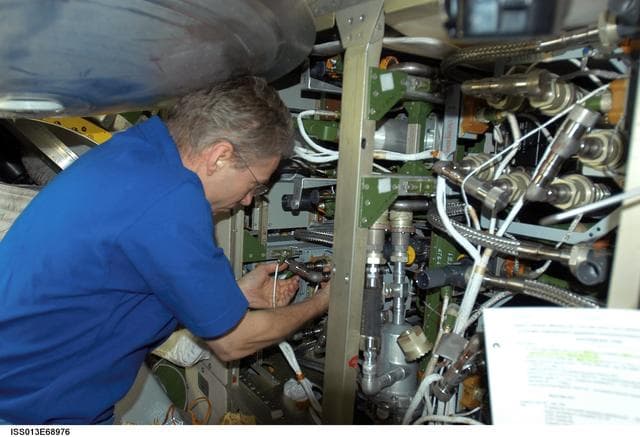
NASA image: Reiter works on the Internal Thermal Cooling Loop Pump in the SM during Expedition 13
Image
Aug 1, 2006

Reiter works on the Internal Thermal Cooling Loop Pump in the SM during Expedition 13

ISS013-E-68976 (August 2006) --- European Space Agency (ESA) astronaut Thomas Reiter, Expedition 13 flight engineer,...

JSC
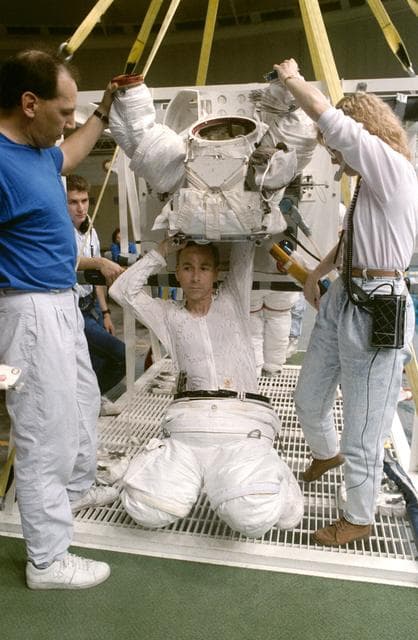
NASA image: STS-38 Mission Specialist (MS) Carl J. Meade dons EMU in JSC's WETF Bldg 29
Image
Feb 14, 1990

STS-38 Mission Specialist (MS) Carl J. Meade dons EMU in JSC's WETF Bldg 29

STS-38 Mission Specialist (MS) Carl J. Meade, wearing liquid cooling and ventilation garment (LCVG) and...

JSC
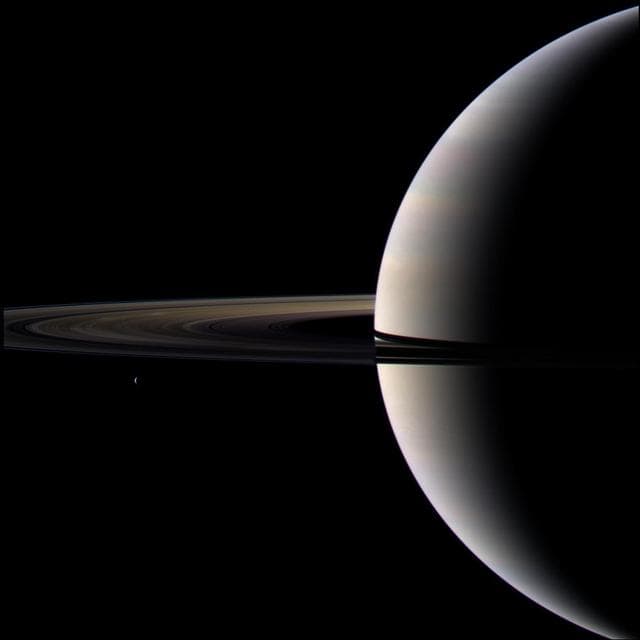
NASA image: World of Clouds and Ice
Image
Oct 22, 2009

World of Clouds and Ice

Looking cool and serene, Saturn shares its soft glow with NASA Cassini Orbiter.

JPL
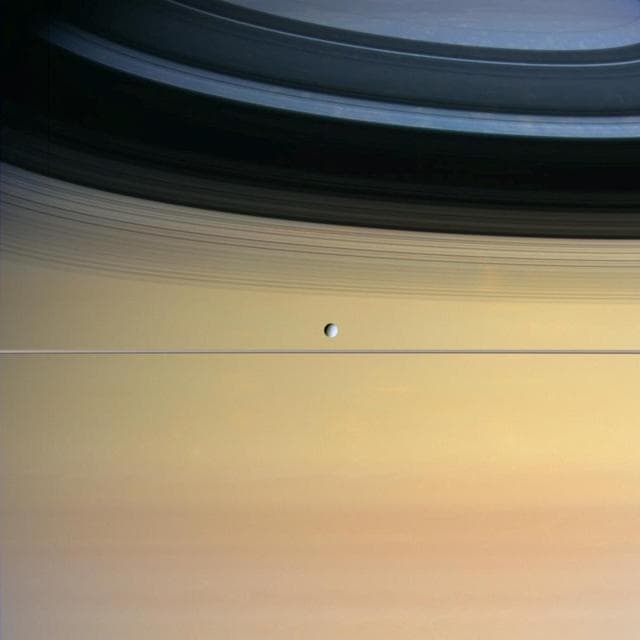
NASA image: Dazzling Color
Image
Dec 22, 2005

Dazzling Color

Cool and icy Dione floats in front of giant Saturn bedecked in a dazzling array of colors

JPL
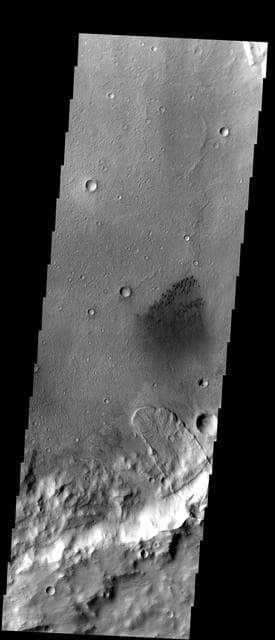
NASA image: Cool Crater
Image
Jan 18, 2007

Cool Crater

This unnamed crater east of Herschel Crater contains both a large landslide and a field of small dark sand dunes

JPL
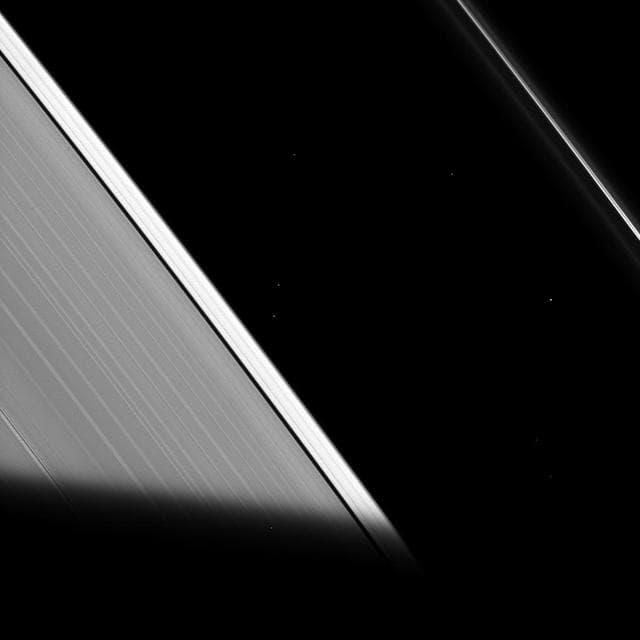
NASA image: Cool Shadow
Image
Oct 17, 2013

Cool Shadow

The shadow of Saturn cuts across the rings as seen by NASA Cassini spacecraft. As the ring particles enter Saturn...

JPL
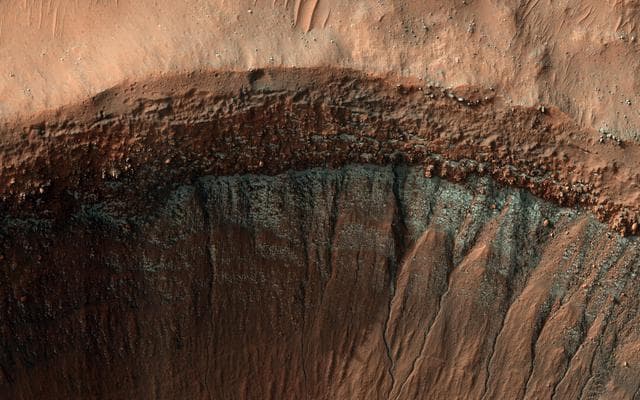
NASA image: Cool as Ice
Image
Mar 18, 2022

Cool as Ice

Every winter, a layer of carbon dioxide frost (dry ice) forms on the surface of Mars. At its greatest extent in...

JPL
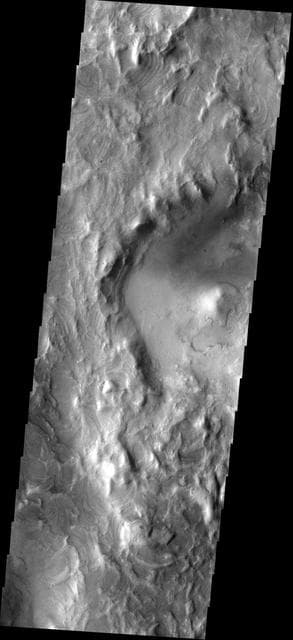
NASA image: Cool Texture
Image
May 10, 2006

Cool Texture

The erosion of the western rim of Hellas Basin has exposed a surface composed of layered material

JPL
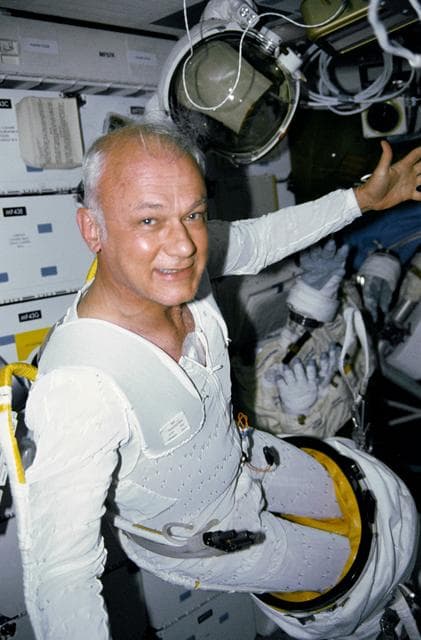
NASA image: STS-31 MS McCandless in LCVG removes EMU lower torso on OV-103's middeck
Image
Apr 29, 1990

STS-31 MS McCandless in LCVG removes EMU lower torso on OV-103's middeck

STS-31 Mission Specialist (MS) Bruce McCandless II, wearing liquid cooling and ventilation garment (LCVG), works his...

JSC
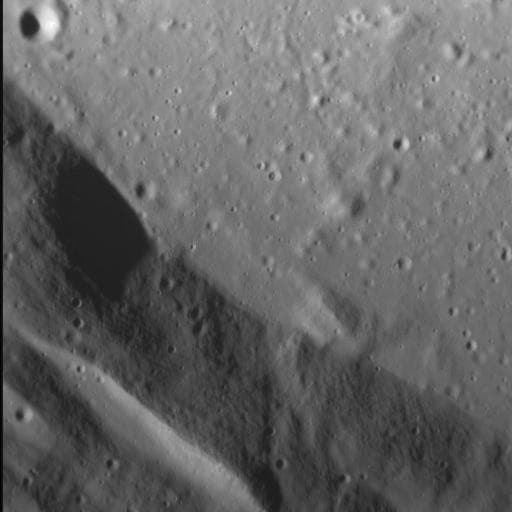
NASA image: Melting Point
Image
Mar 6, 2015

Melting Point

Impact crater floors are commonly flat and relatively smooth, the result of the cooling and solidification of impact...

JPL
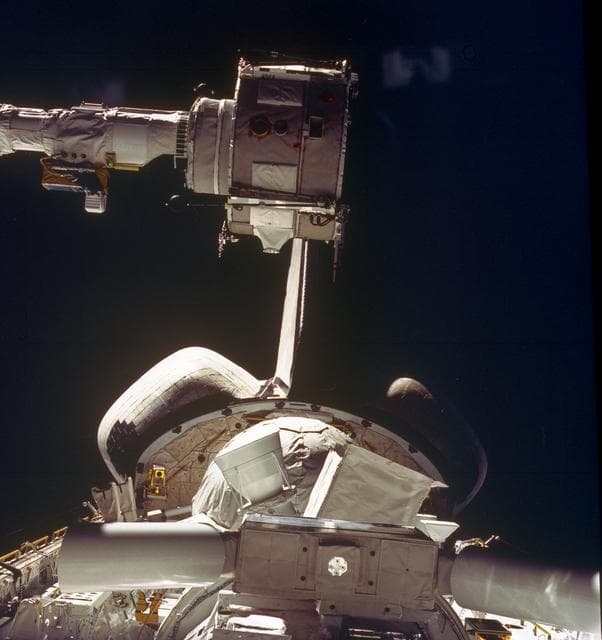
NASA image: Spacelab
Image
Jul 1, 1985

Spacelab

This STS-51F mission onboard Photograph shows some of the Spacelab-2 instruments in the cargo bay of the Orbiter...

MSFC
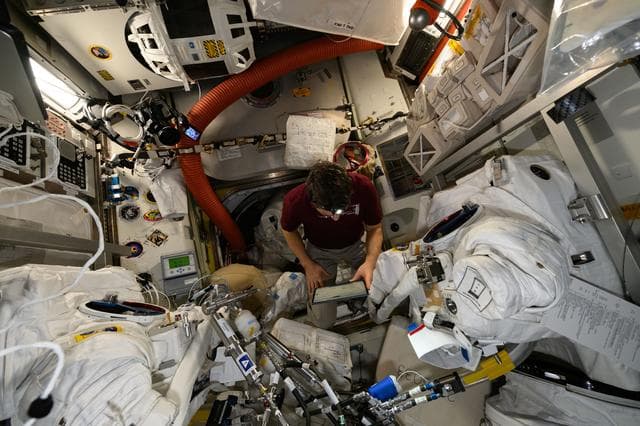
NASA image: EMU Cooling Loop Maintenance
Image
Apr 15, 2024

EMU Cooling Loop Maintenance

iss071e007603 (April 15, 2024) --- Expedition 71 Flight Engineer and NASA astronaut Mike Barratt reviews procedures...

JSC
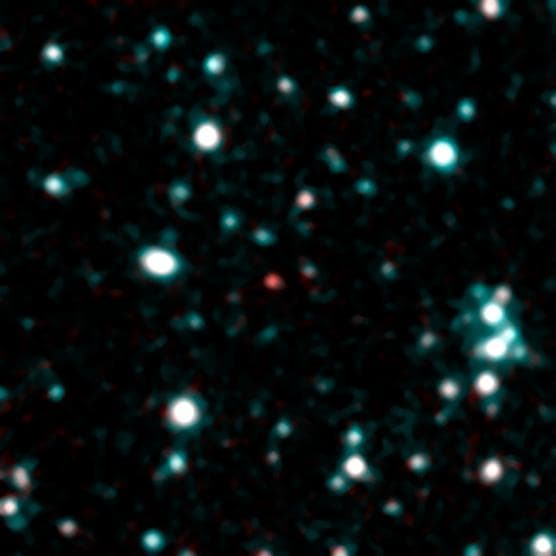
NASA image: Cool as a Stellar Cucumber
Image
Jun 24, 2010

Cool as a Stellar Cucumber

This image from NASA Spitzer Space Telescope using infrared light shows what astronomers think is one of the coldest...

JPL
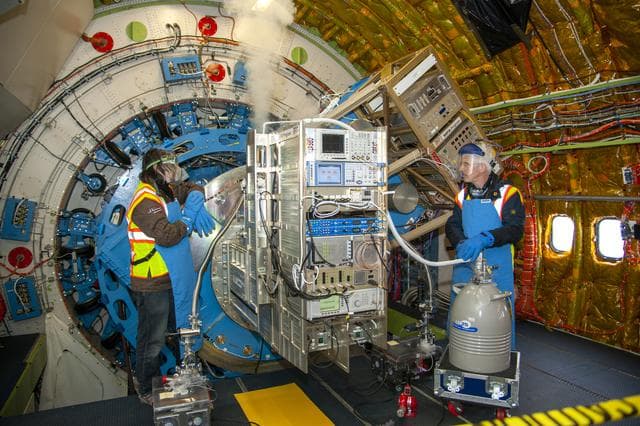
NASA image: Cooling Off SOFIA’S Telescope
Image
Jul 15, 2013

Cooling Off SOFIA’S Telescope

Technicians introduce liquid nitrogen to an instrument linked to SOFIA’s telescope. Detection of infrared...

AFRC
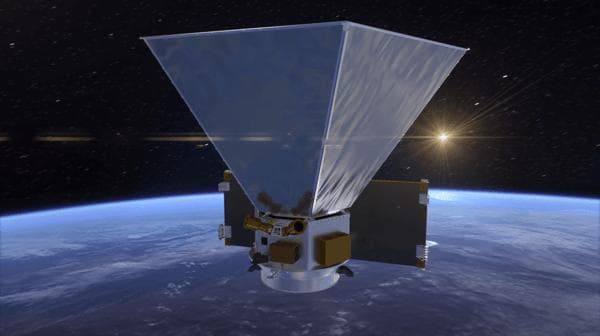
NASA image: SPHEREx Preliminary Design (Illustration)
Image
Jan 5, 2021

SPHEREx Preliminary Design (Illustration)

NASA's SPHEREx mission will study the universe's early expansion, the history of galaxies, and the composition of...

JPL
NASA image: Evaporation and Transpiration
Video
Mar 8, 2012

Evaporation and Transpiration

Much of the water that soaks into the soil from irrigation or rain ultimately returns the the atmosphere as water...

GSFC
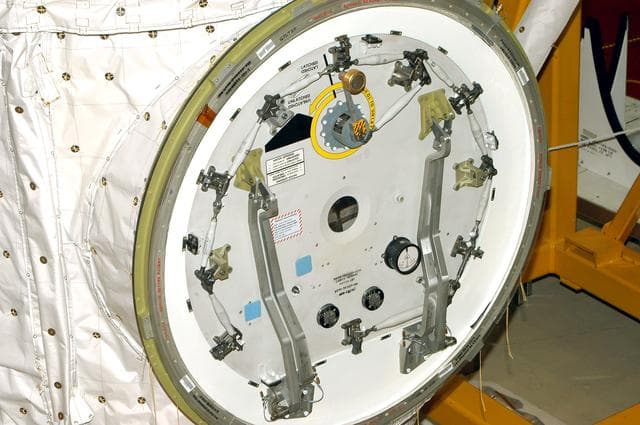
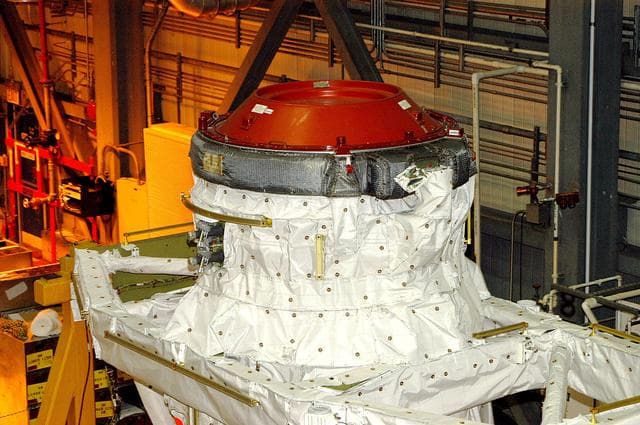
NASA image: KENNEDY SPACE CENTER, FLA. -  Seen in the photo is one end of the airlock that is installed in the payload bay of orbiter Discovery.  The airlock is normally located inside the middeck of the spacecraft’s pressurized crew cabin. The airlock is sized to accommodate two fully suited flight crew members simultaneously. Support functions include airlock depressurization and repressurization, extravehicular activity equipment recharge, liquid-cooled garment water cooling, EVA equipment checkout, donning and communications. The outer hatch isolates the airlock from the unpressurized payload bay when closed and permits the EVA crew members to exit from the airlock to the payload bay when open.
Image
Jan 22, 2004

KENNEDY SPACE CENTER, FLA. - Seen in the photo is one end of the airlock that is installed in the payload bay of orbiter Discovery. The airlock is normally located inside the middeck of the spacecraft’s pressurized crew cabin. The airlock is sized to accommodate two fully suited flight crew members simultaneously. Support functions include airlock depressurization and repressurization, extravehicular activity equipment recharge, liquid-cooled garment water cooling, EVA equipment checkout, donning and communications. The outer hatch isolates the airlock from the unpressurized payload bay when closed and permits the EVA crew members to exit from the airlock to the payload bay when open.

KENNEDY SPACE CENTER, FLA. - Seen in the photo is one end of the airlock that is installed in the payload bay of...
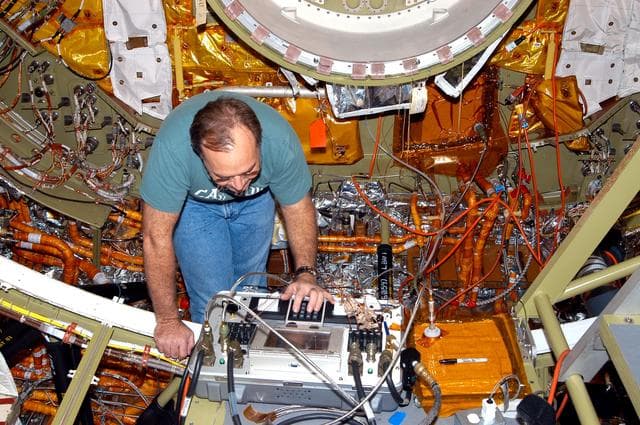
NASA image: KENNEDY SPACE CENTER, FLA. -  In the Orbiter Processing Facility, a worker checks out part of the equipment in the airlock, at one end of Discovery’s payload bay.  The airlock is sized to accommodate two fully suited flight crew members simultaneously. Support functions include airlock depressurization and repressurization, extravehicular activity equipment recharge, liquid-cooled garment water cooling, EVA equipment checkout, donning and communications. The outer hatch isolates the airlock from the unpressurized payload bay when closed and permits the EVA crew members to exit from the airlock to the payload bay when open.
Image
Jan 22, 2004

KENNEDY SPACE CENTER, FLA. - In the Orbiter Processing Facility, a worker checks out part of the equipment in the airlock, at one end of Discovery’s payload bay. The airlock is sized to accommodate two fully suited flight crew members simultaneously. Support functions include airlock depressurization and repressurization, extravehicular activity equipment recharge, liquid-cooled garment water cooling, EVA equipment checkout, donning and communications. The outer hatch isolates the airlock from the unpressurized payload bay when closed and permits the EVA crew members to exit from the airlock to the payload bay when open.

KENNEDY SPACE CENTER, FLA. - In the Orbiter Processing Facility, a worker checks out part of the equipment in the...
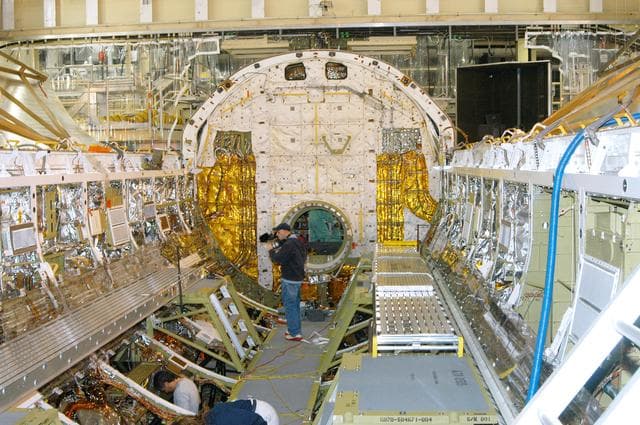
NASA image: KENNEDY SPACE CENTER, FLA. -  In the Orbiter Processing Facility, a cameraman films part of Discovery’s payload bay for a special feature on the KSC Web.  In the background is the open hatch of the airlock, located inside the middeck of the spacecraft’s pressurized crew cabin. The airlock is sized to accommodate two fully suited flight crew members simultaneously. Support functions include airlock depressurization and repressurization, extravehicular activity equipment recharge, liquid-cooled garment water cooling, EVA equipment checkout, donning and communications. The outer hatch isolates the airlock from the unpressurized payload bay when closed and permits the EVA crew members to exit from the airlock to the payload bay when open.
Image
Jan 22, 2004

KENNEDY SPACE CENTER, FLA. - In the Orbiter Processing Facility, a cameraman films part of Discovery’s payload bay for a special feature on the KSC Web. In the background is the open hatch of the airlock, located inside the middeck of the spacecraft’s pressurized crew cabin. The airlock is sized to accommodate two fully suited flight crew members simultaneously. Support functions include airlock depressurization and repressurization, extravehicular activity equipment recharge, liquid-cooled garment water cooling, EVA equipment checkout, donning and communications. The outer hatch isolates the airlock from the unpressurized payload bay when closed and permits the EVA crew members to exit from the airlock to the payload bay when open.

NASA image: KENNEDY SPACE CENTER, FLA. -  Seen in the photo is one end of the airlock that is installed in the payload bay of orbiter Discovery.  The airlock is normally located inside the middeck of the spacecraft’s pressurized crew cabin. The airlock is sized to accommodate two fully suited flight crew members simultaneously. Support functions include airlock depressurization and repressurization, extravehicular activity equipment recharge, liquid-cooled garment water cooling, EVA equipment checkout, donning and communications. The outer hatch isolates the airlock from the unpressurized payload bay when closed and permits the EVA crew members to exit from the airlock to the payload bay when open.
Image
Jan 22, 2004

KENNEDY SPACE CENTER, FLA. - Seen in the photo is one end of the airlock that is installed in the payload bay of orbiter Discovery. The airlock is normally located inside the middeck of the spacecraft’s pressurized crew cabin. The airlock is sized to accommodate two fully suited flight crew members simultaneously. Support functions include airlock depressurization and repressurization, extravehicular activity equipment recharge, liquid-cooled garment water cooling, EVA equipment checkout, donning and communications. The outer hatch isolates the airlock from the unpressurized payload bay when closed and permits the EVA crew members to exit from the airlock to the payload bay when open.

KENNEDY SPACE CENTER, FLA. - Seen in the photo is one end of the airlock that is installed in the payload bay of...
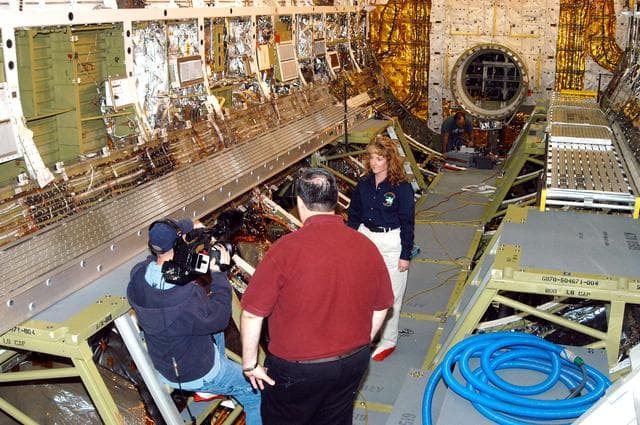
NASA image: KENNEDY SPACE CENTER, FLA. -  Standing inside Discovery’s payload bay, Carol Scott (right), lead orbiter engineer, talks about her job as part of a special feature for the KSC Web.  With his back to the camera is Bill Kallus, Media manager in the KSC Web Studio.  Behind Scott can be seen the open hatch of the airlock, which provides support functions such as airlock depressurization and repressurization, extravehicular activity equipment recharge, liquid-cooled garment water cooling, EVA equipment checkout, donning and communications. The outer hatch isolates the airlock from the unpressurized payload bay when closed and permits the EVA crew members to exit from the airlock to the payload bay when open.
Image
Jan 22, 2004

KENNEDY SPACE CENTER, FLA. - Standing inside Discovery’s payload bay, Carol Scott (right), lead orbiter engineer, talks about her job as part of a special feature for the KSC Web. With his back to the camera is Bill Kallus, Media manager in the KSC Web Studio. Behind Scott can be seen the open hatch of the airlock, which provides support functions such as airlock depressurization and repressurization, extravehicular activity equipment recharge, liquid-cooled garment water cooling, EVA equipment checkout, donning and communications. The outer hatch isolates the airlock from the unpressurized payload bay when closed and permits the EVA crew members to exit from the airlock to the payload bay when open.

KENNEDY SPACE CENTER, FLA. - Standing inside Discovery’s payload bay, Carol Scott (right), lead orbiter engineer,...
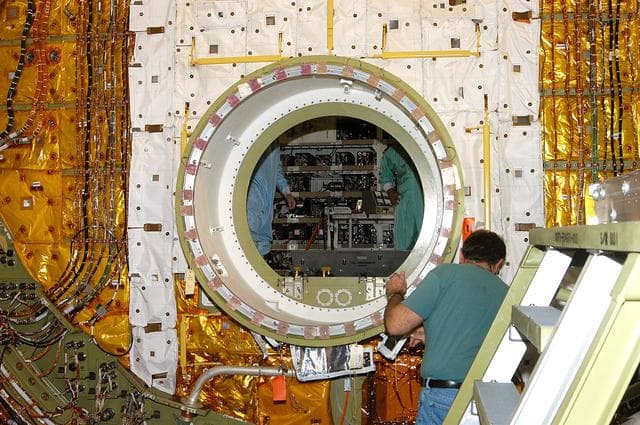
NASA image: KENNEDY SPACE CENTER, FLA. -  A worker in the Orbiter Processing Facility checks the open hatch of the airlock in Discovery’s payload bay. The airlock is normally located inside the middeck of the spacecraft’s pressurized crew cabin. The airlock is sized to accommodate two fully suited flight crew members simultaneously. Support functions include airlock depressurization and repressurization, extravehicular activity equipment recharge, liquid-cooled garment water cooling, EVA equipment checkout, donning and communications. The outer hatch isolates the airlock from the unpressurized payload bay when closed and permits the EVA crew members to exit from the airlock to the payload bay when open.
Image
Jan 22, 2004

KENNEDY SPACE CENTER, FLA. - A worker in the Orbiter Processing Facility checks the open hatch of the airlock in Discovery’s payload bay. The airlock is normally located inside the middeck of the spacecraft’s pressurized crew cabin. The airlock is sized to accommodate two fully suited flight crew members simultaneously. Support functions include airlock depressurization and repressurization, extravehicular activity equipment recharge, liquid-cooled garment water cooling, EVA equipment checkout, donning and communications. The outer hatch isolates the airlock from the unpressurized payload bay when closed and permits the EVA crew members to exit from the airlock to the payload bay when open.

KENNEDY SPACE CENTER, FLA. - A worker in the Orbiter Processing Facility checks the open hatch of the airlock in...
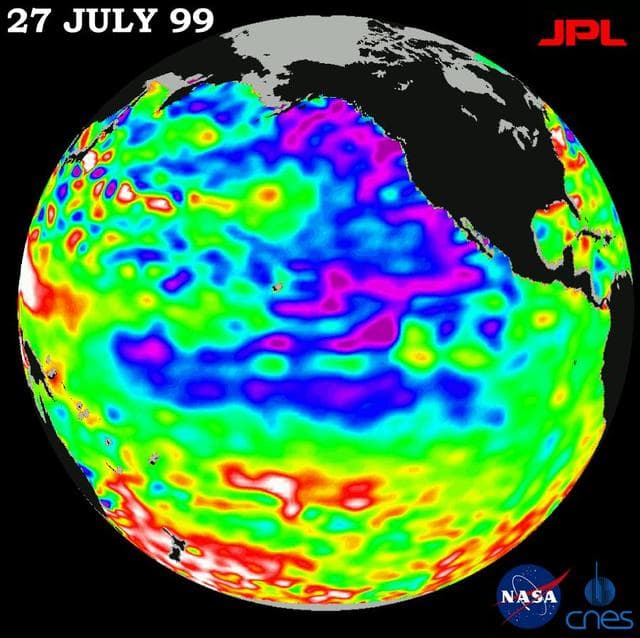
NASA image: TOPEX/El Niño Watch - Pacific Ocean Conditions are Split: Cold in East, Hot in West, July 27, 1999
Image
Aug 23, 1999

TOPEX/El Niño Watch - Pacific Ocean Conditions are Split: Cold in East, Hot in West, July 27, 1999

The North Pacific Ocean continues to run hot and cold, with abnormally low sea levels and cool waters in the...

JPL
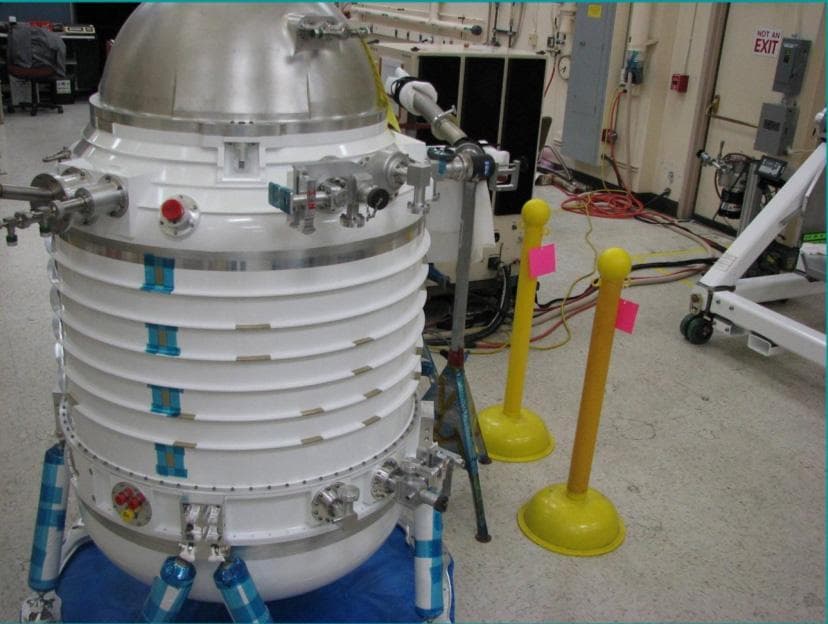
NASA image: NASA WISE Cryostat
Image
Oct 13, 2009

NASA WISE Cryostat

Initial assembly of NASA Wide-field Infrared Survey Explorer cryostat. The cryostat is a 2-stage solid hydrogen...

JPL
PreviousPage 2 of 85Next

Frequently Asked Questions About NASA Images

Are NASA images free to use?+
Yes, most NASA images are in the public domain and are free to use for educational, informational, and personal purposes. NASA's media usage guidelines state that NASA material is not copyrighted unless otherwise noted. However, the NASA logo and certain insignia are protected. Some images may include identifiable individuals or third-party content that requires additional permissions. Always check the specific image's usage rights and credit NASA as the source.
How many images does NASA have?+
NASA's Image and Video Library contains over 140,000 publicly accessible images, videos, and audio files spanning the agency's entire history, from the Mercury program of the 1960s to the latest James Webb Space Telescope discoveries. The collection grows daily as new missions capture imagery and archival materials are digitized. Individual mission archives, such as Mars rover photos, contain hundreds of thousands of additional images.
Can I download NASA images?+
Yes, you can download NASA images in multiple resolutions directly from this gallery. Each image detail page provides download links for original (full resolution), large (1920px), medium (960px), small (480px), and thumbnail sizes. NASA encourages the public to use these images for education, media, and personal projects. High-resolution originals are ideal for printing and professional use.

Explore More NASA Content

Astronomy Picture of the Day

Daily curated space image

Mars Rover Photos

Curiosity & Perseverance images

Earth from Space

DSCOVR EPIC daily images

Launch Schedule

Upcoming rocket launches

Space News

Mission updates & discoveries

KSC
KSC

KENNEDY SPACE CENTER, FLA. - In the Orbiter Processing Facility, a cameraman films part of Discovery’s payload bay...

KSC
KSC
KSC
KSC