![NASA image: Spun and Confused [video]](/_next/image?url=https%3A%2F%2Fimages-assets.nasa.gov%2Fimage%2FGSFC_20171208_Archive_e001026%2FGSFC_20171208_Archive_e001026~thumb.jpg&w=1920&q=75)
Image
Dec 8, 2017
Spun and Confused [video]
A long arch of plasma (called a prominence) was pulled this way and that by magnetic forces for a week before it...
GSFC

Image
Dec 8, 2017
Epic Filament Eruption from the Sun
NASA image captured December 6, 2010 To view a video of this event go here: www.flickr.com/photos/gsfc/5258354738 A...
GSFC

Image
Dec 8, 2017
Eiffel Tower Plume
A single plume of plasma, many times taller than the diameter of Earth, rose up from the Sun, twisted and spun...
GSFC

Image
Dec 8, 2017
From the Sun with Love
This Solar Dynamics Observatory (SDO) image of the Sun taken on January 20, 2012 in extreme ultraviolet light...
GSFC

Image
Dec 8, 2017
Extensive Arch
A giant arch of plasma rose up out of the Sun and then stretched itself until it had reached back to a point behind...
GSFC

Image
Dec 8, 2017
Spasmodic Active Region
An active region that was rotating out of view off the sun's western limb, displayed a dazzling variety of dozens of...
GSFC

Image
Dec 8, 2017
Spun and Confused
A long arch of plasma (called a prominence) was pulled this way and that by magnetic forces for a week before it...
GSFC

Image
Dec 8, 2017
Brief Outburst
The Sun blew out a coronal mass ejection along with part of a solar filament over a three-hour period (Feb. 24,...
GSFC
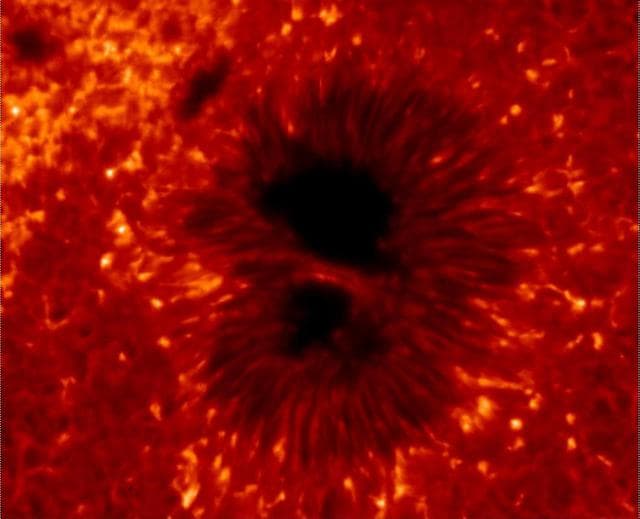
Image
Aug 9, 2005
Space Science
Hinode (Sunrise), formerly known as Solar-B before reaching orbit, was launched from the Uchinoura Space Center in...
MSFC
![NASA image: Gigantic Rolling Wave Captured on the Sun [hd video]](/_next/image?url=https%3A%2F%2Fimages-assets.nasa.gov%2Fimage%2FGSFC_20171208_Archive_e001516%2FGSFC_20171208_Archive_e001516~thumb.jpg&w=1920&q=75)
Image
Dec 8, 2017
Gigantic Rolling Wave Captured on the Sun [hd video]
A corona mass ejection (CME) erupted from just around the edge of the sun on May 1, 2013, in a gigantic rolling...
GSFC

Image
Dec 8, 2017
X4 Flare was no Shrimp
An active region at the edge of the Sun blew out an X4 flare (one of the largest of the solar cycle) and a coronal...
GSFC

Image
Dec 8, 2017
CME Blow Out
A substantial coronal mass ejection, or CME, blew out from side of the Sun, giving us a great view of the event in...
GSFC

Image
Dec 8, 2017
GOES EXIS Quadruplets Together in a Clean Room "Nursery"
Four Extreme Ultraviolet and X-ray Irradiance Sensors or EXIS instruments that will fly aboard four of NOAA's...
GSFC

Image
Dec 8, 2017
NASA’s Solar Dynamics Observatory Captured Trio of Solar Flares April 2-3
The sun emitted a trio of mid-level solar flares on April 2-3, 2017. The first peaked at 4:02 a.m. EDT on April 2,...
GSFC

Image
Sep 25, 2019
Pegasus ICON Rollout at VAFB
The Northrop Grumman Pegasus XL rocket, with NASA's Ionospheric Connection Explorer (ICON) secured in its payload...
KSC

Image
Sep 10, 2019
Pegasus ICON Spacecraft Mate
Technicians attach NASA's Ionospheric Connection Explorer (ICON) to the Northrop Grumman Pegasus XL rocket inside...
KSC

Image
Sep 25, 2019
Pegasus ICON Rollout at VAFB
The Northrop Grumman Pegasus XL rocket, with NASA's Ionospheric Connection Explorer (ICON) secured in its payload...
KSC

Image
Sep 25, 2019
Pegasus ICON Rollout at VAFB
The Northrop Grumman Pegasus XL rocket, with NASA's Ionospheric Connection Explorer (ICON) secured in its payload...
KSC

Image
Sep 10, 2019
Pegasus ICON Spacecraft Mate
NASA's Ionospheric Connection Explorer (ICON) is attached to the Northrop Grumman Pegasus XL rocket inside Building...
KSC

Image
Sep 10, 2019
Pegasus ICON Spacecraft Mate
Technicians perform a black light inspection of the Northrop Grumman Pegasus XL rocket inside Building 1555 at...
KSC

Image
Sep 25, 2019
Pegasus ICON Rollout at VAFB
The Northrop Grumman Pegasus XL rocket, with NASA's Ionospheric Connection Explorer (ICON) secured in its payload...
KSC

Image
Sep 10, 2019
Pegasus ICON Spacecraft Mate
Technicians attach NASA’s Ionospheric Connection Explorer (ICON) to the Northrop Grumman Pegasus XL rocket inside...
KSC

Image
Sep 10, 2019
Pegasus ICON Spacecraft Mate
Technicians perform a black light inspection of the Northrop Grumman Pegasus XL rocket inside Building 1555 at...
KSC

Image
Sep 10, 2019
Pegasus ICON Spacecraft Mate
NASA's Ionospheric Connection Explorer (ICON) is attached to the Northrop Grumman Pegasus XL rocket inside Building...
KSC