CosmosObservatory
Explore
Solar System
Live
Learn
Tools
About
Cosmos Observatory
ToolsAbout
Cosmos Observatory

Explore the universe through NASA data, real-time ISS tracking, Mars rover imagery, asteroid monitoring, and comprehensive space encyclopedia. Your gateway to the cosmos.

Explore

  • APOD
  • Mars Rovers
  • Earth Imagery
  • NASA Gallery
  • ISS Tracker

Data

  • Asteroids
  • Solar System
  • Exoplanets
  • Space Weather
  • Launches

Tools

  • Glossary
  • News
  • Calculators

Legal

  • About
  • Privacy Policy
  • Terms of Use
  • Space Tools
  • Contact

Stay updated with the cosmos

Get weekly digests of APOD highlights, upcoming launches, and space events.

© 2026 Cosmos Observatory. All rights reserved. Built with for space enthusiasts.

This website is not affiliated with, maintained, authorized, endorsed by, or in any way officially connected with NASA or any of its subsidiaries or affiliates. All NASA imagery is in the public domain unless otherwise noted. Data sourced from NASA Open APIs, Launch Library 2, and other open data services.

NASA Gallery

Explore NASA's vast collection of space images, videos, and audio from missions past and present.

  1. Home
  2. /
  3. NASA Gallery

NASA's Image and Video Library: A Visual Archive of Space Exploration

NASA's Image and Video Library is one of the most comprehensive public archives of space imagery in the world, containing over 140,000 images, videos, and audio recordings spanning more than six decades of space exploration. From the earliest Mercury and Gemini missions through the Apollo Moon landings, the Space Shuttle era, and today's cutting-edge observations from the James Webb Space Telescope, this collection documents humanity's journey into the cosmos.

The library includes imagery from diverse sources: telescopes like Hubble and Webb that capture deep-space nebulae, galaxies, and exoplanets; planetary missions like the Mars rovers ( browse Mars photos) and Cassini at Saturn; Earth observation satellites ( see EPIC imagery); astronaut photography from the ISS; and documentation of rocket launches, spacecraft assembly, and ground testing. Most NASA images are in the public domain and free to download at full resolution for educational, editorial, and personal use.

Use the search bar above to find specific subjects — try queries like "Apollo 11," "Hubble Deep Field," "Mars surface," or "astronaut EVA." You can also filter by media type (image, video, or audio). For a daily curated experience, visit the Astronomy Picture of the Day.

Showing results for "B-1"

1,280 results found - Page 12 of 54

NASA image: Hubble Team Unveils Most Colorful View of Universe Captured by Space Telescope
Image
Dec 8, 2017

Hubble Team Unveils Most Colorful View of Universe Captured by Space Telescope

Astronomers using NASA's Hubble Space Telescope have assembled a comprehensive picture of the evolving universe –...

GSFC
NASA image: Nodosaur Footprint Verified
Image
Dec 8, 2017

Nodosaur Footprint Verified

Dr. Robert Weems, emeritus paleontologist for the USGS verifies the recently discovered dinosaur track found on the...

GSFC
NASA image: A New Identity for Denali
Image
Dec 8, 2017

A New Identity for Denali

Physically, not too much has changed on Denali, North America’s highest peak. What did change in 2015 is how people...

GSFC
NASA image: Filament Eruption Creates 'Canyon of Fire' on the Sun
Image
Dec 8, 2017

Filament Eruption Creates 'Canyon of Fire' on the Sun

A magnetic filament of solar material erupted on the sun in late September, breaking the quiet conditions in a...

GSFC
NASA image: A New Identity for Denali
Image
Dec 8, 2017

A New Identity for Denali

Physically, not too much has changed on Denali, North America’s highest peak. What did change in 2015 is how people...

GSFC
NASA image: Nodosaur Footprint Verified
Image
Dec 8, 2017

Nodosaur Footprint Verified

Dr. Robert Weems, emeritus paleontologist for the USGS verifies the recently discovered dinosaur track found on the...

GSFC
NASA image: Preparing NASA's Next Solar Satellite for Launch
Image
Dec 8, 2017

Preparing NASA's Next Solar Satellite for Launch

Orbital Sciences team members move the second half of the payload fairing before it is placed over NASA's IRIS...

GSFC
NASA image: Hubble Sees an Intriguing Young-Looking Dwarf Galaxy
Image
Dec 8, 2017

Hubble Sees an Intriguing Young-Looking Dwarf Galaxy

The bright streak of glowing gas and stars in this NASA/ESA Hubble Space Telescope image is known as PGC 51017, or...

GSFC
NASA image: Harvest Moon at NASA Goddard
Image
Dec 8, 2017

Harvest Moon at NASA Goddard

September's Harvest Moon as seen around NASA's Goddard Space Flight Center. According to folklore, every full Moon...

GSFC
NASA image: Nodosaur Footprint Verified
Image
Dec 8, 2017

Nodosaur Footprint Verified

On Friday, Aug. 17, 2012, noted dinosaur hunter Ray Stanford shared the location of that footprint with Goddard’s...

GSFC
NASA image: Lunar Satellite Snaps Image of Earth
Image
Dec 8, 2017

Lunar Satellite Snaps Image of Earth

This image, captured Feb. 1, 2014, shows a colorized view of Earth from the moon-based perspective of NASA's Lunar...

GSFC
NASA image: NASA's Fermi Proves Supernova Remnants Produce Cosmic Rays
Image
Dec 8, 2017

NASA's Fermi Proves Supernova Remnants Produce Cosmic Rays

The W44 supernova remnant is nestled within and interacting with the molecular cloud that formed its parent star....

GSFC
NASA image: NASA's Ship-Aircraft Bio-Optical Research (SABOR)
Image
Dec 8, 2017

NASA's Ship-Aircraft Bio-Optical Research (SABOR)

Instruments Overboard On July 26, 2014, scientists worked past dusk to prepare and deploy the optical instruments...

GSFC
NASA image: NASA's Ship-Aircraft Bio-Optical Research (SABOR)
Image
Dec 8, 2017

NASA's Ship-Aircraft Bio-Optical Research (SABOR)

Sunset Over the Gulf of Maine On July 20, 2013, scientists at sea with NASA's SABOR experiment witnessed a...

GSFC
NASA image: Matusevich Glacier
Image
Dec 8, 2017

Matusevich Glacier

NASA image acquired September 6, 2010 The Matusevich Glacier flows toward the coast of East Antarctica, pushing...

GSFC
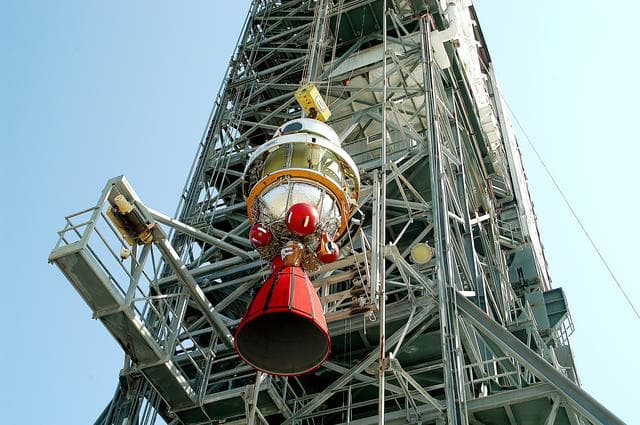
NASA image: KENNEDY SPACE CENTER, FLA. - The second stage of a Delta II rocket is lifted up the launch tower on Pad 17-B, Cape Canaveral Air Force Station.  It will be mated to the Delta first stage already at the pad in preparation for the launch of the Mars Exploration Rover-1 (MER-B) on June 25.  NASA’s twin Mars Exploration Rovers are designed to study the history of water on Mars. These robotic geologists are equipped with a robotic arm, a drilling tool, three spectrometers, and four pairs of cameras that allow them to have a human-like, 3D view of the terrain. Each rover could travel as far as 100 meters in one day to act as Mars scientists' eyes and hands, exploring an environment where humans are not yet able to go. The launch of MER-2 (MER-A) is tentatively set for June 8.
Image
May 29, 2003

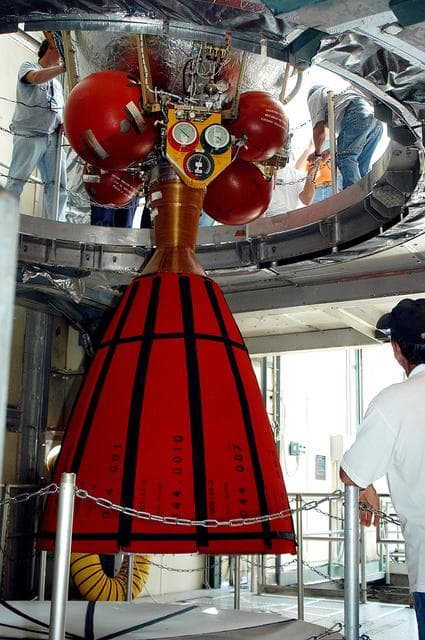
KENNEDY SPACE CENTER, FLA. - The second stage of a Delta II rocket is lifted up the launch tower on Pad 17-B, Cape Canaveral Air Force Station. It will be mated to the Delta first stage already at the pad in preparation for the launch of the Mars Exploration Rover-1 (MER-B) on June 25. NASA’s twin Mars Exploration Rovers are designed to study the history of water on Mars. These robotic geologists are equipped with a robotic arm, a drilling tool, three spectrometers, and four pairs of cameras that allow them to have a human-like, 3D view of the terrain. Each rover could travel as far as 100 meters in one day to act as Mars scientists' eyes and hands, exploring an environment where humans are not yet able to go. The launch of MER-2 (MER-A) is tentatively set for June 8.
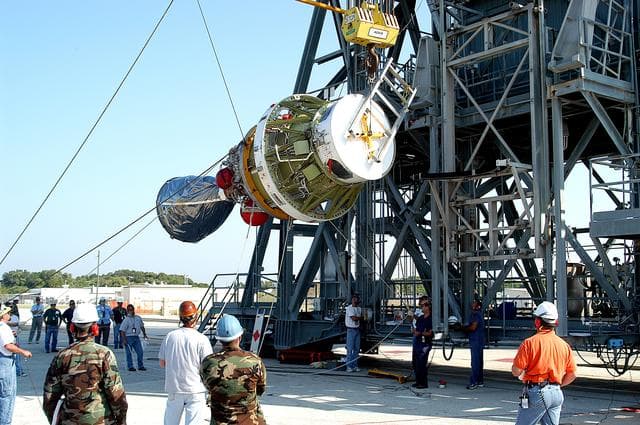
NASA image: KENNEDY SPACE CENTER, FLA. - The second stage of a Delta II rocket is lowered into positioned above a first stage at Pad 17-B, Cape Canaveral Air Force Station. Next, it will be mated to the first stage in preparation for the launch of the Mars Exploration Rover-1 (MER-B) on June 25.  NASA’s twin Mars Exploration Rovers are designed to study the history of water on Mars. These robotic geologists are equipped with a robotic arm, a drilling tool, three spectrometers, and four pairs of cameras that allow them to have a human-like, 3D view of the terrain. Each rover could travel as far as 100 meters in one day to act as Mars scientists' eyes and hands, exploring an environment where humans are not yet able to go. The launch of MER-2 (MER-A) is tentatively set for June 8.
Image
May 29, 2003

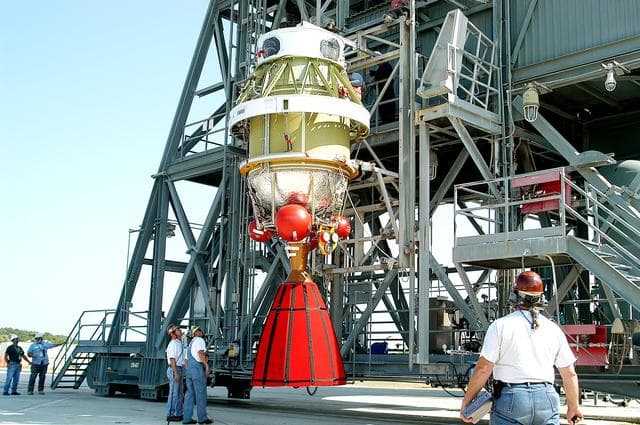
KENNEDY SPACE CENTER, FLA. - The second stage of a Delta II rocket is lowered into positioned above a first stage at Pad 17-B, Cape Canaveral Air Force Station. Next, it will be mated to the first stage in preparation for the launch of the Mars Exploration Rover-1 (MER-B) on June 25. NASA’s twin Mars Exploration Rovers are designed to study the history of water on Mars. These robotic geologists are equipped with a robotic arm, a drilling tool, three spectrometers, and four pairs of cameras that allow them to have a human-like, 3D view of the terrain. Each rover could travel as far as 100 meters in one day to act as Mars scientists' eyes and hands, exploring an environment where humans are not yet able to go. The launch of MER-2 (MER-A) is tentatively set for June 8.
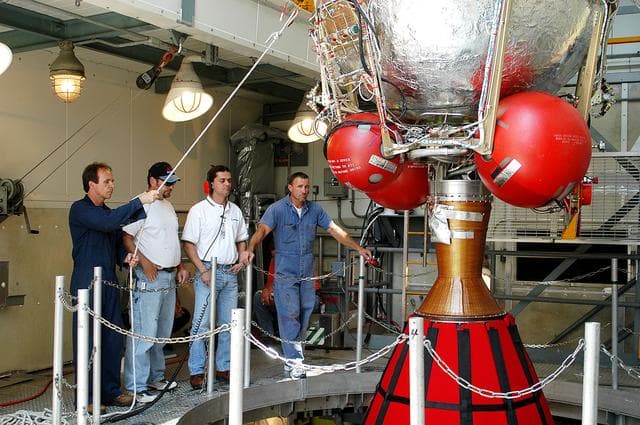
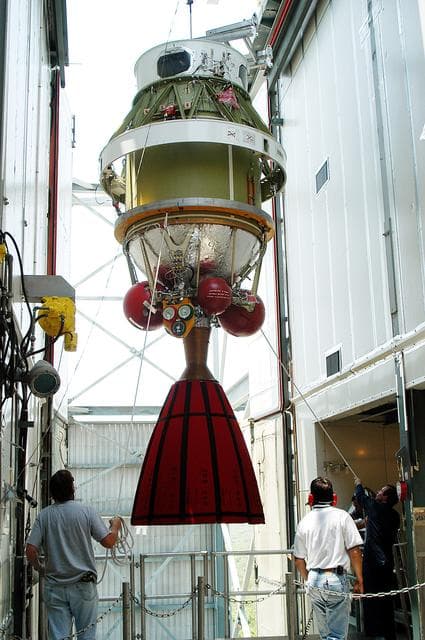
NASA image: KENNEDY SPACE CENTER, FLA. - Workers begin to lift the second stage of a Delta II rocket up the launch tower on Pad 17-B, Cape Canaveral Air Force Station.  It will be mated to the Delta first stage already at the pad in preparation for the launch of the Mars Exploration Rover-1 (MER-B) on June 25.  NASA’s twin Mars Exploration Rovers are designed to study the history of water on Mars. These robotic geologists are equipped with a robotic arm, a drilling tool, three spectrometers, and four pairs of cameras that allow them to have a human-like, 3D view of the terrain. Each rover could travel as far as 100 meters in one day to act as Mars scientists' eyes and hands, exploring an environment where humans are not yet able to go. The launch of MER-2 (MER-A) is tentatively set for June 8.
Image
May 29, 2003

KENNEDY SPACE CENTER, FLA. - Workers begin to lift the second stage of a Delta II rocket up the launch tower on Pad 17-B, Cape Canaveral Air Force Station. It will be mated to the Delta first stage already at the pad in preparation for the launch of the Mars Exploration Rover-1 (MER-B) on June 25. NASA’s twin Mars Exploration Rovers are designed to study the history of water on Mars. These robotic geologists are equipped with a robotic arm, a drilling tool, three spectrometers, and four pairs of cameras that allow them to have a human-like, 3D view of the terrain. Each rover could travel as far as 100 meters in one day to act as Mars scientists' eyes and hands, exploring an environment where humans are not yet able to go. The launch of MER-2 (MER-A) is tentatively set for June 8.
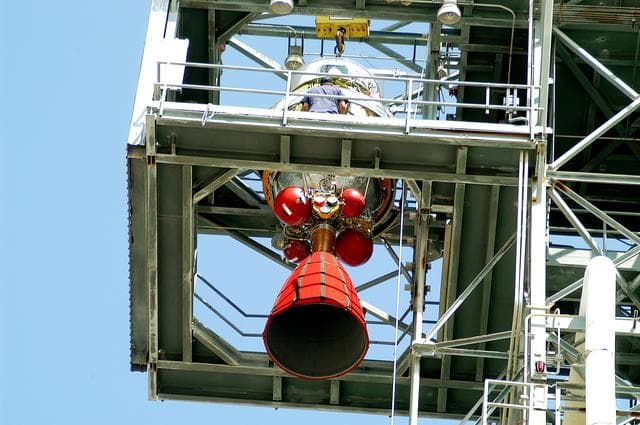
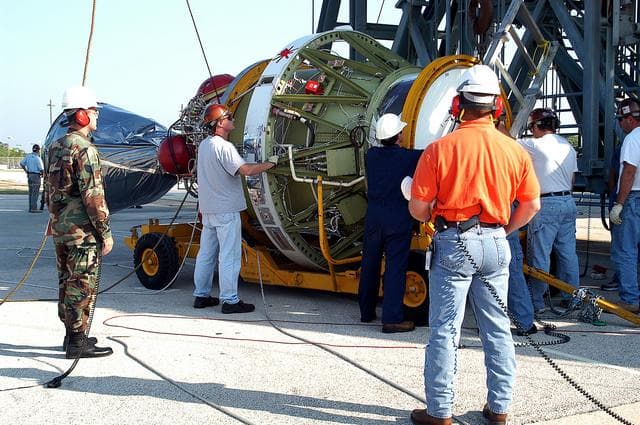
NASA image: KENNEDY SPACE CENTER, FLA. - The second stage of a Delta II rocket is raised to a vertical position and prepared for its lift up the launch tower on Pad 17-B, Cape Canaveral Air Force Station.  It will be mated to the Delta first stage already at the pad in preparation for the launch of the Mars Exploration Rover-1 (MER-B) on June 25.  NASA’s twin Mars Exploration Rovers are designed to study the history of water on Mars. These robotic geologists are equipped with a robotic arm, a drilling tool, three spectrometers, and four pairs of cameras that allow them to have a human-like, 3D view of the terrain. Each rover could travel as far as 100 meters in one day to act as Mars scientists' eyes and hands, exploring an environment where humans are not yet able to go. The launch of MER-2 (MER-A) is tentatively set for June 8.
Image
May 29, 2003

KENNEDY SPACE CENTER, FLA. - The second stage of a Delta II rocket is raised to a vertical position and prepared for its lift up the launch tower on Pad 17-B, Cape Canaveral Air Force Station. It will be mated to the Delta first stage already at the pad in preparation for the launch of the Mars Exploration Rover-1 (MER-B) on June 25. NASA’s twin Mars Exploration Rovers are designed to study the history of water on Mars. These robotic geologists are equipped with a robotic arm, a drilling tool, three spectrometers, and four pairs of cameras that allow them to have a human-like, 3D view of the terrain. Each rover could travel as far as 100 meters in one day to act as Mars scientists' eyes and hands, exploring an environment where humans are not yet able to go. The launch of MER-2 (MER-A) is tentatively set for June 8.
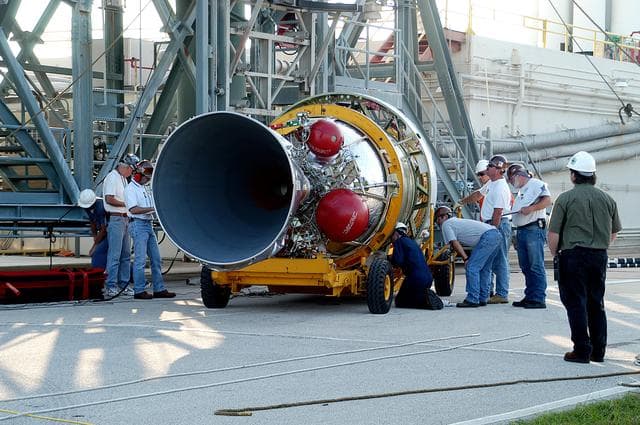
NASA image: KENNEDY SPACE CENTER, FLA. - The second stage of a Delta II rocket is positioned above a first stage at the top of the launch tower on Pad 17-B, Cape Canaveral Air Force Station. Next, it will be mated to the first stage in preparation for the launch of the Mars Exploration Rover-1 (MER-B) on June 25.  NASA’s twin Mars Exploration Rovers are designed to study the history of water on Mars. These robotic geologists are equipped with a robotic arm, a drilling tool, three spectrometers, and four pairs of cameras that allow them to have a human-like, 3D view of the terrain. Each rover could travel as far as 100 meters in one day to act as Mars scientists' eyes and hands, exploring an environment where humans are not yet able to go. The launch of MER-2 (MER-A) is tentatively set for June 8.
Image
May 29, 2003

KENNEDY SPACE CENTER, FLA. - The second stage of a Delta II rocket is positioned above a first stage at the top of the launch tower on Pad 17-B, Cape Canaveral Air Force Station. Next, it will be mated to the first stage in preparation for the launch of the Mars Exploration Rover-1 (MER-B) on June 25. NASA’s twin Mars Exploration Rovers are designed to study the history of water on Mars. These robotic geologists are equipped with a robotic arm, a drilling tool, three spectrometers, and four pairs of cameras that allow them to have a human-like, 3D view of the terrain. Each rover could travel as far as 100 meters in one day to act as Mars scientists' eyes and hands, exploring an environment where humans are not yet able to go. The launch of MER-2 (MER-A) is tentatively set for June 8.

NASA image: KENNEDY SPACE CENTER, FLA. - The second stage of a Delta II rocket is moved into position at the top of the launch tower on Pad 17-B, Cape Canaveral Air Force Station.  It will be mated to the Delta first stage already at the pad in preparation for the launch of the Mars Exploration Rover-1 (MER-B) on June 25.  NASA’s twin Mars Exploration Rovers are designed to study the history of water on Mars. These robotic geologists are equipped with a robotic arm, a drilling tool, three spectrometers, and four pairs of cameras that allow them to have a human-like, 3D view of the terrain. Each rover could travel as far as 100 meters in one day to act as Mars scientists' eyes and hands, exploring an environment where humans are not yet able to go. The launch of MER-2 (MER-A) is tentatively set for June 8.
Image
May 29, 2003

KENNEDY SPACE CENTER, FLA. - The second stage of a Delta II rocket is moved into position at the top of the launch tower on Pad 17-B, Cape Canaveral Air Force Station. It will be mated to the Delta first stage already at the pad in preparation for the launch of the Mars Exploration Rover-1 (MER-B) on June 25. NASA’s twin Mars Exploration Rovers are designed to study the history of water on Mars. These robotic geologists are equipped with a robotic arm, a drilling tool, three spectrometers, and four pairs of cameras that allow them to have a human-like, 3D view of the terrain. Each rover could travel as far as 100 meters in one day to act as Mars scientists' eyes and hands, exploring an environment where humans are not yet able to go. The launch of MER-2 (MER-A) is tentatively set for June 8.

NASA image: KENNEDY SPACE CENTER, FLA. - The second stage of a Delta II rocket is lifted to the top of the launch tower on Pad 17-B, Cape Canaveral Air Force Station.  It will be mated to the Delta first stage already at the pad in preparation for the launch of the Mars Exploration Rover-1 (MER-B) on June 25.  NASA’s twin Mars Exploration Rovers are designed to study the history of water on Mars. These robotic geologists are equipped with a robotic arm, a drilling tool, three spectrometers, and four pairs of cameras that allow them to have a human-like, 3D view of the terrain. Each rover could travel as far as 100 meters in one day to act as Mars scientists' eyes and hands, exploring an environment where humans are not yet able to go. The launch of MER-2 (MER-A) is tentatively set for June 8.
Image
May 29, 2003

KENNEDY SPACE CENTER, FLA. - The second stage of a Delta II rocket is lifted to the top of the launch tower on Pad 17-B, Cape Canaveral Air Force Station. It will be mated to the Delta first stage already at the pad in preparation for the launch of the Mars Exploration Rover-1 (MER-B) on June 25. NASA’s twin Mars Exploration Rovers are designed to study the history of water on Mars. These robotic geologists are equipped with a robotic arm, a drilling tool, three spectrometers, and four pairs of cameras that allow them to have a human-like, 3D view of the terrain. Each rover could travel as far as 100 meters in one day to act as Mars scientists' eyes and hands, exploring an environment where humans are not yet able to go. The launch of MER-2 (MER-A) is tentatively set for June 8.

NASA image: KENNEDY SPACE CENTER, FLA. - Workers prepare to lift the second stage of a Delta II rocket up the launch tower on Pad 17-B, Cape Canaveral Air Force Station.  It will be mated to the Delta first stage already at the pad in preparation for the launch of the Mars Exploration Rover-1 (MER-B) on June 25.  NASA’s twin Mars Exploration Rovers are designed to study the history of water on Mars. These robotic geologists are equipped with a robotic arm, a drilling tool, three spectrometers, and four pairs of cameras that allow them to have a human-like, 3D view of the terrain. Each rover could travel as far as 100 meters in one day to act as Mars scientists' eyes and hands, exploring an environment where humans are not yet able to go. The launch of MER-2 (MER-A) is tentatively set for June 8.
Image
May 29, 2003

KENNEDY SPACE CENTER, FLA. - Workers prepare to lift the second stage of a Delta II rocket up the launch tower on Pad 17-B, Cape Canaveral Air Force Station. It will be mated to the Delta first stage already at the pad in preparation for the launch of the Mars Exploration Rover-1 (MER-B) on June 25. NASA’s twin Mars Exploration Rovers are designed to study the history of water on Mars. These robotic geologists are equipped with a robotic arm, a drilling tool, three spectrometers, and four pairs of cameras that allow them to have a human-like, 3D view of the terrain. Each rover could travel as far as 100 meters in one day to act as Mars scientists' eyes and hands, exploring an environment where humans are not yet able to go. The launch of MER-2 (MER-A) is tentatively set for June 8.

NASA image: KENNEDY SPACE CENTER, FLA. - The second stage of a Delta II rocket arrives at Pad 17-B, Cape Canaveral Air Force Station. It will be mated to the Delta first stage already at the pad in preparation for the launch of the Mars Exploration Rover-1 (MER-B) on June 25.  NASA’s twin Mars Exploration Rovers are designed to study the history of water on Mars. These robotic geologists are equipped with a robotic arm, a drilling tool, three spectrometers, and four pairs of cameras that allow them to have a human-like, 3D view of the terrain. Each rover could travel as far as 100 meters in one day to act as Mars scientists' eyes and hands, exploring an environment where humans are not yet able to go. The launch of MER-2 (MER-A) is tentatively set for June 8.
Image
May 29, 2003

KENNEDY SPACE CENTER, FLA. - The second stage of a Delta II rocket arrives at Pad 17-B, Cape Canaveral Air Force Station. It will be mated to the Delta first stage already at the pad in preparation for the launch of the Mars Exploration Rover-1 (MER-B) on June 25. NASA’s twin Mars Exploration Rovers are designed to study the history of water on Mars. These robotic geologists are equipped with a robotic arm, a drilling tool, three spectrometers, and four pairs of cameras that allow them to have a human-like, 3D view of the terrain. Each rover could travel as far as 100 meters in one day to act as Mars scientists' eyes and hands, exploring an environment where humans are not yet able to go. The launch of MER-2 (MER-A) is tentatively set for June 8.

PreviousPage 12 of 54Next

Frequently Asked Questions About NASA Images

Are NASA images free to use?+
Yes, most NASA images are in the public domain and are free to use for educational, informational, and personal purposes. NASA's media usage guidelines state that NASA material is not copyrighted unless otherwise noted. However, the NASA logo and certain insignia are protected. Some images may include identifiable individuals or third-party content that requires additional permissions. Always check the specific image's usage rights and credit NASA as the source.
How many images does NASA have?+
NASA's Image and Video Library contains over 140,000 publicly accessible images, videos, and audio files spanning the agency's entire history, from the Mercury program of the 1960s to the latest James Webb Space Telescope discoveries. The collection grows daily as new missions capture imagery and archival materials are digitized. Individual mission archives, such as Mars rover photos, contain hundreds of thousands of additional images.
Can I download NASA images?+
Yes, you can download NASA images in multiple resolutions directly from this gallery. Each image detail page provides download links for original (full resolution), large (1920px), medium (960px), small (480px), and thumbnail sizes. NASA encourages the public to use these images for education, media, and personal projects. High-resolution originals are ideal for printing and professional use.

Explore More NASA Content

Astronomy Picture of the Day

Daily curated space image

Mars Rover Photos

Curiosity & Perseverance images

Earth from Space

DSCOVR EPIC daily images

Launch Schedule

Upcoming rocket launches

Space News

Mission updates & discoveries

KENNEDY SPACE CENTER, FLA. - The second stage of a Delta II rocket is lifted up the launch tower on Pad 17-B, Cape...

KSC

KENNEDY SPACE CENTER, FLA. - The second stage of a Delta II rocket is lowered into positioned above a first stage at...

KSC

KENNEDY SPACE CENTER, FLA. - Workers begin to lift the second stage of a Delta II rocket up the launch tower on Pad...

KSC

KENNEDY SPACE CENTER, FLA. - The second stage of a Delta II rocket is raised to a vertical position and prepared for...

KSC

KENNEDY SPACE CENTER, FLA. - The second stage of a Delta II rocket is positioned above a first stage at the top of...

KSC

KENNEDY SPACE CENTER, FLA. - The second stage of a Delta II rocket is moved into position at the top of the launch...

KSC

KENNEDY SPACE CENTER, FLA. - The second stage of a Delta II rocket is lifted to the top of the launch tower on Pad...

KSC

KENNEDY SPACE CENTER, FLA. - Workers prepare to lift the second stage of a Delta II rocket up the launch tower on...

KSC

KENNEDY SPACE CENTER, FLA. - The second stage of a Delta II rocket arrives at Pad 17-B, Cape Canaveral Air Force...

KSC