
Video
Sep 13, 2016
ORACLES Campaign: B-Roll 1
Southern Africa produces almost a third of the world’s vegetative burning, which sends smoke particles up into the...
GSFC

Video
Sep 13, 2016
ORACLES Campaign: B-Roll 9
Southern Africa produces almost a third of the world’s vegetative burning, which sends smoke particles up into the...
GSFC

Video
Sep 13, 2016
ORACLES Campaign: B-Roll 6
Southern Africa produces almost a third of the world’s vegetative burning, which sends smoke particles up into the...
GSFC

Video
Sep 13, 2016
ORACLES Campaign: B-Roll 11
Southern Africa produces almost a third of the world’s vegetative burning, which sends smoke particles up into the...
GSFC

Video
Sep 13, 2016
ORACLES Campaign: B-Roll 2
Southern Africa produces almost a third of the world’s vegetative burning, which sends smoke particles up into the...
GSFC

Video
Sep 13, 2016
ORACLES Campaign: B-Roll 10
Southern Africa produces almost a third of the world’s vegetative burning, which sends smoke particles up into the...
GSFC

Video
Sep 13, 2016
ORACLES Campaign: B-Roll 5
Southern Africa produces almost a third of the world’s vegetative burning, which sends smoke particles up into the...
GSFC

Video
Nov 7, 2018
GEDI: Mapping Carbon in 3-D
NASA's new laser instrument, the Global Ecosystem Dynamics Investigation, or GEDI, has advanced laser technology...
GSFC

Video
Sep 13, 2016
ORACLES Campaign: B-Roll 3
Southern Africa produces almost a third of the world’s vegetative burning, which sends smoke particles up into the...
GSFC

Video
Dec 17, 2020
NISAR Mission Video
The joint U.S.-Indian NISAR satellite mission will use radar to observe a wide range of Earth processes, from the...
JPL

Video
Nov 16, 2016
NASA Scientists Help Citites Prepare for Climate Change
Researchers and city officials from two of the world’s major metropolises, New York City and Rio de Janeiro, are...
GSFC

Video
Nov 10, 2014
Why is the Ozone Hole Getting Smaller?
The Antarctic ozone hole reached its annual peak size on Sept. 11, according to scientists from NASA and the...
GSFC

Video
Oct 28, 2015
Brazil’s Extreme Drought Seen From Space
Empty water reservoirs, severe water rationing, and electrical blackouts are the new status quo in major cities...
GSFC
Image
Mar 3, 2004
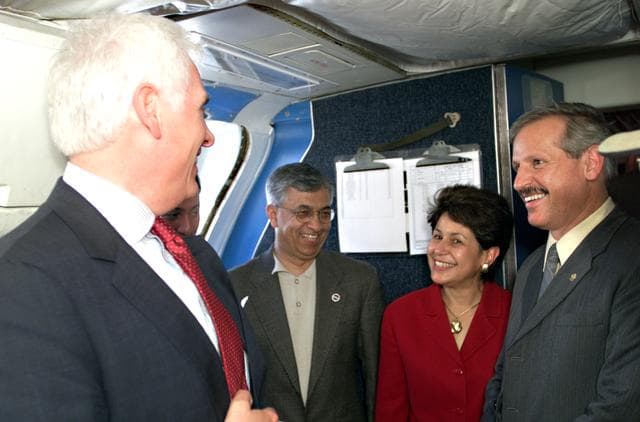
VIP’s onboard NASA's DC-8 aircraft during the AirSAR 2004 Mesoamerica campaign
VIP’s onboard NASA's DC-8 aircraft during the AirSAR 2004 Mesoamerica campaign, L-R: Mr. John Danilovich, US...
AFRC
Image
May 16, 2023
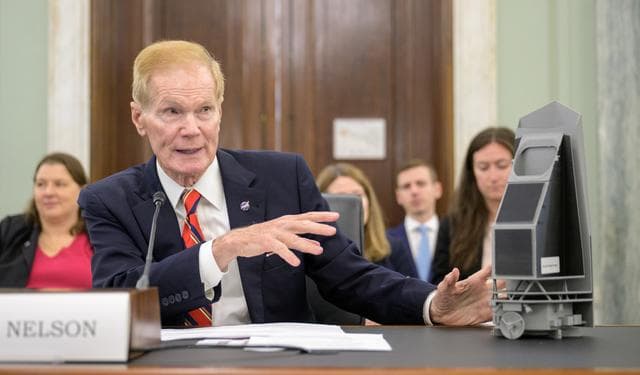
Senate Hearing on NASA’s Budget and Priorities
NASA Administrator Bill Nelson points to a model of the Near-Earth Object Surveyor space telescope (NEO Surveyor) as...
HQ

Video
Feb 9, 2017
ATom Postcard - Alaska and the Arctic
The ATom mission aboard NASA’s DC-8 aircraft and flying laboratory is sampling world-wide in one of the most...
GSFC

Video
May 15, 2018
During a Year in Orbit, IceCube Created a New Map of Earth's Clouds
Although it was only designed to last three months, the tiny CubeSat known as IceCube has been orbiting Earth for a...
GSFC

Video
Mar 16, 2017
ATom Postcard - Ascension Island to the Azores Islands
The ATom mission aboard NASA’s DC-8 aircraft and flying laboratory is sampling world-wide in one of the most...
GSFC

Video
Mar 13, 2019
Science Discoveries Beyond Earth┃Go Forward
NASA is going to the Moon and on to Mars, in a measured, sustainable way. Working with U.S. companies and...
HQ
Image
Sep 8, 2003
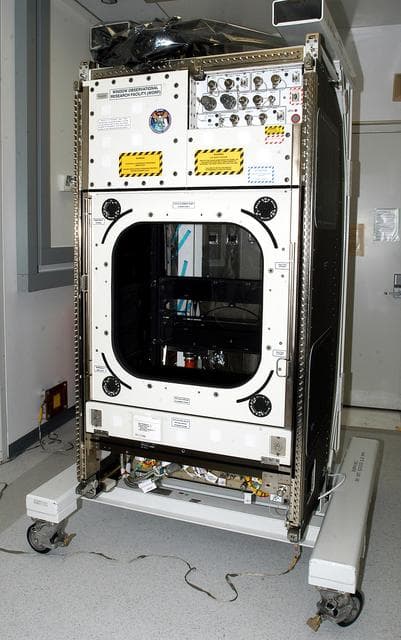
KENNEDY SPACE CENTER, FLA. - The Window Observational Research Facility (WORF), seen in the Space Station Processing Facility, was designed and built by the Boeing Co. at NASA’s Marshall Space Flight Center in Huntsville, Ala. WORF will be delivered to the International Space Station and placed in the rack position in front of the Destiny lab window, providing locations for attaching cameras, multi-spectral scanners and other instruments. WORF will support a variety of scientific and commercial experiments in areas of Earth systems and processes, global ecological changes in Earth’s biosphere, lithosphere, hydrosphere and climate system, Earth resources, natural hazards, and education. After installation, it will become a permanent focal point for Earth Science research aboard the space station.

Video
Apr 26, 2024
Prelaunch Activities for Our Next Commercial Crew Flight Test on This Week @NASA – April 26, 2024
Prelaunch Activities for Our Next Commercial Crew Flight Test, celebrating our home planet for Earth Day, and...
HQ

Video
Jan 10, 2013
LDCM Overview
The Landsat Data Continuity Mission (LDCM) is a collaboration between NASA and the U.S. Geological Survey that will...
GSFC

Video
Jan 13, 2023
Continuing a Collaboration in Space Exploration on This Week @NASA – January 13, 2023
Continuing a collaboration in space exploration, space station research heads back to Earth, and highlighting new...
HQ
Video
Jul 25, 2022
Your Orbiting Laboratory: Space Station Benefits
The International Space Station is a modern marvel. Only 400 kilometers (250 miles) above our heads, it streaks...
HQ