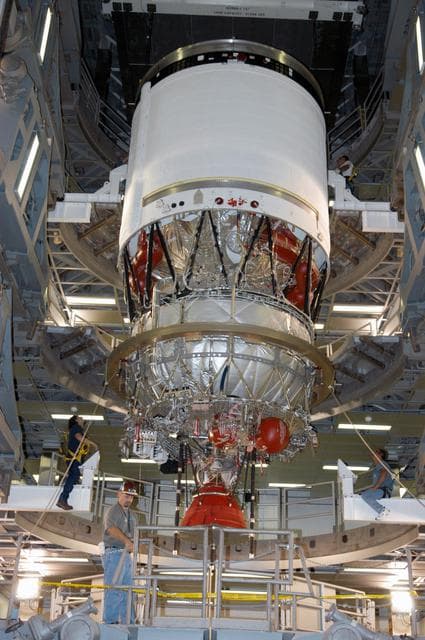
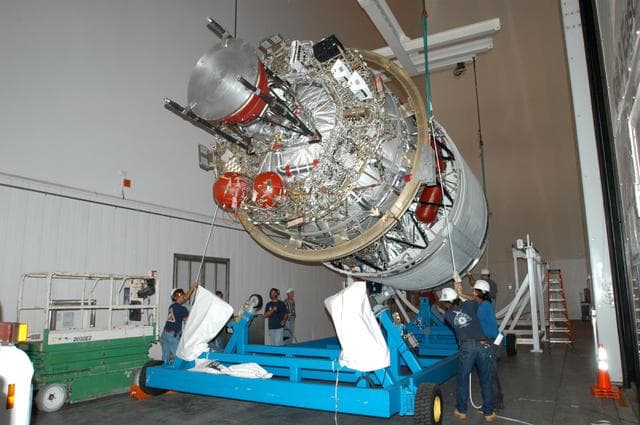
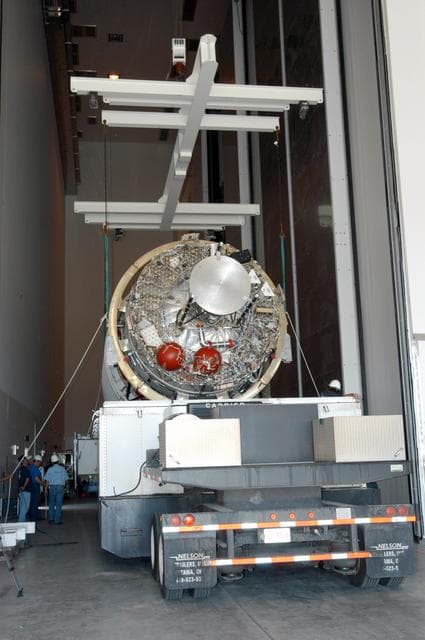
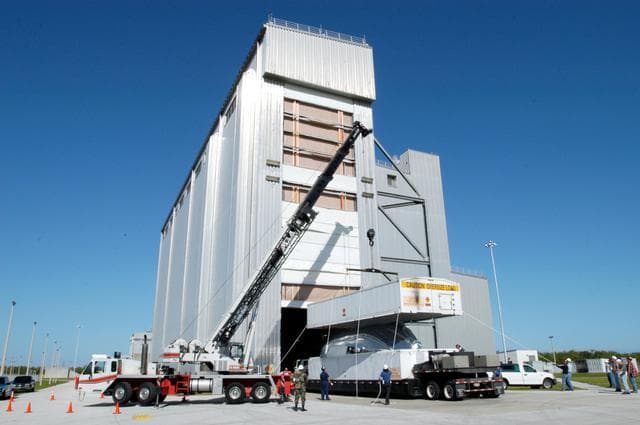
BRUCE BUCKINGHAM: It's a privilege to have Boeing launch manager Rick Navarro here in the studio. Rick, thanks for stopping by. RICK NAVARRO: Thank you, Bruce. BRUCE BUCKINGHAM: As we heard earlier, this mission requires a lot of coordination between Goddard Space Flight Center and Kennedy Space Center. How important is this partnership to ensuring a successful launch and a mission? RICK NAVARRO: It's been crucial in the success of the mission. Getting here involved a lot of coordination between Goddard, Kennedy Space Center and the Boeing launch teams. If it hadn't been for that, we wouldn't be here today getting ready for a launch. BRUCE BUCKINGHAM: Well, tell us how the vehicle and the spacecraft were prepared for launch. RICK NAVARRO: The best way to show you is to roll a tape, in which we show some of the major components coming together. We receive our vehicle hardware from our Decatur production facility via a ship, the Delta Mariner. And we offload that ship and you see there the first stage of the vehicle coming to our facility for horizontal processing. It's a shirt-sleeve working environment. And there, we see the second stage, which we bring to a test facility first. We make sure there was no shipping damage and do a preliminary checkout. Once we're happy with the condition of the second stage, then we will bring it to that first horizontal integration facility. Now, the advantages of that facility is that we perform all our operations indoors, outside of the weather. We are able to lift both of the stages from underneath without using cranes, and we use a precision placer-alignment system that actually cracks the position of the stages and softly and gently mates them, puts them together. When we are done, we will actually be rolling a mated vehicle to the launch pad, both first and second stages. We use a transporter system that picks up the entire vehicle stack and places it on the launch pad. When we go to the launch pad, we park on top of an erection truss we call the 'fixed pad erector.' What this will do is actually take it from the horizontal position and rotate it to vertical. This takes about 20 minutes or so. At that point, we have a vertical vehicle, first and second stage. Around the vehicle will be a mobile service tower we call an ST, which protects it, and at this point we'll bring the solid motors. With the GOES mission, we have two solid rocket motors. We bring those individually to the launch pad, because of the amount of propellant. We carefully place them in an outside facility. We bring them to the launch pad and then we hoist them with a crane on the mobile service tower. We bring them around and next to the vehicle, and mate them one at a time. You see some of the processing that leads us to bring the solid motors to the launch pad. As we mate the solid rocket motors, we now have an integrated vehicle, and when all this comes together, we're able to perform checkout leading to today's countdown. BRUCE BUCKINGHAM: Well, Rick, thanks so much for being with us today, and good luck today with launch. RICK NAVARRO: Thank you. Pleasure to be here.
Most NASA images are in the public domain and free to use. Credit NASA as the source. Check NASA's media usage guidelines for details. Images featuring identifiable individuals may require additional permissions.
NASA ID
ksc_081505_goesn_navarro
Date Created
August 19, 2005
Center
KSC
Media Type
video
Photographer
NASA or National Aeronautics and Space Administration
Download this video in multiple resolutions. All NASA media are free for public use.
Captions
Subtitles