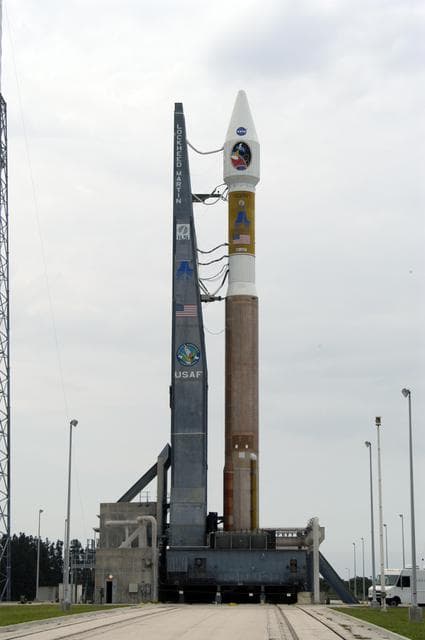
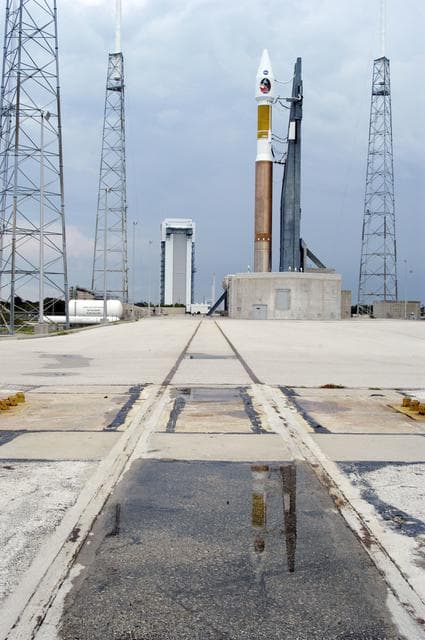
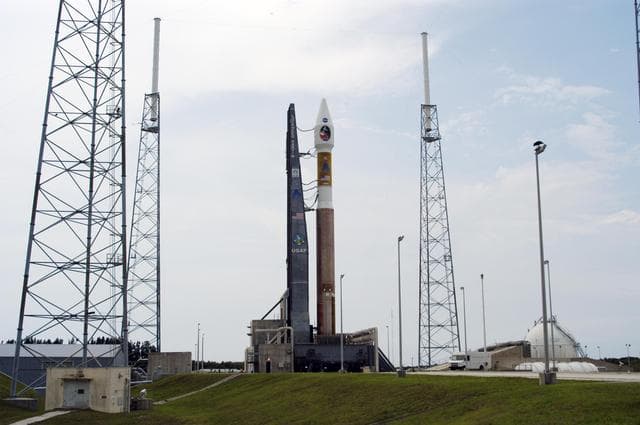
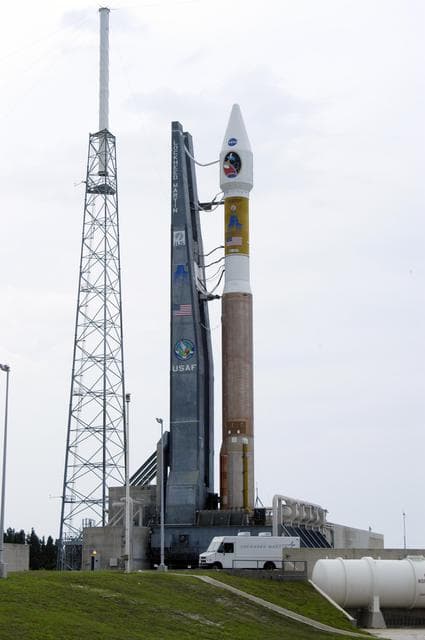
Now here live to talk about launch day and all the preparations leading up to it is MRO Launch Director Chuck Dovale. Thanks for taking time to be with us, Chuck. Thank you, it's great to be here, Tiffany. Launching any rocket is an extremely complex process. Since this is NASA's first launch aboard the Atlas V, were the launch preparations very different? They were quite different for us. As you mentioned, this is the first Atlas V for NASA, as well as the government. Our last Atlas launch was an Atlas II several years ago. So, this being our first Atlas V, there was a lot of work going into familiarizing ourselves with the new launch vehicle, the new complex, and what it would take to launch it. We had to certify the launch vehicle for the first government usage, and that took almost a year and greater than 120 folks to perform that. One very visible task that you'll notice different from an Atlas II is that the launch vehicle is stacked in the Vertical Integration Facility and then rolled out the night of launch. It's not stacked on the launch pad, on a conventional launch pad, like months prior to. So that's one thing that you'll see tomorrow evening: the entire stack rolling out about 10:30 tomorrow. So that was one thing that, one major thing that we had to get used to. Chuck, I believe we have a processing flow tape. Would you take us through what we've done to prepare for launch? Sure. We can roll the tape. Okay, that is a picture of the Vertical Integration Facility that I just mentioned. That's near Complex 41 at Cape Canaveral Air Force Station. There's the common core booster coming into view. This is built by Lockheed Martin in Denver. It was shipped here by air on March 31, and this day is May 6, as it's being erected into the first cell of the Vertical Integration Facility. Booster is about 12-1_2 feet in diameter, 106 feet long. You'll get a good shot here of the Russian-built RD-180 engine that provides almost 900,000 pounds of thrust. There it is, there. It's a combination of liquid oxygen and RP-1, which is refined kerosene that fuels the booster. And it holds 450,000 pounds of liquid oxygen and 169,000 pounds of kerosene. Next up would be the upper stage, the Centaur. It arrived at the Cape air freight as well on June 6th. This was also built in Denver by Lockheed Martin. The VIF doors open up and this was June 17, starting to hoist the Centaur. Centaur is 10 feet in diameter and this particular configuration is 41 feet long. It's powered by a single Pratt-Whitney RL-10 engine which provides almost 22,000 pounds of thrust. Unlike the booster, this is a cryogenic engine, which means it runs on liquid hydrogen and liquid oxygen combination, a very potent combination. This is one of the most powerful upper stages, and it's been the workhorse for us and Lockheed Martin for years. Here it is being lowered into the inner stage. The next scene you'll see is the encapsulated spacecraft, the Mars Reconnaissance Orbiter in the payload fairing, arriving from the Payload Hazardous Servicing Facility. This is Lockheed's four-meter version of the fairing. The spacecraft, when the solar arrays are released, from tip to tip is 14 meters long and it's seven meters high. It weighs about 4,800 pounds, so it's a very heavy spacecraft, especially when compared to the other Mars spacecraft. This was July 28, and that's the configuration that you'll see tomorrow evening as it rolls out at about 10:36 local time tomorrow. We've received questions from viewers about launching this mission. Are you ready to answer some of them? Sure. Okay. Our first question comes from Mark from Bowie. When the countdown clock rolls back to T-45 seconds, what happens from that point? Good question, Mark. You picked probably the most exciting time of the countdown. As you can imagine, at that point there are thousands of measurements being checked and double-checked, either by ground computers or by engineers in the control room. The automatic sequence has started at T-80 seconds, so all systems are internal or on internal, and the tanks are pressurized. The flight computer goes to its inertial mode at T-8 seconds. On the Centaur, there's a forward-adaptor vent door pyrotechnic device that is fired, which actually opens the door and this helps vent the Centaur stage upon ascent. And that's at T-7 seconds. There's a Centaur aft-plate umbilical that's ejected at T-5 seconds. The engines start command to the RD-180, the Russian engine is given, and the Russian engine starts at T-2.7 seconds. Just prior to that, the water-suppression system on the pad is released. We do a final health check in the last milliseconds of the count, and we have liftoff. And upon liftoff and a sense of the rise off the launch pad, the release systems will back out of the way so the vehicle can arrive safely. Our next question comes from Michael from Lancaster: I would like to know how many pounds of thrust each stage of the Atlas V has. Okay, as you saw in the video, the Russian-built RD-180 that powers the common-core booster is almost 900,000 pounds of thrust. It's through two engine chambers, as you can see, it's one engine feeding two chambers. And then the Centaur, the upper stage, provides 22,000 pounds of thrust. Chuck, thanks so much for being here, and good luck on launch day. You're welcome. Thank you.
Most NASA images are in the public domain and free to use. Credit NASA as the source. Check NASA's media usage guidelines for details. Images featuring identifiable individuals may require additional permissions.
NASA ID
ksc_080805_mro_dovale
Date Created
August 24, 2005
Center
KSC
Media Type
video
Photographer
NASA or National Aeronautics and Space Administration
Download this video in multiple resolutions. All NASA media are free for public use.
Captions
Subtitles