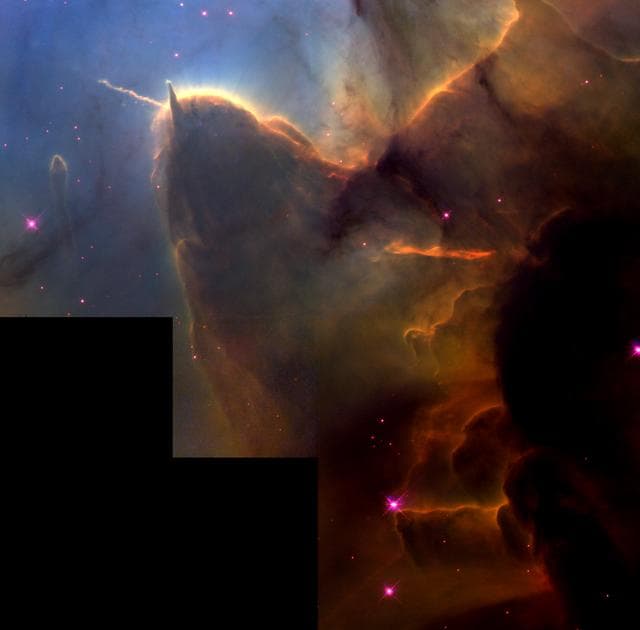
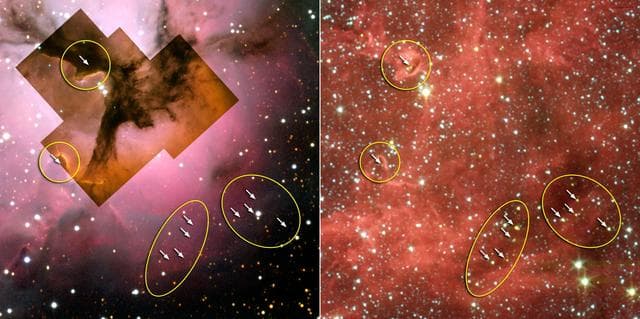
The Hubble Space Telescope has trained its eyes on the Trifid Nebula, a dazzling star nursery 9,000 light-years from Earth. With its three huge intersecting dark lanes of interstellar dust, the Trifid Nebula is easily recognizable in the night sky. In the nebula's center is a group of young, massive 'O-type' stars -- the hottest and bluest type of star known to astronomers. The stars are releasing a flood of ultraviolet radiation that has blown away all the nearby gas and dust. Because there is no more star-forming material in that region, star formation is no longer happening in that particular area. But nearby, there are signs of new stars being born. One is surrounded a protoplanetary disk, which is believed to be an early formation of a planetary system. The spectacular images were taken with Hubble's Wide Field Planetary Camera 2 during the summers of 2001 and 2002. Thanks to this new look at the Trifid Nebula, astronomers are learning much more about how gas, dust, and stars of varying ages interact in space.
Most NASA images are in the public domain and free to use. Credit NASA as the source. Check NASA's media usage guidelines for details. Images featuring identifiable individuals may require additional permissions.
NASA ID
ksc_061404_t-nebula
Date Created
June 14, 2004
Center
KSC
Media Type
video
Photographer
NASA or National Aeronautics and Space Administration
Download this video in multiple resolutions. All NASA media are free for public use.
Captions
Subtitles