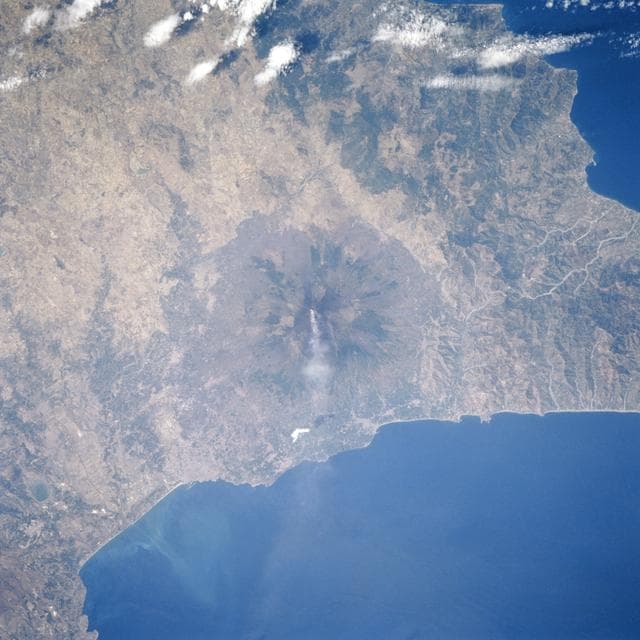
Mount Etna, Sicily taken from Atlantis during STS-106
STS106-706-055 (8-20 September 2000) --- One of the STS-106 crew members on board the Space Shuttle Atlantis used a handheld 70mm camera to photograph this image of the Etna Volcano on Sicily. Mt. Etna is known as the volcano with the longest record of volcanic activity with the first being in 1500 BC. It has erupted many times since then and is almost continuously venting gas and steam, as shown in this view. Astronauts can almost be assured of seeing some venting whenever they fly in orbit. Mt. Etna appears as a cone with an almost circular base in this near-vertical view. The Salso River winds around the western and southern flanks of the volcano. The city of Catania appears as a diffuse gray patch at the foot of the volcano where the river meets the Mediterranean Sea. Mt. Etna has a complex of cones at its summit, which is nearly 3300 meters above sea level. Its slopes are a patchwork of colors, the darker colors being lava flows of different ages. Greens are patches of forest on slopes which have not been disrupted by lava and ash in the last few decades. Mt. Etna is a constructional landform which has been built upwards for millennia; it contrasts subtly but distinctly in this view with the surrounding lower hills which are water-eroded landforms everywhere sculpted into V-shaped valleys by the erosive power of flowing water of streams.
Usage Rights
Most NASA images are in the public domain and free to use. Credit NASA as the source. Check NASA's media usage guidelines for details. Images featuring identifiable individuals may require additional permissions.
Details
NASA ID
STS106-706-055
Date Created
October 4, 2000
Center
JSC
Media Type
image