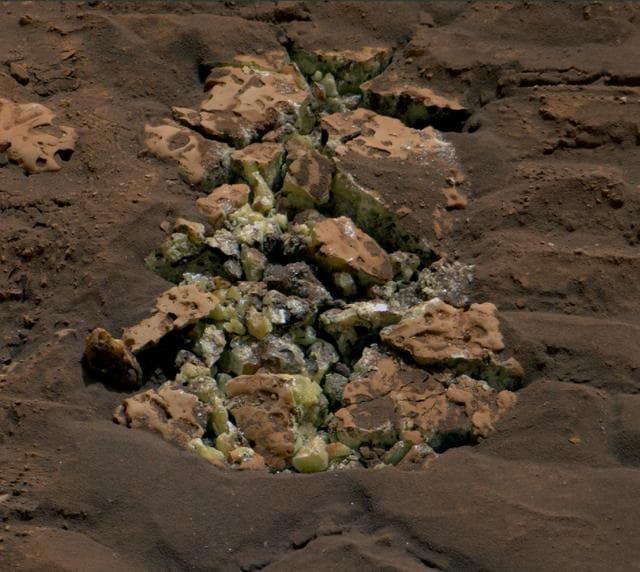
Curiosity Views Sulfur Crystals Within a Crushed Rock
NASA's Curiosity Mars rover viewed these yellow crystals of elemental sulfur using its Mast Camera, or Mastcam, on June 7, 2024, the 4,208th Martian day, or sol, of the mission. The discovery marks the first time this mineral has ever been found in a pure form on Mars. Nicknamed "Convict Lake" after a location in California's Sierra Nevada, this collection of fragments is about 5 inches (13 centimeters) across from left to right. The color has been adjusted to match lighting conditions as the human eye would see them on Earth. These crystals were found after Curiosity happened to drive over and crush the rock several days before, on May 30. The rover later used an instrument on the end of its robotic arm, called the Alpha Particle X-ray Spectrometer, to determine the composition of the rock. Scientists have seen many kinds of sulfur on Mars; the region Curiosity found this rock is, in fact, known for being rich in sulfates – a kind of sulfur-based salt that was left behind as water dried up on this part of the Red Planet billions of years ago. It isn't clear what relationship, if any, the elemental sulfur has to other sulfur-based minerals in the area. Elemental sulfur consists only of pure sulfur atoms, unlike the sulfur bound to oxygen in sulfate. It's an odorless mineral that on Earth is created by a variety of different geological processes, including volcanic and hydrothermal activity. Curiosity's team doesn't yet know which processes would have formed the elemental sulfur found by the rover, but they're searching for clues in the rocks and surrounding area. https://photojournal.jpl.nasa.gov/catalog/PIA26309
Usage Rights
Most NASA images are in the public domain and free to use. Credit NASA as the source. Check NASA's media usage guidelines for details. Images featuring identifiable individuals may require additional permissions.
Details
NASA ID
PIA26309
Date Created
July 18, 2024
Center
JPL
Media Type
image