The Infrared Face of the Andromeda Galaxy
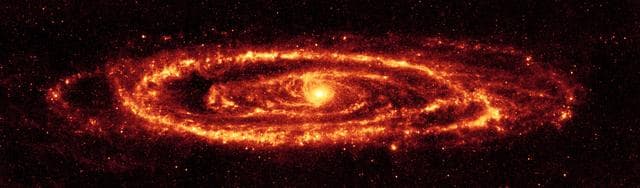
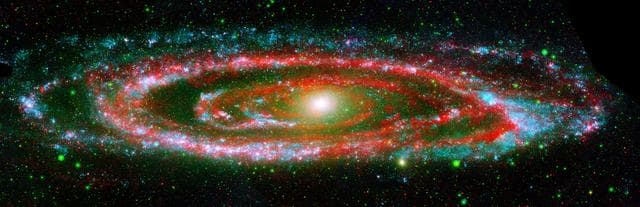
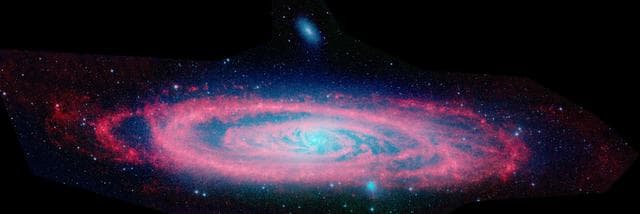
This image from NASA's retired Spitzer Space Telescope highlights the stars and dust clouds in the Andromeda galaxy. One of Earth's nearest galactic neighbors, Andromeda spans a swath of sky nearly 3.8 degrees across, which is close to the width of eight full Moons lined up side by side. The area around the galaxy includes data from NASA's Wide-field Infrared Survey Explorer (WISE). Spitzer observed infrared light, a range of wavelengths longer than what human eyes can detect. In this image, starlight glows blue and cyan (representing infrared wavelengths of 3.6 and 4.5 microns). Dust dominates the galaxy in red (8 microns). The longest wavelength detected by Spitzer (24 microns) gives an indication of the dust's temperature and is represented in green; it combines with the red to create orange and yellow, indicating regions where stars are forming. https://photojournal.jpl.nasa.gov/catalog/PIA26276
Usage Rights
Most NASA images are in the public domain and free to use. Credit NASA as the source. Check NASA's media usage guidelines for details. Images featuring identifiable individuals may require additional permissions.
Keywords
Details
NASA ID
PIA26276
Date Created
May 9, 2024
Center
JPL
Media Type
image
Downloads
Download this image in multiple resolutions. All NASA media are free for public use.