Mastcam-Z's View of 'Franklin Cliffs'
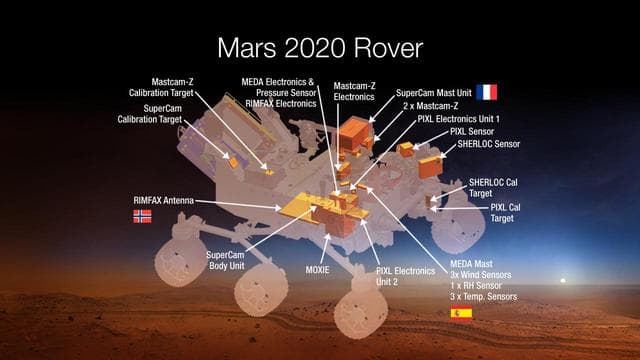
Sedimentary layers at "Franklin Cliffs" are displayed in a mosaic captured by NASA's Perseverance Mars rover using its Mastcam-Z camera on Feb. 12, 2023, the 704th Martian day, or sol, of the mission. The mosaic is made up of three individual images that were stitched together after being sent back from Mars. This natural color view is approximately how the scene would appear to an average person if they were on Mars. Franklin Cliffs, along with other locations like "Skrinkle Haven" and "Pinestand" may have been created as sediment built up here in an ancient river or delta. Arizona State University leads the operations of the Mastcam-Z instrument, working in collaboration with Malin Space Science Systems in San Diego, on the design, fabrication, testing, and operation of the cameras, and in collaboration with the Niels Bohr Institute of the University of Copenhagen on the design, fabrication, and testing of the calibration targets. A key objective for Perseverance's mission on Mars is astrobiology, including the search for signs of ancient microbial life. The rover will characterize the planet's geology and past climate, pave the way for human exploration of the Red Planet, and be the first mission to collect and cache Martian rock and regolith (broken rock and dust). Subsequent NASA missions, in cooperation with ESA (European Space Agency), would send spacecraft to Mars to collect these sealed samples from the surface and return them to Earth for in-depth analysis. The Mars 2020 Perseverance mission is part of NASA's Moon to Mars exploration approach, which includes Artemis missions to the Moon that will help prepare for human exploration of the Red Planet. https://photojournal.jpl.nasa.gov/catalog/PIA25911
Usage Rights
Most NASA images are in the public domain and free to use. Credit NASA as the source. Check NASA's media usage guidelines for details. Images featuring identifiable individuals may require additional permissions.
Details
NASA ID
PIA25911
Date Created
May 11, 2023
Center
JPL
Media Type
image
Downloads
Download this image in multiple resolutions. All NASA media are free for public use.