Magnetic Fields Around an Ultraluminous X-ray Source (Illustration)
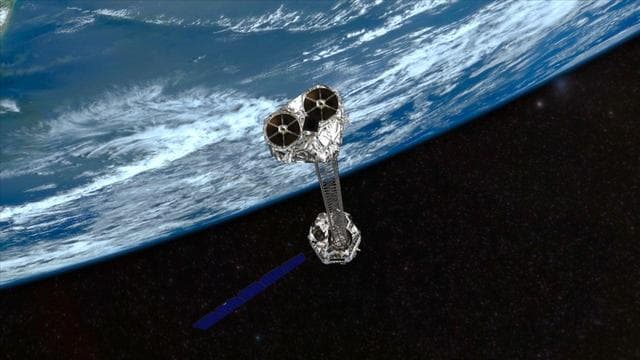
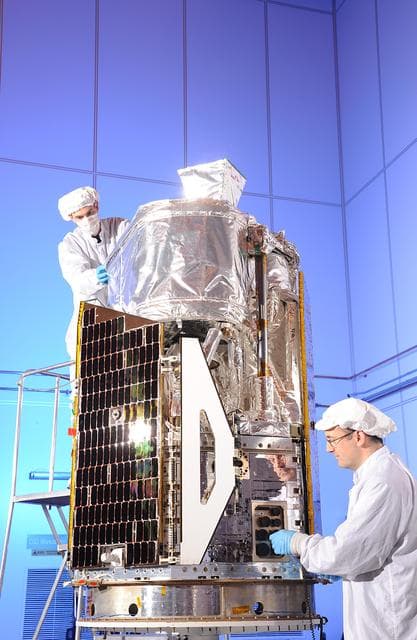
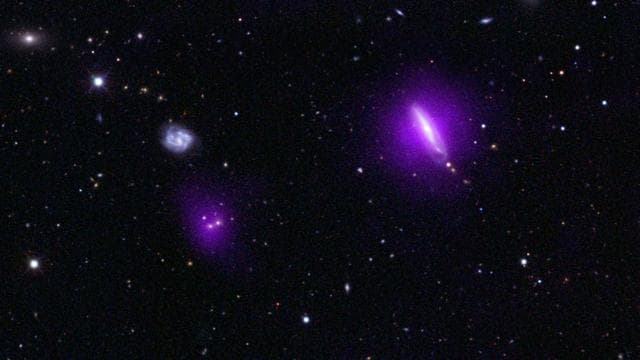
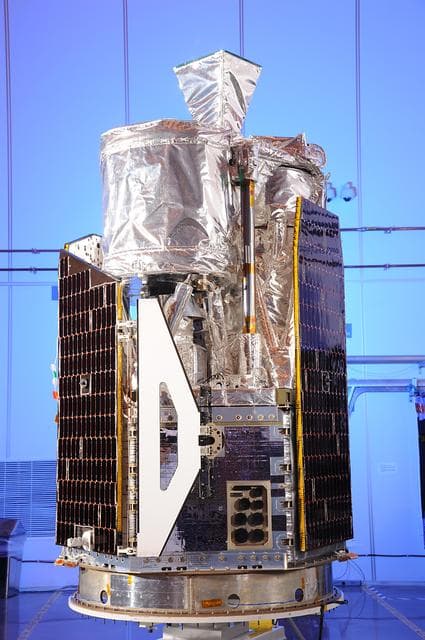
Two rivers of hot gas are siphoned onto the surface of a neutron star (the collapsed remains of a dead star) in this illustration. Neutron stars pack roughly the mass of our Sun into an area about 10 miles (6 kilometers) across. The gravity at the neutron star's surface is about 100 trillion times stronger than the gravitational pull on Earth's surface. Under those conditions, the captured gas accelerates to millions of miles per hour, releasing tremendous energy and radiation when it hits the neutron star's surface. Because these sources of light emit primarily X-rays, they are known as ultra-luminous X-ray sources (ULXs), and are visible by telescopes like NASA's NuSTAR (the Nuclear Spectroscopic Telescope Array). The neutron star's twisted magnetic field lines are illustrated in green. Some scientists hypothesize that strong magnetic fields like the ones produced by neutron stars can distort the normal shape of atoms from roughly spherical to elongated, stringy shapes. This may ultimately increase an object's maximum possible brightness. https://photojournal.jpl.nasa.gov/catalog/PIA25781
Usage Rights
Most NASA images are in the public domain and free to use. Credit NASA as the source. Check NASA's media usage guidelines for details. Images featuring identifiable individuals may require additional permissions.
Keywords
Details
NASA ID
PIA25781
Date Created
April 6, 2023
Center
JPL
Media Type
image
Downloads
Download this image in multiple resolutions. All NASA media are free for public use.