NASA's Europa Clipper Gets Its Reaction Wheels
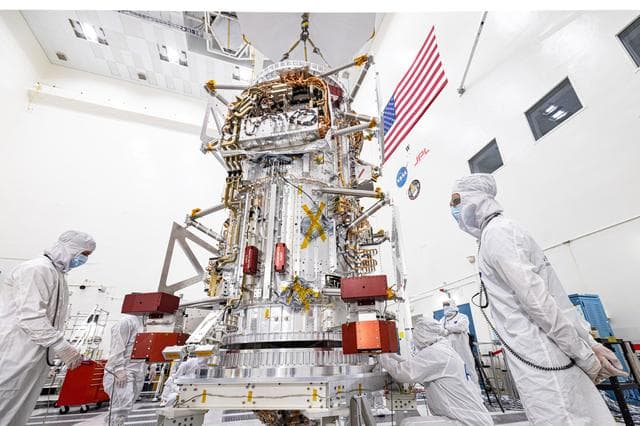
Engineers install 2-foot-wide reaction wheels onto the main body of NASA's Europa Clipper spacecraft at the agency's Jet Propulsion Laboratory in Southern California. In all, four wheels were integrated onto the spacecraft, which is being assembled for its launch to Jupiter's moon Europa in October 2024. When the spacecraft heads through deep space, slips into orbit around Jupiter, and collects science observations while flying dozens of times by Europa, the wheels rotate the orbiter so that its antennas can communicate with Earth and so its science instruments, including cameras, can stay oriented toward Europa. Two feet wide and made of steel, aluminum, and titanium, the wheels spin rapidly to create a force that causes the orbiter to rotate in the opposite direction. The wheels will run on electricity provided by the spacecraft's vast solar arrays. The green tape that is visible here keeps cables temporarily secured during the wheel installation. Scientists believe the icy moon Europa harbors a vast internal ocean that may have conditions suitable for supporting life. Europa Clipper will fly by the moon about 50 times while its suite of science instruments gathers data on the moon's atmosphere, surface, and interior – information that will help scientists learn more about the ocean, the ice crust, and potential plumes that may be venting subsurface water into space. https://photojournal.jpl.nasa.gov/catalog/PIA25494
Usage Rights
Most NASA images are in the public domain and free to use. Credit NASA as the source. Check NASA's media usage guidelines for details. Images featuring identifiable individuals may require additional permissions.
Keywords
Details
NASA ID
PIA25494
Date Created
November 23, 2022
Center
JPL
Media Type
image
Downloads
Download this image in multiple resolutions. All NASA media are free for public use.