A Striking Crater on Jupiter's Moon Ganymede
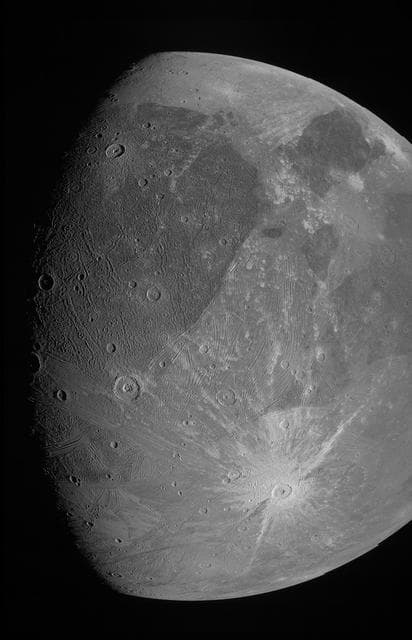
This look at the complex surface of Jupiter's moon Ganymede came from NASA's Juno mission during a close pass by the giant moon in June 2021. At closest approach, the spacecraft came within just 650 miles (1,046 kilometers) of Ganymede's surface. Most of Ganymede's craters have bright rays extending from the impact scar, but about 1 percent of the craters have dark rays. This image taken by JunoCam during the close Ganymede pass shows one of the dark-rayed craters. The crater, named Kittu, is about 9 miles (15 kilometers) across, surrounded by darker material ejected during the impact that formed the crater. Scientists believe that contamination from the impactor produced the dark rays. As time passes, the rays stay dark because they are a bit warmer than the surroundings, so ice is driven off to condense on nearby colder, brighter terrain. Ganymede is the largest moon in our solar system, larger even than the planet Mercury. It's the only moon known to have its own magnetic field, which causes auroras that circle the moon's poles. Evidence also indicates Ganymede may hide a liquid water ocean beneath its icy surface. Citizen scientist Thomas Thomopoulos created this enhanced-color image using data from the JunoCam camera. The original image was taken on June 7, 2021. https://photojournal.jpl.nasa.gov/catalog/PIA25012
Usage Rights
Most NASA images are in the public domain and free to use. Credit NASA as the source. Check NASA's media usage guidelines for details. Images featuring identifiable individuals may require additional permissions.
Details
NASA ID
PIA25012
Date Created
February 22, 2022
Center
JPL
Media Type
image
Downloads
Download this image in multiple resolutions. All NASA media are free for public use.