Jupiter's Great Red Spot: Both Deep and Wide
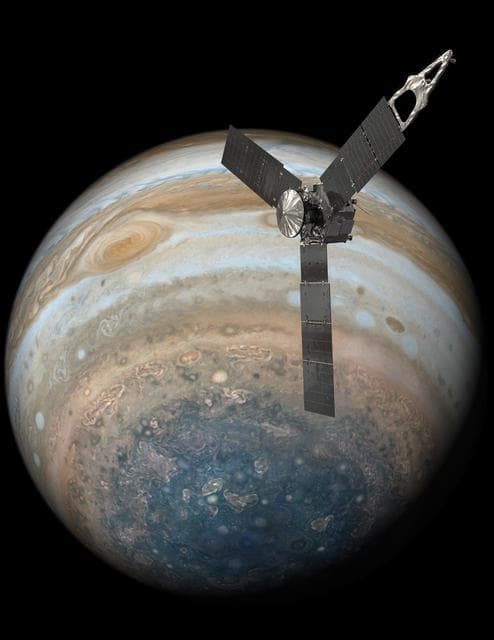
NASA's Juno spacecraft captured this detailed look at Jupiter's most recognizable feature, the Great Red Spot. Data from Juno's instruments indicate this giant, long-lived vortex extends far deeper into Jupiter's atmosphere than scientists previously expected, to about 300 miles (500 kilometers) below the cloud tops. The surprising discovery demonstrates that the Great Red Spot and other vortices descend below the depth where sunlight warms the atmosphere, providing new clues about the inner workings of the planet's beautiful but violent atmosphere. Researchers published the findings in the journal Science in Oct. 2021: https://www.nasa.gov/press-release/nasa-s-juno-science-results-offer-first-3d-view-of-jupiter-atmosphere Citizen scientist Andrea Luck processed this image from raw JunoCam data. The original image was taken on July 10, 2017, at 07:10 p.m. PDT (10:10 p.m. EDT), as the Juno spacecraft performed its seventh close flyby of Jupiter. At the time, the spacecraft was about 8,600 miles (13,840 kilometers) from the cloud tops, above latitude 33 degrees south. https://photojournal.jpl.nasa.gov/catalog/PIA25011
Usage Rights
Most NASA images are in the public domain and free to use. Credit NASA as the source. Check NASA's media usage guidelines for details. Images featuring identifiable individuals may require additional permissions.
Details
NASA ID
PIA25011
Date Created
December 7, 2021
Center
JPL
Media Type
image
Downloads
Download this image in multiple resolutions. All NASA media are free for public use.