Measuring the Gravity of Jupiter's Great Red Spot
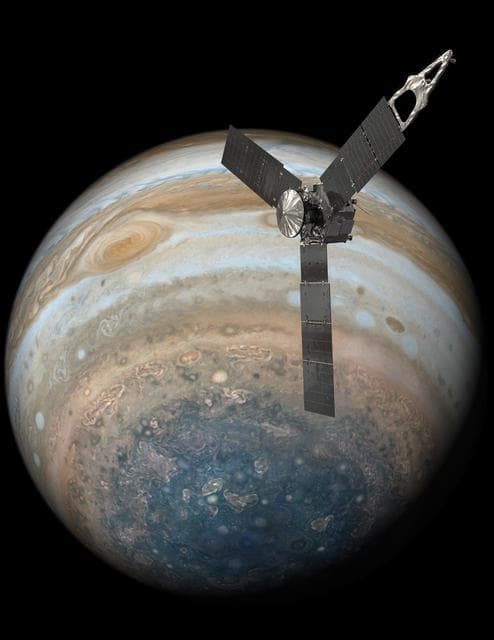
This representation depicts how NASA's Juno mission obtained gravity science data of Jupiter's Great Red Spot. The Juno spacecraft flew twice over the crimson vortex in 2019 at low altitudes with the goal of picking up its subtle gravitational signal. The concentration of mass related to the powerful winds surrounding the Great Red Spot induced a minute Doppler shift in the spacecraft's radio signals that could be measured by a NASA's Deep Space Network tracking antenna on Earth. With Juno traveling at about 130,000 mph (209,000 kph) over Jupiter's cloud deck, mission scientists were able to measure velocity changes as small 0.01 millimeter per second This enabled them to constrain the depth of the Great Red Spot to about 186 miles (300 kilometers) below the cloud tops. https://photojournal.jpl.nasa.gov/catalog/PIA24820
Usage Rights
Most NASA images are in the public domain and free to use. Credit NASA as the source. Check NASA's media usage guidelines for details. Images featuring identifiable individuals may require additional permissions.
Details
NASA ID
PIA24820
Date Created
October 28, 2021
Center
JPL
Media Type
image
Downloads
Download this image in multiple resolutions. All NASA media are free for public use.