A Mushball and Shallow-Lightning Factory (Illustration)
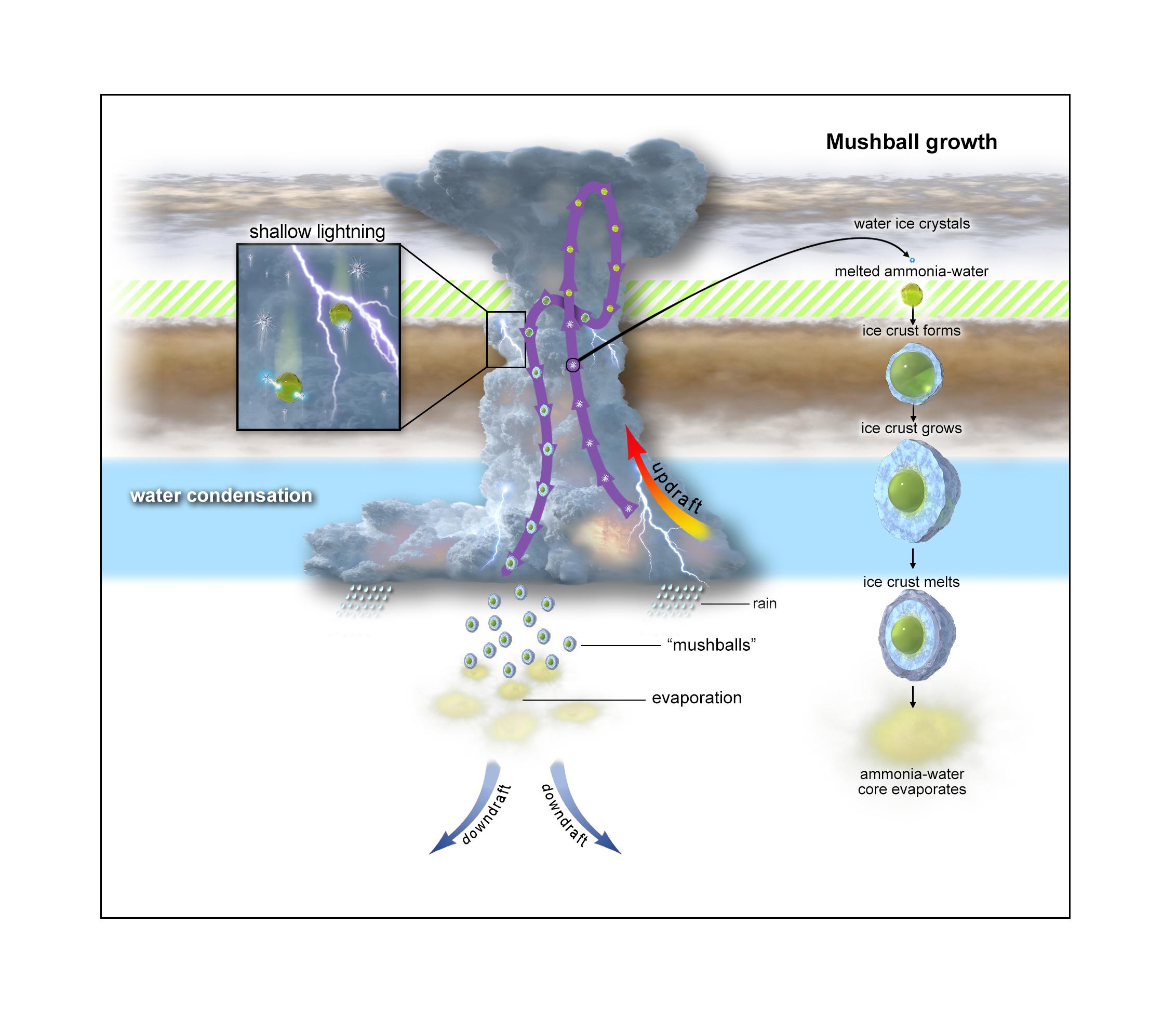
This graphic depicts the evolutionary process of "shallow lightning" and ammonia-water hailstones called "mushballs." An anvil-shaped thunderstorm cloud originates about 40 miles (65 kilometers) below Jupiter's visible cloud deck. Powered by water-based moist convection, the cloud generates strong updrafts that move liquid water and water ice particles upward. About 12 miles (19 kilometers) up, temperatures are so low that all of the water particles turn to ice. Still climbing, the ice particles cross a region located about 14 miles (23 kilometers) below the upper clouds, where temperatures are between minus 121 degrees Fahrenheit (minus 85 degrees Celsius) and minus 150 degrees Fahrenheit (minus 100 degrees Celsius), (depicted as green-hashed layer). At that point, ammonia vapor in the atmosphere acts like an antifreeze, melting the water-ice crystals, transforming them into ammonia-water liquid droplets which then grow and gather a solid icy shell to become mushballs. Once big enough, these slushy hailstones fall down, transporting both ammonia and water into Jupiter's deep atmosphere where the mushballs eventually evaporate. https://photojournal.jpl.nasa.gov/catalog/PIA24042
Usage Rights
Most NASA images are in the public domain and free to use. Credit NASA as the source. Check NASA's media usage guidelines for details. Images featuring identifiable individuals may require additional permissions.
Keywords
Details
NASA ID
PIA24042
Date Created
August 5, 2020
Center
JPL
Media Type
image
Downloads
Download this image in multiple resolutions. All NASA media are free for public use.