Night on Europa (Illustration)
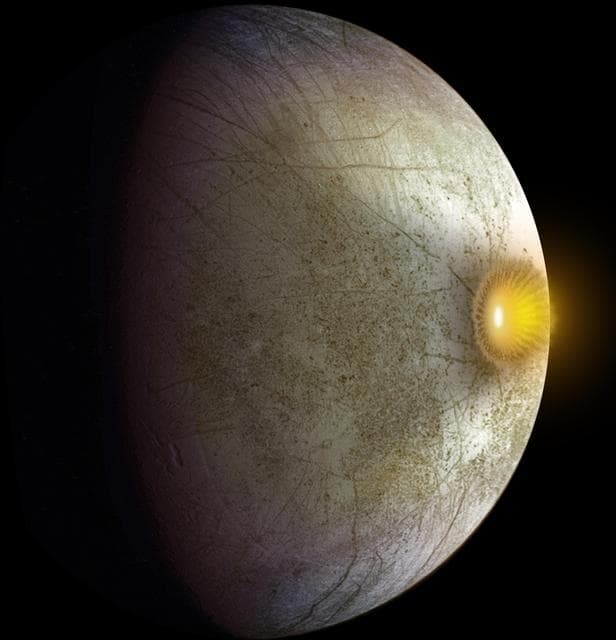
This illustration of Jupiter's moon Europa shows how the icy surface may glow on its nightside, the side facing away from the Sun. New lab experiments re-created the environment of Europa and find that the icy moon shines, even on its nightside, due to an ice glow. As Jupiter bombards Europa with radiation, the electrons penetrate the surface, energizing the molecules underneath. When those molecules relax, they release energy as visible light. Variations in the glow and the color of the glow itself could reveal information about the composition of ice on Europa's surface. Different salty compounds react differently to the radiation and emit their own unique glimmer. Color will vary based on the real composition of Europa's surface. https://photojournal.jpl.nasa.gov/catalog/PIA24028
Usage Rights
Most NASA images are in the public domain and free to use. Credit NASA as the source. Check NASA's media usage guidelines for details. Images featuring identifiable individuals may require additional permissions.
Keywords
Details
NASA ID
PIA24028
Date Created
November 9, 2020
Center
JPL
Media Type
image
Downloads
Download this image in multiple resolutions. All NASA media are free for public use.