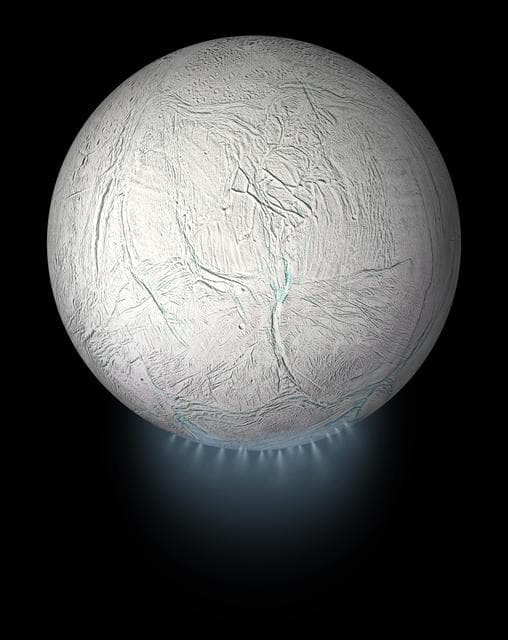
Enceladus Organics on Grains of Ice (Illustration)
This illustration shows how newly discovered organic compounds — the ingredients of amino acids — were detected by NASA's Cassini spacecraft in the ice grains emitted from Saturn's moon Enceladus. Powerful hydrothermal vents eject material from Enceladus' core into the moon's massive subsurface ocean. After mixing with the water, the material is released into space as water vapor and ice grains. Condensed onto the ice grains are nitrogen- and oxygen-bearing organic compounds. On Earth hydrothermal vents on the ocean floor provide the energy that fuels reactions that produce amino acids, the building blocks of life. Scientists believe Enceladus' hydrothermal vents may operate in the same way, supplying energy that leads to the production of amino acids. https://photojournal.jpl.nasa.gov/catalog/PIA23173
Usage Rights
Most NASA images are in the public domain and free to use. Credit NASA as the source. Check NASA's media usage guidelines for details. Images featuring identifiable individuals may require additional permissions.
Keywords
Details
NASA ID
PIA23173
Date Created
October 2, 2019
Center
JPL
Media Type
image
Downloads
Download this image in multiple resolutions. All NASA media are free for public use.