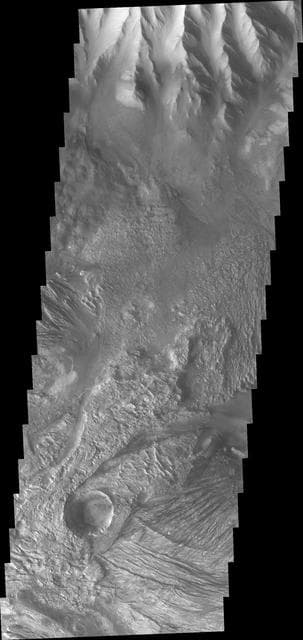
Investigating Mars: Candor Chasma
This THEMIS image shows part of western Candor Chasma. Near the bottom of the image is an impact crater. Impact craters are relatively rare within all the canyons of Valles Marineris. The lack of craters may be due to the relative young age of the canyon system - younger surfaces on Mars have fewer craters than older surfaces. Another factor is that the high rate of erosion and deposition within the canyon erodes the ejecta blanket and fills in the crater, effectively removing the crater over time. Candor Chasma is one of the largest canyons that make up Valles Marineris. It is approximately 810 km long (503 miles) and has is divided into two regions - eastern and western Candor. Candor is located south of Ophir Chasma and north of Melas Chasma. The border with Melas Chasma contains many large landslide deposits. The floor of Candor Chasma includes a variety of landforms, including layered deposits, dunes, landslide deposits and steep sided cliffs and mesas. Many forms of erosion have shaped Chandor Chasma. There is evidence of wind and water erosion, as well as significant gravity driven mass wasting (landslides). The Odyssey spacecraft has spent over 15 years in orbit around Mars, circling the planet more than 69000 times. It holds the record for longest working spacecraft at Mars. THEMIS, the IR/VIS camera system, has collected data for the entire mission and provides images covering all seasons and lighting conditions. Over the years many features of interest have received repeated imaging, building up a suite of images covering the entire feature. From the deepest chasma to the tallest volcano, individual dunes inside craters and dune fields that encircle the north pole, channels carved by water and lava, and a variety of other feature, THEMIS has imaged them all. For the next several months the image of the day will focus on the Tharsis volcanoes, the various chasmata of Valles Marineris, and the major dunes fields. We hope you enjoy these images! Orbit Number: 16479 Latitude: -5.02282 Longitude: 284.268 Instrument: VIS Captured: 2005-09-01 04:09 https://photojournal.jpl.nasa.gov/catalog/PIA22166
Usage Rights
Most NASA images are in the public domain and free to use. Credit NASA as the source. Check NASA's media usage guidelines for details. Images featuring identifiable individuals may require additional permissions.
Keywords
Details
NASA ID
PIA22166
Date Created
January 15, 2018
Center
JPL
Media Type
image
Downloads
Download this image in multiple resolutions. All NASA media are free for public use.


