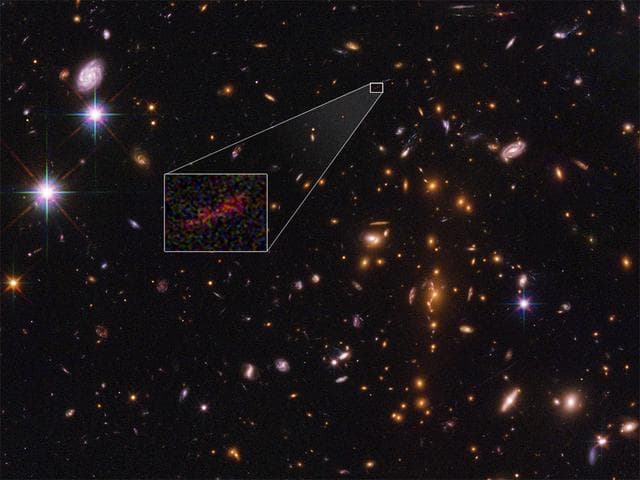
NASA's Hubble Spots Embryonic Galaxy SPT0615-JD
This Hubble Space Telescope image shows the farthest galaxy yet seen in an image that has been stretched and amplified by a phenomenon called gravitational lensing. The embryonic galaxy, named SPT0615-JD, existed when the universe was just 500 million years old. Though a few other primitive galaxies have been seen at this early epoch, they have essentially all looked like red dots, given their small size and tremendous distances. However, in this case, the gravitational field of a massive foreground galaxy cluster, called SPT-CL J0615-5746, not only amplified the light from the background galaxy but also smeared the image of it into an arc (about 2 arcseconds long). Image analysis shows that the galaxy weighs in at no more than 3 billion solar masses (roughly 1/100th the mass of our fully grown Milky Way galaxy). It is less than 2,500 light-years across, half the size of the Small Magellanic Cloud, a satellite galaxy of our Milky Way. The object is considered prototypical of young galaxies that emerged during the epoch shortly after the big bang. https://photojournal.jpl.nasa.gov/catalog/PIA22079
Usage Rights
Most NASA images are in the public domain and free to use. Credit NASA as the source. Check NASA's media usage guidelines for details. Images featuring identifiable individuals may require additional permissions.
Details
NASA ID
PIA22079
Date Created
January 11, 2018
Center
JPL
Media Type
image
Downloads
Download this image in multiple resolutions. All NASA media are free for public use.