Rosetta Moving Cometary Boulder
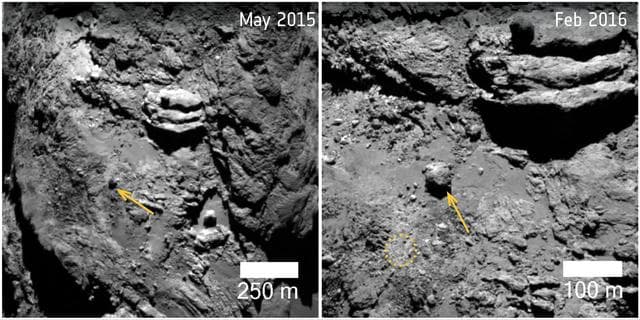
A 100 foot-wide (30 meter), 28-million-pound (12.8-million-kilogram) boulder, was found to have moved 460 feet (140 meters) on comet 67P/Churyumov-Gerasimenko in the lead up to perihelion in August 2015, when the comet's activity was at its highest. In both images, an arrow points to the boulder; in the right-hand image, the dotted circle outlines the original location of the boulder for reference. The movement could have been triggered in one of two ways: either the material on which it was sitting eroded away, allowing it to roll downslope, or a sufficiently forceful outburst could have directly lifted it to the new location. Indeed, several outburst events were detected close to the original position of the boulder during perihelion. The images were taken by Rosetta's OSIRIS camera on May 2, 2015 (left) and Feb. 7, 2016 (right), with resolutions of 7.5 feet (2.3 meters) per pixel and 2.6 feet (0.8 meters) per pixel, respectively. http://photojournal.jpl.nasa.gov/catalog/PIA21565
Usage Rights
Most NASA images are in the public domain and free to use. Credit NASA as the source. Check NASA's media usage guidelines for details. Images featuring identifiable individuals may require additional permissions.
Details
NASA ID
PIA21565
Date Created
March 21, 2017
Center
JPL
Media Type
image