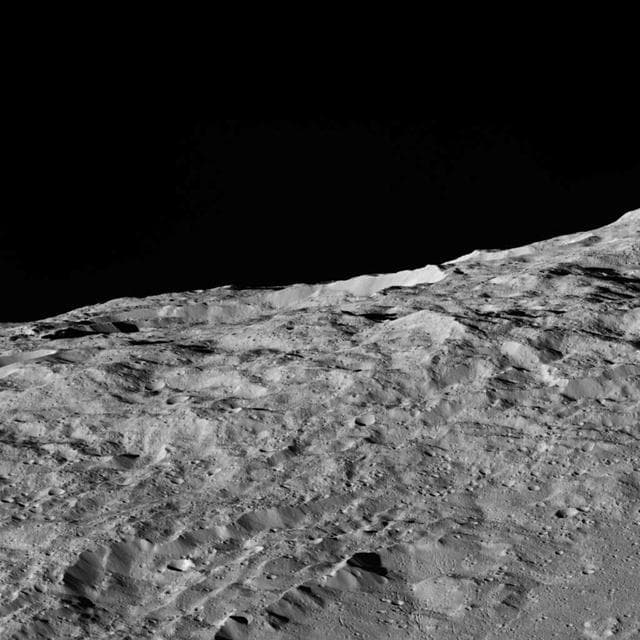
Hakumyi Crater from LAMO
This close-up view of Hakumyi crater, as seen by NASA's Dawn spacecraft, provides insight into the origin of the small crater and lobe-shaped flow next to its southern rim. The sharp edges of these features indicate they are relatively recent with respect to the more subdued Hakumyi, which is 43 miles (70 kilometers) wide. The lobate flow ends in a tongue-shaped deposit. A more discrete feature slightly west (left) of the large lobe-shaped flow suggests an ancient or partially developed lobe. These kinds of flow features, which typically are found at high latitudes on Ceres, are expressions of what is termed "mass wasting," meaning the downslope movement of material. This process is initiated by slumping or detachment of material from crater rims. Here the process seems to have been triggered by small craters whose remnant shapes can be discerned at the top of each flow. Dawn took this image from its low-altitude mapping orbit, or LAMO, at a distance of about 240 miles (385 kilometers) above the surface. The center coordinates of this image are 52 degrees North latitude and 26 degrees east longitude. https://photojournal.jpl.nasa.gov/catalog/PIA21414
Usage Rights
Most NASA images are in the public domain and free to use. Credit NASA as the source. Check NASA's media usage guidelines for details. Images featuring identifiable individuals may require additional permissions.
Details
NASA ID
PIA21414
Date Created
July 20, 2017
Center
JPL
Media Type
image
Downloads
Download this image in multiple resolutions. All NASA media are free for public use.