Hakumyi Crater
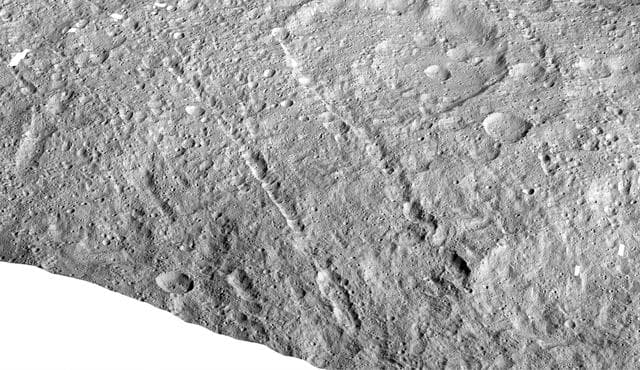
NASA's Dawn spacecraft took this image of Hakumyi Crater on Ceres, visible left of center. The crater is named after a Paraguayan, Brazilian and Bolivian spirit said to be helpful in gardening. Hakumyi, 18 miles (29 kilometers) in diameter, is located about 43 miles (70 kilometers) west of Ernutet Crater. Ernutet is where scientists found evidence of organic material, thanks to Dawn's visible and infrared mapping spectrometer. Evidence for organics was also found at the 4-mile (6.5 kilometer) wide fresh crater on the southern rim of Hakumyi and on the lobe-shaped flow of material that runs into Hakumyi. These two features look relatively young in comparison to the rest of Hakumyi Crater, whose rims and overall shape are subdued. The lobate flow is reminiscent of the Type I flows identified in multiple places at high latitudes on Ceres, and suggests a significant amount of ice near the surface. Dawn took this image on August 20, 2015, from 915 miles (1,470 kilometers) altitude. The center coordinates of this image are 48.9 degrees north latitude and 27.0 degrees east longitude. https://photojournal.jpl.nasa.gov/catalog/PIA21413
Usage Rights
Most NASA images are in the public domain and free to use. Credit NASA as the source. Check NASA's media usage guidelines for details. Images featuring identifiable individuals may require additional permissions.
Keywords
Details
NASA ID
PIA21413
Date Created
July 6, 2017
Center
JPL
Media Type
image
Downloads
Download this image in multiple resolutions. All NASA media are free for public use.