Yalode Crater on Ceres
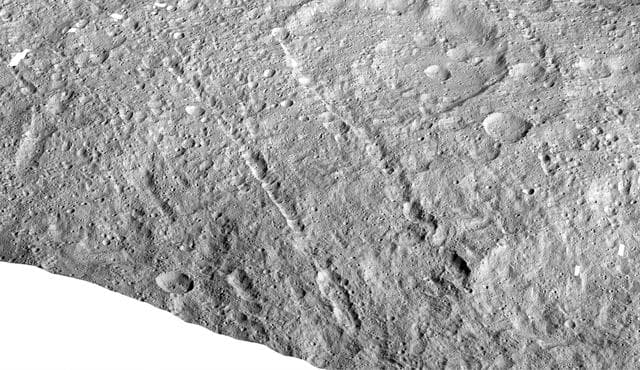
Yalode crater is so large -- at 162 miles, 260 kilometers in diameter -- that a variety of vantage points is necessary to understand its geological context. This view of the northern portion of Yalode is one of many images NASA's Dawn spacecraft has taken of this crater. The large impact that formed the crater likely involved a lot of heat, which explains the relatively smooth crater floor punctuated by smaller craters. A couple of larger craters in Yalode have polygonal shapes. This type of crater shape is frequently found on Ceres and may be indicative of extensive underground fractures. The larger crater to the right of center in this image is called Lono (12 miles, 20 kilometers in diameter) and the one below it is called Besua (11 miles, 17 kilometers). Some of the small craters are accompanied by ejecta blankets that are more reflective than their surroundings. The strange Nar Sulcus fractures can be seen in the bottom left corner of the picture. Linear features seen throughout the image may have formed when material collapsed above empty spaces underground. These linear features include linear chains of craters called catenae. Dawn took this image on September 27, 2015, from 915 miles (1,470 kilometers) altitude. The center coordinates of this image are 32 degrees south latitude and 300 degrees east longitude. Yalode gets its name from a goddess worshipped by women at the harvest rites in the Dahomey culture of western Africa. Besua takes its name from the Egyptian grain god, and Lono from the Hawaiian god of agriculture. https://photojournal.jpl.nasa.gov/catalog/PIA21410
Usage Rights
Most NASA images are in the public domain and free to use. Credit NASA as the source. Check NASA's media usage guidelines for details. Images featuring identifiable individuals may require additional permissions.
Keywords
Details
NASA ID
PIA21410
Date Created
June 28, 2017
Center
JPL
Media Type
image
Downloads
Download this image in multiple resolutions. All NASA media are free for public use.