Inamahari Crater
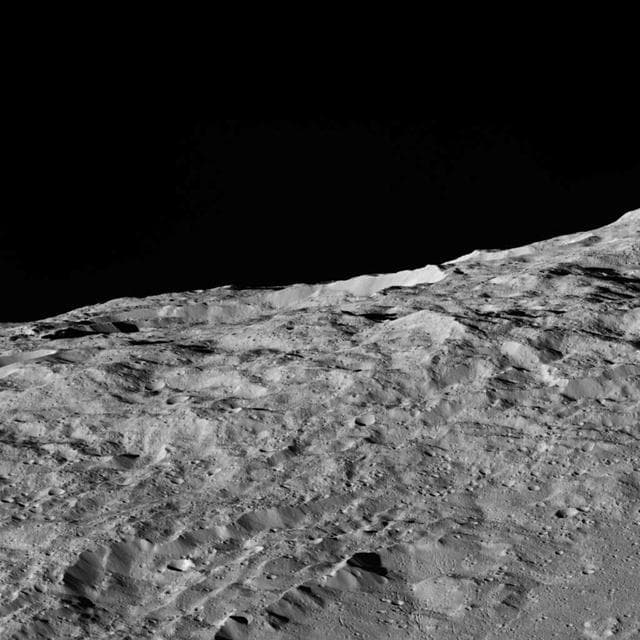
Inamahari Crater on Ceres, the large well-defined crater at the center of this image, is one of the sites where scientists have discovered evidence for organic material. The crater, 42 miles (68 kilometers) in diameter, presents other interesting attributes. It has a polygonal shape and an association with another crater of similar size and geometry called Homshuk (center right), although the latter appears eroded and is likely older. Future studies of Inamahari crater and surroundings may help uncover the mechanisms involved in the exposure of organic material onto Ceres' surface. Inamahari was named for a pair of male and female deities from the ancient Siouan tribe of South Carolina, invoked for a successful sowing season. Homshuk refers to the spirit of corn (maize) from the Popoluca peoples of southern Mexico. Inamahari is located at 14 degrees north latitude, 89 degrees east longitude. This picture was taken by NASA's Dawn on September 25, 2015 from an altitude of about 915 miles (1,470 kilometers). It has a resolution of 450 feet (140 meters) per pixel. https://photojournal.jpl.nasa.gov/catalog/PIA21402
Usage Rights
Most NASA images are in the public domain and free to use. Credit NASA as the source. Check NASA's media usage guidelines for details. Images featuring identifiable individuals may require additional permissions.
Details
NASA ID
PIA21402
Date Created
April 13, 2017
Center
JPL
Media Type
image
Downloads
Download this image in multiple resolutions. All NASA media are free for public use.