Fejokoo Crater
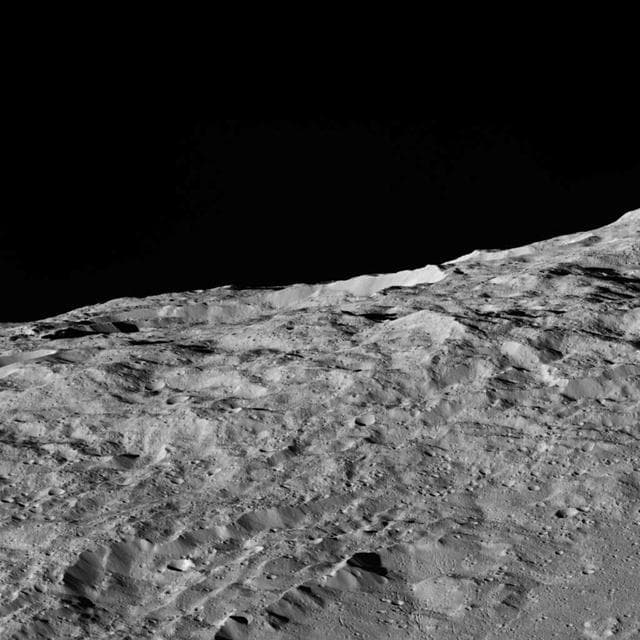
NASA's Dawn mission has found that craters on Ceres show a diversity of shapes that provide important clues about the structure of Ceres' subsurface. The bottom half of this pair of craters is called Fejokoo, named after the Nigerian god who supplied yams. The hexagonal shape of that 42-mile (68-kilometer) crater is probably due to the presence of fractures in the crust, along which the crater rims tend to align. Polygonal craters are frequent on Ceres. Most display six or seven sides, like in the case of Fejokoo, but a few nonagons -- nine-sided shapes -- have been discovered. Polygonal craters are also commonly found on other solar system bodies, such as Mars, Earth's moon and icy moons of giant planets. Dawn took this image on May 4, 2015, from an altitude of 915 miles (1,470 kilometers). The image has a resolution of 450 feet (140 meters) per pixel. http://photojournal.jpl.nasa.gov/catalog/PIA21399
Usage Rights
Most NASA images are in the public domain and free to use. Credit NASA as the source. Check NASA's media usage guidelines for details. Images featuring identifiable individuals may require additional permissions.
Details
NASA ID
PIA21399
Date Created
March 17, 2017
Center
JPL
Media Type
image
Downloads
Download this image in multiple resolutions. All NASA media are free for public use.