Zoom-in on Epimetheus
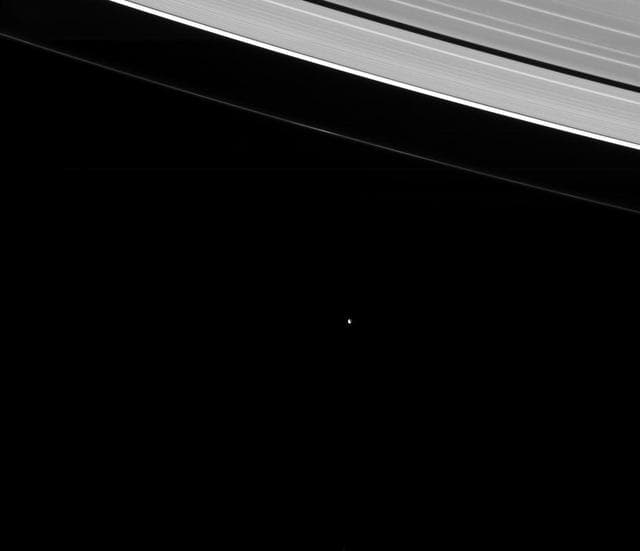
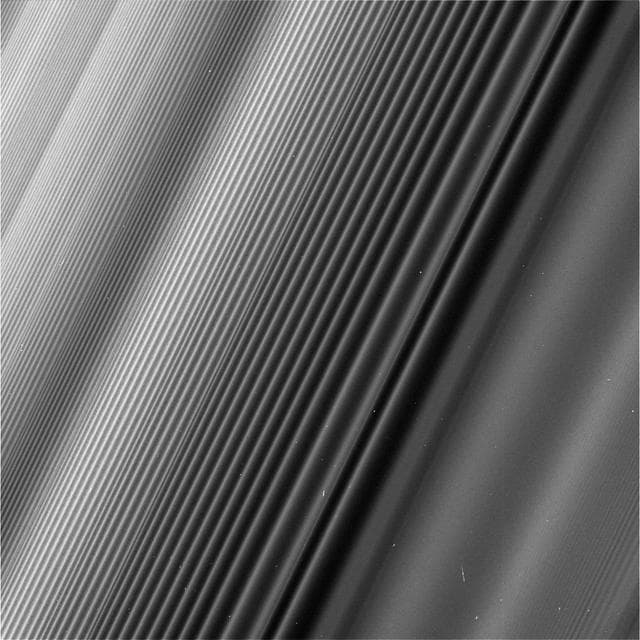
This zoomed-in view of Epimetheus, one of the highest resolution ever taken, shows a surface covered in craters, vivid reminders of the hazards of space. Epimetheus (70 miles or 113 kilometers across) is too small for its gravity to hold onto an atmosphere. It is also too small to be geologically active. There is therefore no way to erase the scars from meteor impacts, except for the generation of new impact craters on top of old ones. This view looks toward anti-Saturn side of Epimetheus. North on Epimetheus is up and rotated 32 degrees to the right. The image was taken with the Cassini spacecraft narrow-angle camera on Feb. 21, 2017 using a spectral filter which preferentially admits wavelengths of near-infrared light centered at 939 nanometers. The view was acquired at a distance of approximately 9,300 miles (15,000 kilometers) from Epimetheus and at a Sun-Epimetheus-spacecraft, or phase, angle of 71 degrees. Image scale is 290 feet (89 meters) per pixel. https://photojournal.jpl.nasa.gov/catalog/PIA21335
Usage Rights
Most NASA images are in the public domain and free to use. Credit NASA as the source. Check NASA's media usage guidelines for details. Images featuring identifiable individuals may require additional permissions.
Keywords
Details
NASA ID
PIA21335
Date Created
July 3, 2017
Center
JPL
Media Type
image
Downloads
Download this image in multiple resolutions. All NASA media are free for public use.