Beautiful Blocks of Bedrock
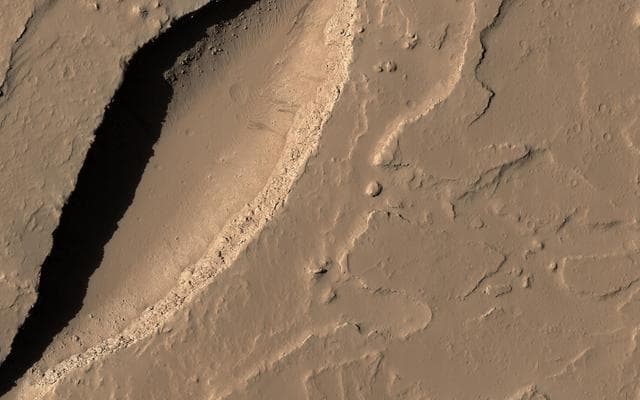
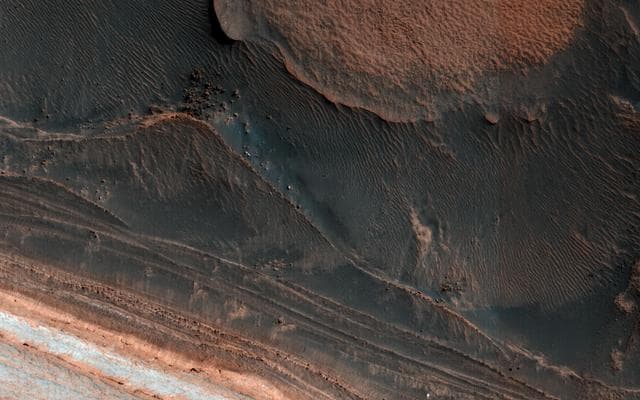
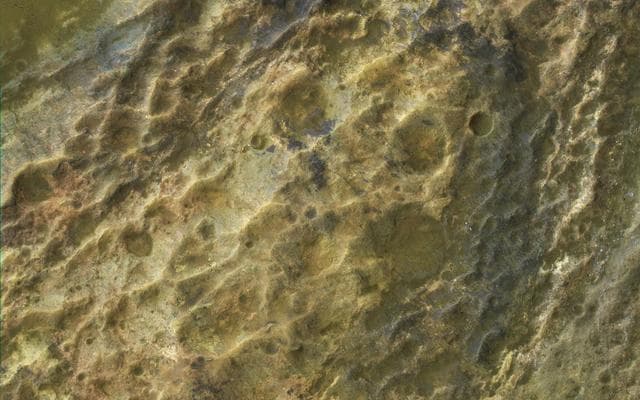
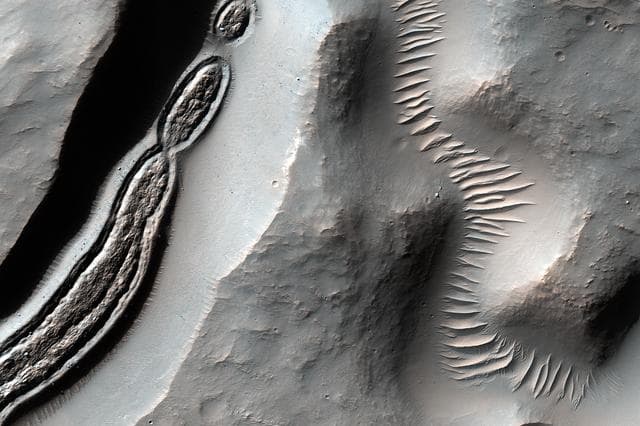
This image captured by NASA Mars Reconnaissance Orbiter spacecraft targets a 3-kilometer diameter crater that occurs within the ejecta blanket of the much older Bakhuysen Crater, a 150-kilometer diameter impact crater in Noachis Terra. Impact craters are interesting because they provide a mechanism to uplift and expose underlying bedrock, allowing for the study of the subsurface and the geologic past. An enhanced color image shows the wall of the crater, which exposes layering as well as blocks of rock. There is a distinctive large block in the upper left of the crater wall, generally referred to as a "mega-block."Â It is an angular, light-toned, highly fragmented block, about 100 meters across. Several smaller light-toned blocks are also in the crater wall, possibly of the same rock type as the "mega-block." Ejecta blocks are thrown outward during the initial excavation of a crater, or are deposited as part of the ground-hugging flows of which the majority of the ejecta blanket is comprised. Through images like these, we are able to study the deeper subsurface of Mars that is not otherwise exposed. http://photojournal.jpl.nasa.gov/catalog/PIA20728
Usage Rights
Most NASA images are in the public domain and free to use. Credit NASA as the source. Check NASA's media usage guidelines for details. Images featuring identifiable individuals may require additional permissions.
Details
NASA ID
PIA20728
Date Created
June 1, 2016
Center
JPL
Media Type
image
Downloads
Download this image in multiple resolutions. All NASA media are free for public use.