Plateaus Up Close
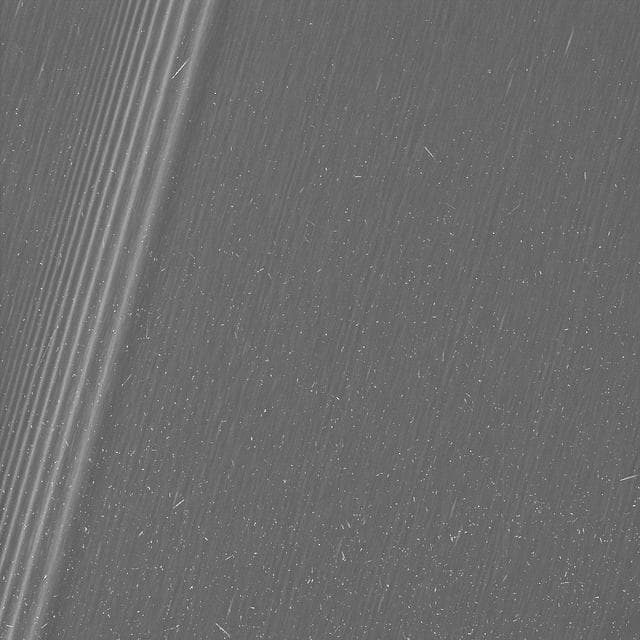
Saturn's C ring isn't uniformly bright. Instead, about a dozen regions of the ring stand out as noticeably brighter than the rest of the ring, while about half a dozen regions are devoid of ring material. Scientists call the bright regions "plateaus" and the devoid regions "gaps." Scientists have determined that the plateaus are relatively bright because they have higher particle density and reflect more light, but researchers haven't solved the trickier puzzle of how the plateaus are created and maintained. This view looks toward the sunlit side of the rings from about 62 degrees above the ring plane. The image was taken Jan. 9, 2017 in green light with the Cassini spacecraft's narrow-angle camera. Cassini obtained the image while approximately 194,000 miles (312,000 kilometers) from Saturn and at a Sun-Saturn-spacecraft, or phase, angle of 67 degrees. Image scale is 1.2 miles (2 kilometers) per pixel. https://photojournal.jpl.nasa.gov/catalog/PIA20529
Usage Rights
Most NASA images are in the public domain and free to use. Credit NASA as the source. Check NASA's media usage guidelines for details. Images featuring identifiable individuals may require additional permissions.
Keywords
Details
NASA ID
PIA20529
Date Created
April 10, 2017
Center
JPL
Media Type
image
Downloads
Download this image in multiple resolutions. All NASA media are free for public use.