Dichotomy
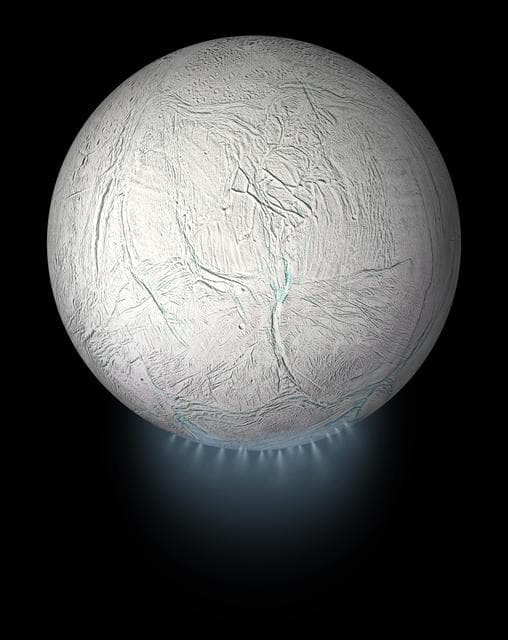
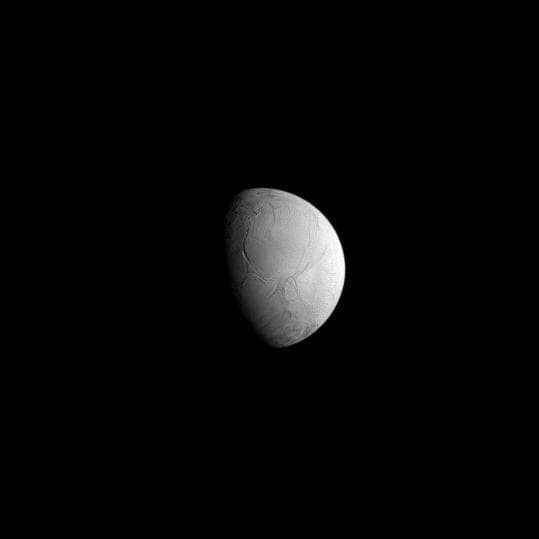
Enceladus is a world divided. To the north, we see copious amounts of craters and evidence of the many impacts the moon has suffered in its history. However, to the south we see a smoother body with wrinkles due to geologic activity. Most solar system bodies lacking an atmosphere are heavily cratered like Enceladus' (313 miles or 504 kilometers across) northern region. However, the geologic activity in the south, including the famous plume above the moon's south pole, can erase craters and leave a younger, smoother-looking surface. This view looks toward the anti-Saturn hemisphere of Enceladus. North on Enceladus is up and rotated 4 degrees to the right. The image was taken in visible light with the Cassini spacecraft narrow-angle camera on Nov. 27, 2016. The view was obtained at a distance of approximately 41,000 miles (66,000 kilometers) from Enceladus. Image scale is 1,310 feet (398 meters) per pixel. http://photojournal.jpl.nasa.gov/catalog/PIA20524
Usage Rights
Most NASA images are in the public domain and free to use. Credit NASA as the source. Check NASA's media usage guidelines for details. Images featuring identifiable individuals may require additional permissions.
Keywords
Details
NASA ID
PIA20524
Date Created
March 6, 2017
Center
JPL
Media Type
image
Downloads
Download this image in multiple resolutions. All NASA media are free for public use.