Dawn HAMO Image 63
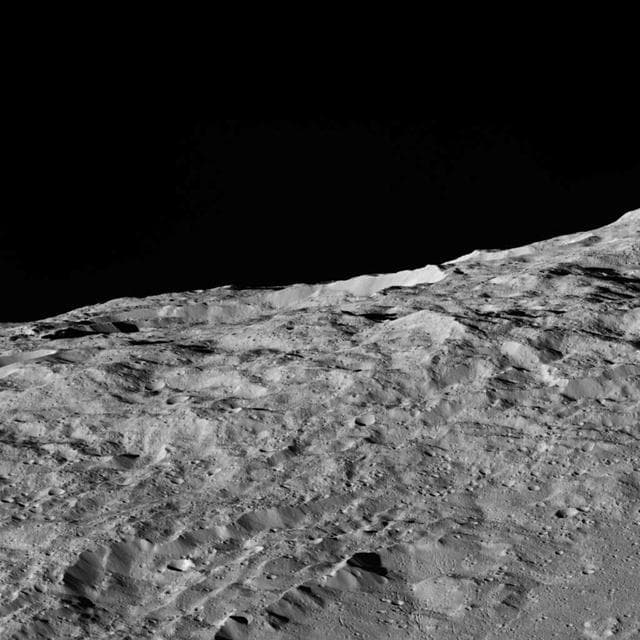
This image of Ceres from NASA's Dawn spacecraft shows hummocky terrain -- a surface covered in low, rounded hills -- with numerous impact craters of varying sizes. The two biggest craters display central peaks and many places where masses of material have collapsed and slid downward along their walls and floors -- a phenomenon geologists call "mass wasting". The sharp crater at upper right is surrounded by smooth ejecta with a streaky texture to the south. A graben -- what geologists call a linear feature where terrain has dropped -- measuring 2 to 5 miles (3 to 8 kilometers) in width, and two prominent scarps, or linear, cliff-like slopes, are located in the southeastern (lower right) part of the image. Dawn took this image on Oct. 5, 2015, from an altitude of 915 miles (1,470 kilometers). It has a resolution of 450 feet (140 meters) per pixel. http://photojournal.jpl.nasa.gov/catalog/PIA20125
Usage Rights
Most NASA images are in the public domain and free to use. Credit NASA as the source. Check NASA's media usage guidelines for details. Images featuring identifiable individuals may require additional permissions.
Details
NASA ID
PIA20125
Date Created
November 19, 2015
Center
JPL
Media Type
image
Downloads
Download this image in multiple resolutions. All NASA media are free for public use.