Light-Toned Layers in Tithonium Chasma
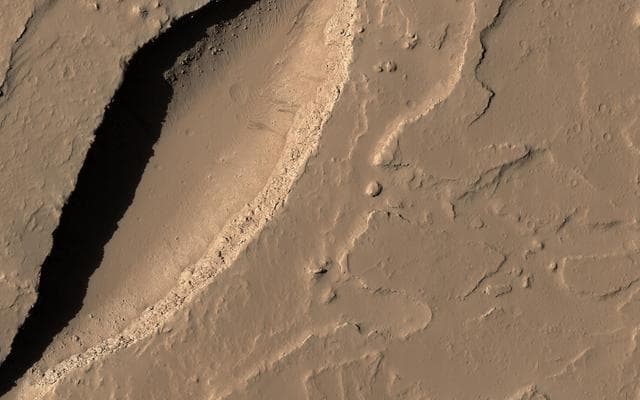
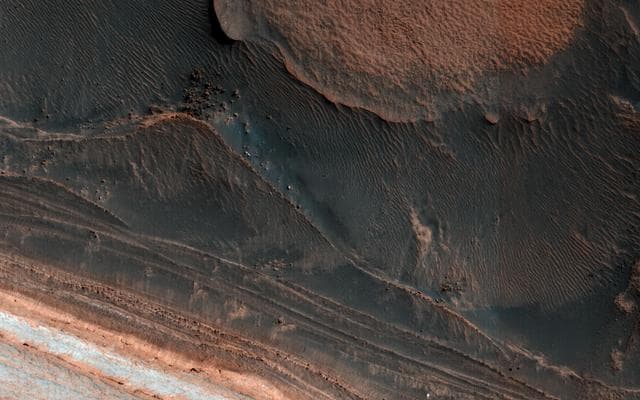
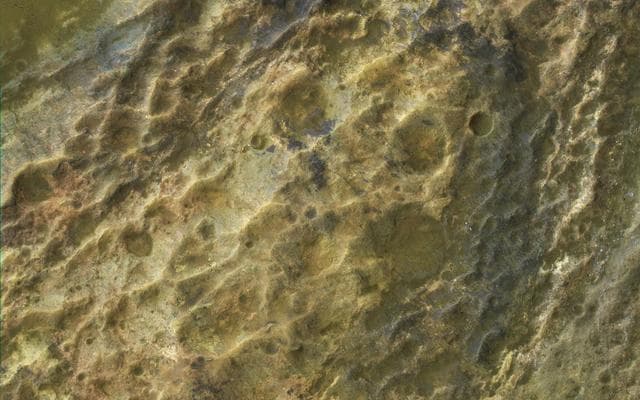
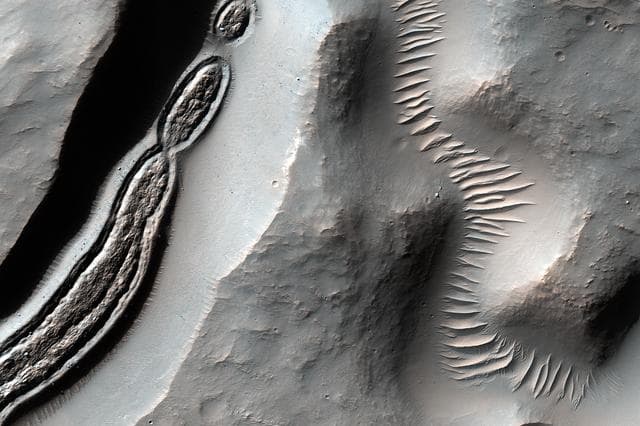
Tithonium Chasma is a part of Valles Marineris, the largest canyon in the Solar System. If Valles Marineris was located on Earth, at more than 4,000 kilometers long and 200 kilometers wide, it would span across almost the entire United States. Tithonium Chasma is approximately 800 kilometers long. A "chasma," as defined by the International Astronomical Union, is an elongate, steep-sided depression. The walls of canyons often contain bedrock exposing numerous layers. In some regions, light-toned layered deposits erode faster than the darker-toned ones. The layered deposits in the canyons are of great interest to scientists, as these exposures may shed light on past water activity on Mars. The CRISM instrument on MRO indicates the presence of sulfates, hydrated sulfates, and iron oxides in Tithonium Chasma. Because sulfates generally form from water, the light-toned sulfate rich deposits in the canyons may contain traces of ancient life. The mid-section of this image is an excellent example of the numerous layered deposits, known as interior layered deposits. The exact nature of their formation is still unclear. However, some layered regions display parallelism between strata while other regions are more chaotic, possibly due to past tectonic activity. Lobe-shaped deposits are associated with depositional morphologies, considered indicative of possible periglacial activity. Overall, the morphological and lithological features we see today are the result of numerous geological processes, indicating that Mars experienced a diverse and more active geological past. http://photojournal.jpl.nasa.gov/catalog/PIA19868
Usage Rights
Most NASA images are in the public domain and free to use. Credit NASA as the source. Check NASA's media usage guidelines for details. Images featuring identifiable individuals may require additional permissions.
Details
NASA ID
PIA19868
Date Created
August 12, 2015
Center
JPL
Media Type
image
Downloads
Download this image in multiple resolutions. All NASA media are free for public use.