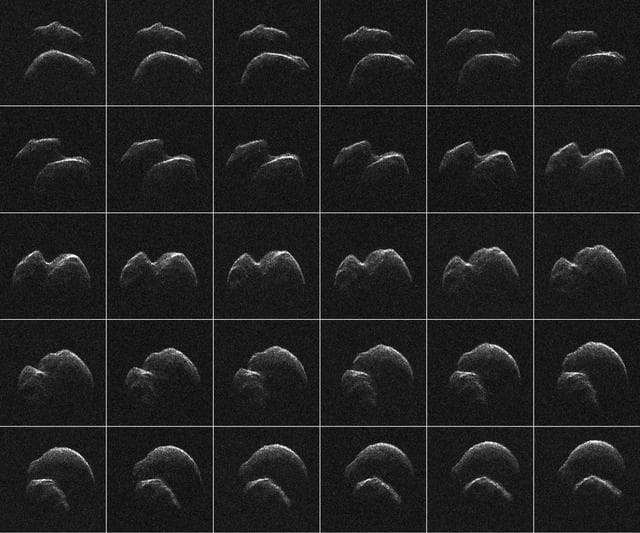
Radar Movie of Asteroid 1999 JD6
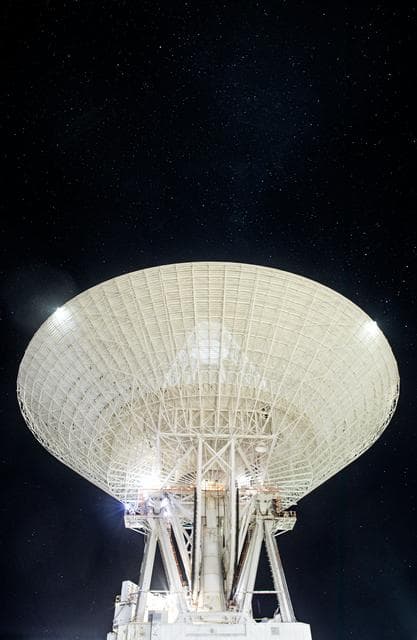
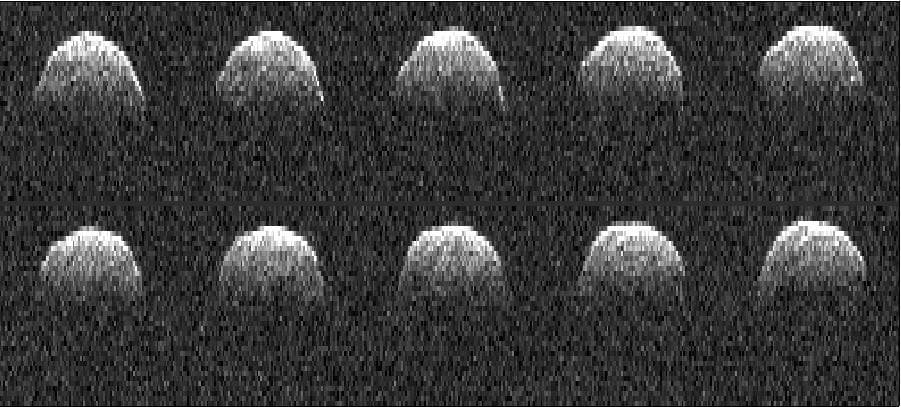
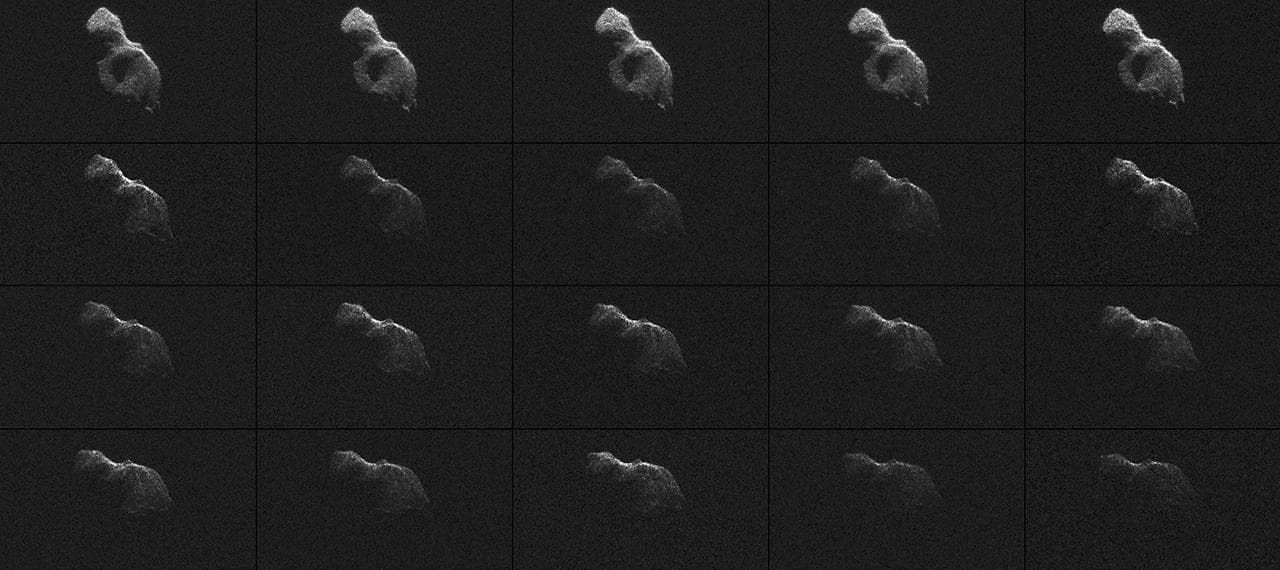
This frame from a movie made from radar images of asteroid 1999 JD6 was collected by NASA scientists on July 25, 2015. The images show the rotation of the asteroid, which made its closest approach on July 24 at 9:55 p.m. PDT (12:55 a.m. EDT on July 25) at a distance of about 4.5 million miles (7.2 million kilometers, or about 19 times the distance from Earth to the moon). The asteroid appears to be a contact binary -- an asteroid with two lobes that are stuck together. The radar images show the asteroid is highly elongated, with a length of approximately 1.2 miles (2 kilometers) on its long axis. These images are radar echoes, which are more like a sonogram than a photograph. The views were obtained by pairing NASA's 230-foot-wide (70-meter) Deep Space Network antenna at Goldstone, California, with the 330-foot (100-meter) National Science Foundation Green Bank Telescope in West Virginia. Using this approach, the Goldstone antenna beams a radar signal at an asteroid and Green Bank receives the reflections. The technique, referred to as a bistatic observation, dramatically improves the amount of detail that can be seen in radar images. The new views obtained with the technique show features as small as about 25 feet (7.5 meters) wide. http://photojournal.jpl.nasa.gov/catalog/PIA19646
Usage Rights
Most NASA images are in the public domain and free to use. Credit NASA as the source. Check NASA's media usage guidelines for details. Images featuring identifiable individuals may require additional permissions.
Details
NASA ID
PIA19646
Date Created
July 31, 2015
Center
JPL
Media Type
image
Downloads
Download this image in multiple resolutions. All NASA media are free for public use.