Mercury Sodium Tail
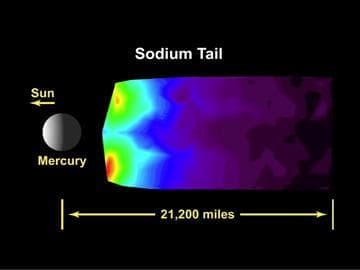
This image from NASA MESSENGER spacecraft is stitched together from thousands of observations made over the past 4 years by the MASCS/UVVS instrument, which measures sunlight scattered off of Mercury tenuous atmosphere. Scattered sunlight gives the sodium a bright orange glow. This scattering process also gives sodium atoms a push - this "radiation pressure" is strong enough, during parts of Mercury's year, to strip the atmosphere and give Mercury a long glowing tail. Someone standing on Mercury's nightside at the right time of year would see a faint orange similar to a city sky illuminated by sodium lamps! Instrument: Mercury Atmospheric and Surface Composition Spectrometer (MASCS)/Ultraviolet and Visible Spectrometer (UVVS) http://photojournal.jpl.nasa.gov/catalog/PIA19418
Usage Rights
Most NASA images are in the public domain and free to use. Credit NASA as the source. Check NASA's media usage guidelines for details. Images featuring identifiable individuals may require additional permissions.
Details
NASA ID
PIA19418
Date Created
April 16, 2015
Center
JPL
Media Type
image
Downloads
Download this image in multiple resolutions. All NASA media are free for public use.