Boulders in Gully Alcoves
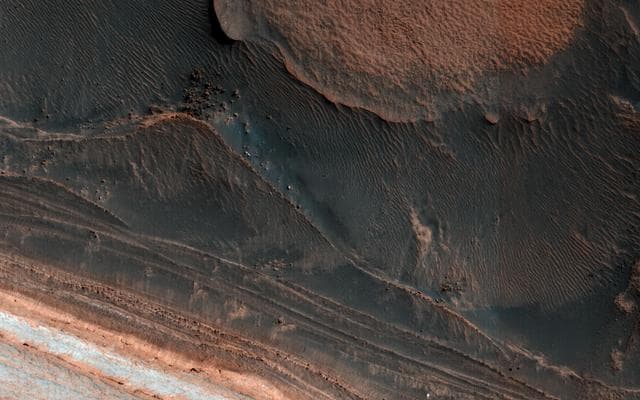
Gullies are often found on steep slopes. In the winter, this area is covered with a layer of carbon dioxide ice (dry ice). In the spring, when the ice warms up and transitions to gas, it dislodges material on the slope, forming a gully. In general, this process works best on fine material, leaving behind large boulders. These boulders can be seen collected in the gully alcoves. Occasionally, boulders slide or roll downhill, like those sprinkled downslope in this image. This set of gullies is found at -71 degrees latitude in the Southern hemisphere. http://photojournal.jpl.nasa.gov/catalog/PIA19295
Usage Rights
Most NASA images are in the public domain and free to use. Credit NASA as the source. Check NASA's media usage guidelines for details. Images featuring identifiable individuals may require additional permissions.
Details
NASA ID
PIA19295
Date Created
February 11, 2015
Center
JPL
Media Type
image
Downloads
Download this image in multiple resolutions. All NASA media are free for public use.