Icy Wonderland
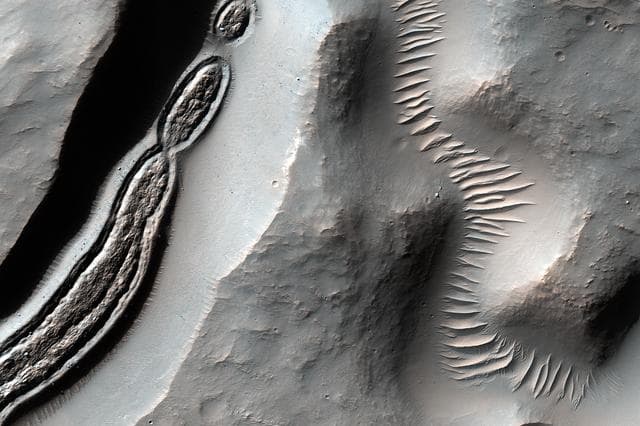
Although the season is late spring, carbon dioxide ice still covers much of the surface at this high latitude site. It is still a chilly -128 degrees Celsius. The weak boundaries of the polygonal structure of the surface have been eroded by spring sublimation of carbon dioxide as energy from the Sun turns ice to gas. The larger troughs in this image accentuate the surface polygonal structure, while the narrow cracks show the erosion caused when carbon dioxide gas escapes from under the seasonal ice layer carrying fine material from the surface. The dark fans in this image are made up of small particles from the surface deposited on top of the seasonal layer of ice. The fans originate at a crack, a weak spot that allows the gas to escape. The material is deposited in a direction determined by the direction of the wind as the gas was escaping. http://photojournal.jpl.nasa.gov/catalog/PIA19292
Usage Rights
Most NASA images are in the public domain and free to use. Credit NASA as the source. Check NASA's media usage guidelines for details. Images featuring identifiable individuals may require additional permissions.
Details
NASA ID
PIA19292
Date Created
February 4, 2015
Center
JPL
Media Type
image
Downloads
Download this image in multiple resolutions. All NASA media are free for public use.